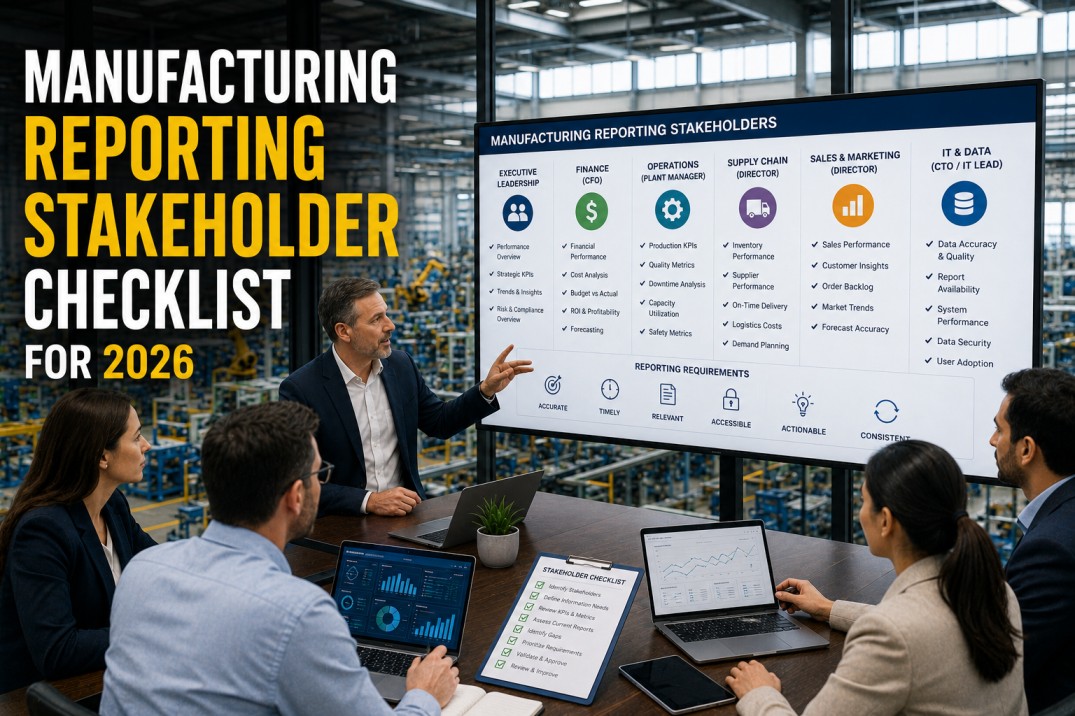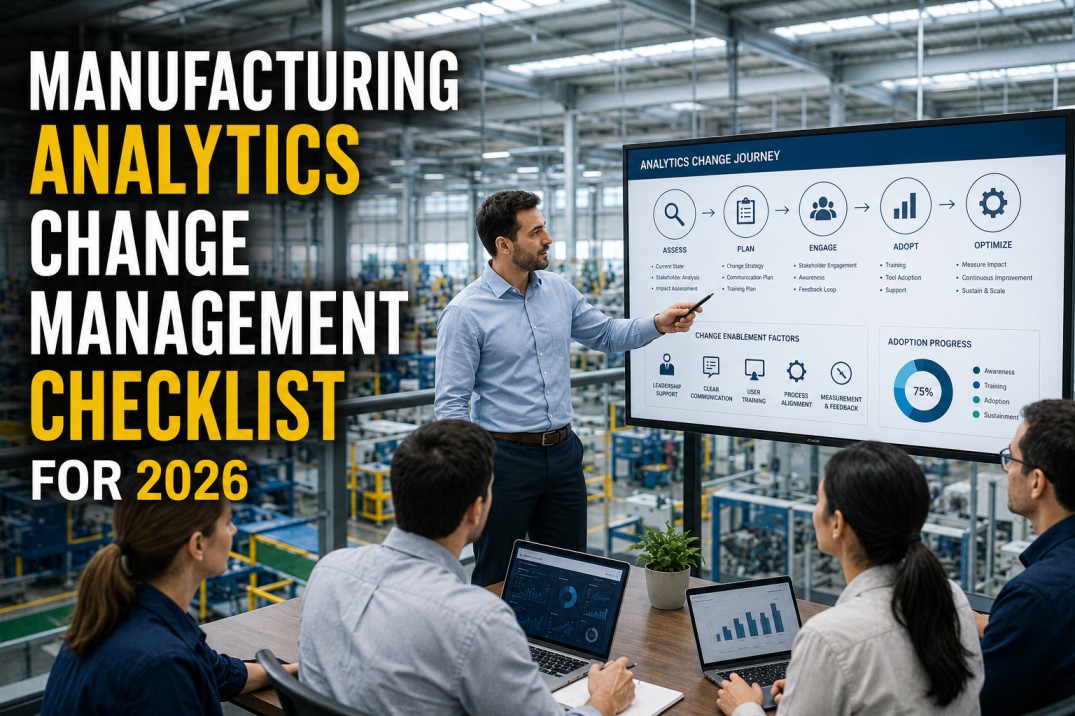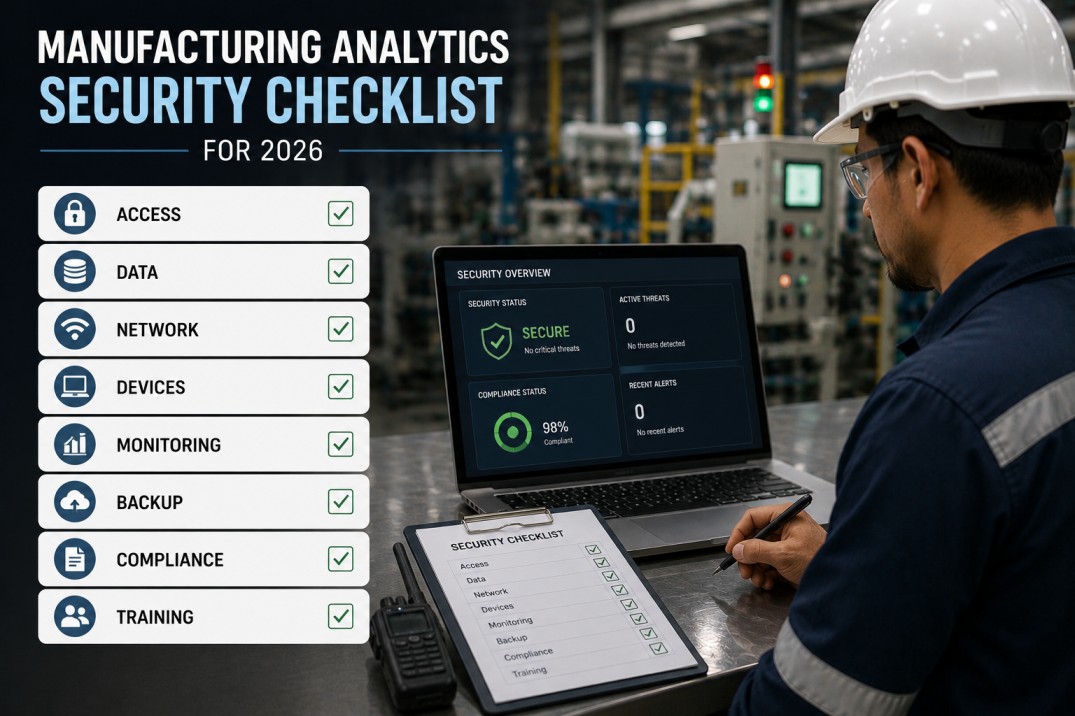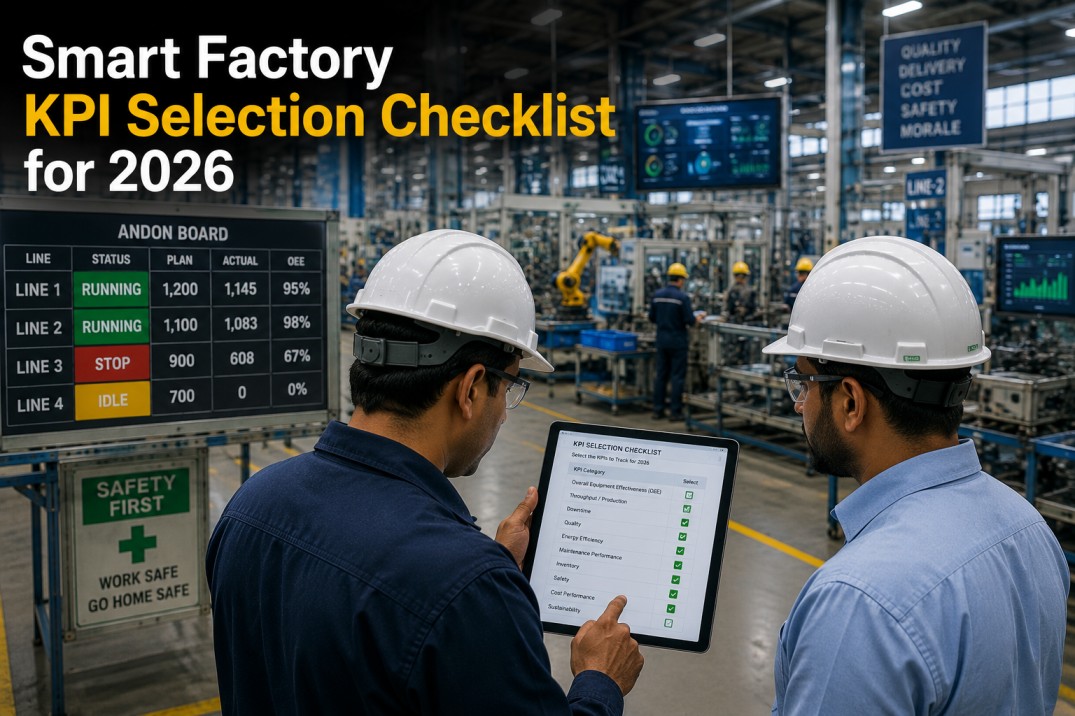
Selecting a manufacturing analytics platform in 2026 is a more consequential decision than it was three years ago. The market now includes purpose-built manufacturing intelligence platforms, general-purpose BI tools configured for factory use, and AI-native platforms that promise predictive capabilities before they have delivered on descriptive ones. Getting the selection wrong means two to three years of a platform that does not connect to your equipment, produces OEE numbers nobody trusts, and generates more work for the IT team than value for the production floor. This vendor selection checklist gives manufacturing operations, IT, and procurement teams a structured 30-point evaluation framework covering six dimensions: connectivity, core analytics, AI capabilities, deployment and support, pricing and contract terms, and vendor qualification.
iFactory Passes Every Criterion on This Checklist — See It Live on Your Use Cases
See iFactory demonstrated on your specific use cases — OEE on your machine types, downtime Pareto with your reason code structure, and quality analytics linked to your inspection data.
Connectivity — The Criterion That Determines Everything Else
The most important question in any manufacturing analytics evaluation is not "how good are the dashboards?" — it is "how does your data get in?" Connectivity failures are cited in over 60% of manufacturing analytics disappointments post-purchase, and they are almost always visible during evaluation if the buyer tests on their specific systems rather than vendor-managed data.
Demand Live Connector Demos
Bring your actual data source list — ERP version, PLC types, MES platform name — and ask the vendor to demonstrate data flowing from your system type into their platform during the evaluation. Do not accept demos on vendor-managed sample data.
Native vs. Middleware
A native connector built by the analytics vendor is materially different from one relying on third-party middleware. Native connectors have faster throughput, fewer failure points, and vendor accountability when they break.
Connector Maintenance SLA
Ask every vendor: how are connectors maintained when source systems update? What is the SLA for restoring a broken connector? Who is responsible when your ERP releases a new API version?
Legacy Equipment Strategy
Ask how the platform handles equipment without PLC connectivity: edge device options, manual operator entry, or hybrid capture. Vendors who say "we only connect to modern PLCs" cannot serve a real factory floor.
Integration Timeline
Get a written scope and timeline for your specific integration list before contract. A vendor who says "two weeks" for any integration without reviewing your systems is not giving you a real answer.
Connector Documentation
Request technical integration documentation for your top three connectors before signing. A vendor who cannot provide this pre-sale does not have mature connectors — they have demos.
Core Analytics — OEE, Downtime, Quality, and Maintenance
Core analytics — OEE calculation, downtime capture, quality metrics, and maintenance KPIs — cover 80% of the ROI available from manufacturing analytics in most plants. Evaluate these in depth before spending time on AI features that require 12 months of data to deliver value.
A platform with a hardcoded OEE formula will produce numbers your team rejects. During evaluation, configure OEE with your specific definitions and verify the output against a manually calculated shift.
Platforms with a fixed reason code list are not suitable for production. Evaluate whether the hierarchy is fully configurable and can be maintained by operations staff without vendor involvement.
Mature quality analytics show SPC charts with control limits, defect Pareto by cause with trend, First-Pass Yield at operation level, and correlation with process parameters. Evaluate depth, not visual polish.
Multi-plant OEE benchmarking is only meaningful if every plant uses the same definition. A platform that allows each site to configure independently produces incomparable scores — worse than no benchmarking at all.
AI and Advanced Analytics — What to Evaluate in 2026
AI capabilities range from genuinely value-creating (anomaly detection, predictive maintenance with measurable lead times) to marketing-grade (a chatbot over standard dashboards, "smart alerts" on threshold-crossing logic). Evaluation must focus on demonstrated outcomes, not feature descriptions.
Evaluate on Your Data
Ask every vendor to run anomaly detection on a sample of your historical production data. A genuine AI capability surfaces anomalies in your data; a demo-only AI only works on the vendor's curated dataset.
Predictive Maintenance Specificity
A model that says "this machine may fail soon" is not predictive maintenance — it is a conditional alert. A genuine model specifies the failure mode, expected time to failure with a confidence interval, and recommended action.
Training Data Requirements
Most AI models require 6–18 months of labelled historical data. Ask: how much history is needed, who labels the data, how frequently is the model retrained, and what happens to accuracy when the process changes.
False Positive Rate
40 alerts per shift produces fatigue more damaging than no alerts. Ask for the measured false positive rate in a production environment and require a reference customer who can confirm alert quality in practice.
AI Roadmap in Writing
If AI capabilities are a significant selection factor, require a written roadmap with delivery dates — not verbal commitments. Include roadmap milestones as performance clauses in the contract.
Phase Your AI Investment
Do not select primarily on AI features you will not use for 12–18 months. Select on the quality of core analytics today. Excellent descriptive analytics are the foundation that makes AI features valuable later.
Deployment — From Contract to Production Value
A platform that takes eight months to deploy when the vendor promised eight weeks has not delivered value — it has consumed eight months of internal resource and delayed the operational improvement that justified the investment.
The go-live timeline must be in the contract — not in the SOW as a "target." A vendor who will not contractually commit to a pilot-line go-live date does not believe the estimate they gave in sales.
The implementation manager must be named before contract signing. The quality of that person is more important than the quality of the platform for a successful go-live. Ask to speak with them before you sign.
Data connections, dashboard configuration, and user training must be in scope in the base contract — not an additional professional services charge. Vendors who quote these separately are hiding the true cost.
The SLA during implementation differs from the SLA in production. Confirm response time for P1 issues, escalation path, and named support contact versus generic ticket queue after go-live.
The implementation plan must include 2–4 weeks of parallel running alongside existing reporting before decommissioning. A vendor who omits this has not delivered enough production go-lives to know why it matters.
Pricing, Contract Terms, and Exit Rights
Manufacturing analytics contracts now combine per-site licences, per-connector fees, professional services charges, AI feature tiers, and escalation clauses not visible in the headline price. Evaluate total cost of ownership over three years — not annual licence.
All-In Pricing Request
Request a 3-year TCO model: year 1 (platform + implementation + training), year 2 (platform + support + connector fees), year 3 (platform + support + estimated new feature fees). Compare TCO, not headline licence.
Connector Fees
A low headline price with per-connector fees can cost significantly more at full deployment than a higher-priced platform with connectors included. Model your full connector list before comparing prices.
Scaling Economics
Model the cost of adding a second and third plant. A pricing model competitive for one plant may be prohibitive for five. Evaluate scaling economics before signing.
Data Portability Rights
Your operational data — production records, downtime events, OEE history — must be exportable in a standard format on exit. Without explicit data portability rights in the contract, your data is effectively hostage.
Exit Clause
Require a performance-based exit clause: if defined KPIs (uptime, go-live milestones, support SLAs) are not met, you have the right to exit without penalty. A contract without this shifts all risk to the buyer.
Price Escalation Cap
Require a cap — CPI plus a defined maximum percentage — written into the contract. Vendors who refuse a price cap on a multi-year deal should be scored accordingly.
See iFactory Scored Against Every Criterion on This Checklist
iFactory is built for manufacturing operations teams who need analytics running in production. We provide written RFP responses, live connector demonstrations, and contractual go-live commitments.
Manufacturing Analytics Vendor Selection Checklist — 30 Items
Score each vendor 1–3 per criterion (1 = does not meet, 2 = partially meets, 3 = fully meets). Weight Must-Have criteria at 3×. A "1" on any Must-Have is a disqualifying finding.
| # | Evaluation Criterion | Type | Priority | Demo | Required | Must-Have |
|---|---|---|---|---|---|---|
| 1 | Native connectors to your ERP (SAP, Oracle, Dynamics) demonstrated live — not via middleware only | Verify Live | High | ✓ | ✓ | ✓ |
| 2 | PLC/SCADA connectivity shown for your machine types (Siemens, Fanuc, Mitsubishi, Allen-Bradley) | Verify Live | High | ✓ | ✓ | ✓ |
| 3 | MES integration path documented — direct API or certified connector, not custom script | Evaluate | High | ✓ | ✓ | ✓ |
| 4 | Connector library breadth confirmed — number of certified connectors, update cadence, support SLA per connector | Evaluate | High | ✓ | ✓ | — |
| 5 | Legacy equipment without PLC connectivity handled — manual entry fallback or edge device option | Evaluate | Med | ✓ | ✓ | — |
| # | Evaluation Criterion | Type | Priority | Demo | Required | Must-Have |
|---|---|---|---|---|---|---|
| 6 | OEE calculation shown live — Availability, Performance, Quality, Six Big Losses ranked | Verify Live | High | ✓ | ✓ | ✓ |
| 7 | Downtime Pareto with reason codes demonstrated — drill-down from plant to line to event | Verify Live | High | ✓ | ✓ | ✓ |
| 8 | Quality analytics covers first-pass yield, defect Pareto, and SPC charts — not dashboard only | Verify Live | High | ✓ | ✓ | ✓ |
| 9 | Maintenance analytics: MTBF, MTTR, PM compliance, and work order tracking in scope | Evaluate | High | ✓ | ✓ | — |
| 10 | Multi-line, multi-shift, multi-plant OEE benchmarking demonstrated | Verify Live | High | ✓ | ✓ | ✓ |
| # | Evaluation Criterion | Type | Priority | Demo | Required | Must-Have |
|---|---|---|---|---|---|---|
| 11 | AI anomaly detection demonstrated on real production data — not only on curated demo dataset | Verify Live | High | ✓ | ✓ | — |
| 12 | Predictive maintenance model shown — specific failure prediction with lead time, not generic alert | Evaluate | High | ✓ | ✓ | — |
| 13 | AI model training data requirements clarified — how much history needed, who trains, how often retrained | Evaluate | High | ✓ | ✓ | — |
| 14 | AI feature roadmap for 2026 provided in writing — not only verbal commitments | Reference | Med | — | ✓ | — |
| 15 | False positive rate for anomaly alerts measured and disclosed — not only stated as "low" | Evaluate | High | ✓ | ✓ | — |
| # | Evaluation Criterion | Type | Priority | Demo | Required | Must-Have |
|---|---|---|---|---|---|---|
| 16 | Go-live timeline contractually committed — not estimated during sales process only | Contractual | High | — | ✓ | ✓ |
| 17 | Implementation methodology documented: phases, milestones, and client responsibilities | Evaluate | High | ✓ | ✓ | ✓ |
| 18 | Named implementation manager assigned — not handed to a generic support queue after contract | Evaluate | High | ✓ | ✓ | ✓ |
| 19 | Pilot line go-live included in scope — not an additional professional services charge | Contractual | High | — | ✓ | ✓ |
| 20 | Training materials and change management support included — operator and supervisor level | Evaluate | Med | ✓ | ✓ | — |
| # | Evaluation Criterion | Type | Priority | Demo | Required | Must-Have |
|---|---|---|---|---|---|---|
| 21 | All-in pricing provided: platform licence, connectors, implementation, training, and support — no hidden line items | Contractual | High | — | ✓ | ✓ |
| 22 | Per-site vs. per-user pricing model clarified — scaling cost modelled for full plant rollout | Contractual | High | — | ✓ | ✓ |
| 23 | Contract term minimum and auto-renewal clauses reviewed — no 5-year lock-in without break clause | Contractual | High | — | ✓ | ✓ |
| 24 | Data export and portability rights in contract — your data is exportable in standard format on exit | Contractual | High | — | ✓ | ✓ |
| 25 | Annual price escalation cap specified in contract — not at vendor discretion on renewal | Contractual | Med | — | ✓ | — |
| # | Evaluation Criterion | Type | Priority | Demo | Required | Must-Have |
|---|---|---|---|---|---|---|
| 26 | Reference customers in your industry and plant size provided — not only enterprise references for an SME buyer | Reference | High | — | ✓ | ✓ |
| 27 | Reference call completed with a customer using the platform for 12+ months in production | Reference | High | — | ✓ | ✓ |
| 28 | Vendor financial stability confirmed — funding status, customer count, and year founded reviewed | Evaluate | High | — | ✓ | — |
| 29 | Security certifications confirmed: SOC 2 Type II, ISO 27001, or equivalent — certificates in date | Evaluate | High | — | ✓ | ✓ |
| 30 | SLA for uptime (min 99.5%), support response (P1 < 1 hour), and data breach notification reviewed | Contractual | High | — | ✓ | ✓ |
Vendor Evaluation Scoring
Score each vendor 1–3 per criterion. Weight Must-Have criteria at 3×. A "1" on any Must-Have should be flagged before contract negotiation — a gap identified after signing is a deployment risk, not a negotiation point.
| Evaluation Dimension | What to Verify in Demo | Contract Requirement | Disqualifier if Missing |
|---|---|---|---|
| Connectivity | Live connection to your ERP and PLC type — not vendor-managed data | Named connectors and SLAs in scope of work | ✓ |
| OEE Analytics | OEE configured with your definitions — Availability, Performance, Quality, Six Big Losses | OEE methodology documented in contract | ✓ |
| Downtime Tracking | Configurable reason code hierarchy, Pareto, drill-down to event level | Reason code configuration in onboarding scope | ✓ |
| Quality Analytics | FPY, defect Pareto, SPC charts — not just defect count dashboard | Quality analytics scope defined in contract | ~ |
| AI / Predictive | Anomaly detection on your historical data — false positive rate disclosed | AI roadmap milestones as contract clauses if material | ✗ |
| Go-Live Timeline | Implementation plan with named manager reviewed pre-sale | Contractual go-live date for pilot line | ✓ |
| Pricing / TCO | 3-year TCO model including connectors, implementation, escalation | Price escalation cap, data portability, exit clause | ✓ |
| Vendor Stability | Reference call with 12-month production customer in your industry | Uptime SLA (99.5%+), support SLA, breach notification | ~ |
Frequently Asked Questions
What are the most important criteria when selecting a manufacturing analytics platform?
The three most important criteria are connectivity, OEE calculation correctness, and deployment track record. Connectivity determines whether the platform produces real data or demo data. OEE correctness determines whether the number produced is meaningful. Deployment track record determines whether the go-live timeline is achievable. AI features, UI design, and reporting flexibility matter less if these three fundamentals are not met.
What is a manufacturing analytics RFP and what should it include?
A manufacturing analytics RFP should include: company and plant overview, current data sources and systems (ERP, MES, PLC types), Phase 1 analytics use cases and KPIs required, integration requirements, deployment timeline, contract term constraints, and evaluation scoring methodology. Vendors who cannot provide written RFP responses within two weeks typically cannot support a structured implementation either. Book a Demo — iFactory provides written RFP responses on request.
How do you evaluate AI features in a manufacturing analytics platform?
Evaluate on three dimensions: demonstrated outcome on real data, specificity of predictions (failure mode and time horizon, not just "anomaly detected"), and false positive rate in production use. Request a reference customer using the AI feature in production for over six months and ask: how many alerts fire per shift, what percentage are actionable, and has it led to a measurable reduction in unplanned downtime?
What contract terms are essential in a manufacturing analytics agreement?
Essential terms: contractual go-live date for the pilot line, data portability rights, exit clause for non-performance tied to SLA metrics, price escalation cap on annual renewal, named connectors in the statement of work, support SLA for P1 issues (response within one hour), and uptime SLA of at least 99.5%. Contracts missing these terms shift all performance risk to the buyer.
How is iFactory different from general-purpose BI tools configured for manufacturing?
iFactory is purpose-built — not a BI tool with manufacturing templates. The difference is visible in: connectivity (certified connectors for PLCs, MES, QMS — not generic data connectors), analytics depth (OEE, Six Big Losses, MTBF pre-built with manufacturing logic, not recreated in a BI layer), and deployment speed (live in two weeks because use cases are pre-configured — not 2–6 months of BI configuration). Book a Demo to compare directly.
iFactory Welcomes Structured Evaluation Against Every Criterion
Request a live demo structured around this vendor selection checklist — we demonstrate OEE on your machine types, show live connector documentation, and arrange reference customer calls within five working days.