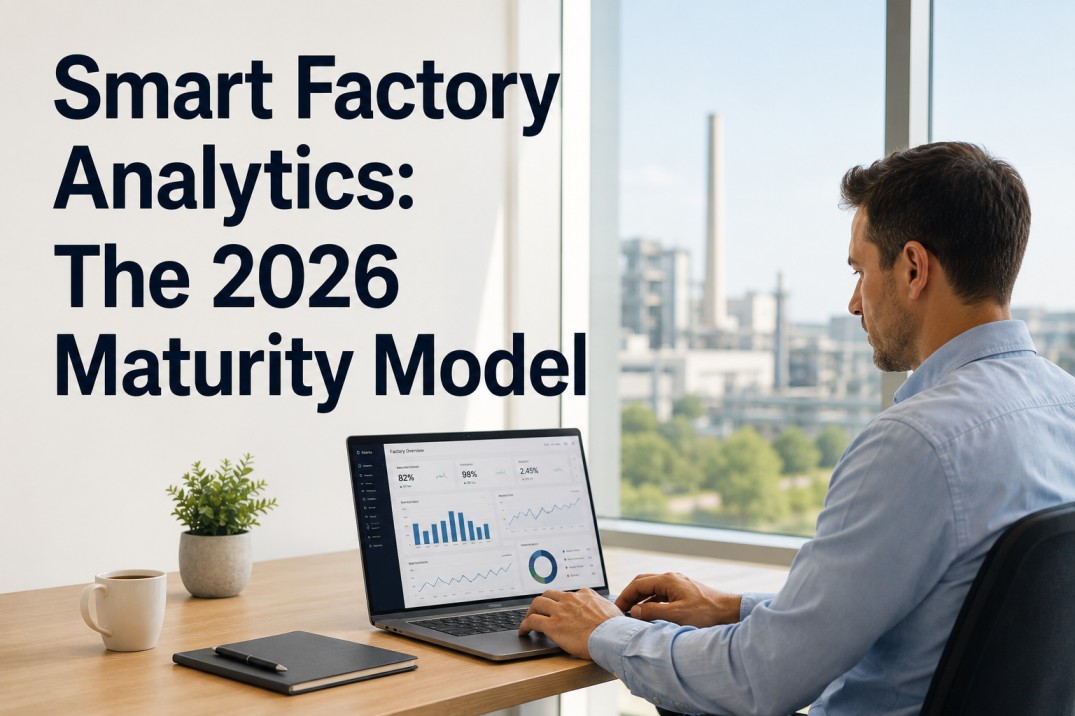
The term "smart factory" gets used broadly, but the reality is that analytics maturity varies enormously across US manufacturing plants. Some facilities run real-time dashboards with machine learning alerts; others still export data from machines to spreadsheets by hand. This article defines a five-level smart factory analytics maturity model based on deployments across 400+ plants. It is designed to help you benchmark where your operation stands today and identify the specific capabilities you need to build to reach the next level.
Where Does Your Plant Sit on the Maturity Curve?
Get a 30-minute maturity assessment with an iFactory analytics specialist. We'll map your current capabilities across all five levels and deliver a prioritized action plan to move you up — using your actual plant data.
The 5 Levels of Smart Factory Analytics Maturity
Each level builds on the previous one. A plant at Level 2 cannot jump to Level 4 without first establishing the data infrastructure and process discipline that Level 3 requires. The model is designed as a progression, and the fastest path is to close gaps in order.
L1 — Manual & Disconnected: Where Most Plants Start
At Level 1, all analytics activity is manual. Data is collected from machines by hand or via basic SCADA exports, entered into spreadsheets, and reformatted for each audience. There is no integration between systems, no automated calculations, and no scheduled distribution.
- OEE calculated in spreadsheets once per week
- Downtime tracked on paper or whiteboards
- Quality data exported from CMMS and reformatted
- Reports emailed as PDF attachments
- No shared data source for operations and finance
- 12-18 hrs per person per week on reporting tasks
- Data discrepancies between shifts and departments
- Decisions delayed because reports are stale by the time they arrive
- Single points of failure — only one person knows how to produce each report
- At least one automated data feed from MES or ERP
- Role-based dashboards replacing spreadsheet reports
- Scheduled report distribution for top-3 recurring reports
L2 — Basic Digital Monitoring: The Most Common Trap
Level 2 is where the majority of US manufacturing plants sit today. SCADA screens exist on the plant floor, some machines stream data to basic dashboards, and periodic reports are generated from individual systems. But the systems are siloed, dashboards are not role-specific, and data still requires manual reconciliation across sources.
- SCADA screens visible on the plant floor
- Separate dashboards for production, quality, and maintenance
- ERP reports run weekly with manual formatting
- Some automated alerts (email-based)
- No unified view across production lines
- Data must be manually reconciled between systems
- Operators have too much data, supervisors not enough context
- Dashboards don't reflect the same numbers across shifts
- IT owns the tools, operations owns the data — no bridge
- Cross-system dashboards with a single source of truth
- Role-specific views (operator, supervisor, executive)
- Automated KPI calculation across all data sources
L3 — Integrated Plant Analytics: The Target Zone
Level 3 is the first maturity level where the plant has a unified analytics platform. All major data sources — MES, ERP, SCADA, CMMS — feed into a single system. Dashboards are role-based and automatically updated. Reports are scheduled and distributed without manual intervention.
- Unified analytics platform connected to all data sources
- Role-based dashboards with role-appropriate refresh rates
- Automated OEE, yield, and throughput calculations
- Scheduled report distribution via email or portal
- Single source of truth for all operational KPIs
- Reporting labor reduced by 60-80%
- Data discrepancies eliminated across departments
- Decisions made hours faster, not days
- Team shifts from gathering data to acting on insights
- Predictive models running on at least two use cases
- Anomaly detection with automated alerts
- Root-cause analysis suggestions available in dashboards
L4 — Predictive & Prescriptive: The Competitive Edge
At Level 4, the analytics platform shifts from descriptive to predictive. Machine learning models identify patterns in the data, flag anomalies before they become quality events, and suggest root causes for recurring issues. The plant operates proactively rather than reactively.
L5 — Autonomous Operations: The Long-Term Vision
Level 5 represents a fully autonomous operation where analytics drives closed-loop control. Production schedules adjust automatically based on demand signals and machine availability. Quality parameters are self-correcting. Reports are entirely self-serve, and the platform alerts humans only when human judgment is required.
- ML-driven anomaly detection on machine data
- Predictive maintenance recommendations
- Quality defect prediction before production
- Root-cause analysis with automated suggestions
- Scenario modeling for production planning
- Closed-loop process control adjustments
- Self-optimizing production scheduling
- Zero-touch reporting and distribution
- AI-driven root-cause resolution
- Full digital twin integration
Where Most Plants Are Stuck — and Why
Based on data from 400+ US manufacturing plants, the distribution of maturity levels reveals a striking pattern: the majority cluster at Level 2, and very few reach Level 4 or 5 without external platform support.
The most common barrier to moving past Level 2 is not technology — it is integration. Plants adopt point solutions for individual problems (SCADA here, CMMS there, ERP somewhere else) but never connect them into a unified analytics layer. The result is more data but no more insight, which erodes confidence in analytics investments and stalls further progress.
Built for the Jump
iFactory Takes Most Plants from L2 to L3 in Under 30 Days
Pre-built connectors for 20+ MES and ERP platforms, role-based dashboard templates, and a library of 50+ manufacturing-specific analytics views. No custom code, no data engineering team required.
How to Move Up One Level in 90 Days
Each maturity transition follows a repeatable pattern: assess the current state, identify the single highest-impact capability gap, build the data pipeline to close it, and deploy the corresponding analytics view. Here is the roadmap for the most common transition — L2 to L3.
Map every data source, every recurring report, and every manual step in the reporting workflow. Identify the top-3 data sources that carry 80% of decision-critical information. Establish baseline metrics for reporting labor hours and data accuracy.
Connect primary data sources (MES, ERP, SCADA) to a unified analytics platform. Establish data validation and normalization rules so that every system speaks the same language. Deploy the first cross-system dashboard showing production, quality, and maintenance in one view.
Configure role-specific dashboards: operator wallboards at 60-second refresh, supervisor panels at 5-minute intervals, and executive summaries updated daily. Replace the top-5 recurring manual reports with automated, role-based views.
Configure scheduled report distribution for stakeholders who need offline access. Set up threshold-based alerts for critical KPIs (OEE drops, scrap spikes, downtime events). Enable self-service access so teams can explore data without requesting ad-hoc reports.
Establish data governance rules — who owns each KPI, how often it is reviewed, and what constitutes a trigger for escalation. Add secondary data sources (CMMS, IIoT, environmental sensors). Begin scoping predictive use cases for the L3-to-L4 transition.
Quick Maturity Scorecard
Rate your plant on each capability from 1 (not started) to 5 (fully deployed). Total your score and match it to the maturity level below.
Frequently Asked Questions About Smart Factory Analytics Maturity
What is the smart factory analytics maturity model?
The smart factory analytics maturity model is a five-level framework that describes how manufacturing plants progress from manual, disconnected reporting to autonomous, AI-driven operations. It covers data collection, integration, analytics, prediction, and control capabilities. The model helps plant leadership teams assess their current state and prioritize investments for the next level.
Why are most plants stuck at Level 2?
Level 2 is the most common trap because plants adopt point solutions for individual problems — a SCADA system for machine monitoring, a CMMS for maintenance, an ERP for planning — but never connect them into a unified analytics layer. Each system produces its own reports, but cross-system insights require manual reconciliation. The result is more data but no more actionable insight, which erodes confidence in further analytics investments.
How long does it take to move from L2 to L3?
With a purpose-built manufacturing analytics platform, most plants can move from L2 to L3 in 30-90 days. The fastest transitions happen when plants already have digital data sources (SCADA, MES) and the primary bottleneck is integration rather than data availability. Plants starting from L1 typically need 3-6 months to build the data infrastructure required for L3.
Do we need AI or machine learning to reach Level 3?
No. Level 3 is about integration, automation, and role-based access — not AI. Machine learning and predictive analytics are Level 4 capabilities. Many plants see tremendous value at Level 3 without any ML, simply from eliminating manual reporting, unifying data across sources, and giving every role the right view at the right cadence. AI becomes valuable once the data infrastructure is solid.
What is the ROI of moving from L2 to L3?
Plants that move from L2 to L3 typically see a 60-80% reduction in reporting labor, elimination of cross-system data discrepancies, and decision-making cycles that shrink from days to hours. The median payback period for a unified analytics platform like iFactory is under 6 months. The ROI comes from both labor savings and faster, more accurate operational decisions.
Can we skip levels in the maturity model?
Each level builds on the data infrastructure and organizational discipline of the previous one. A plant at L1 cannot sustain L4 predictive models because the data feeds, validation rules, and operational consistency required for ML are not in place. The fastest path to advanced maturity is to close gaps in sequence. However, a unified analytics platform can accelerate the progression by addressing multiple level requirements simultaneously.
You've seen the model. Now see where you stand.
Get Your Plant's Maturity Assessment in 30 Minutes
An iFactory analytics specialist will walk through your current data landscape, identify your maturity level, and deliver a prioritized roadmap to reach the next level — using your actual plant data, not generic benchmarks.