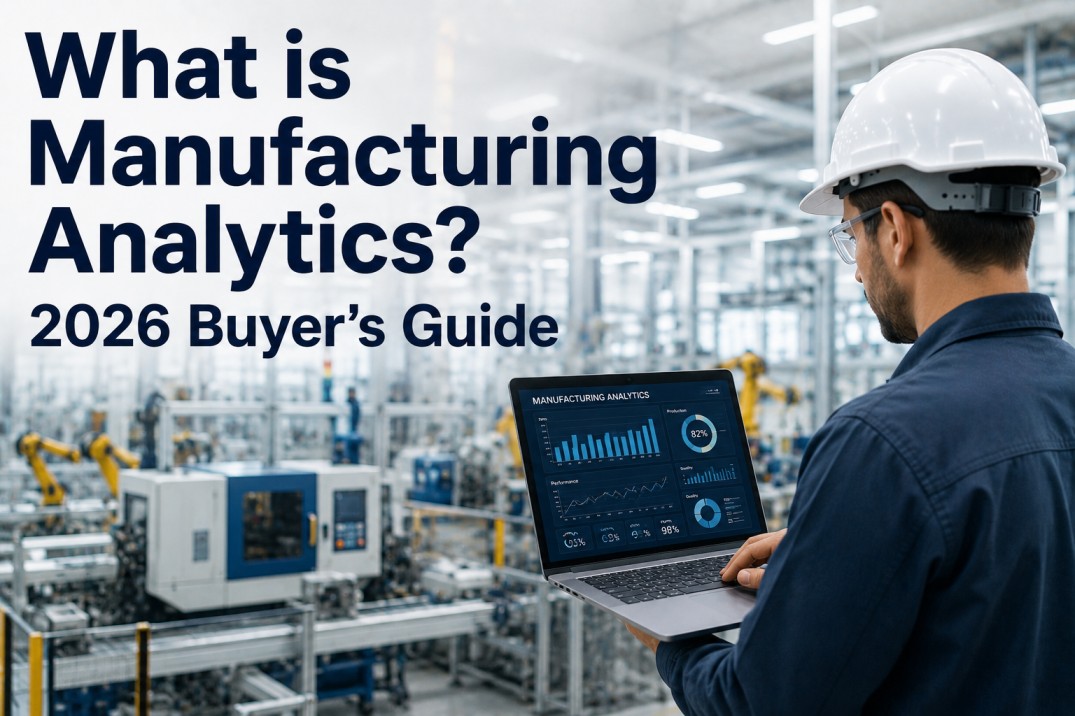
Manufacturing analytics is evolving faster than at any point in the past decade. Five trends are reshaping how plants collect, process, and act on data: generative AI moves from experimentation to structured deployment; edge analytics becomes the default architecture for latency-critical decisions; digital twins transition from engineering tools to operational platforms; prescriptive analytics closes the loop between prediction and action; and the connected worker platform becomes the primary interface for frontline operators.
Each trend is at a different maturity stage — some are delivering measurable ROI today, while others are 12-24 months from mainstream adoption. This guide evaluates each trend through the lens of a plant manager or manufacturing leader: what it is, where it delivers value, what adoption looks like in 2026, and how to decide whether to invest now or wait.
For each trend, we include a readiness score based on iFactory deployment data, the typical adoption timeline, and specific action items for plant leaders who want to evaluate whether 2026 is the right year to invest. The goal is not to chase every trend but to identify the one or two that align with your plant's current maturity and deliver the fastest return on investment.
Five Trends. One Platform. Ready for Any of Them.
iFactory is purpose-built to support all five trends — GenAI, edge analytics, digital twins, prescriptive analytics, and connected worker — on a single platform. Book a 30-minute demo to see which trend is ready for your plant today.
The Five Trends Reshaping Manufacturing Analytics in 2026
Each trend below includes a definition, the primary value driver, an adoption readiness score (1-10 based on iFactory deployment data across 200+ plants), and the typical timeline from pilot to scaled deployment.
Natural-language querying, automated report summarization, and anomaly explanation are moving from experimental to structured deployment. 35% of iFactory plants have deployed at least one GenAI capability. Primary value: reducing time spent on data retrieval and analysis by 4-8 hours per user per week.
Edge processing is no longer a niche — it is the default architecture for any analytics use case requiring sub-second latency. 70% of new iFactory deployments include edge gateways for real-time inference, data compression, and protocol conversion. Primary value: reducing cloud bandwidth by 60-80% and enabling real-time alerts.
Digital twins are expanding beyond engineering design into daily operations — simulating production scenarios, predicting changeover impact, and optimizing line configurations before making physical changes. Primary value: reducing trial-and-error on the physical line by 40-60%.
Moving beyond predicting what will happen to prescribing what to do about it. Prescriptive models recommend optimal machine settings, maintenance timing, and production schedules based on current conditions. Primary value: converting 40-60% of predictions into automated or guided actions.
Mobile-first platforms that put analytics, work instructions, quality checks, and communication in the hands of frontline operators. 80% of iFactory deployments now include a connected worker component. Primary value: reducing time spent on administrative tasks by 2-3 hours per shift per operator.
Which Trend Is Right for Your Plant Right Now?
iFactory's deployment team will assess your current analytics maturity and recommend which trend to invest in first — based on your data readiness, team capability, and expected ROI. A 30-minute discovery session gives you a prioritized roadmap.
Adoption Timeline: When Each Trend Hits Mainstream
The adoption curves vary significantly across the five trends. Some are delivering ROI today. Others require 12-24 months of infrastructure maturation. This timeline is based on iFactory deployment data and industry analyst projections for discrete and process manufacturing.
Trend Impact vs Implementation Effort
The decision to invest in a trend depends on the balance between potential operational impact and the effort required to implement it. The table below scores each trend on a 1-10 scale for both dimensions based on iFactory deployment data across 200+ plants.
Industry Adoption by Trend
Adoption varies significantly by industry segment. Automotive and electronics lead in most categories. Food and beverage leads in connected worker. Pharma leads in digital twins for batch process simulation. The matrix below shows which industries are driving each trend in 2026.
| Trend | Automotive | Food & Bev | Pharma | Electronics | Heavy Ind. |
|---|---|---|---|---|---|
| Generative AI | High | Medium | High | High | Low |
| Edge Analytics | High | Medium | High | High | Medium |
| Digital Twins | High | Low | Medium | High | Medium |
| Prescriptive Analytics | Medium | Low | High | Medium | Low |
| Connected Worker | High | High | High | Medium | Medium |
Action Guide: What to Do About Each Trend in 2026
Each trend requires a different approach depending on your plant's current analytics maturity. The action guide below is organized by investment priority — start with the trends that deliver最快 ROI with the least infrastructure change.
The highest-readiness trend with immediate ROI. Deploy edge gateways on your top 5 loss-producing assets. Connect to existing PLCs. Enable real-time alerts for critical thresholds. Expected timeline: 2-4 weeks for pilot, 2-3 months for plant-wide rollout. No new sensors required for most use cases.
Start with a single GenAI capability — natural-language querying for shift supervisors. Connect to your OEE and quality data sources. Measure time savings per user in the first 30 days. If adoption exceeds 60%, add anomaly explanation in month two and report summarization in month three.
If your operators are still using paper checklists, clipboards, and whiteboards, connected worker is the highest-impact trend available. Deploy mobile interfaces for quality checks, shift handovers, and maintenance requests. Start with one line or one department as a pilot. Typical pilot: 4-6 weeks.
Prescriptive analytics requires mature predictive models and reliable data streams. If you already have predictive maintenance or predictive quality running, add prescriptive recommendations — optimal maintenance timing, process parameter adjustments, production schedule optimization. Not recommended as a first analytics investment.
Digital twins for operational decisions are 12-18 months from mainstream. Invest now only if you have dedicated engineering resources and a specific high-value use case — changeover optimization on a critical bottleneck line, or scenario simulation for a new product introduction. For most plants, monitoring progress is the right 2026 strategy.
Frequently Asked Questions About Manufacturing Analytics Trends
Which of these five trends should my plant prioritize first?
For most plants, edge analytics and connected worker deliver the fastest ROI with the least infrastructure change. Edge analytics reduces cloud costs and enables real-time alerts using existing PLC and sensor infrastructure. Connected worker eliminates paper-based processes and puts analytics directly in the hands of operators. Generative AI is the third priority — it delivers significant time savings but requires a minimum level of data maturity and user adoption. Prescriptive analytics and digital twins are best suited for plants that already have mature predictive analytics and dedicated engineering resources. A practical approach: deploy edge analytics and connected worker in the first 3-6 months, pilot GenAI in months 4-8, and evaluate prescriptive and digital twins in year two.
How much should my plant budget for these trends in 2026?
Budget requirements vary significantly by trend and plant size. Edge analytics deployment for a single plant with 5-10 edge gateways typically costs $20,000-$50,000 including hardware, configuration, and integration. Generative AI capabilities add $5,000-$15,000 per year for LLM inference costs and platform configuration. Connected worker platforms range from $30,000-$80,000 per year depending on user count and feature scope. Digital twins and prescriptive analytics are the most expensive trends — $50,000-$150,000 each for initial deployment — and should only be budgeted after the foundational trends are in place. Most plants allocate 60% of their analytics budget to the first three trends and 40% to the last two in 2026.
Can one analytics platform support all five trends?
Yes, but platform selection is critical. Many analytics platforms support only one or two of these trends — a BI tool cannot run edge inference, and an edge gateway cannot generate GenAI summaries. iFactory is designed as a unified platform that spans all five trends: edge agents for real-time processing, a cloud data lake for cross-plant analytics, pre-trained AI models for prescriptive recommendations, GenAI capabilities for natural-language interaction, and mobile-first connected worker interfaces. Deploying a single platform for all five trends eliminates data silos between capabilities, reduces integration cost, and ensures consistent data governance across all use cases.
Which trends require new sensor or infrastructure investment?
Edge analytics and connected worker typically require minimal new sensor investment — they use existing PLCs, sensors, and mobile devices. Generative AI requires no new sensors at all; it works with the data already flowing through your analytics platform. Digital twins may require additional sensor density on the lines being simulated — typically 10-20% more data points than standard monitoring requires. Prescriptive analytics depends on having reliable predictive models first, which may require additional sensor data for certain use cases. As a rule, the first three trends (edge, GenAI, connected worker) can be deployed with existing infrastructure for 80% of plants. The last two (digital twins, prescriptive) may require incremental sensor investments.
How do I evaluate a platform for supporting these trends?
Evaluate platforms against five criteria: breadth of supported trends (does it cover at least four of the five listed here?), integration depth (does it connect to your existing PLCs, CMMS, quality systems, and ERP through native connectors?), edge capability (does it include edge gateways for real-time processing or require third-party hardware?), AI readiness (does it ship pre-trained models or require data science resources?), and deployment timeline (can the first trend be live within 30 days?). Request a proof-of-concept on your data for the highest-priority trend before committing to a platform. Most vendors will run a POC within 2-3 weeks of engagement.
What skills does my team need to adopt these trends?
The skill requirements vary significantly by trend. Edge analytics and connected worker require IT and OT collaboration but no data science skills — the configuration is handled by the platform vendor. Generative AI requires no specialized skills beyond basic data literacy; the GenAI assistant is designed for frontline operators and plant managers with no technical background. Prescriptive analytics and digital twins benefit from having at least one data-literate engineer or analyst on staff who can interpret model outputs and validate recommendations. Across all five trends, the most important skill is not technical — it is the ability to ask the right questions of the data. iFactory provides training and change management support for each trend as part of the deployment process, covering both technical configuration and user adoption.
Five Trends. One Platform. Your Plant. This Year.
iFactory supports all five manufacturing analytics trends on a single platform — from edge inference to GenAI querying to connected worker interfaces. Book a 30-minute demo to see which trend delivers the fastest ROI for your plant in 2026.