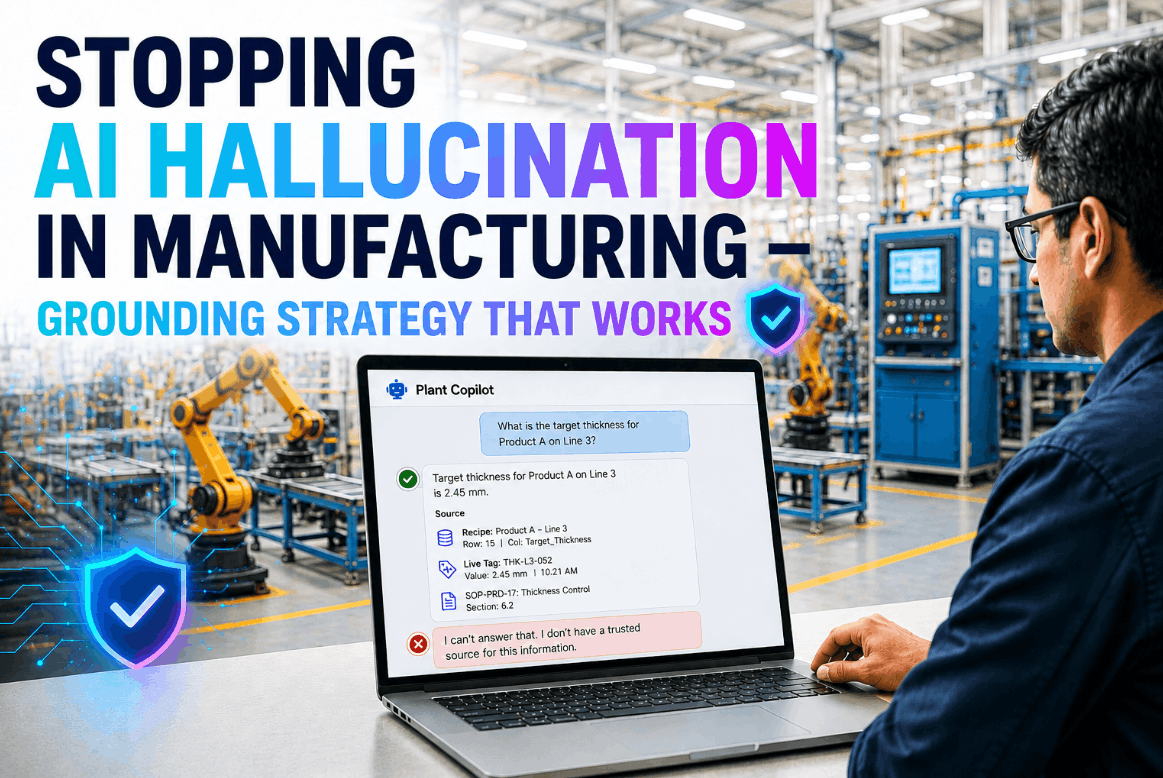
In manufacturing, a wrong number isn't a minor inconvenience — it is a production disaster. When an AI system confidently cites an incorrect recipe parameter, a superseded heat treatment specification, or a tolerance value that never existed in your quality records, the result is scrap tonnage, a failed audit, or worse, a product safety event. AI hallucination — the phenomenon where a language model generates plausible-sounding but factually unsupported output — is the single greatest barrier to deploying AI confidently on the plant floor. iFactory's Plant Copilot was engineered specifically to eliminate this risk. Every answer it delivers is grounded in live plant data: the exact sensor tag, the current recipe row, the approved SOP version, or the most recent CAPA record. If the Copilot cannot locate a verified source for a response, it refuses to answer rather than fabricate one. That architectural commitment to grounded, source-cited AI is why quality leads at regulated manufacturers trust it to influence real decisions. Book a Demo to see how every Plant Copilot answer is tied to a verifiable source.
Every AI Answer Grounded in Live Plant Data — Never Fabricated
iFactory's Plant Copilot cites the exact source — sensor tag, recipe row, SOP, or past CAPA — behind every response. When a verified source doesn't exist, the system refuses to answer rather than hallucinate.
Why AI Hallucination Is a Production-Critical Problem in Manufacturing
Most AI hallucination discussions happen in the context of writing assistance or customer service. In manufacturing, the stakes are categorically different. A hallucinated answer in a chat application produces a mildly incorrect email. A hallucinated answer on a steel mill floor can specify the wrong carbon content for a heat, approve a parameter outside metallurgical tolerance, or reference a procedure that was revised out of service three years ago. The downstream consequences — scrap batches, customer rejections, regulatory nonconformances, and personnel safety events — are measured in tens of thousands of dollars per incident.
The root cause of hallucination in general AI systems is straightforward: these models are trained on broad datasets and generate responses based on statistical probability, not verified fact retrieval. They have no access to your plant's live sensor tags, your current recipe database, your approved SOP library, or your CAPA history. When asked a question, they produce a confident-sounding answer from generalized training data — with no grounding in your actual operational reality. For quality leads and process engineers, deploying that type of AI is not acceptable. Book a Demo to see how iFactory's grounded architecture eliminates this risk entirely.
Recipe Parameter Hallucination
An AI citing an incorrect temperature setpoint, alloy ratio, or cooling rate from generalized training data — rather than your live, approved recipe database — can send an entire heat to scrap before anyone realizes the error.
Superseded SOP References
General AI models have no visibility into your document control system. They may cite procedural steps that were revised, withdrawn, or replaced — creating a change-control liability that auditors will flag immediately.
Fabricated CAPA History
When an operator asks "has this failure mode occurred before," an ungrounded AI may generate a plausible-but-false historical narrative, misdirecting the root cause investigation and wasting engineering time on ghost problems.
Confident Uncertainty
The most dangerous property of hallucinating AI is that it never signals uncertainty. It answers unknown questions with the same confident tone as verified ones — making it impossible for operators to know when to trust the output.
How iFactory's Plant Copilot Eliminates Hallucination at the Architecture Level
iFactory's Plant Copilot does not answer questions from a generalized language model's training memory. It uses a Retrieval-Augmented Generation (RAG) architecture connected directly to your plant's live data sources — sensor tags, recipe databases, approved SOP libraries, and historical CAPA records. Every response is generated only from content that was actively retrieved and verified from these sources at query time. The source document, tag name, or record ID is surfaced alongside every answer so operators and engineers can verify the basis of the recommendation in seconds.
Query Interpretation & Intent Routing
When a user submits a question, the Plant Copilot first classifies the intent — recipe lookup, SOP reference, CAPA history, sensor status, or process parameter — and routes the query to the appropriate verified data source within your plant's knowledge corpus. No general-knowledge inference is used.
Live Source Retrieval from Plant Data
The system retrieves the most current, version-controlled content from your connected data sources — including live OPC-UA sensor values, the active recipe version in your MES, the current approved SOP from your document control system, and closed CAPA records from your quality management system.
Grounded Response Generation with Citation
The response is generated exclusively from the retrieved content. The answer is accompanied by the exact source reference — the tag name, the recipe row number, the SOP section, or the CAPA ID — so the user can immediately navigate to the underlying record for independent verification.
Refusal When Ungrounded
If the Plant Copilot cannot retrieve a verified source for a question, it explicitly declines to answer rather than generating a plausible-sounding fabrication. The user receives a clear message indicating the data is unavailable or the question falls outside the plant's verified knowledge base — prompting escalation to a qualified engineer. Book a Demo to see a live refusal example.
Grounded AI vs. Ungrounded AI: What Quality Leads Need to Know
The difference between a grounded and ungrounded AI system is not a matter of model quality — it is a matter of architecture. This comparison maps the two approaches across the specific query types that quality leads and process engineers encounter daily in a regulated manufacturing environment.
| Query Type | Ungrounded AI Response | iFactory Grounded Copilot Response | Manufacturing Risk Difference |
|---|---|---|---|
| Recipe Parameter Lookup | Generates a value from training data; may be industry-generic, not plant-specific | Retrieves the exact value from your live MES recipe record, cites the recipe ID and version | Eliminates scrap risk from wrong parameter application |
| SOP Procedure Reference | May cite a step from a generic or outdated procedure without version awareness | Retrieves the current approved SOP from document control; cites section and revision number | Eliminates change-control audit findings |
| CAPA History Query | May generate a plausible-sounding but fabricated historical narrative | Retrieves actual closed CAPAs matching the failure mode; cites CAPA ID and closure date | Eliminates misdirected root cause investigations |
| Live Sensor Status | Cannot access real-time data; responds with generic operational guidance | Retrieves the current tag value from the OPC-UA feed; cites tag name and timestamp | Eliminates decisions based on stale or fabricated process data |
| Unknown or Out-of-Scope Question | Generates a confident-sounding answer from general knowledge | Explicitly refuses to answer; flags the question for engineering escalation | Eliminates confident misguidance on unverifiable topics |
What Quality AI Leads Actually Need From a Plant Copilot
"The hallucination problem in industrial AI is fundamentally different from hallucination in consumer applications. In manufacturing, the failure mode is not embarrassing — it is financially and physically consequential. What quality leads actually need is not a smarter language model. They need an architecture that refuses to answer without a verified source. iFactory's Plant Copilot does exactly that: it retrieves from your live plant data, it cites the source on every response, and it has a hard refusal mechanism for anything it cannot verify. That architecture is the only appropriate design for a regulated production environment."
Grounded AI Is Not a Feature — It Is a Manufacturing Requirement
The question for quality leads evaluating AI tools for the plant floor is not whether a system is intelligent — it is whether the system is safe. An AI that halluccinates confidently in a regulated production environment is not a productivity tool; it is a liability. The architecture that prevents hallucination — source retrieval, citation, version control awareness, and a hard refusal mechanism — is not optional. It is the baseline requirement for any AI deployed in a quality-critical manufacturing context.
iFactory's Plant Copilot was built to meet that requirement without compromise. Every answer is grounded in your plant's actual data. Every response carries a source citation. Every unanswerable question triggers an explicit refusal rather than a fabricated response. For quality leads, process engineers, and compliance officers who need to deploy AI with confidence, that architecture is the difference between a tool that helps and a tool that creates liability. Book a Demo with iFactory's product team to walk through the grounding architecture and see how it maps to your plant's specific data environment.
AI Hallucination in Manufacturing — Frequently Asked Questions
What exactly is AI hallucination and why is it dangerous in a plant environment?
AI hallucination occurs when a language model generates confident-sounding output that is factually unsupported; in manufacturing, a hallucinated recipe parameter or SOP step can directly cause scrap, a failed audit, or a safety event.
How does iFactory's Plant Copilot prevent hallucination?
The Copilot uses a RAG (Retrieval-Augmented Generation) architecture that retrieves answers exclusively from your live plant data — sensor tags, MES recipes, SOPs, and CAPA records — and cites the source on every response.
What happens when the Plant Copilot cannot find a verified answer?
It explicitly refuses to respond rather than generating an unverified answer, flagging the question for escalation to a qualified engineer — the only appropriate failure mode for production-critical AI.
Can the Copilot access our current approved SOP versions rather than outdated documents?
Yes — the Copilot integrates with your document control system and always retrieves the current approved version, including the revision number, so every SOP citation is change-control compliant.
Does iFactory's grounding architecture work with our existing MES and quality systems?
Yes — iFactory connects via standard APIs to major MES, EQMS, and document control platforms, grounding Copilot responses in your existing system-of-record data without requiring a platform migration.
Deploy AI on Your Plant Floor Without the Hallucination Risk.
iFactory's Plant Copilot grounds every answer in live plant data — sensor tags, recipes, SOPs, and CAPAs — and refuses when a verified source cannot be found.