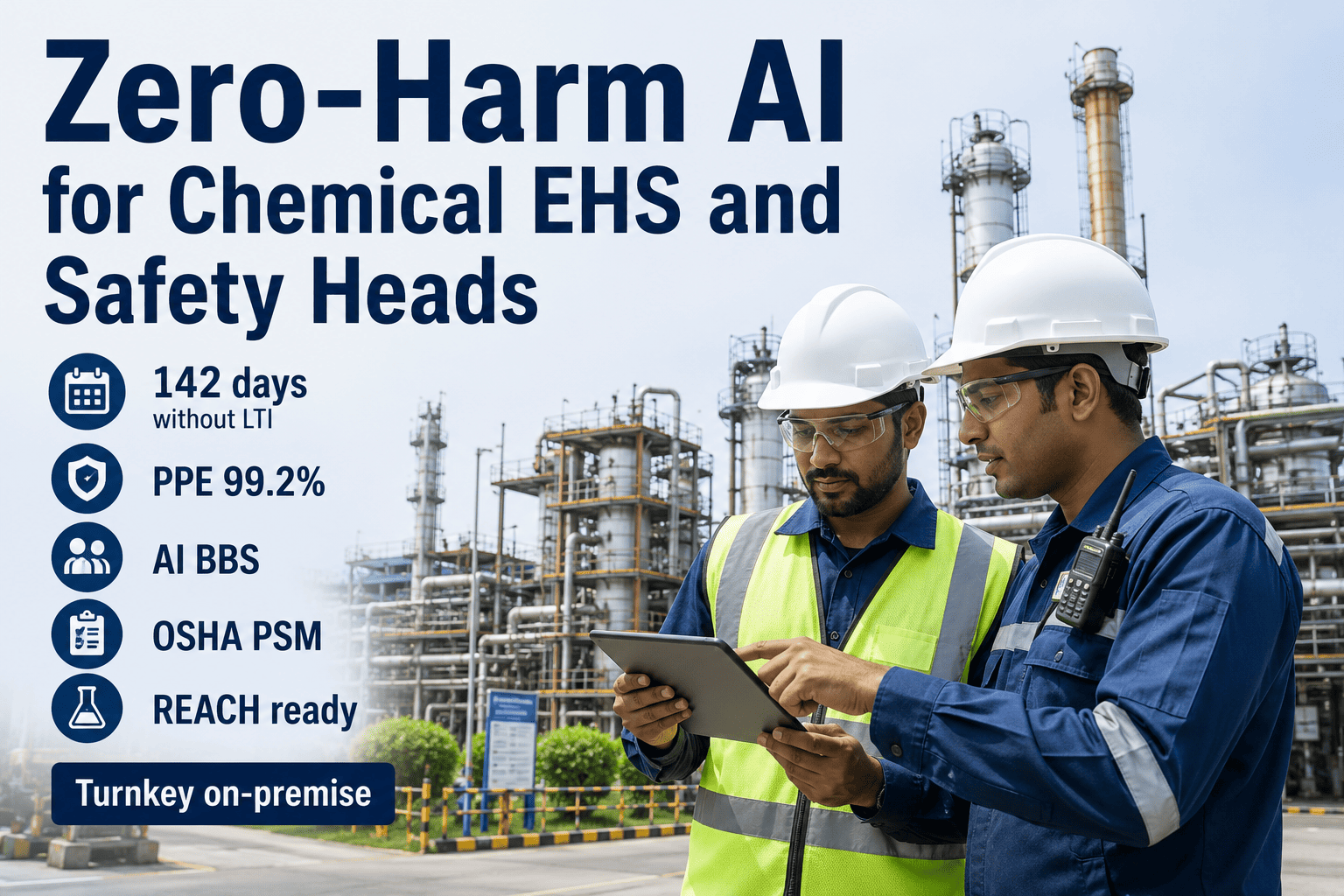
You just walked past the board in reception — 142 days without a Lost Time Injury. Every operator sees it. Every visitor sees it. Every insurance auditor sees it. And you know exactly what day 143 could look like, because you have run the incident review often enough to know that for every recordable that finally lands on your desk, roughly 29 near-misses preceded it, quietly, in the shadows of the plant — and most were never logged. Zero-Harm is not a poster. It is a control system. iFactory chemical EHS AI gives the Safety Head a working control system — computer-vision PPE detection, behaviour-based safety scoring, and near-miss capture on the base of the pyramid — turnkey, on-premise, live in 6 to 12 weeks.
Built for the Chemical EHS / Safety Head
Zero-Harm AI for Chemical Plants — On-Premise, Turnkey, Day-One Ready
142 days without an LTI is a number worth defending. Real-time PPE detection, AI-driven Behaviour Based Safety, zone-entry control, and OSHA PSM / IS 14489 / ISO 45001 / REACH-ready records — all on a single on-prem edge server.
99.2%
PPE compliance target
29:1
near-miss to recordable ratio
6-12wk
to go-live, on-prem
The 142-Day Number Is a Leading Indicator That Went Silent
Every EHS Head in a chemical plant knows the same uncomfortable truth. TRIR and LTIFR are lagging indicators — they measure harm that already happened. The board looks at the number, congratulates the plant, and moves on. But the working control system sits under the number, in the base of the Heinrich pyramid — the unsafe acts, the near-misses, the PPE violations that manual walkarounds and monthly BBS forms cannot possibly capture at the scale a running plant produces them. That base is where day 143 gets decided. And that is where AI actually earns its place on your floor.
1
Serious injury or fatality
3,000+
Unsafe acts & PPE violations
Where AI actually works
Manual reporting captures the top of the pyramid — the incidents you cannot hide. AI vision on your existing cameras captures the base at continuous rate. Chemical plants deploying vision-based safety report near-miss reporting jumping 5x to 8x within the first quarter — not because more happened, but because the base finally became visible.
The Six Pillars a Chemical Safety Head Actually Owns
Nobody outside EHS understands the surface area. You own six mandates, and any one of them going quiet is enough to end a career and shut a plant. iFactory covers the operational surface of all six on a single on-prem platform — because chasing them across five vendor tools is how gaps happen.
01
Process Safety (PSM)
14 OSHA PSM elements, mechanical integrity, MOC, PHA cadence — audit-ready records the moment an inspector walks in.
02
Personal Safety (PPE & BBS)
Vision-based PPE compliance, behaviour observations, unsafe-act capture on every camera your plant already has.
03
Incident & Near-Miss
Every event timestamped, categorised, and closed. The 29:1 base of the pyramid finally logged instead of missed.
04
Regulatory Reporting
OSHA 300 logs, IS 14489 audits, ISO 45001 evidence, REACH substance tracking — one platform, every framework.
05
Contractor & Permit Control
Permit-to-work status, zone-entry authorisation, contractor induction check — enforced by camera, not clipboard.
06
Safety Culture & KPIs
Leading indicators alongside LTIFR, TRIR, DART. Culture score by shift, area, and crew — visible to the CEO on demand.
Which of the six pillars is quietly under-covered in your plant right now? Book a 30-minute demo and we'll walk your pillar map against live monitoring.
What iFactory Watches on Your Floor, Right Now
iFactory runs edge AI on your existing CCTV network — no new cameras, no rip-and-replace. Four continuous watches, running on a single on-prem edge server, feeding your EHS dashboard and your PSM audit trail simultaneously.
01
PPE Compliance
Helmets, safety glasses, gloves, respirators, high-vis, chemical suits — detected per worker, per zone, per shift. Vision-based PPE detection routinely operates at 95%+ accuracy in the field.
Per-zone rulesReal-time alertAuto-logged
02
Restricted Zone Entry
Confined space, hot work, permit-required areas, tank farms, reactor decks. Unauthorised entry surfaces the moment it happens — not on the next audit.
Permit-linkedContractor IDEscalation ladder
03
Behaviour-Based Safety
Unsafe posture, three-point contact, ladder use, lifting technique, chemical handling. AI BBS captures observations at a scale a walk-around program can never match.
Observations at scaleTrend by crewCoaching data
04
Man-Down & Emergency Response
Fall detection, worker down, motionless-person alerts. Every second between event and response is what turns a near-miss into an incident.
2-3 sec alertEscalation routingResponse time logged
Your Compliance Stack, One Platform
Chemical EHS operates against more frameworks than any other manufacturing sector — and each one wants the same underlying data captured slightly differently. iFactory captures once, formats for every regulator. This is what the five headline frameworks demand, and what iFactory answers.
OSHA PSM
29 CFR 1910.119
All 14 elements — MOC, PHA, mechanical integrity, incident investigation, contractor management, PSSR — captured with immutable timestamps. Audit windows measured in seconds, not weeks.
ISO 45001
OH&S management
Leading indicators, worker consultation records, hazard identification trends, corrective action closure loops. The evidence portfolio your certification body asks for, pre-built.
IS 14489
Indian hazardous audit
Statutory safety audit for hazardous chemical facilities in India. Section-by-section evidence bank aligned to the audit checklist, ready before the auditor asks.
REACH
EU chemical registration
Substance handling records, exposure monitoring data, safe-use verification evidence. Everything the downstream user documentation and dossiers require.
Seveso III
EU major-accident hazard
Safety report, MAPP, and major accident scenario records maintained in living form — updated by operational data, not by a triennial re-write project.
The KPI Board Every Safety Head Defends
The board wants numbers that go the right way. You want numbers you can defend behind the scenes with real leading indicators. This is the shape of the board before and after a real safety AI platform lands — what the CEO reads, and what the EHS Head actually controls.
KPI
Before AI
After iFactory
Days without LTI
Number on the board; nobody knows what protects it
Number backed by daily PPE %, near-miss rate, BBS trend
PPE compliance
Sampled by monthly walkaround, extrapolated to 100%
Continuous per-zone %, per-shift, per-crew, per-camera
Near-miss reports
Manual forms, chronic under-reporting, base invisible
5x to 8x increase in captured events — base finally visible
BBS observations
Target: 4 per supervisor per month; often skipped
Vision-driven observations at continuous rate, coaching-grade
Man-down response
Depends on who happens to be nearby
2 to 3 second detection to alert, escalation logged
Audit prep time
Two weeks pulling records before every inspection
Records retrievable in seconds — audit-ready every day
Curious what your KPI board would look like six months in? Talk to our EHS team and walk your metrics against live safety AI.
On-Prem AI, Live in 6 to 12 Weeks
Safety data, worker records, and incident logs are core regulated IP — and REACH, OSHA PSM, and IS 14489 records must stay within your control. The iFactory AI runs on a pre-configured edge server on-premise, with all processing inside your firewall and no external egress required to operate. It ships racked and ready with the software pre-loaded, connects to your existing camera network, and puts the safety board live in a single quarter.
1
Rack the edge server
A pre-configured edge AI server slots into your plant, shipped pre-validated with EHS models pre-loaded.
2
Wire to existing cameras
Read-only integration with your existing CCTV network — no new cameras, no rip-and-replace, no wiring project.
3
Safety board goes live
PPE, BBS, near-miss, and man-down monitoring run on-prem inside your firewall — your safety data never leaves the plant.
What Zero-Harm AI Delivers on a Chemical Site
Moving from manual walkarounds and monthly BBS forms to continuous vision-based safety AI converts directly into the numbers the board watches — and the ones you defend. These outcomes reflect what chemical plants report within the first two quarters after go-live.
5-8x
Near-miss capture
the base of the pyramid finally logged rather than missed
95%+
PPE detection accuracy
field accuracy across helmet, glasses, gloves, chemical suit
$6:$1
Safety ROI ratio
Liberty Mutual benchmark on proactive workplace safety investment
Audit
Ready by default
OSHA PSM, ISO 45001, IS 14489, REACH, Seveso III records at source
Frequently Asked Questions
How does iFactory work with our existing cameras?
iFactory runs on your existing CCTV. No new cameras, no rewiring. The edge AI server ingests video feeds read-only, applies computer vision models for PPE, zone entry, BBS observations, and man-down detection, and pushes events to your EHS dashboard. Chemical plants typically go live on 30 to 60 cameras in the first phase and scale from there.
Does iFactory replace our EHS software or add to it?
Both patterns work. Some plants use iFactory as the primary EHS platform covering incident management, near-miss capture, audit records, and KPI reporting. Others keep an existing EHS system and use iFactory as the AI vision layer — PPE, BBS, zone, man-down — with events pushed into the incumbent platform through the API. The right shape depends on where the gaps are.
How does AI BBS work in practice?
Traditional BBS depends on supervisors filling out observation cards during walkarounds — which caps observations at a few hundred per plant per month. AI BBS captures observations continuously wherever a camera is watching. Unsafe posture, three-point contact, ladder use, chemical handling — every observable behaviour becomes a data point. Supervisors then coach based on real trend data, not a small manual sample.
What happens to worker privacy in a vision-based safety system?
All processing runs on-prem, inside your firewall, with no external egress. Face-identification is not required for any of the core safety detections — helmet, PPE, posture, and zone entry work on body and object detection, not identity. Privacy controls, retention windows, and access rules are configurable, and every camera is scoped by policy before it goes live.
Where does the data live, and how long to deploy?
Everything runs on-prem. The AI is delivered on a pre-configured edge server with software pre-loaded and no external egress required to operate. Safety data, worker records, near-miss logs, and audit trails stay inside your firewall. A structured deployment puts the safety board live in 6 to 12 weeks. The fastest way to see fit is a demo on your own camera map — book one and bring your zone list and current PPE policy.
Defend Day 143 With a Working Control System.
Zero-Harm AI for Chemical, On-Prem in 6 to 12 Weeks
Bring your camera map, PPE policy, and last three months of incident data. We'll show live PPE, BBS, zone, and man-down detection — and the compliance evidence bank OSHA PSM, ISO 45001, IS 14489, and REACH auditors ask for.