Every time two consecutive vehicles on a paint line are different colors, the robots have to stop, purge the previous color out of the lines and bell, flush with solvent, and load the new one. That changeover burns solvent, wastes the paint left in the lines, and costs cycle time — and on a line running a high mix of colors in the random order bodies happen to arrive from the body shop, it happens over and over, shift after shift. There are two ways to attack it, and the smartest paint shops use both. The first is to stop changing color so often: re-sequence the queue so same-color bodies run in blocks, cutting the number of changeovers without adding a single piece of hardware. The second is to make each unavoidable changeover cheaper: tune the purge recipe itself so it uses less solvent while still leaving the lines clean enough that the first body of the new color still matches spec at ΔE under 0.8. iFactory's AI does both — sequencing the color queue against your real assembly constraints and optimizing the purge recipe per changeover — and it does it on-premise, because your production schedule and color data stay in-house. It deploys in 6 to 12 weeks. To see it run on your queue, book a demo.
AUTOMOTIVE PAINT · AI COLOR QUEUE & PURGE OPTIMIZATION
Change Color Less Often — and Purge Less Every Time You Do.
Every color change purges solvent, wastes paint, and costs cycle time. iFactory re-sequences the color queue to batch same-color bodies and tunes the purge recipe per changeover — cutting solvent per purge while still matching color at ΔE under 0.8 on the first body. On-premise so your schedule stays in-house, live in 6 to 12 weeks.
1.4→1.05L
Solvent per purge after recipe optimization
$42K/yr
Solvent and paint savings on one line
7 mo
Payback on the optimization deployment
95%
Of changeovers still matching ΔE under 0.8
The Hidden Tax of Every Color Change
Changing color in the painting process is expensive because of the paint and solvent wasted during the change, and the cost is incurred every single time two consecutive bodies differ. When the robots switch color, they must purge the previous paint from the delivery lines and bell, flush with solvent to prevent the new color being contaminated, and load the new color — a sequence that consumes material and cycle time on every changeover. Bodies arrive from the body shop in essentially random color order, so on a high-mix line the default is a color change from almost one car to the next, multiplying the tax across the whole shift. It's one of the most persistent, least-visible costs in the paint shop, precisely because it's spread across hundreds of small events rather than concentrated in one big line item.
Solvent Down the Drain
Each purge flushes solvent through the lines to clear the old color, and that solvent — plus the contaminated mix it becomes — is waste that must be bought, then disposed of. Across hundreds of changeovers a shift, the liters add up into a large, recurring solvent bill that scales directly with how often color changes.
Paint Left in the Lines
The paint remaining in the delivery tube and bell when a color ends is pushed out and lost on every change — valuable basecoat discarded rather than sprayed onto a body. The longer the supply path, the more paint each changeover wastes, turning frequent color changes into a steady leak of material.
Cycle Time and Capacity
A color change takes time the robot spends purging instead of painting, and that lost cycle time is lost booth capacity on the most expensive operation in the plant. Cutting changeovers recovers saleable production time — often the cheapest incremental capacity a paint shop can find, since it needs no new hardware.
VOC and Disposal Burden
Purge solvent is a major source of the volatile organic compounds a paint shop must control, and the contaminated waste carries rising disposal costs under tightening regulation. Every liter of purge avoided is a liter of VOC emission and hazardous waste avoided — a compliance and sustainability win stacked on top of the material saving.
The reason this tax stays hidden is that it hides in plain sight: it's not one $500,000 problem, it's a thousand small changeovers each quietly spending solvent, paint, and minutes. Attacked at that scale, a modest saving per changeover compounds into a large annual number — which is exactly what makes color-change optimization one of the highest-return, lowest-disruption improvements available to a paint shop.
Two Levers: Fewer Changes, Cheaper Changes
There are exactly two ways to reduce color-change cost, and they're independent, so using both multiplies the benefit. One reduces how many changeovers happen; the other reduces what each one costs. iFactory's AI works both levers at once.
LEVER 1
Sequence the Queue — Fewer Changeovers
The colors assigned to bodies are fixed, but the order they're painted in can be optimized. By re-sequencing the queue so that same-color bodies run consecutively in blocks, the number of color changes drops — and every changeover eliminated is its full cost of solvent, paint, and cycle time saved outright. This is the Color-batching Resequencing Problem, and reducing the count of changes without any hardware investment is the single largest lever available, because a changeover that never happens costs nothing.
LEVER 2
Tune the Purge — Cheaper Changeovers
Some color changes are unavoidable, and for those the purge recipe itself can be optimized — the solvent volume, the air-assist push, the sequence of solvent and pulsed-water-purge steps — to clear the lines using less solvent while still leaving them clean enough that the next color isn't contaminated. Tuning a changeover from a heavy solvent flush to a leaner, staged purge cuts the solvent per event without sacrificing the color match, so every unavoidable change is made as cheap as it can be.
The two levers compound: sequencing cuts the number of changeovers, and purge optimization cuts the cost of the ones that remain. A shop that only batches leaves the per-change cost untouched; a shop that only tunes the purge still pays for too many changes. Working both is what turns a color-change program from a marginal saving into a material one.
See Your Queue Re-Sequenced and Your Purge Tuned
Bring a shift's color queue and your purge recipes. iFactory engineers will show how many changeovers batching removes against your real assembly constraints, how much solvent a tuned purge saves per change, and the payback for your line — with the color match held at spec.
Color Queue Sequencing, Within Real Constraints
Batching same-color bodies sounds simple until you remember the queue can't be reordered freely — the paint shop feeds a downstream assembly line that needs bodies in a particular build order, and the buffers that allow resequencing hold only so many. Effective sequencing is a constrained optimization, and that's exactly what makes it a job for AI rather than a rule of thumb.
01
Group Colors Into Blocks
The core move is grouping bodies of the same color into consecutive runs so the robots change color between blocks instead of between cars. With hundreds of vehicles per shift the number of possible orderings is astronomical, so the AI searches for the sequence that maximizes block size and minimizes total changeovers — a combinatorial problem intractable to solve by hand.
02
Respect the Assembly Sequence
Bodies can't be reordered arbitrarily, because final assembly needs them in a build order driven by options, model mix, and just-in-time part delivery. The AI honors those downstream constraints and due-date windows, batching color only as far as the assembly schedule allows — optimization that fits the real line, not a theoretical one.
Work Within Buffer Capacity
03
Resequencing happens through selectivity banks, mix banks, and pull-off buffers that physically hold and reorder bodies, and those have finite lanes and slots. The AI plans the batching within the real buffer capacity available, using the reshuffling room the shop actually has rather than assuming unlimited freedom to reorder.
Sequence Light to Dark
04
Within the batching, order matters: running light colors before increasingly darker ones minimizes the cleaning needed between colors, an established best practice for reducing purge. The AI sequences light-to-dark where it can, so even the changeovers that remain are the cheapest, easiest-to-clean transitions possible.
This is why the problem resists simple rules and rewards AI: it's a large-scale constrained optimization balancing color blocking against assembly-sequence requirements, buffer limits, and cleaning-friendly ordering all at once. Reinforcement-learning and search-based methods can find sequences that cut changeovers substantially while still delivering bodies in a valid order to assembly — something a static heuristic can't reliably do.
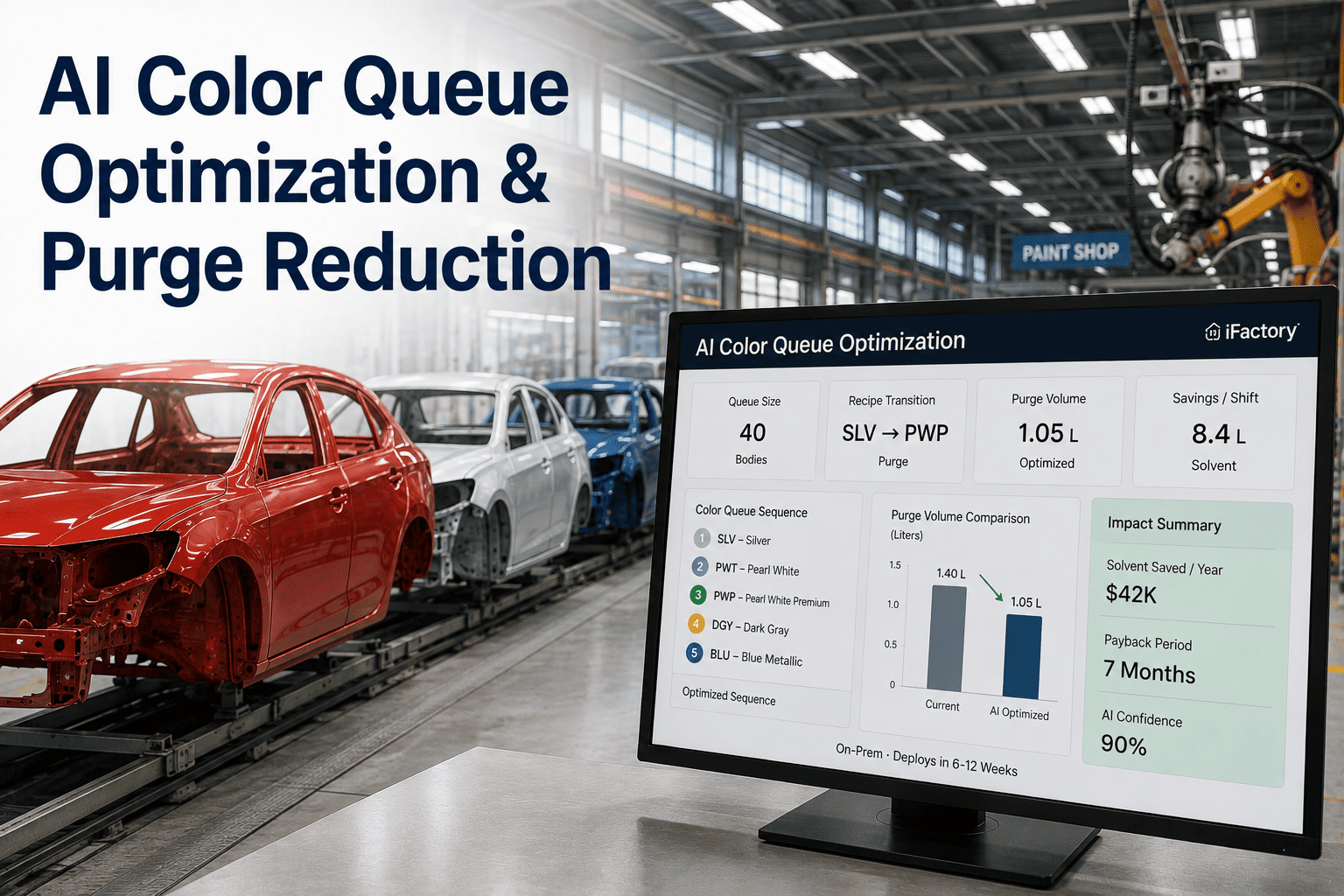
The Optimization: A 40-Body Queue
Here's what the combined optimization does on a real block of work — a color queue of 40 bodies moving through the booth. It's not a theoretical model; it's a sequence and a purge recipe applied to the next 40 vehicles.
1
Batch the 40 Bodies by Color
The AI takes the next 40 bodies and re-sequences them within assembly and buffer constraints to group colors into the largest valid blocks, collapsing what might have been dozens of car-to-car changes into a handful of block-to-block ones. Fewer changeovers across the queue is the first and largest saving.
2
Optimize the SLV to PWP Purge
For each changeover that remains, the purge recipe is tuned — shifting from a heavy straight-solvent flush toward a staged solvent-then-pulsed-water-purge sequence that clears the lines with less solvent. On this line that cuts the solvent per purge from 1.4 liters to 1.05 liters, a 25 percent reduction on every change.
3
Hold the Color Match at ΔE Under 0.8
The leaner purge is only acceptable if the first body of the new color still matches spec, so the recipe is tuned to leave the lines clean enough that 95 percent of changeovers land the first body within ΔE 0.8 — no contamination, no reject. Less solvent, same color quality, is the whole constraint the optimization respects.
4
Bank the Savings
Fewer changeovers plus less solvent per changeover adds up — on this line, roughly 8.4 liters of solvent saved per shift and about $42,000 a year in solvent and paint, for a payback near seven months at 90 percent confidence in the projection. A material return from reordering a queue and tuning a recipe, with no new hardware.
That's the combined lever in one queue: 40 bodies batched to cut the number of changes, each remaining SLV-to-PWP purge trimmed from 1.4 to 1.05 liters, color held at ΔE under 0.8 on 95 percent of changes — 8.4 liters saved per shift, $42K a year, seven-month payback at 90 percent confidence. None of it requires touching the robots or the booth; it's a smarter sequence and a smarter purge.
Less Purge, Same Color — and Lower VOC
The reason this optimization is safe to run is that it never trades color quality for solvent savings — and the reason it's doubly valuable is that every liter of purge avoided is also a liter of VOC emission and hazardous waste avoided. Cost and compliance move together.
The Color Match Is the Hard Constraint
Purge exists to prevent the new color being contaminated by the old, so the optimization treats color quality as the constraint it must never violate — the leaner recipe is only adopted where the first body of the new color still lands within spec at ΔE under 0.8. Solvent is minimized subject to a clean changeover, never at its expense, so the savings never show up as rejects downstream.
Every Avoided Liter Cuts VOC and Waste
Purge solvent is a leading source of paint-shop VOC emissions and generates contaminated hazardous waste with rising disposal costs. Because sequencing removes whole changeovers and recipe tuning trims the rest, the program cuts total solvent consumption — reducing VOC emissions, hazardous-waste disposal volume, and new-solvent purchasing all at once, turning a cost saving into an ESG and compliance gain.
This is what makes color-change optimization unusually clean as an investment: it lowers material cost, recovers capacity, and reduces environmental burden simultaneously, with no hardware and no quality trade-off. The same fewer-and-leaner purges that save the solvent bill also shrink the VOC footprint and the waste manifest.
On-Premise: Your Schedule Stays In-House
Color queue optimization runs on your production schedule, order book, and color data — some of the most sensitive operational information in the plant — so the AI is built to run on-premise, inside your firewall, with the speed and reliability a live line demands.
Schedule and Order Data Stay Local
Sequencing needs the production schedule, build order, and color assignments, which reveal volumes, model mix, and customer orders. On-premise processing keeps all of it inside your network and out of any external cloud, so competitively sensitive operational data never leaves the plant.
Real-Time Re-Sequencing Speed
The queue changes as bodies arrive and priorities shift, so the optimizer has to re-plan against the live line in real time — which local, on-premise inference delivers without a round trip to a remote server. The sequence and purge recommendations keep pace with the conveyor.
Runs Through Network Interruptions
A paint line can't have its sequencing depend on an internet link, so on-premise operation keeps the optimizer running within the isolated operational-technology environment regardless of external connectivity — the resilience a continuous production process requires.
Live in 6 to 12 Weeks
The turnkey model ships a pre-configured, racked-and-ready AI server with the software pre-loaded, so a focused color-queue-and-purge scope goes live in 6 to 12 weeks — predictive sequencing and purge optimization without an open-ended platform build.
Start on One Line, Then Scale
Color-change optimization proves out fast on a single line before it spreads, because the savings are measurable per shift and the tuning validates quickly against real production. The rollout is deliberately staged.
1
Map the Changeovers and Purge Cost
Deployment starts by measuring the current state on one line — how many color changes per shift, how much solvent and paint each purge consumes, and what the color mix looks like — to size the opportunity from both levers against real data before anything changes.
2
Model the Constraints
The AI ingests the assembly-sequence requirements, buffer and selectivity-bank capacity, and purge recipes, learning how far the queue can legally be reordered and how lean each purge can run while holding the color match — so its recommendations fit the real line's limits.
3
Validate Sequence and Recipe
The team confirms that the batched sequences deliver bodies in a valid order to assembly and that the tuned purge holds ΔE under 0.8 on the first body, building confidence on a bounded scope before the optimizer drives sequencing and purge decisions in production.
4
Scale Across Lines and Booths
With savings proven on the first line, the optimization extends to additional lines and booths, and the purge data feeds the broader paint-shop analytics so applicator and changeover trends inform maintenance too. Color-change optimization becomes standard across the shop.
What Changes in the Paint Shop
AI color queue and purge optimization turns color change from an unmanaged, repeated tax into a continuously optimized process — cutting cost, VOC, and lost capacity together, with no new hardware.
01
Fewer Changeovers, Full Cost Saved
Batching same-color bodies within assembly constraints removes whole color changes from the shift, and each one eliminated saves its full solvent, paint, and cycle-time cost — the largest lever, achieved purely by reordering the queue with no hardware.
02
Every Remaining Purge Costs Less
Tuning the purge recipe from a heavy solvent flush to a leaner staged sequence trims solvent per changeover — 1.4 liters to 1.05 on the example line — so even unavoidable changes are as cheap as they can be while still clearing the lines.
03
Color Quality Never Trades Down
Because the color match at ΔE under 0.8 is the hard constraint, the savings never arrive as contamination or rejects — 95 percent of changeovers land the first body in spec, so less solvent genuinely means less waste, not more rework.
04
Lower VOC and a Fast Payback
Fewer and leaner purges cut VOC emissions and hazardous-waste disposal alongside the material bill — roughly 8.4 liters of solvent a shift and $42,000 a year on one line, paying back in about seven months, entirely on-premise.
Frequently Asked Questions
The questions paint-shop and process engineers ask most often about AI color queue and purge optimization.
How can you re-sequence the queue when assembly needs bodies in a set order?
That constraint is exactly what the optimization is built around — it never reorders freely. The paint shop feeds a downstream assembly line that needs bodies in a build order driven by options, model mix, and just-in-time part delivery, and resequencing happens only through the physical buffers the shop has: selectivity banks, mix banks, and pull-off tables with finite lanes and slots. The AI treats all of that as hard constraints, batching same-color bodies into blocks only as far as the assembly schedule, due-date windows, and buffer capacity actually allow. It's a constrained optimization — maximize color blocking subject to delivering a valid sequence to assembly — which is precisely why it needs AI rather than a simple rule: with hundreds of vehicles a shift the number of possible orderings is astronomical, and the feasible ones are bounded by real physical and scheduling limits. Reinforcement-learning and search methods can find sequences that cut changeovers substantially while still handing assembly bodies in an order it can build. You get fewer color changes without ever violating the downstream schedule. To see it run against your constraints,
book a demo.
Does using less purge solvent risk color contamination?
No — the color match is the hard constraint the optimization is not allowed to violate. Purge exists to clear the previous color so the new one isn't contaminated, so the recipe tuning minimizes solvent only up to the point where the lines are still clean enough that the first body of the new color lands within spec. Concretely, the leaner recipe is validated to hold ΔE under 0.8 on the first body across 95 percent of changeovers, meaning the color quality is preserved, not sacrificed. The savings come from removing genuinely excess solvent — a heavy straight-solvent flush is often using more than a clean changeover actually requires — and from smarter staging, such as shifting toward a solvent-then-pulsed-water-purge sequence that clears the lines efficiently. If a particular color transition genuinely needs more purge to stay clean, the optimization gives it more; the point is to match the purge to what each changeover actually requires rather than running a worst-case flush on every change. That's why the savings show up as lower solvent use rather than as contamination or rejects downstream — less waste, same color.
Do we need new color changers, buffers, or robots?
No — that's a large part of the appeal. Both levers work with the hardware you already have. Sequencing uses your existing selectivity banks, mix banks, and buffers to reorder bodies; it just plans the reordering intelligently within their real capacity rather than adding storage. Purge optimization tunes the recipe your existing color changers and robots already run — the solvent volume, the air-assist, the sequence of solvent and water-purge steps — rather than replacing the equipment. The value comes from software making better decisions about sequence and purge, not from a capital retrofit, which is why the payback is measured in months and the deployment in weeks. This is consistent with how color-change reduction has long been shown to work: intelligently selecting and ordering bodies reduces the number of color changes without additional hardware investment. If you later choose to add more efficient color-change hardware, the optimization complements it, but the savings described here — fewer changeovers and leaner purges — come purely from the AI working your current line smarter.
Where do the savings actually come from, and how real is the payback?
From two compounding sources. First, sequencing removes whole changeovers: every color change eliminated saves its full cost — the solvent flushed, the paint left in the lines and lost, and the cycle time the robot spent purging instead of painting. Second, purge optimization makes each remaining changeover cheaper, trimming the solvent per purge — on the example line from 1.4 to 1.05 liters, a 25 percent cut on every change that still happens. Together, on that line, they save roughly 8.4 liters of solvent per shift and about $42,000 a year in solvent and paint, for a payback near seven months at 90 percent confidence in the projection. The reason the payback is fast is that color change is a high-frequency event — hundreds of changeovers a shift — so a modest saving per change and a reduction in the number of changes both compound quickly, and neither requires new hardware. There's also an uncounted upside: recovered booth capacity from less time spent purging, and lower VOC and hazardous-waste disposal cost, which improve the economics further without being in the headline figure. The projection is grounded in your line's actual changeover count, purge volumes, and color mix, measured during scoping.
How fast does it deploy, and will our production data leave the plant?
Deployment runs in a defined 6-to-12-week window, because the turnkey model ships a pre-configured, racked-and-ready AI server with the software pre-loaded rather than requiring a ground-up build, and the recommended scope is a single line first so the savings validate quickly before scaling. On data, nothing leaves the plant: the optimization runs on-premise, inside your firewall, precisely because it operates on your production schedule, build order, and color assignments — information that reveals volumes, model mix, and customer orders and is among the most competitively sensitive operational data you hold. Processing it locally keeps it out of any external cloud. On-premise operation also serves two production realities: it delivers the real-time speed the optimizer needs to re-plan against a live, changing queue without a round trip to a remote server, and it keeps sequencing running within the isolated operational-technology environment regardless of external connectivity, so a network interruption never stalls the line. So you get a fast, bounded deployment and full data control at once — your schedule, colors, and purge recipes stay entirely in-house. Contact
iFactory support to scope the first line.
BATCH THE QUEUE · TUNE THE PURGE · HOLD THE COLOR
Change Color Less Often, Purge Less Each Time — Without Touching the Robots.
AI that re-sequences the color queue to batch same-color bodies within your real assembly and buffer constraints, and tunes each remaining purge from 1.4 to 1.05 liters while holding the first body at ΔE under 0.8 on 95 percent of changes. Roughly 8.4 liters of solvent saved per shift, $42K a year, seven-month payback — lower VOC included, on-premise, live in 6 to 12 weeks, no new hardware.