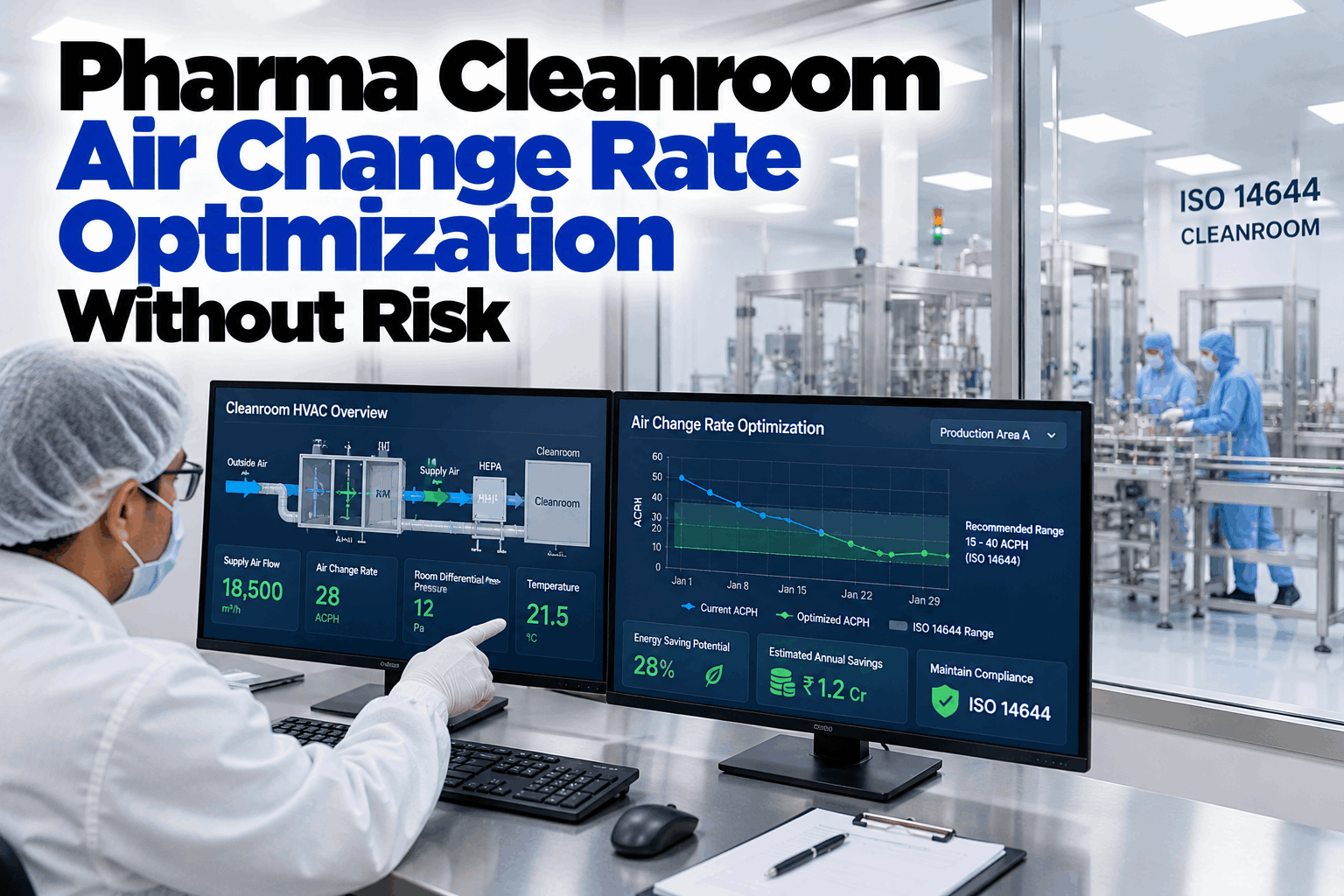
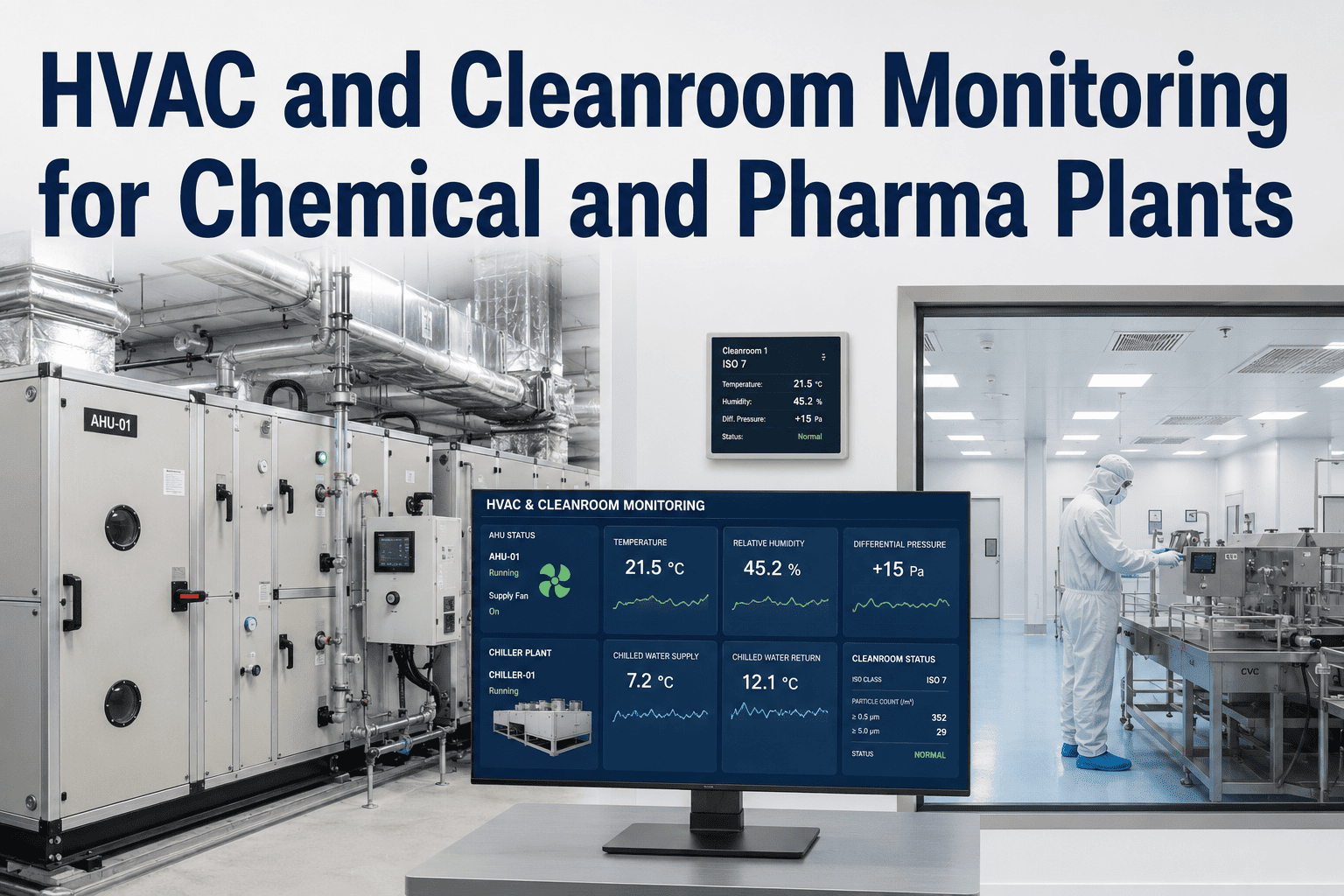
Air handling is one of the largest energy loads in a pharmaceutical plant, and in a cleanroom most of that energy is set by one number: the air change rate. ACPH is usually fixed at design, often conservatively, and then left alone for the life of the facility. Rooms run at the same airflow at three in the morning with nobody inside as they do during a full production shift. Nobody wants to touch the number, because a reduction that is not properly justified can put a cleanroom out of its qualified state. The answer is neither to leave it alone nor to cut it. It is to test the change on a validated model, verify it against particle, recovery and pressure data, and then approve it through your quality system. iFactory What-If Energy Analytics gives operations and energy teams the evidence needed to optimise air change rate without putting compliance at risk.
iFactory What-If Energy Analytics - Pharma Cleanroom Efficiency
Pharma Cleanroom Air Change Rate Optimization Without Risk
Model the effect of a lower air change rate on energy, recovery time and pressure cascade before any damper moves, then confirm it with live data and your own qualification process.
What-if first
test a change on a model, not on a qualified room
Evidence-led
particle counts, recovery and differentials back every decision
QA approves
changes go through your change control and validation
Room by room
each room judged on its own risk, class and process
Why Pharma Cleanrooms Run More Air Than They Need
Many cleanrooms are ventilated well above what their contamination control actually requires. It is rarely negligence. It is the result of reasonable caution that was never revisited. These are the six common reasons.
01
Worst-case design values
Air change rate is set for maximum occupancy, maximum particle load and a safety margin. Real operation is usually well below that worst case.
02
Copied from another site or an older design
A rate that worked in a previous facility is carried across without checking the room's own particle generation, layout and use.
03
Constant volume around the clock
Airflow is the same during production, cleaning and an empty weekend. Energy is spent maintaining conditions nobody is working in.
04
Fear of requalification
Any change to airflow feels like a risk to the qualified state, so the safest-looking choice is to change nothing and accept the energy cost.
05
No link between airflow and cleanliness data
Particle counts, recovery tests and differentials sit in separate systems from the AHU data, so nobody can show how much margin a room really has.
06
Energy cost not attributed to rooms
AHU energy appears as a utilities line, not as a cost per room, so there is no clear case for reviewing any individual space.
Room-by-Room What-If Screening
The screening view compares each room's current air change rate with a modelled candidate and shows the condition that must be met before any change is considered. The figures below are an illustrative example, and several rooms are deliberately left unchanged.
Room
Current ACPH
Candidate
Airflow
Verdict
Condition before change
Grade C compounding
45
30
-33%
Candidate
Recovery test and pressure cascade confirmed
Grade D support area
25
15
-40%
Candidate
Particle counts at rest and in operation
Packaging hall
30
20
-33%
Review
Heat load and humidity control checked first
Grade B background to Grade A
60
60
0%
Hold
Aseptic risk; no change without full risk assessment
Dispensing booth (containment)
40
40
0%
Not eligible
Containment function governs airflow
Screening summary
5 rooms
-
-
2 candidates
1 review, 2 held; only evidence moves a room to candidate
What Decides the Right Air Change Rate
ISO 14644 classifies cleanrooms by the airborne particle concentration they must achieve. It does not prescribe a fixed ACPH. The rate that delivers the required cleanliness depends on the room, and the what-if model is built around the factors that decide it.
Contamination control
Factor
Particle generation, occupancy, gowning and process activity in the room
Evidence
Particle counts at rest and in operation, and recovery test results
What-if question
Does a lower rate still recover to the required class within the defined time
Pressure and flow
Factor
Pressure cascade between rooms, door leakage, supply and return balance
Evidence
Differential pressure trends and airflow visualisation where relevant
What-if question
Does the cascade hold at the lower flow, including during door openings
Thermal and humidity
Factor
Equipment heat load, process moisture and the need for dehumidification
Evidence
Temperature and humidity logs against room limits
What-if question
Can the room stay within limits when airflow is reduced
Five Steps to Optimise Air Change Rate Without Risk
The method keeps quality and engineering in the same process. Energy savings are a result of the evidence, not the starting point.
1
Map each room to its requirement
Record the class, the governing guidance and the process in every room, so rooms with different risks are never treated alike.
Example: Room C-204 - Grade C - non-sterile compounding
2
Baseline what the room actually does
Combine ACPH, AHU power, particle counts, recovery data and pressure trends into one view for each room.
Example: 45 ACPH, counts well inside limit, 5 min recovery
3
Run the what-if on the model
Test lower rates and occupancy-based setback for energy, recovery time, cascade and thermal limits, before touching the plant.
Example: 30 ACPH - recovery within limit - fan energy lower
4
Qualify the change through QA
Take the model result into your change control, with recovery testing, pressure checks and approval before implementation.
Example: Change request approved after recovery test
5
Monitor and keep the margin visible
Track particle counts and differentials against the new rate, with alerts if a room loses its margin.
Example: Alert if differential falls below action level
Want to see which of your rooms are candidates? Book a demo - bring your room list, current ACPH and AHU data and we will show a first screening.
How iFactory Runs the What-If Cycle
The platform links energy data with cleanliness data, so a proposed change can be tested and then monitored with the same evidence.
01
Baseline
AHU, BMS and cleanroom monitoring data brought together per room.
02
Model
What-if scenarios built for airflow, energy and recovery.
03
Qualify
Results handed to QA with the supporting data for change control.
04
Implement
Approved changes made by your engineering team, room by room.
05
Monitor
Live tracking of cleanliness margin and energy after each change.
What Careful Air Change Rate Optimization Delivers
The result is lower air handling energy where the evidence supports it, and a record that shows why each decision was safe.
Lower fan energy
Where it is safe
fan power falls faster than airflow
Less conditioning
Heating and cooling load
less air to cool, heat and dehumidify
Evidence kept
Audit-ready record
model, test data and approvals in one place
QA in the loop
No unapproved change
nothing moves without your change control
Frequently Asked Questions
Does ISO 14644 set a required air change rate?
No. ISO 14644 defines cleanliness classes by airborne particle concentration and sets out testing methods. The air change rate needed to hold a class depends on the room, its activity and its design, and published ranges are only indicative. GMP guidance and your own risk assessment also apply, particularly for aseptic areas.
Does the what-if model replace qualification?
No. The model shows which rooms may have margin and what a change is likely to do, so effort goes to the right rooms. Any change still needs verification through recovery testing, particle monitoring, pressure checks and approval under your change control and quality system.
What data do you need to start?
A room list with class and use, current air change rates, AHU and fan energy data, and any available particle, pressure, temperature and humidity records from your BMS or environmental monitoring system. Missing data is identified at scoping, and the first screening works with what you have.
Can we begin with one AHU or one area?
Yes, and that is the sensible way to start. Choose a lower-risk area such as a Grade D support space or a packaging area, run the what-if, and take the result through change control. The experience then sets the approach for higher-grade rooms.
Stop running every cleanroom at the worst case.
See Which Cleanrooms Have Air Change Rate Margin
Bring your room list, current ACPH and AHU data. We will show a first what-if screening, which rooms are candidates and what evidence each one would need.
What-if
before any change