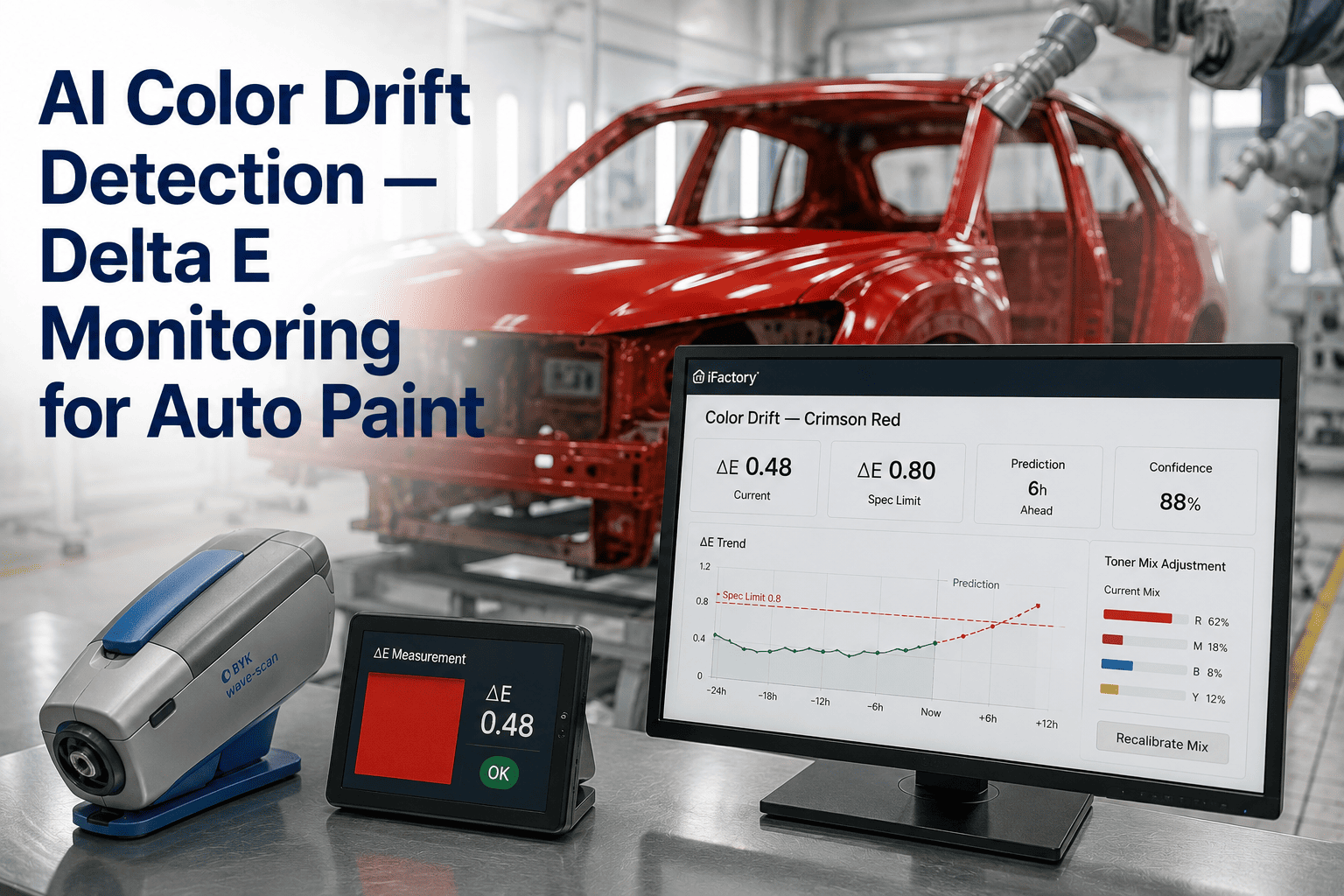
Crimson Red is reading ΔE 0.48 right now, and every booth operator would call that a pass. It is a pass. But the trend underneath it is climbing, and at the current rate of toner drift the color will cross the ΔE 0.8 spec limit in about six hours — somewhere in the middle of second shift, on bodies nobody is watching closely because the last measured panel looked fine. By the time a wave-scan walk-around catches the breach, a run of vehicles has already been painted out of tolerance, and each one is a rework decision: a respray that consumes booth capacity, paint, energy, and labor to run a finished body back through the most expensive operation in the plant. The problem was never that ΔE 0.48 is bad. The problem is that color drift is gradual and continuous while measurement is periodic and after-the-fact, so the breach is discovered on painted metal instead of predicted in the mix. AI color drift detection closes that gap: it watches the ΔE trend continuously, predicts the spec breach hours before it happens, and tells you the toner-mix correction to make now — while the fix is still a calibration, not a respray. Because color formulas and body images are sensitive IP, the AI runs on-premise, and it deploys in 6 to 12 weeks. To see color-drift prediction on your line, book a demo.
AUTOMOTIVE PAINT · AI COLOR DRIFT DETECTION
Catch ΔE Creep Before It Leaves the Booth — Not After.
Color drifts gradually; wave-scan measurement catches it late. iFactory watches the ΔE trend continuously, predicts the spec breach hours ahead, and recommends the toner-mix calibration while the fix is still a mix correction instead of a respray. On-premise paint AI that keeps your color formulas inside your firewall — live in 6 to 12 weeks.
ΔE 0.8
Spec limit the AI predicts before you cross it
6 hrs
Advance warning before the ΔE breach hits metal
88%
Confidence on the drift prediction
6–12 wks
On-premise deployment, formulas stay in-house
Why Color Drift Escapes the Booth
The paint shop is the most expensive single operation in an automotive plant and the most unforgiving — a flawless topcoat requires more than a hundred process parameters held within tolerance at once. Color is the one the customer sees. And color deviation beyond the OEM ΔE tolerance, typically under 1.0, is most visible exactly where it matters: at the boundary between a body panel and an adjacent bumper or add-on part, where a shift invisible on a single panel becomes an obvious mismatch. The trouble is structural: the color creeps continuously while the plant measures it intermittently, so the deviation is found on painted vehicles rather than caught in the process that produced it.
Drift Is Gradual and Continuous
Color doesn't jump out of spec — it creeps there, as toner batches vary, mix ratios shift, and coating viscosity moves with ambient temperature and humidity even within a single batch. Each body is fractionally different from the last, so the color walks toward the tolerance limit over hours while every individual panel still looks acceptable.
Measurement Is Periodic and Late
A BYK-Gardner wave-scan walk-around samples finished bodies at intervals, so it reports where color was at the moment of the scan, not where the trend is heading. Between scans the drift continues unwatched, and the breach is discovered after a run of vehicles has already been painted out of tolerance.
The Mismatch Shows at the Seam
A small ΔE shift is invisible on one panel but unmistakable where two parts meet, because the eye compares adjacent surfaces directly. Metallic and tri-coat colors are especially prone, since flake orientation adds an angle-dependent dimension to the difference — so a deviation that passes a flat reading fails at the body-to-bumper line.
Every Miss Is a Respray
Once a body is painted out of tolerance the only remedy is rework — a respray that sends a finished vehicle back through the booth, consuming the paint, energy, booth time, and labor of the entire process a second time. Caught at final inspection rather than booth exit, it's a full repaint cycle that steals capacity from first-pass vehicles.
The cost of the lag compounds quickly: a color deviation caught at the booth exit is rework before the vehicle moves on, but one caught at final assembly is a full repaint cycle — booth capacity, material, energy, and labor all spent twice on a body that should have been right the first time. The entire value of prediction is moving the catch upstream of the paint.
What ΔE Actually Measures
To predict a spec breach you have to measure color the way the spec does — numerically, not by eye. ΔE is the standard metric for the difference between two colors, and understanding what it captures is what makes a 0.48-versus-0.8 conversation meaningful rather than abstract.
THE NUMBER
ΔE ≈ 1.0 = just perceptible
ΔE expresses the distance between a measured color and its reference standard, and the scale is anchored to human vision: a ΔE of roughly 1.0 is the smallest difference a person can perceive, and anything below it reads as the same color regardless of viewer or lighting. That's why automotive OEMs specify such tight tolerances — often at or below the perceptual threshold — because a body must match its bumper under every light a customer will ever see it in. A spec of ΔE 0.8 sits deliberately below the just-noticeable line, so a color measured at 0.48 is comfortably in spec but has little room to drift before it isn't.
A single ΔE number tells you the size of the difference but not its nature, so it decomposes into three components: ΔL for lightness, ΔC for chroma or saturation, and ΔH for hue. When Crimson Red drifts, knowing whether it's going lighter, losing saturation, or shifting in hue is what tells the operator which toner is responsible — a lightness drift and a hue drift call for different corrections. Reading the axes, not just the aggregate, is what turns a failing number into a specific, actionable diagnosis of which pigment in the mix is moving.
THE FORMULA
CIEDE2000 for automotive
Not every ΔE formula is equal, and for automotive coatings CIEDE2000 — ΔE00 — offers the best correlation with how people actually perceive color difference, which is why it's the standard for high-precision color work. It corrects the uneven perceptual spacing of earlier formulas so that a given ΔE means the same perceived difference across the color space. Measuring and predicting against the formula the spec is written in is what keeps the AI's warnings aligned with what a human inspector — and ultimately a customer — will judge at the seam.
See the ΔE Trend Predicted on Your Colors
Bring a color that gives your booth trouble — a metallic, a tri-coat, a red that walks. iFactory engineers will show how continuous ΔE trending predicts the spec breach hours ahead and recommends the toner-mix calibration before a single body is painted out of tolerance.
Why the Color Walks: The Drift Sources
Color drift isn't random — it comes from a handful of inputs that move continuously during production, each nudging the measured ΔE a little further from target. Predicting the breach means modeling these, because they're the levers that both cause the drift and, once understood, correct it.
01
Toner Batch and Mix-Ratio Variation
Pigment strength varies batch to batch, and small errors in the mix ratio shift the balance of toners in the basecoat, moving the color steadily off target. Batch-to-batch pigment and mix drift is a primary cause of a color that reads fine one hour and edges toward spec the next — the drift the AI catches by comparing readings continuously against the target.
02
Viscosity, Temperature, and Humidity
Coating viscosity shifts with ambient temperature and humidity even within the same batch, changing how the paint lays down and how much film builds. Because the inputs a color was tuned against keep moving, a formula that was perfect at the start of shift walks out of tune as booth conditions change through the day.
Atomizer Bell Wear
03
A robotic atomizer bell wears gradually, and its spray pattern shifts in ways too subtle to see — first as small changes in width and transfer efficiency, well before any visible appearance effect. That drift changes film build and metallic lay-down, feeding directly into a color shift that trends over days as the bell degrades.
Metallic Flake Orientation
04
In metallic and pearl colors, spray angle, distance, and gun pressure all affect how the aluminum flakes orient in the film, which changes the color's appearance by viewing angle. This angle-dependent behavior is why metallics are the most drift-prone and why multi-angle measurement — not a single flat reading — is needed to catch their shift before it shows at the seam.
The reason manually tuned parameters drift out of tune is that the inputs they were tuned against keep changing — viscosity with the weather, bells with wear, toners with the batch. A static formula can't track a moving target, which is exactly why continuous, predictive correction beats periodic manual adjustment.
The Prediction: Crimson Red, Six Hours Out
Here's what predictive color drift detection actually does, in the concrete case the booth faces. It's not a dashboard reporting a number that already breached — it's a forecast that turns a future respray into a present calibration.
1
Continuous ΔE Trending Against Target
Spectrophotometer readings are compared continuously against the target color values for Crimson Red, so instead of discrete pass/fail snapshots the AI sees a live ΔE trend — currently 0.48, and climbing. It's watching the slope, not just the level, which is what makes a forecast possible at all.
2
A Forecast to the Spec Line
Projecting the current drift rate forward, the AI predicts Crimson Red will reach the ΔE 0.8 spec limit in roughly six hours, at 88 percent confidence — a specific, time-bounded warning that a breach is coming while the color is still comfortably passing. The value is entirely in the lead time the forecast creates.
3
The Axis Tells the Cause
By reading which component — lightness, chroma, or hue — is driving the drift, the AI identifies which toner is responsible for the movement, turning "the red is going out" into "this specific tint is trending." The diagnosis is what makes the correction precise instead of trial-and-error.
4
A Toner-Mix Calibration, Now
The AI recommends the specific toner-mix calibration to bring Crimson Red back to center before it ever crosses the line — a mix adjustment made during normal production instead of a run of resprayed bodies discovered on second shift. The breach is prevented, not merely detected.
That's the whole shift in one color: ΔE 0.48 climbing to a predicted 0.8 breach six hours out, at 88 percent confidence, corrected by a toner-mix calibration before a single body is painted out of tolerance. The alternative — the wave-scan finding 0.82 on finished metal — is the same information arriving too late to prevent the rework it describes.
Predict-and-Prevent vs. Measure-and-Rework
The difference between continuous prediction and periodic measurement isn't incremental — it's the difference between a calibration and a repaint. Setting the two side by side shows why moving the catch upstream changes the economics of the booth.
MEASURE & REWORK
The Wave-Scan Walk-Around
Periodic sampling reports the color of finished bodies at the moment of the scan. Between scans the drift runs unwatched, so a breach is discovered after vehicles are already painted out of tolerance — each one a respray that consumes booth capacity, paint, energy, and labor to run a finished body back through the most expensive operation in the plant. The measurement is accurate but arrives after the cost is already incurred, and worse cases caught at final assembly become full repaint cycles that steal capacity from first-pass production.
Continuous Predictive Trending
PREDICT & PREVENT
Continuous ΔE trending sees the drift as it develops and forecasts the breach hours before it reaches metal, so the response is a toner-mix calibration made during normal production rather than a respray afterward. The color is corrected while it's still passing, no body is painted out of tolerance, and booth capacity stays on first-pass vehicles. iFactory replaces the intermittent wave-scan walk-around with continuous appearance measurement, turning color control from an after-the-fact audit into an upstream, preventive process.
Real-time optimization works by continuously correlating process inputs against measured color outcomes and adjusting before drift becomes a visible defect. The spectrophotometer trend catches batch-to-batch pigment and mix-ratio drift before a visibly mismatched panel ever reaches final assembly — which is the entire difference between preventing a respray and paying for one.
On-Premise: Your Color Formulas Stay Yours
Color formulas, toner recipes, and vehicle body images are among the most sensitive intellectual property in an automotive plant, which is why this paint AI is built to run on-premise, inside your firewall. The deployment model is designed around data governance and the realities of a production paint shop.
Formulas Never Leave the Plant
The AI runs on-premise on a pre-configured server, so proprietary color formulas, toner-mix recipes, and body imagery are processed inside your network and never sent to an outside cloud. For an OEM or tier supplier, keeping color IP within the firewall isn't a preference — it's a requirement that an on-premise deployment satisfies by design.
Real-Time Speed at the Booth
Predicting a breach six hours out and recommending a correction only helps if the analysis keeps pace with the line, and on-premise processing delivers the low latency continuous trending needs. Local inference means the ΔE forecast and toner-mix recommendation are available in the booth in real time, not after a round trip to a remote server.
OT Isolation and Reliability
A paint shop can't have its color control depend on an internet link, so on-premise operation keeps the AI running within the isolated operational-technology environment regardless of external connectivity. Color prediction stays live through network interruptions, which is exactly the resilience a continuous production process demands.
Live in 6 to 12 Weeks
The turnkey model ships a pre-configured, racked-and-ready AI server with the software pre-loaded, so deployment runs in a defined window rather than an open-ended integration project. A focused color-drift scope goes live in 6 to 12 weeks, delivering predictive color control without a multi-year platform build.
Start With One Color, Then Scale
Predictive color control doesn't require boiling the ocean — the practical rollout starts with a single high-value color and expands once the tuning is validated, which is a common and reasonable way to bring paint-shop AI online.
1
Pick the Color That Costs You Most
Begin with a single high-volume or trouble-prone color — a metallic or a red that walks — since starting with a well-understood scope lets the process-engineering team validate the drift model and toner-mix recommendations before expanding. The color causing the most rework is the one that proves the value fastest.
2
Connect the Spectrophotometer Feed
The AI ingests the continuous spectrophotometer readings — multi-angle for metallics and tri-coats — and compares them against target color values, learning the color's normal drift behavior against booth conditions, toner batches, and applicator wear from real production data.
3
Validate the Predictions
The team confirms the forecasts against what the booth actually experiences — that a predicted breach would have occurred, that the recommended calibration holds the color — building confidence in the tuning on a bounded scope before it drives corrections more broadly.
4
Expand Across Colors and Booths
With the model proven on the first color, coverage extends to the full palette and additional booths, and the drift predictions feed the maintenance loop so an applicator-wear-driven shift becomes a scheduled bell replacement rather than a color escape. Predictive color control becomes standard across the shop.
What Changes in the Paint Shop
AI color drift detection changes color from a variable the booth measures after the fact into one it predicts and corrects in advance — with effects on rework, capacity, and quality at once.
01
Breaches Predicted, Not Discovered
Continuous ΔE trending forecasts a spec breach hours ahead — a color at 0.48 flagged before it reaches 0.8 — so the correction is a toner-mix calibration during production instead of a run of resprayed bodies found at inspection. The catch moves upstream of the paint.
02
Resprays Become Calibrations
Correcting the color before any body is painted out of tolerance replaces the most expensive remedy — a full repaint cycle consuming booth time, paint, energy, and labor twice — with a mix adjustment that costs almost nothing, keeping capacity on first-pass vehicles.
03
The Seam Matches Every Time
Because drift is caught before it reaches metal, the body-to-bumper boundary where mismatch is most visible stays within tolerance under every light — protecting the finish quality the customer actually judges, including on the metallics and tri-coats most prone to shift.
04
Color IP Stays In-House
On-premise deployment keeps formulas, toner recipes, and body images inside the firewall with real-time booth-side speed and OT isolation, delivering predictive color control in a 6-to-12-week window without sending a single proprietary formula to an outside cloud.
Frequently Asked Questions
The questions paint-shop and process engineers ask most often about AI color drift detection.
How can it predict a ΔE breach that hasn't happened yet?
By watching the trend rather than the snapshot. Instead of periodic pass/fail readings, the AI compares spectrophotometer measurements continuously against the target color values, so it sees ΔE as a live, moving trend — for Crimson Red, currently 0.48 and climbing. Because color drift is gradual and driven by inputs that move predictably — toner batch strength, mix ratios, viscosity shifting with temperature and humidity, gradual applicator wear — the rate and direction of the drift can be projected forward. That projection is what lets the AI forecast that the color will reach the ΔE 0.8 spec limit in roughly six hours, at 88 percent confidence. It's the same logic as any trend-based forecast: a measurement still comfortably in spec but moving steadily toward the limit at a known rate tells you when it will cross, while there's still time to act. The value is entirely in that lead time — it converts a breach you'd otherwise discover on painted metal into one you prevent in the mix. To see the forecast on your colors,
book a demo.
What is a toner-mix calibration, and does the AI make it automatically?
A toner-mix calibration is an adjustment to the balance of tints in the basecoat that brings a drifting color back to its target. When Crimson Red trends toward spec, the cause is usually that one or more toners have shifted — a pigment batch is slightly stronger, a mix ratio has moved — and the correction is to adjust the mix to compensate. The AI helps in two ways. First, by reading which ΔE component is driving the drift — lightness, chroma, or hue — it identifies which toner is responsible, so the correction is targeted rather than trial-and-error. Second, it recommends the specific calibration to make, before the color crosses the limit. Whether that recommendation is applied automatically or confirmed by an operator depends on how your shop configures it; the common approach, especially during initial rollout, is that the AI surfaces the recommended correction and the process team validates it, building confidence before allowing more automated action. Either way, the calibration is made during normal production while the color is still passing — which is what prevents the respray rather than documenting the need for one.
Does this work for metallic and tri-coat colors, or just solids?
It's built for exactly the hard ones. Solid colors are the easiest to control, but metallic, pearl, and tri-coat finishes are where drift is most dangerous and most valuable to catch, because they add an angle-dependent dimension to color: spray angle, distance, and gun pressure all affect how the aluminum or mica flakes orient in the film, changing the appearance depending on viewing angle. That's why a single flat reading isn't enough for these colors — the system uses multi-angle spectrophotometer data, the same multi-angle measurement approach professional color control relies on for metallics, to capture the color as it will actually appear across viewing angles. The AI trends the ΔE across those angles against target, so a metallic shift that would pass a face reading but fail at the flop angle is caught in the trend. Since flake orientation is driven by applicator behavior and bell wear, the same model also links a developing metallic drift back to its process cause. In short, metallics and tri-coats aren't an edge case for this system — they're the primary reason it exists, since they're the colors most prone to the seam mismatch predictive control is designed to prevent.
Will our color formulas and vehicle data leave the plant?
No. The AI is deliberately built to run on-premise, on a pre-configured server inside your own network, precisely because color formulas, toner-mix recipes, and vehicle body imagery are among the most sensitive intellectual property an automotive plant holds. Everything is processed locally, within your firewall, and nothing is sent to an external cloud — so proprietary color IP never leaves the building. This on-premise model also serves two other production realities. It delivers the low latency that real-time, booth-side prediction needs, since local inference means the ΔE forecast and toner-mix recommendation are available immediately rather than after a round trip to a remote server. And it keeps color control running inside the isolated operational-technology environment regardless of external connectivity, so a network interruption never takes down your color prediction. On-premise here isn't just a data-security checkbox — it's what makes the AI fast enough and reliable enough for a continuous paint operation, while keeping your formulas entirely in-house. Contact
iFactory support to review the deployment for your shop.
How long until it's running, and do we start plant-wide?
Deployment runs in a defined 6-to-12-week window, not an open-ended integration project, because the turnkey model ships a pre-configured, racked-and-ready AI server with the software pre-loaded rather than requiring a ground-up build. And you don't start plant-wide — the recommended and lowest-risk approach is to begin with a single high-volume or trouble-prone color, the one causing the most rework, since a bounded, well-understood scope lets your process-engineering team validate the drift predictions and toner-mix recommendations before expanding. On that first color the AI ingests the continuous spectrophotometer feed, learns the color's normal drift behavior against booth conditions and toner batches, and you confirm its forecasts against what the booth actually experiences. Once the tuning is proven, coverage extends to the full palette and additional booths, and the drift predictions feed the maintenance loop so an applicator-wear-driven shift becomes a scheduled bell replacement rather than a color escape. This phased path means you see predictive color control working on your highest-cost color quickly, and scale from demonstrated results rather than a leap of faith. Contact
iFactory support to scope the first color.
TREND · FORECAST · CALIBRATE · PREVENT
Stop Discovering ΔE Breaches on Painted Metal — Predict Them in the Mix.
Continuous ΔE trending that forecasts the spec breach hours ahead — Crimson Red at 0.48 flagged before it hits the 0.8 limit, at 88 percent confidence — with the toner-mix calibration recommended while the fix is still a mix correction, not a respray. Multi-angle coverage for metallics and tri-coats, on-premise so your formulas stay in-house, live in 6 to 12 weeks. Turn resprays into calibrations.