Ask three shifts to inspect the same fifty parts and you will usually get three different reject piles. Nobody is being careless: the criteria live in people's heads, the light changes, the last hour of a shift is not the first, and a borderline scratch is a judgement call. In automotive supply that variability becomes sorting cost, customer complaints and arguments between shifts. This article explains how to measure inspection consistency, and how vision AI holds it steady through standardized criteria, operator-independent scoring and automated result logging. To see it applied to your own parts, book a consistency review.
The Same Part Should Get the Same Verdict on Every Shift
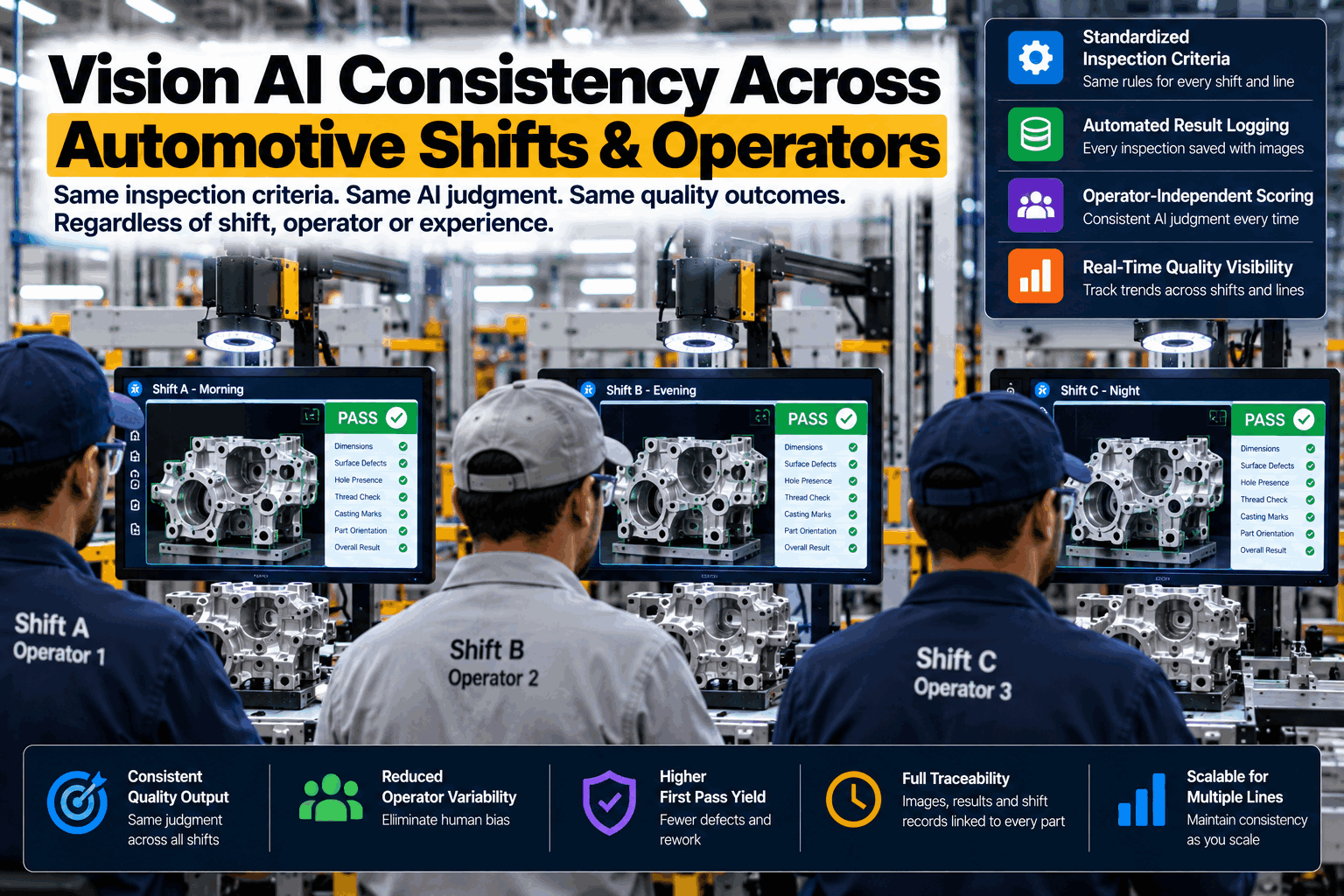
iFactory vision AI scores every part against one versioned set of criteria, on every shift, and writes the result, the image and the score to a record nobody has to fill in. People still decide the borderline cases — with the score in front of them and their decisions logged.
- One criteria version for every shift and station
- Scoring that does not know who is on shift
- Every result logged with its image and score
Why the Same Part Gets a Different Verdict
Visual inspection by people is better than its reputation and worse than most plans assume. In Judi See's 2015 study at Sandia National Laboratories, 82 trained inspectors examined 140 precision parts: they caught 85% of the defective ones and wrongly rejected 35% of the good ones. Both errors vary from person to person and from hour to hour. A case study published by Circadian found that in the last hour of a shift, in-line inspectors handled the most parts per minute and rejected the lowest percentage. None of this is a discipline problem. It is what happens when the standard is held in human judgement. If shift-to-shift differences are showing up in your reject data, our quality engineers can help separate inspection effects from process effects.
Criteria held in people's heads
"Light scratch, not visible at arm's length" means something slightly different to every inspector, and to the same inspector on a different day.
Boundary samples that age
The limit sample at the station was approved two years ago. It has been handled, faded and scratched, and each shift's copy is a little different.
Time on task
Sustained attention to a repetitive search task declines with time, however skilled the person. Hour seven is not hour one.
Throughput pressure
When parts back up, inspection speeds up and the reject rate falls. The parts have not improved; the look has got shorter.
Light and viewing angle
Daylight through a roof panel on the day shift, lamps only at night. A dent that shows at one angle disappears at another.
Experience mix by shift
The most experienced inspectors tend to work days. New starters learn on nights, from whoever is there, and inherit their habits.
Measure Agreement Before You Argue About It
Different reject rates on different shifts prove little by themselves, because the parts were different too. The test that settles it is an attribute agreement study: the same parts, judged blind by each shift, more than once. Raw agreement flatters. Take 50 parts judged by a day-shift and a night-shift inspector. They agree on 40, which sounds like 80%. But two people accepting most parts would agree often by chance alone — here, about 58% of the time. Kappa measures agreement beyond chance, and in this example it is 0.52, well short of the 0.75 the AIAG MSA manual reads as good. To run this study on your own parts, book a study session.
These are the criteria commonly quoted from the AIAG MSA manual; values in between are marginal. Many customers set tighter limits for safety characteristics. Read kappa together with the miss rate — a decent kappa can still hide escapes.
Put One Inspection Station on a Single Standard in Six Weeks
Choose one station and one part family. We turn your limit samples into versioned criteria, train and validate the model against a reference set, and report agreement by shift before and after.
Three Mechanisms That Make Inspection Operator-Independent
Vision AI does not make inspection consistent by being clever. It does it by moving three things out of individual judgement and into the system: what counts as a defect, how each part is scored, and how the result is recorded. Our vision specialists can show how each one would be set for your parts.
Standardized inspection criteria
Each defect class has one written definition with limit images: size, contrast, count and location thresholds, set per surface zone so that a mark that fails on a visible A-surface can pass on a hidden one. The criteria are approved by quality, given a version number, and applied to every part on every shift. A change is a controlled revision, not a conversation at the station.
Operator-independent scoring
Every part is scored by the same model on the same scale, and fixed thresholds turn the score into pass, review or reject. The score does not know which shift is running, how long it has been running, or how many parts are waiting. Borderline parts go to a person, who sees the score, the defect location and comparable past decisions before deciding.
Automated result logging
Each result is written as it is made: image, score, verdict, criteria version, model version, station, part identifier and time. There is no tally sheet to fill in and none to reconstruct at the end of the shift. When a reviewer changes a verdict, the record keeps who changed it and why.
What Keeps the Vision System Itself Consistent
A camera does not tire, but it can drift. Lamps age, a lens collects dust, a fixture moves a millimetre, a model is retrained, a threshold is nudged on the night shift to clear a backlog. A vision system that is not governed simply replaces operator variation with a variation nobody is watching. Consistency has to be checked, and the checks are simple. To review the controls on an existing vision station, book a system audit.
The challenge set is the anchor: a fixed group of known good, known defective and borderline parts or images, run at the start of each shift. If the verdicts match the reference, the station is released. If they do not, it is held until someone finds out why.
Where People Still Decide — and How That Stays Consistent
Operator-independent scoring does not mean no operators. Parts in the review band need a person, and so does any disagreement with the system. The difference is that those decisions are now few, visible and measured, so reviewer variation can be managed like any other source of variation.
The Record Behind Every Verdict
Automated logging is the least glamorous of the three mechanisms and the one that pays back most often. It is what lets a plant answer a customer complaint with the image of the part, show an auditor the measurement system evidence, and find out whether a change in reject rate began with a lot, a shift or a software release.
- Complaint response. Retrieve the image and verdict for a part by its identifier, instead of asking who was on shift.
- Measurement system evidence. IATF 16949 expects measurement system analysis for inspection and test systems in the control plan, and that includes attribute inspection. The records and challenge-set results are that evidence.
- Before-and-after comparison. Every criteria or model revision is dated, so its effect on reject rate can be read directly.
- Training material. Borderline images with their agreed verdicts become the calibration set for new reviewers.
What the AI Adds Beyond a Fixed Rule
Rule-based machine vision is perfectly consistent and often too rigid for automotive surfaces, where reflections, texture and harmless variation trip fixed thresholds. Trained models tolerate that variation while holding the criteria steady. iFactory's models run on a GPU server in your plant, so images stay on site and the same model serves every shift.
- One model, every shift. The released model version is locked; no station runs a private copy.
- Comparable past decisions. Reviewers see similar images and how they were judged, which pulls decisions toward one standard.
- Drift watch. Score distributions, review-band share and override rates are tracked by shift, and a change raises an alert.
- Questions in plain language. Engineers ask about shifts, parts and defect classes and get the records behind the answer.
Manual Inspection, Rule-Based Vision and Vision AI Compared
Each approach is consistent about some things and not others. The useful question is where the standard lives and who can change it. Our application team can compare these against the inspection you run today.
Delivered as a Turnkey AI System — Hardware and Software Together
iFactory ships as a complete bundle: a pre-configured NVIDIA AI server, racked and ready, with the vision software and AI models pre-loaded, plus the cameras and lighting for your stations. Rack it, plug in power and Ethernet, and the AI is live on your network — part images stay in your plant. Our team handles camera and lighting installation, cabling, network setup, PLC and SCADA integration, links to your MES, operator training and 24×7 remote monitoring. For a scoped proposal, book a deployment call.
Ship, network and data
Server delivered and racked. Cameras and lighting fitted at the first station. Limit samples turned into written criteria. Reference set assembled and images collected.
Model training and pilot
Model trained and validated against the reference set. The station runs alongside manual inspection on all shifts, and agreement is reported weekly.
Go-live and training
Vision verdicts go live with the review band. Reviewers complete the calibration set. Challenge-set checks and change control handed over to your quality team.
Frequently Asked Questions
Why do inspection results differ between shifts?
Usually because the standard is held in individual judgement. Criteria are interpreted differently, limit samples age, attention declines over a shift, throughput pressure shortens the look, and lighting and experience vary between shifts. Process differences can contribute too, which is why an agreement study on the same parts is the way to tell them apart.
How do we measure inspection consistency?
With an attribute agreement study: a set of good, defective and borderline parts judged blind by each appraiser more than once. The results give agreement within each person, between people and against the reference, expressed as kappa, effectiveness, miss rate and false alarm rate.
Is vision AI always consistent?
It gives the same verdict for the same image, which people cannot promise. But images change if lighting, lenses or fixtures drift, and verdicts change if models or thresholds are edited. Consistency over time depends on reference checks at each shift start, version locks and change control.
Does consistent mean accurate?
No. A system can be consistently wrong. Accuracy is shown separately, by validating the model against a reference set agreed with quality and, where relevant, with the customer, and reporting its miss rate and false alarm rate.
What happens to borderline parts?
Parts scoring inside the review band are sent to a trained reviewer, who sees the score, the defect location and similar past decisions. The reviewer's verdict and reason are logged, and override rates are tracked by person and shift.
Can we change the criteria after go-live?
Yes, and you will need to as customer requirements change. A change is made as a numbered revision approved by quality, the challenge set is rerun, and the date is recorded so the effect on reject rate can be seen.
How long does deployment take, and what do we need to provide?
A typical station is live in 6–12 weeks. You provide rack space, power, an Ethernet connection, access to the station, your limit samples and inspection standard, and a set of good, defective and borderline parts. iFactory supplies the pre-configured NVIDIA AI server, cameras, lighting, software, integration and training. To scope your line, contact our deployment team.
One Standard, Every Shift, Every Part
One turnkey system — NVIDIA AI server, cameras, vision software, integration and training — delivered and live inside 12 weeks. Start with the station where the shifts disagree most.
- 1Pick 50 parts: good, defective and borderline
- 2Have each shift judge them blind, twice
- 3Calculate agreement and kappa
- 4Compare miss and false alarm rates
- 5Decide where criteria or automation are needed