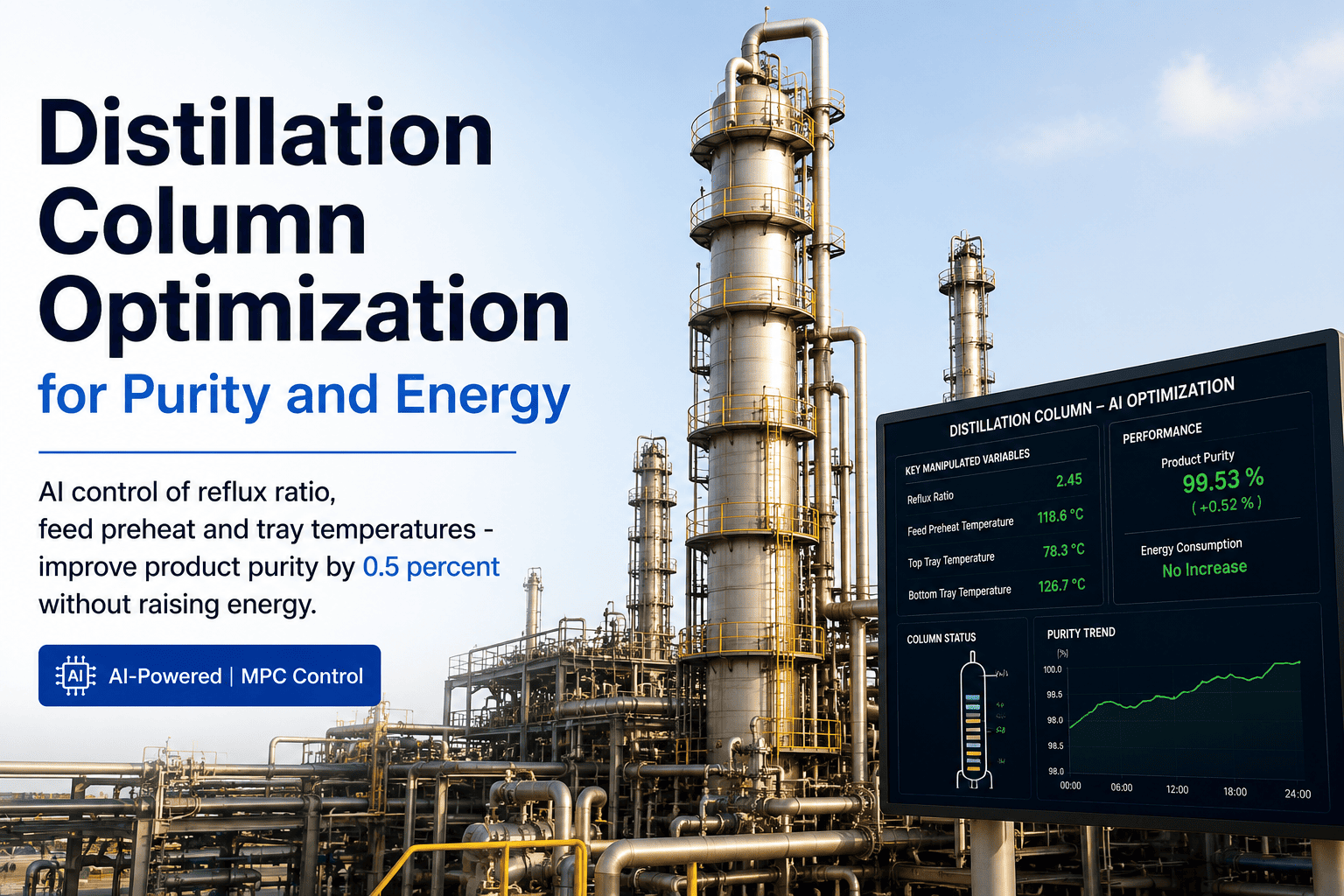
A reflux ratio sits at 3.2 because that is where the commissioning engineer set it four years ago. The feed comes in at 82 degrees because that is what the heat exchanger delivers. The column makes spec — barely — and the reboiler burns steam at a rate nobody has questioned since startup. But the feed composition has shifted, the ambient temperature has changed with the season, and the column is now running 14% more steam than it needs to hit the same purity. Nobody notices because the product is on-spec and the energy bill is someone else's line item. This is the quiet waste of distillation — a column that works but does not optimise, because the interactions between reflux, feed preheat, tray temperatures, and column pressure are too coupled for a human operator or a PID loop to solve in real time. An iFactory on-prem AI layer reads every variable simultaneously and adjusts the column toward the energy minimum that still meets purity — continuously, automatically, shift after shift.
iFactory · Chemical Separation AI
AI Distillation Optimisation: Hit Purity Spec at Minimum Energy by Controlling Reflux, Feed Preheat, and Tray Temperatures Together
Distillation consumes 40% of a chemical plant's energy. AI reads every column variable in real time and moves reflux ratio, feed temperature, and pressure toward the energy minimum that still meets product purity — cutting steam without touching spec.
40%
of plant energy consumed by distillation
10-14%
steam reduction demonstrated by AI control
19 min
advance flooding detection by ML models
On-prem
AI runs inside your plant DCS network
Why a PID Loop Cannot Optimise a Distillation Column
A distillation column is a multi-variable, non-linear, coupled system. The reflux ratio affects tray temperatures, which affect separation efficiency, which affects reboiler duty. Feed temperature changes the vapour-liquid split at the feed tray, shifting the energy balance across the entire column. Column pressure changes the relative volatility of every component. A PID controller manages one loop at a time — reflux flow, reboiler steam, condenser level — and each loop fights the others. The result is a column that oscillates around a conservative setpoint rather than finding the true operating optimum. AI solves the coupled problem simultaneously, moving all variables together toward the point where purity is met at minimum energy.
PID control
One variable at a time, loops fight each other
Conservative setpoints to avoid interaction upsets
Reflux set high to guarantee purity with margin
Energy waste hidden inside the safety margin
AI model-predictive control
All variables moved together — coupled problem solved
Setpoints adjusted to actual feed and ambient conditions
Reflux reduced to minimum that still meets purity
Energy minimum found continuously, not once at commissioning
The Five Levers AI Controls Together
Column optimisation is not about turning one knob — it is about finding the right combination of five interdependent variables for the current feed composition, ambient conditions, and product spec. AI reads all five in real time and moves them together toward the energy minimum.
Reflux ratio
Primary separation lever. Higher reflux improves purity but costs energy directly — every unit of reflux is reboiler steam. AI finds the minimum reflux that still meets spec, adjusted to the actual feed composition, not the design case.
Feed preheat temperature
Feed temperature sets the vapour fraction entering the column. Raising it shifts energy from the reboiler to the feed heater — often using cheaper waste heat. The optimum depends on feed composition and column loading.
Tray temperature profile
Tray temperatures are the real-time fingerprint of separation quality. AI reads the full profile and infers composition without waiting for the lab — enabling minute-by-minute adjustments instead of shift-by-shift corrections.
Column pressure
Lower pressure increases relative volatility — easier separation, less energy — but moves the column closer to its hydraulic limit. AI holds pressure at the lowest safe point by predicting the flooding margin in real time.
Reboiler duty
The variable that sets the energy bill. AI minimises reboiler steam by letting reflux, feed preheat, and pressure do as much separation work as possible before adding heat — the opposite of the conservative PID approach.
Want to see how AI controls these five levers on your column? Talk to a distillation AI specialist — we will model your column from its process data.
Flooding Prediction: The Constraint AI Cannot Ignore
Every energy-saving move on a distillation column pushes it closer to its hydraulic limit. Reduce pressure and relative volatility improves — but so does vapour velocity. Increase feed preheat and reboiler duty drops — but vapour loading in the stripping section rises. The constraint that bounds every optimisation is flooding: the point where vapour velocity overwhelms the downcomers and the column loses its separation entirely. Traditional monitoring catches flooding after it happens — products go off-spec and the column may trip. ML models trained on tray differential pressure, temperature profiles, and flow rates predict flooding 19-37 minutes before it occurs, giving the AI enough time to back off the optimisation before the column is at risk.
Normal operating region
Column running at conservative setpoints. On-spec but far from energy minimum. Reflux higher than necessary.
AI-optimised region
Column running at minimum-energy setpoints. Purity met, reflux reduced, pressure lowered. Closer to hydraulic limit but monitored continuously.
Flooding approach zone
ML model detects incipient flooding 19-37 minutes ahead from differential pressure trends. AI backs off optimisation automatically before column reaches hydraulic limit.
What Changes When AI Runs the Column
The shift from fixed setpoints to AI-optimised operation changes four things simultaneously — purity control, energy consumption, column stability, and operator workload.
Reflux set at commissioning and left
Reflux adjusted continuously to feed composition
Purity over-shot by 0.5-1% as safety margin
Purity held at spec with tight confidence band
Reboiler burns 14% more steam than needed
Steam reduced to minimum that meets purity at current conditions
Flooding discovered when column trips
Flooding predicted 19-37 minutes ahead, averted automatically
Operator adjusts column by experience and lab results
AI adjusts column in real time; operator supervises and overrides
Ready to see AI optimise your column? Book a demo and we will model the energy savings from your column's actual operating data.
Why On-Prem for Distillation Control
Distillation control is a real-time, closed-loop problem. The AI must read process variables, compute the optimal move, and write setpoints back to the DCS within seconds — not minutes, not after a cloud round-trip. Running the model on-premise inside your plant network delivers the latency, security, and resilience that a control-layer application demands.
Latency
Model-predictive control executes on a cycle measured in seconds. Cloud round-trip latency introduces delay that degrades control performance. On-prem inference keeps the loop tight enough for real-time column control.
Security
Column operating data, product specifications, and energy consumption profiles are proprietary process intelligence. On-prem keeps that data inside your plant perimeter — it never leaves your network.
Resilience
If the internet drops, the AI keeps optimising. The column never reverts to conservative fixed setpoints because of a network outage. On-prem means continuous optimisation, 24/7, regardless of connectivity.
Frequently Asked Questions
How much energy can AI actually save on a distillation column?
Published results show 10-14% steam reduction on industrial columns. The savings come from reducing the reflux ratio to the minimum that meets purity, optimising feed preheat to shift energy from the reboiler to cheaper heat sources, and holding column pressure at the lowest safe point. The exact savings depend on how conservative the current setpoints are — columns that have not been retuned since commissioning typically show the largest gains.
Does the AI write directly to the DCS?
The AI computes optimal setpoints and sends them to the DCS as supervisory targets. The existing regulatory PID loops execute the moves. Operators can see every recommendation, override any setpoint, and switch the AI to advisory mode at any time. The column's safety interlocks and DCS limits are never bypassed — the AI operates within the same constraints as a human operator.
What data does the AI need from the column?
The variables your DCS already logs: tray temperatures, feed flow and temperature, reflux flow, reboiler steam flow, column pressure, differential pressure across tray sections, distillate and bottoms flows, and condenser duty. Online analyser data (composition) improves performance but is not required — the model can infer composition from the tray temperature profile when analyser data is not available.
Will this work on a dividing-wall column?
Yes — and DWCs benefit even more from AI control because they have additional degrees of freedom (liquid split, vapour split) that PID loops cannot coordinate. MPC has been demonstrated to outperform multi-loop PID on DWC configurations, delivering less oscillation, shorter transition times, and implicit energy minimisation through liquid split manipulation.
How long does deployment take?
A single column typically goes live in 6-12 weeks. Weeks 1-3: DCS data connection and model training on historical operating data. Weeks 3-6: shadow mode — AI computes recommendations but does not write setpoints; engineering team validates against actual column behaviour. Weeks 6-12: live mode with operator supervision. Turnkey on-prem: pre-configured NVIDIA AI server, 1000+ industrial clients, 99.9% uptime.
Your column is running. It is not optimised. Fix that.
See AI Optimisation Running on Your Distillation Column
Bring your column's operating data — tray temperatures, reflux, feed conditions, reboiler duty. We will model the energy savings from your actual process, show where the reflux ratio can come down without touching purity, and demonstrate flooding prediction from your differential pressure history. Turnkey on-prem AI: pre-configured server, live in weeks, 1000+ clients, 99.9% uptime.
10-14%
steam reduction on industrial columns
19 min
advance flooding prediction
5
levers controlled simultaneously
On-prem
real-time control, no cloud dependency