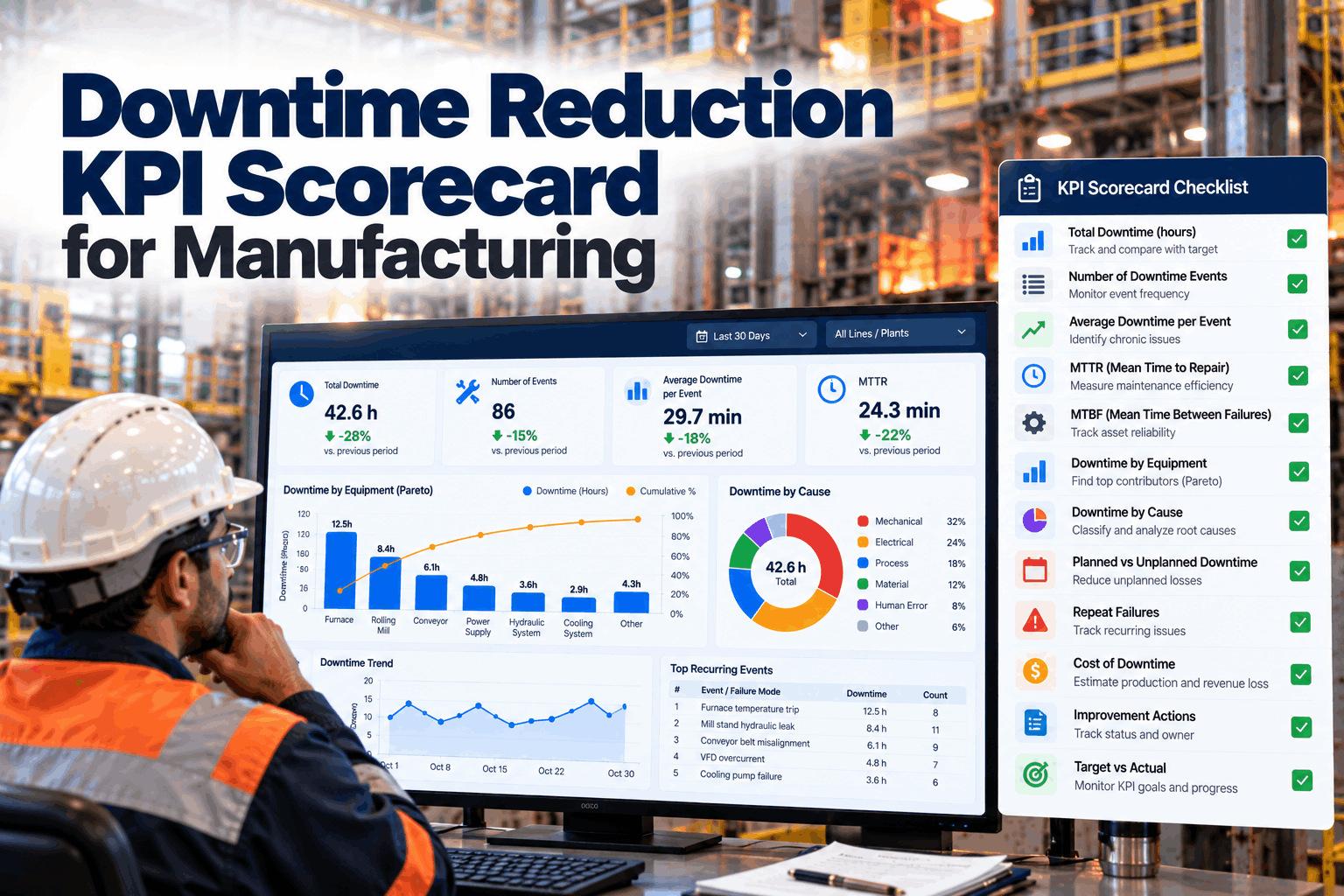
Improving MTBF and MTTR in Pharma Manufacturing Plants
By Josh Brook on May 29, 2026
In most industries a broken machine is a production problem. In pharma it is also a quality event. When a lyophilizer vacuum pump fails mid-cycle, or a filling-line servo drops out during a validated sterile run, the cost is not just downtime — it is a lost batch, a deviation, an investigation, and a line of questioning at the next inspection. That is why two reliability numbers carry double weight in a regulated plant: MTBF, which tells you how often equipment fails, and MTTR, which tells you how fast you recover. Together they drive your OEE availability and your audit standing at the same time. The good news is that both are already sitting in your work-order history, and a reliability-focused maintenance platform turns that history into the trend that tells you which assets are quietly degrading.
iFactory Reliability Intelligence
Improving MTBF and MTTR in Pharma Manufacturing Plants
Lift mean time between failures and slash mean time to repair on regulated equipment — protecting OEE and audit readiness in one move, without breaking GMP.
What makes reliability different in pharma is that the same metrics serve two masters. Every hour of MTTR is an hour of lost production — that is the OEE story everyone tracks. But in a regulated plant, the maintenance record behind that hour is also evidence. Incomplete or manually assembled equipment records are a top driver of Form 483 observations. So MTBF and MTTR improvement is not just an efficiency play; it is how you keep the line running and walk into an inspection with a clean, defensible asset history.
The OEE Side
MTBF and MTTR combine into availability, the first factor of OEE. Rising MTBF and falling MTTR move availability straight into the 85%+ world-class range and protect your output plan.
The Audit Side
A documented reliability program with audit-ready records reduces 483 exposure. Facilities with proper maintenance audit trails report dramatically fewer equipment-control findings.
Two Numbers, Two Different Problems
MTBF and MTTR are often quoted together, but they point at opposite failures and demand opposite fixes. Confusing them is why reliability initiatives scatter their effort. Get the diagnosis right first.
MTBF
Mean Time Between Failures
Total Operating Time ÷ Number of Failures
Measures reliability — how long an asset runs between unplanned stops. Rising MTBF means health is improving; a falling trend is maintenance debt building. The lever is root-cause: reinforced PM, failure-mode analysis, predictive monitoring.
MTTR
Mean Time To Repair
Total Repair Time ÷ Number of Repairs
Measures recovery speed — detection, diagnosis, parts, repair, and return-to-service testing. The surprise: 40 to 60% of MTTR is wait time, not wrench time. The lever is process: faster diagnosis, pre-staged spares, clear escalation.
They Multiply Into Availability
The reason both matter is that they combine into the number leadership and OEE both care about. Availability is MTBF divided by the sum of MTBF and MTTR — which means a fast repair lifts availability just as surely as a more reliable machine does.
Availability = MTBF ÷ (MTBF + MTTR)
Two assets can contribute identical downtime with completely different MTBF/MTTR profiles — which is exactly why you diagnose before you act.
Match the Fix to the Failure Profile
Once you know an asset's profile, the right lever is obvious. Most reliability programs fail because they apply one fix to every asset. These two profiles cover the majority of pharma equipment problems.
Low MTBF, Low MTTR
Breaks often, restarts fast
The dominant problem is reliability — the asset keeps failing. Attack root causes: reinforced preventive maintenance, failure-mode analysis, and condition-based or predictive monitoring on the recurring fault.
High MTBF, High MTTR
Breaks rarely, stays down long
The dominant problem is recovery — when it goes down, it stays down. Attack the repair process: pre-staged critical spares, faster diagnostics, and clear escalation, since most of that time is waiting, not fixing.
If 40 to 60% of repair time is wait time, then the biggest MTTR gains come from attacking the gaps between steps, not the wrench time itself. MTTR is really six segments — and tracking each one separately shows you exactly where the hours leak.
1
Detection — how fast the failure is noticed
2
Notification — alert routed to the right technician
3
Diagnosis — identifying the actual fault
4
Parts wait — the single biggest leak; 47% of extended repair traces to parts
5
Active repair — the actual wrench time
6
Return-to-service — testing and requalification
The Highest-Exposure Failures to Target First
Not all pharma assets carry equal risk. The smart reliability program ranks by financial and compliance exposure, not by failure frequency. These are the single-event failures with the highest impact — the place to spend your first MTBF effort.
Lyophilizer Vacuum Pump
A mid-cycle failure can destroy an entire parenteral batch. High single-event exposure — prioritize condition monitoring on vacuum and compressor health.
Bioreactor Agitator
An agitation failure mid-run threatens cell-culture viability and the whole batch. Monitor motor current, vibration, and seal condition.
Filling-Line Servo
A servo dropout during a validated sterile run is both a yield loss and a contamination risk. Track servo performance and fill-weight drift.
Tablet Press Tooling
Worn tooling produces out-of-spec tablets — a quality deviation, not just downtime. Monitor compression force and punch/turret wear.
The Pharma Trap: Over-Maintenance
There is a uniquely pharma failure mode in chasing reliability the wrong way. Calendar-based PM that replaces components at fixed intervals regardless of wear does not just waste parts — in a validated environment, every unnecessary intervention can trigger a revalidation cycle, consuming engineering hours and production time the equipment never needed. The fix is condition-based intervention: maintain on actual wear state, so you lift MTBF without manufacturing revalidation work.
The Reliability Improvement Loop
1
Measure
Auto-Calculate
MTBF and MTTR computed from every closed work order — no spreadsheets
2
Diagnose
Trend & Flag
Rolling 30/90/365-day trends flag any asset dropping 20%+ quarter over quarter
3
Act
Right Lever
Root-cause for low MTBF, spares and process for high MTTR
4
Document
Audit-Ready
Every intervention logged with e-signature and timestamp for Part 11
What Closing the Gap Delivers
Reliability improvement converts directly into uptime, recovered batches, and audit confidence. These figures come from reliability and CMMS field data across pharma and manufacturing in 2025 and 2026.
20-30%
Lower MTTR
through better coordination and faster diagnosis with a CMMS
9 hrs
Downtime recovered weekly
live dashboards vs weekly reporting
Zero
483s on records
reported after GMP-compliant audit-trail rollout
85%+
OEE availability
reachable as MTBF rises and MTTR falls together
Every gain starts with measuring both numbers automatically instead of by hand. Want the reliability dashboard configured to your asset types? Talk to our reliability engineers.
Frequently Asked Questions
Should we prioritize raising MTBF or lowering MTTR first?
Diagnose by profile. An asset that fails often but restarts fast is an MTBF problem — attack root causes with PM and predictive monitoring. One that fails rarely but stays down for hours is an MTTR problem — attack the repair process and spares. In pharma, high-exposure single-event assets like lyophilizers usually justify MTBF investment first.
How does reliability work connect to audit readiness?
Directly. Incomplete or manually assembled equipment maintenance records are among the most common Form 483 observations. A documented reliability program that logs every intervention with electronic signature and timestamp closes that gap, so improving MTBF and MTTR and reducing audit exposure happen in the same workflow.
Why is so much MTTR wait time rather than repair?
Because MTTR spans six segments — detection, notification, diagnosis, parts wait, active repair, and return-to-service — and the wait segments dominate. Roughly 40 to 60% of total repair time is non-wrench time, with about 47% of extended repairs traced to parts unavailability. That's why MTTR improvement stalls at diagnosis unless spares are integrated with work orders.
Can chasing MTBF actually hurt us in a GMP plant?
It can, if you do it with calendar-based over-maintenance. Replacing components at fixed intervals regardless of wear wastes parts and, in a validated environment, can trigger unnecessary revalidation cycles that consume engineering and production time. Condition-based intervention lifts MTBF without manufacturing that revalidation burden.
How do we know an asset is degrading before it fails?
Watch the MTBF trend, not the single number. A snapshot tells you little, but a rolling 6-to-12-month trend is a degradation signal. Flag any asset whose MTBF drops more than 20% quarter over quarter for immediate investigation — that decline almost always precedes a failure you can still prevent.
Protect Uptime and the Audit at Once.
See Your Live MTBF and MTTR — on Your Regulated Assets, in 30 Minutes
Bring the asset that keeps stopping your line. We'll pull your work-order history, calculate rolling MTBF, MTTR, and availability, flag what's degrading, and show the audit-ready trail behind every intervention — the fastest path to both higher OEE and a cleaner inspection.