A single undetected micro-short in a lithium-ion cell can trigger thermal runaway at temperatures exceeding 800°C—turning a manufacturing defect into a headline-making vehicle fire. With GM's Chevrolet Bolt recall costing $1.9 billion due to just two battery assembly defects (a torn anode tab and a folded separator), the stakes in EV battery production have never been higher. Smart monitoring systems now detect these invisible risks in real time, before they ever leave the factory floor. Book a free consultation to explore real-time monitoring for your battery lines.
How to Detect Thermal, Assembly, and Quality Risks in EV Battery Production
AI Vision, Thermal Monitoring & Smart Inspection for Safer Battery Manufacturing
Why EV Battery Assembly Safety Is Critical
When battery defects escape the factory, the consequences are measured in lives and billions.
Thermal Runaway Events
A single cell failure can cascade through an entire battery pack in seconds. Internal temperatures can exceed 800°C, causing fires or explosions that are extremely difficult to extinguish once initiated.
Billion-Dollar Recalls
GM recalled 143,000 Chevrolet Bolts at a cost of $1.9 billion—traced back to two manufacturing defects at the cell level. Hyundai and Kia recalled over 208,000 EVs in late 2024 for charging control unit failures.
Regulatory Escalation
China's new GB38031-2025 standard mandates "no fire, no explosion" during thermal events—the strictest battery safety requirement globally. Non-compliance means market exclusion.
Brand Destruction
A single EV fire incident generates outsized media coverage. Consumer confidence in battery safety directly impacts purchase decisions, making quality monitoring an existential business requirement.
Common Defects That Lead to Battery Safety Incidents
From electrode coating to final pack assembly—where defects originate and what they cause.
Thermal Runaway: Early Warning Signs During Production
Understanding the temperature cascade that turns a micro-defect into catastrophe.
Normal Operation
Standard charging and discharging temperatures. Battery Management System (BMS) monitors voltage and temperature. No anomalies detected at this stage.
Early Warning Zone
SEI layer begins decomposing. Micro-short circuits generate localized heat. Thermal cameras can detect abnormal hot spots at this stage—the critical intervention window during production testing.
Separator Failure
Separator softens and melts (130–180°C depending on material). Internal short circuit becomes irreversible. Electrolyte begins decomposing, releasing flammable gases. Gas sensors detect H₂ and CO emissions.
Thermal Runaway
Catastrophic exothermic reaction. Cell venting, fire, or explosion. Heat propagates to adjacent cells causing cascade failure. For NMC chemistry, temperatures can exceed 1,000°C. Event is essentially uncontrollable.
Thermal imaging during production charge/discharge testing can identify cells with micro-shorts or welding defects by detecting abnormal heat patterns in the 80–120°C warning zone—eliminating high-risk cells before they ever enter a vehicle.
Don't Wait for a Recall to Find Your Defects
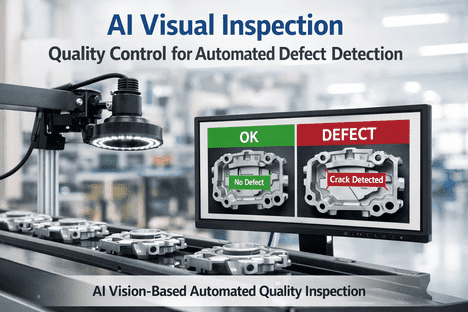
AI vision and thermal monitoring detect battery assembly risks that human inspection and rule-based systems consistently miss.
Using AI Vision Systems for Battery Cell & Pack Inspection
Why deep learning outperforms rule-based inspection in battery manufacturing.
Electrode Coating Inspection
Detects holes, bubbles, and contamination in black glossy coating mixtures where traditional systems fail due to low contrast.
Weld Seam Verification
Separates acceptable weld anomalies from defective seams on prismatic cells. Critical for tab and busbar welding quality.
Cell Surface & Dimension Check
Identifies scratches, dents, and dimensional inaccuracies on pouch, prismatic, and cylindrical cell formats at line speed.
Code Reading & Traceability
Reads etched lot codes on curved cylindrical cells despite deformation, ensuring complete traceability for recall isolation.
Thermal Cameras for Overheating Detection in Assembly Lines
Non-contact, non-destructive monitoring that catches what sensors alone cannot.
Thermographic cameras screen cells during fast charge/discharge cycles, identifying high-risk units with micro-shorts or welding defects by detecting abnormal heat signatures before they leave the production line.
24/7 thermal imaging scanners monitor battery warehouses for spontaneous hot spots—enabling early intervention to prevent lithium fires in stored inventory before shipment to vehicle assembly.
Inline infrared cameras monitor welding zones, electrolyte filling stations, and sealing processes in real time. Temperature deviations of even 2–3°C from baseline trigger automatic alerts and line holds.
Monitoring Welding, Sealing, and Electrolyte Filling Processes
Laser & Ultrasonic Welding
AI vision verifies weld bead consistency, penetration depth, and spatter patterns. Thermal cameras detect high-resistance joints in real time. Critical for tab-to-busbar and cell-to-cell connections where weld quality directly impacts safety.
Enclosure Sealing
Vision systems inspect gasket placement and adhesive bead uniformity on battery enclosures. Leak detection sensors verify hermetic seal integrity. A failed seal allows moisture ingress that corrodes internals and creates short circuit paths.
Electrolyte Filling
Precision sensors monitor fill volume, vacuum levels, and wetting uniformity. Underfilling creates dry spots that increase impedance; overfilling risks leakage. Both conditions degrade cell performance and can lead to premature failure.
Formation & Aging
Continuous voltage and temperature monitoring during initial charge cycles identifies cells with abnormal self-discharge or impedance growth. This is the final quality gate before cells enter module assembly.
Traceability and Data Logging for EV Battery Safety Compliance
Every cell, every weld, every test—linked and retrievable in seconds.
GB38031-2025
"No fire, no explosion" mandate during or after thermal events. Strictest global standard. Requires multi-stage barrier validation at cell, module, and pack levels.
IEC 62660
Covers mechanical, electrical, and thermal abuse testing for EV battery cells. Requires documented test methods and data logging for each qualification batch.
UL 9540A:2025
Encourages digital twin approach—CFD simulations of thermal propagation validated experimentally. Mandates sensor-based monitoring for voltage drops and temperature rises.
UN ECE R100
United Nations regulation for EV safety covering battery system integrity, isolation resistance, and protection against thermal events during and after vehicle operation.
How Smart Monitoring Prevents Recalls and Field Failures
The ROI of catching defects at the factory, not in the field.
AI vision systems reduce defect escape rates by 10x compared to human inspectors, catching variable defects on reflective battery surfaces that rule-based systems miss.
Automated inspection combined with real-time process monitoring reduces overall manufacturing defect rates by identifying root causes and enabling immediate corrective action.
AI distinguishes cosmetic anomalies from functional defects with adjustable thresholds—halving the scrap rate from overkill that wastes good cells worth $50–$150 each.
Typical annual return per inspection line reaches $1.3M through combined labor savings, OEE improvement, and reduced warranty costs. ROI achieved within the first year.
GM's $1.9 billion Bolt recall was traced to two cell-level defects—a torn anode tab and folded separator. In contrast, manufacturers with complete digital traceability have isolated quality issues to as few as 4 vehicles. The difference is inspection precision.
Based on NHTSA recall data and automotive inspection case studiesFrequently Asked Questions
Common questions about EV battery assembly monitoring and safety systems.
What causes thermal runaway in EV batteries?
Thermal runaway is triggered by internal short circuits from manufacturing defects (metal particle contamination, separator tears, electrode misalignment), mechanical damage, or overcharging. Once cell temperature exceeds 120–150°C, the reaction becomes self-sustaining and can reach 800°C+ in NMC chemistries.
How does AI vision improve battery inspection over traditional methods?
AI deep learning handles the variable, complex defects on reflective battery surfaces that rule-based vision cannot. It reduces escaped defects by 10x versus human inspectors, inspects cells in 3.5 seconds (vs. 5 minutes manually), and needs only 5 defect examples to train a new model.
What role do thermal cameras play in battery manufacturing?
Infrared thermal imaging is a non-contact, non-destructive method that detects abnormal heat patterns during cell testing, welding, and storage. It identifies micro-shorts and high-resistance joints by detecting temperature anomalies as small as 2–3°C from baseline—the critical early warning of potential thermal events.
What battery safety standards require monitoring systems?
Key standards include China's GB38031-2025 (no fire/explosion mandate), IEC 62660 (abuse testing), UL 9540A:2025 (digital twin validation), and UN ECE R100 (vehicle-level battery safety). All require documented monitoring data and sensor-based detection of voltage drops and temperature anomalies.
How does traceability reduce recall costs?
Digital traceability links every cell to its material batch, process parameters, and test results. When a defect is found, manufacturers can isolate the specific production window affected—recalling hundreds of vehicles instead of hundreds of thousands, as demonstrated by the contrast between GM's broad Bolt recall and precision-targeted recalls by other OEMs.
What is the ROI of implementing smart monitoring in battery production?
Manufacturers typically see $1.3M annual return per inspection line from combined labor savings, OEE improvement, and reduced warranty exposure. Payback is achieved within 12 months. The alternative—a single battery recall—averages hundreds of millions in direct costs plus immeasurable brand damage.
Implement Real-Time Monitoring to Reduce EV Battery Safety Risks Today
See how iFactory's smart monitoring platform combines AI vision, thermal detection, and digital traceability to catch battery defects before they become billion-dollar problems.