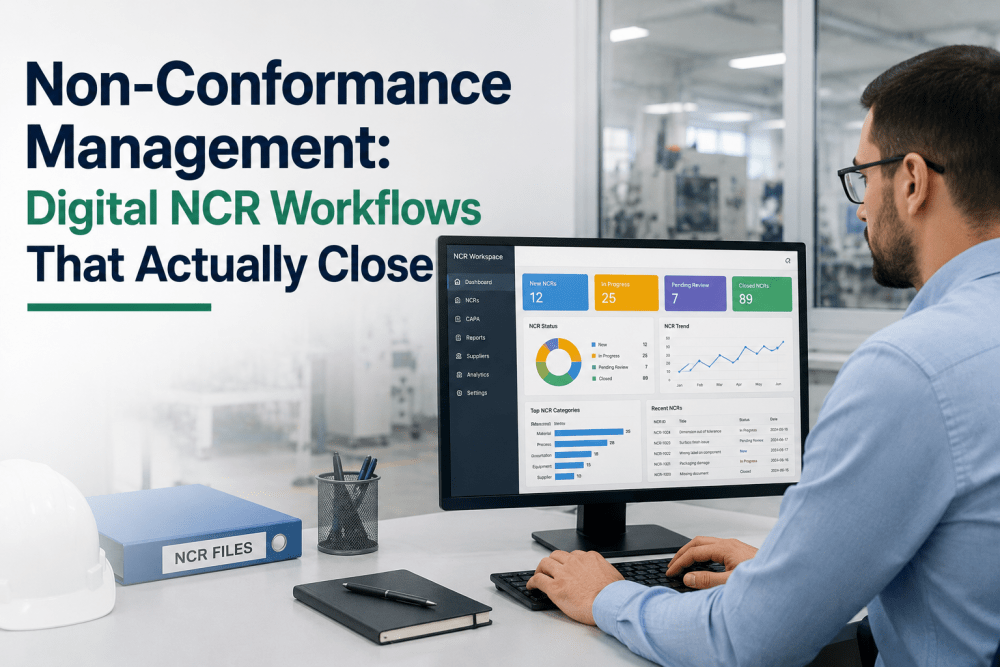
Non-Conformance Management: Digital NCR Workflows That Actually Close
By Daniel Brooks on May 26, 2026
A non-conformance report sitting open for 47 days isn't a quality issue anymore — it's a compliance liability, a recurring defect waiting to happen, and a direct hit to cost of poor quality, which research consistently pegs at 5–30% of revenue for manufacturers who haven't digitized the NCR-to-CAPA loop. The math is brutal: every paper NCR averages 3.2 manual handoffs, loses an estimated 18% of its supporting evidence by the time root cause analysis begins, and has roughly a 60% chance of closure with "operator error" as the root cause — which is auditor-speak for "we never actually fixed it." Digital non-conformance management solves a specific problem: making the workflow structurally incapable of closing without verified root cause, validated corrective action, and an effectiveness check that holds up under ISO 9001, IATF 16949, AS9100, and FDA 21 CFR 820 scrutiny. iFactory's Quality Management module is built around that closure discipline — guided 5 Whys and Fishbone analysis, automatic CAPA linkage, supplier SCAR workflows, and an audit trail your quality team doesn't have to assemble at 2 a.m. before an audit. Book a digital NCR demo and see what closed-loop quality actually looks like.
5–30%
of revenue lost to cost of poor quality in manufacturing
<30 days
target supplier CAPA response time for critical NCRs
>90%
target CAPA closure rate for mature quality programs
$260/hr
average downtime cost from slow defect troubleshooting
Why Paper and Spreadsheet NCRs Stay Open
Walk into any plant with a paper or spreadsheet-based NCR process, and you'll find the same pattern: a backlog of open NCRs older than 60 days, root causes that read like blame statements, and a CAPA tracker that no one trusts. The problem isn't motivation — quality teams want closures. The problem is that the workflow has no enforcement layer. Anyone can mark an NCR as closed, no one is forced to complete root cause analysis, and the link between the NCR and the corrective action lives in someone's email. Digital non-conformance management exists to fix the five failure modes that paper systems can't.
No Single Source of Truth
NCR data lives in shared drives, email threads, paper binders, and ERP comments. When an auditor asks for evidence, the quality team spends three days reconstructing it instead of running the business.
Closures Happen Without RCA
A paper form has no enforcement gate. NCRs get closed with "training issue" or "one-off event" as the root cause, and the same defect resurfaces in the next production run.
No Link Between NCR and CAPA
The NCR sits in one system, the CAPA in another, and the supplier SCAR in a third. Effectiveness checks happen on no system at all — so recurrence rates stay invisible.
Containment Lags Detection
A defective lot keeps moving downstream while someone fills out paperwork. By the time quarantine triggers, contaminated material has already been packed, shipped, or consumed in the next operation.
What "Digital NCR That Actually Closes" Really Means
The phrase gets used loosely. A PDF form on a tablet is digital, but it doesn't close the loop. A workflow tool with status fields is digital, but it doesn't enforce root cause. A genuine digital non-conformance management system is defined by five capabilities working together — and the absence of any one of them is why most "digital QMS" implementations still produce stale NCRs.
01
Point-of-Discovery Capture
Mobile NCR creation on the shop floor with photo evidence, barcode scanning of affected lots, automatic timestamp and operator ID, and offline capability for areas with weak signal. No transcription, no delay.
02
Severity-Based Auto-Routing
Critical defects trigger immediate quarantine, supervisor notification, and MRB (Material Review Board) escalation. Cosmetic issues route to standard review. The rules execute automatically — no one has to remember.
03
Enforced Root Cause Analysis
The workflow refuses to advance past RCA without a completed 5 Whys, Fishbone, or Fault Tree. Generic answers like "operator error" or "supplier issue" are flagged for review rather than accepted as closure.
04
Native CAPA & SCAR Linkage
High-severity or recurring NCRs auto-escalate into formal CAPA. Supplier-attributed NCRs auto-generate SCARs with 8D templates. Every action stays linked to its originating NCR through closure.
05
Effectiveness Verification Gate
No CAPA closes without a verified effectiveness check — typically 30, 60, or 90 days after implementation — proving the corrective action actually prevented recurrence. This is the gate paper systems never have.
06
Audit-Ready Trail
Electronic signatures at every handoff, immutable timestamps, full revision history, and one-click export of complete NCR-to-CAPA records for FDA, ISO, IATF 16949, AS9100, or customer audits.
The NCR Lifecycle iFactory Enforces
iFactory's Quality Management module maps every NCR to a structured eight-stage lifecycle. Each stage has mandatory fields, electronic signatures, and routing rules that make skipping a stage structurally impossible. Here's how a non-conformance moves from detection to verified closure inside the platform.
Swipe to see full workflow
1
Detection & Capture
SPC alert, inspection finding, customer complaint, or supplier deviation triggers NCR creation on mobile or desktop. Unique NCR ID auto-assigned.
2
Documentation
Structured problem statement: what, when, where, how much. Photos, batch/lot numbers, drawings, and process parameters attached as evidence.
3
Severity & Containment
Risk classification triggers severity-based routing. Affected material auto-quarantined above threshold. Supervisor and MRB notified.
4
Disposition Decision
Material Review Board reviews and decides: scrap, rework, return to supplier, or use-as-is with concession. Decision logged with signatures.
5
Root Cause Analysis
Guided 5 Whys, Fishbone, or Fault Tree workspace. Workflow refuses to advance until RCA is complete and signed off by the technical owner.
6
CAPA & SCAR Escalation
Recurring or high-severity NCRs auto-link to CAPA. Supplier issues auto-generate 8D SCARs with response deadlines and reminders.
7
Implementation
Corrective action tasks assigned with owners and due dates. Automated escalation if overdue. Evidence of implementation uploaded and reviewed.
8
Effectiveness & Closure
Verified effectiveness check at 30/60/90 days proves no recurrence. Only then does the NCR close, with full audit trail preserved.
Stop Closing NCRs That Never Actually Closed
iFactory's Quality Management module enforces the closure discipline most QMS platforms only describe — guided RCA, native CAPA linkage, effectiveness gates, and an audit trail you don't have to assemble. Book a 30-minute walkthrough with our quality team.
Most quality teams use these terms interchangeably, and most audit findings start exactly there. An NCR records that something failed a requirement. A CAPA is the structured action that removes the cause. A SCAR is a supplier-directed corrective action request. Conflating them produces messy audits, inflated open-ticket counts, and trend data nobody trusts. Here's the clean separation iFactory enforces inside the workflow.
Want to see how the three workflows connect inside a single quality module? Book a demo and we'll walk you through a live NCR-to-CAPA-to-SCAR trace.
Measurable Outcomes Manufacturers Track After Going Digital
The case for digital non-conformance management isn't theoretical — it shows up in five metrics that auditors, customers, and CFOs all care about. These are the numbers iFactory deployments consistently move, and the ones worth tracking from day one of any digital quality program.
Time to Close NCR
Average days from detection to verified closure. Paper systems run 40–90 days; digital workflows compress this into the 8–20 day range for routine NCRs.
Process efficiency
Recurrence Rate
Percentage of NCRs that repeat within 90 days. High recurrence signals weak RCA. Enforced root cause and effectiveness gates routinely cut this in half.
RCA quality
CAPA Closure Rate
Percentage of CAPAs closed within agreed timeframes. Mature programs target above 90%. Automated escalation and SLA tracking is what moves this number.
Discipline
Supplier CAPA Response Time
Average days from SCAR issuance to supplier response. Industry target is under 30 days for critical issues. SCAR automation with 8D templates is how you get there.
Supplier quality
Cost of Poor Quality
Combined scrap, rework, and warranty cost as a percentage of revenue. Digital traceability surfaces this number for the first time — and shrinks it.
Financial impact
Audit-Prep Time
Hours spent assembling NCR-CAPA evidence before an external audit. Goes from multi-week scramble to single-day pull when the audit trail is built in.
Compliance
What iFactory's Quality Management Module Adds
iFactory's Quality Management module is built specifically around the failure modes paper and basic QMS tools leave unfixed. Four capabilities matter most for closing the NCR-to-CAPA loop in a way that actually holds up.
A
Enforced 8-Stage CAPA Lifecycle
Every CAPA moves through eight mandatory stages with electronic signatures at each handoff. Skipping stages is structurally impossible — which is exactly what FDA, ISO, IATF, and AS9100 auditors want to see.
B
Guided RCA Tools Built In
5 Whys, Fishbone diagrams, Fault Tree Analysis, and Pareto charts run inside the workflow — not in a separate Excel file. Generic answers get flagged; structured root causes get accepted.
C
Live Connection to MES & SPC
NCRs auto-trigger from SPC out-of-control signals, inspection failures, and customer complaint feeds. Quality stops chasing data and starts acting on it in real time.
D
Supplier Portal for SCARs
Suppliers receive 8D-templated SCARs in a portal, respond with evidence, and get tracked against response and closure SLAs — feeding directly into supplier scorecards and QBR reviews.
Want to see how these four capabilities work together on a real plant's data? Book a demo with our quality team.
Expert Perspective
"The fundamental shift in 2026 is that NCR management is no longer a document-centric discipline — it's a control-centric one. The questions that decide whether a quality system is working aren't 'do we have a form for that' but 'can we answer in under two minutes who owns this open NCR, what the root cause was, what corrective action we took, and whether the effectiveness check confirmed it worked.' Plants that can answer those questions in real time are also the plants whose audits stop being events and start being routine. The difference between a 60-day NCR backlog and a 12-day one isn't more headcount in quality — it's a workflow that refuses to let an NCR close without doing the work first."
— Manufacturing Quality Practice, 2026 industry insight
3.2x
average handoffs per paper NCR before closure
2 min
benchmark to surface any open NCR & its status
8D
standard SCAR problem-solving methodology
Conclusion: Closure Is the Whole Game
Every quality program eventually comes down to one question: does the NCR actually close, or does it just get marked closed? Paper systems and spreadsheet trackers can't answer that question honestly — they have no mechanism to enforce root cause analysis, no way to validate corrective action effectiveness, and no native link between an NCR, its CAPA, and the supplier SCAR that should have come out of it. Digital non-conformance management isn't about replacing forms with screens. It's about installing the enforcement layer that makes closure mean something, recurrence trend lines tell the truth, and audit prep stop being a crisis. iFactory's Quality Management module is built on exactly that principle — guided RCA, native CAPA and SCAR integration, effectiveness gates, and an audit trail that holds up under FDA, ISO 9001, IATF 16949, and AS9100 review. The plants closing the NCR-to-CAPA loop today aren't the ones with the largest quality teams. They're the ones whose workflows make it structurally impossible to close an NCR that isn't actually closed.
Build NCR Workflows That Hold Up Under Audit
Whether you're moving off paper, replacing a basic QMS, or scaling a quality program across multiple plants, iFactory's Quality Management team can scope a digital NCR-to-CAPA deployment against your specific audit framework. Get a free 30-minute quality strategy session.
What's the difference between an NCR, an NCMR, and a CAPA?
An NCR (Non-Conformance Report) is the general record that something failed a specification, drawing, process, test, or customer requirement. An NCMR (Non-Conforming Material Report) is a specific type of NCR that focuses on physical material or product — raw material, WIP, finished goods, or purchased parts that don't meet spec. A CAPA (Corrective And Preventive Action) is the structured set of actions taken to remove the root cause and prevent recurrence. The clean separation is: NCRs document and contain a single event, NCMRs do the same for material specifically, and CAPAs eliminate the cause across the process. Conflating them produces inflated open-ticket counts, messy audit trails, and trend data nobody trusts. iFactory enforces the separation inside the workflow so each artifact does its actual job.
When should an NCR be escalated to a formal CAPA?
Four triggers should automatically escalate an NCR into a formal CAPA. First, recurrence — if the same defect, process, supplier, or part has produced an NCR more than once in a defined window (typically 90 days), the issue is systemic and needs structured corrective action. Second, severity — any NCR classified as critical, high-risk, or safety-related warrants CAPA regardless of recurrence. Third, regulatory or customer impact — anything that triggers a customer complaint, audit finding, or regulatory reportable event. Fourth, financial impact above a threshold — recurring scrap, rework, or warranty cost that crosses a defined dollar value. iFactory's workflow auto-evaluates all four triggers at NCR closure and forces escalation when any threshold is hit, so high-leverage CAPAs don't get skipped because someone forgot.
What does "effectiveness check" mean for CAPA closure, and why does it matter?
An effectiveness check is a verification — typically at 30, 60, or 90 days after corrective action implementation — proving that the change actually prevented recurrence of the original defect. Without it, a CAPA is just an implementation, not a fix. Most paper-based and basic QMS systems treat implementation as closure, which is exactly why the same defects keep showing up. The effectiveness check is also the part FDA, ISO 9001, IATF 16949, and AS9100 auditors scrutinize most heavily — finding a closed CAPA with no documented effectiveness evidence is a common audit finding. iFactory's Quality Management module refuses to close any CAPA without a verified effectiveness check signed off by the assigned owner, with the verification evidence preserved in the audit trail.
How does digital NCR management integrate with our existing MES, ERP, and SPC tools?
iFactory's Quality Management module is designed to integrate, not replace. SPC out-of-control signals auto-trigger NCR creation. MES production data attaches relevant work order, operator, and machine context to every NCR automatically. ERP integration handles material disposition decisions — scrap quantities, rework routings, and supplier return notifications flow back into the inventory and procurement systems without duplicate entry. Customer complaint feeds from CRM or service ticket platforms create NCRs in the same pipeline as internal findings. The integration philosophy is that quality data should live in one place but draw context from everywhere, so the workflow has enough information to make routing, severity, and disposition decisions automatically rather than asking quality engineers to chase data across five systems.
What ROI should we expect from moving NCR management from paper or spreadsheets to digital?
The ROI math is dominated by three line items. First, cost of poor quality reduction — published research consistently estimates COPQ at 5–30% of manufacturing revenue, and digital traceability typically surfaces and reduces this by 15–30% within the first year by exposing recurrence patterns paper systems hide. Second, audit-prep time — multi-week scrambles before external audits compress to single-day pulls when the audit trail is built into the workflow, which both reduces labor cost and substantially lowers the risk of audit findings. Third, NCR cycle time — moving average time-to-close from 40–90 days down to 8–20 days frees significant quality engineering capacity for proactive improvement work rather than firefighting. Most iFactory quality clients see payback inside 6–12 months, with multi-year ROI driven primarily by the COPQ line. Specific numbers depend on plant size, current process maturity, and industry — which is exactly what a scoping demo is designed to model.