Paperless Factory: Eliminating Forms, Clipboards & Duplicate Data Entry
By Daniel Brooks on May 26, 2026
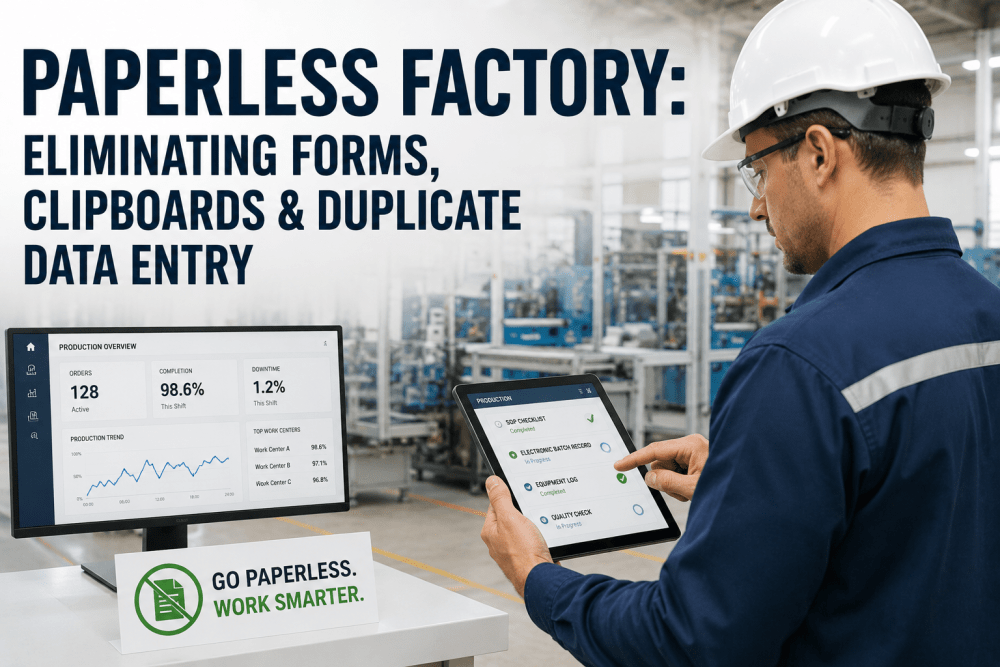
Manufacturing floors still drown in paper. Clipboards on every line, batch records hand-copied three times, SOPs printed and forgotten in binders, shift handovers scribbled on the back of a production sheet — it's a quiet productivity killer that costs U.S. manufacturers $40,000 to $120,000 per plant every year in duplicate data entry, lost records, and rework. Going paperless isn't about saving trees. It's about cutting the latency between what happens on the line and what your systems know about it. Modern paperless factories run on digital SOPs, electronic batch records (eBR), mobile data capture, and MES-driven workflows that eliminate the clipboard entirely — and the operators are happier for it.
Digital Manufacturing Operations
The Paperless Factory Advantage
Eliminate forms, clipboards, and duplicate data entry — and run your plant on real-time digital workflows
Most plant managers underestimate what paper actually costs them. The line items in your budget show maybe $8,000 a year for printing supplies, forms, and storage. The hidden cost — the one that doesn't show up in any P&L — is 4 to 6 times larger. It lives in the gap between when an operator writes something down and when that information becomes usable data.
Where Paper Quietly Drains Your Operating Budget
Duplicate Data Entry
Operators write, supervisors transcribe, clerks key into ERP — same data, three times
$35K – $50K
Lost & Illegible Records
Batch records that can't be read or located during audits and recalls
$20K – $40K
Outdated SOPs in Use
Printed work instructions don't get updated when procedures change
$15K – $30K
Storage & Retrieval
File rooms, archive boxes, and the labor cost of finding a 2-year-old record
$10K – $25K
Delayed Decisions
Production issues that wait hours for paper trails to surface
$25K – $60K
Compliance & Audit Prep
Weeks of staff time assembling paper trails for FDA, ISO, or customer audits
$15K – $35K
Mid-size plant total: $120K–$240K annually in paper-driven inefficiency
What Replaces Paper: The Five Pillars of a Paperless Plant
Going paperless isn't a single project — it's five capabilities that work together. Skip any one of them and you'll end up with a hybrid mess: digital systems on top of paper habits, which is often worse than pure paper. Here's what a complete paperless factory actually looks like.
01
Digital SOPs & Work Instructions
Interactive procedures on tablets at every workstation. Version-controlled, with embedded photos, videos, and decision trees. Operators always see the current revision — printed binders disappear.
02
Electronic Batch Records (eBR)
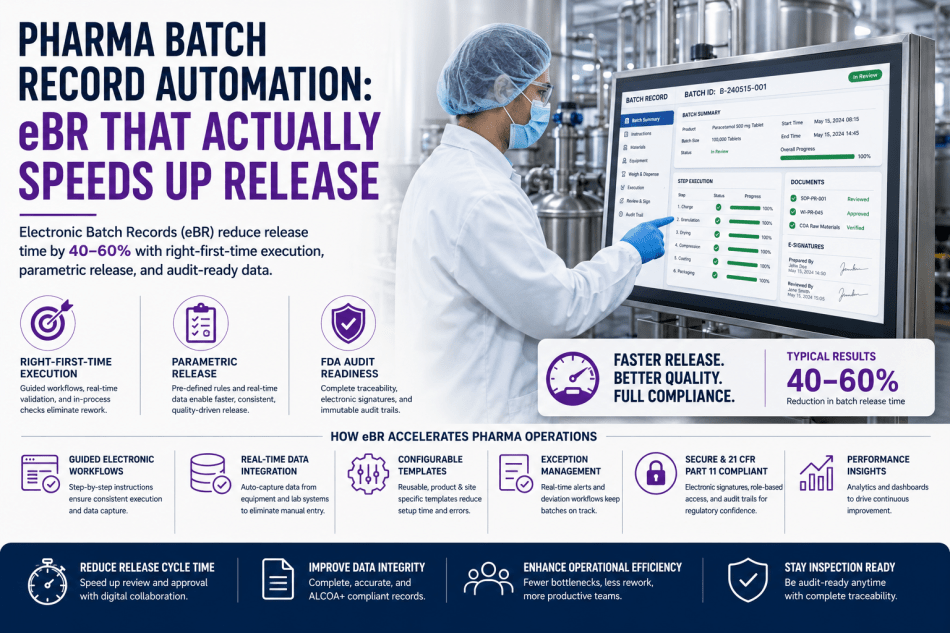
Every batch captured electronically with timestamps, operator IDs, and equipment readings. 21 CFR Part 11 compliant. Review-by-exception cuts batch release from days to hours.
03
Mobile Data Capture
Operators log inspections, downtime, defects, and shift notes directly from tablets or scanners. Data lands in your MES the moment it's entered — no transcription, no delay.
04
MES Workflow Automation
Production orders, quality checks, material movements, and approvals flow as digital workflows. Hand-offs trigger automatically based on rules, not paperwork.
05
Real-Time Production Tracking
Dashboards on the floor and in the office show live OEE, WIP, and quality data. Decisions happen in minutes instead of waiting for end-of-shift paper reports.
Curious how these pillars come together in iFactory's MES workflow? Book a demo and we'll walk through a paperless floor in action.
Paper vs. Paperless: A Side-by-Side Look
The contrast between the two operating models is sharper than most leaders realize. It's not just a matter of "faster" — it's a difference in what your operation is actually capable of doing.
Operation
Paper-Based Plant
Paperless Plant
Batch Record Review
2–5 days, page-by-page
Hours, review-by-exception
Data Entry Errors
5–10% of transcribed fields
Under 1% with validation
SOP Compliance
Trust-based, no audit trail
Enforced step-by-step
Audit Preparation
2–4 weeks of staff time
Hours, instant retrieval
Shift Handover
Verbal + scribbled notes
Digital logbook with context
Production Visibility
End-of-shift reports
Live dashboards
Root Cause Analysis
Days digging through binders
Filtered search in seconds
The Paperless Implementation Workflow
A successful paperless transition isn't a flip-the-switch event. The plants that succeed follow a phased rollout that builds operator confidence before scaling. Here's the path that consistently works.
1
Weeks 1–4
Process Mapping & Pilot Selection
Audit every paper form, clipboard, and binder on the floor. Pick one production line or area with high paper density and motivated operators — that's your pilot.
2
Weeks 5–8
Digitize SOPs & Forms
Convert work instructions and check sheets into interactive digital forms. Build in validation rules — required fields, range checks, conditional logic — that paper never had.
3
Weeks 9–12
Deploy Hardware & Train
Rugged tablets at workstations, handheld scanners for materials, and large screens for dashboards. Train operators on the floor — not in classrooms. Run paper and digital in parallel.
4
Weeks 13–16
Cut Over & Validate
Retire paper on the pilot line. Validate data flow to MES, ERP, and quality systems. Measure error rates, cycle times, and operator feedback before scaling.
5
Months 5–9
Roll Out Plant-Wide
Expand line by line, department by department. Use pilot data and operator champions to drive adoption. Most plants reach 90% paperless within 9 months of starting.
Run Your Plant Without the Clipboards
iFactory's MES workflow turns digital SOPs, electronic batch records, and mobile data capture into one connected system — so the data your floor generates becomes the data your business runs on.
Different industries see different ROI patterns depending on their regulatory burden and process complexity. These are the documented results from U.S. manufacturers who've completed paperless transitions.
Pharmaceutical & Medical Devices
70% faster batch release
eBR with built-in 21 CFR Part 11 controls slashes review cycles. Audit-ready records cut prep time from weeks to hours.
Food & Beverage
90% less audit prep time
HACCP, FSMA, and SQF documentation captured digitally on the line. Recall traceability moves from days to minutes.
Automotive & Heavy Industry
50% fewer quality escapes
Digital work instructions enforce PPAP and IATF 16949 procedures step-by-step. Quality data flows to suppliers in real time.
Consumer Goods & Electronics
40% lower labor on documentation
Mobile data capture eliminates supervisor transcription. Shift handovers and changeover checklists become digital logbooks.
Expert Perspective
"The plants that struggle with paperless aren't the ones with the wrong software — they're the ones that digitize their existing paper processes without rethinking them. The biggest win isn't replacing a form with a screen. It's eliminating the form entirely because the data is already being captured upstream. That's where the 60–80% productivity gains actually come from."
— Manufacturing Operations Research, 2025
5–10%
Error rate on paper-based transcription
<1%
Error rate with validated digital entry
9 mo
Typical full plant paperless rollout
Want to see what a real paperless MES workflow looks like for your industry? Book a demo and we'll tailor it to your floor.
The Paperless Readiness Checklist
Before you start digitizing anything, use this checklist to figure out where your plant actually stands and what needs to be in place for a successful rollout.
Process Readiness
Mapped every paper form, log, and clipboard in use
Identified duplicate data entry points across departments
Standardized SOPs across shifts and lines
Selected a pilot area with measurable baseline
Technology Readiness
Wi-Fi coverage validated across the production floor
MES platform with mobile and offline-capable forms
Integration plan for ERP, QMS, and historian systems
Rugged hardware specced for the plant environment
People Readiness
Operator champions identified on each shift
Floor-based training plan with hands-on practice
Feedback loop for operator-suggested improvements
Executive sponsor with budget authority
Conclusion
Paper isn't expensive because of what it costs to buy. It's expensive because of what it prevents — real-time decisions, validated data, traceable compliance, and operator time spent on production instead of paperwork. Manufacturers that finish their paperless transitions typically see ROI within 12 to 18 months, with ongoing savings of $100K to $250K per plant per year. The technology to do this isn't experimental anymore. The only real question is whether your operation runs on data that's hours old, or data that's seconds old.
Start Your Paperless Transition with iFactory
iFactory's MES workflow platform brings digital SOPs, electronic batch records, mobile data capture, and real-time production tracking into one unified system — built for U.S. manufacturers who need to move fast without breaking compliance.
How long does a typical paperless factory rollout take?
A single-line pilot usually takes 12–16 weeks from process mapping to cutover. Full plant rollouts typically reach 90% paperless within 9 months, depending on plant size and process complexity. Highly regulated industries like pharma may take 12–18 months due to validation requirements.
Is electronic batch record (eBR) software FDA compliant?
Yes — properly implemented eBR systems are designed to meet 21 CFR Part 11 requirements for electronic records and signatures. They provide audit trails, user authentication, time-stamped records, and validated workflows that satisfy FDA, EMA, and other regulatory bodies. The key is choosing a platform built for GxP environments from the ground up.
What about operators who aren't comfortable with technology?
This concern usually fades within the first two weeks of pilot rollout. Modern paperless interfaces are touch-based, designed like consumer apps, and require less reading than a paper SOP. Most operators report that digital workflows are easier than paper once they're trained. The real barrier is process change, not technology comfort.
Can paperless systems work offline if Wi-Fi drops?
Yes — production-grade MES platforms include offline-capable mobile clients that cache data locally and sync once connectivity returns. This is non-negotiable for production environments. Always verify offline behavior during vendor evaluation, not after deployment.
How does paperless integrate with our existing ERP and quality systems?
Modern MES platforms integrate with ERP (SAP, Oracle, Microsoft Dynamics), quality systems, historians, and LIMS through standard APIs and pre-built connectors. The goal is bi-directional data flow — production orders coming down from ERP, completion and quality data flowing back up automatically, eliminating manual re-entry between systems.