.png)
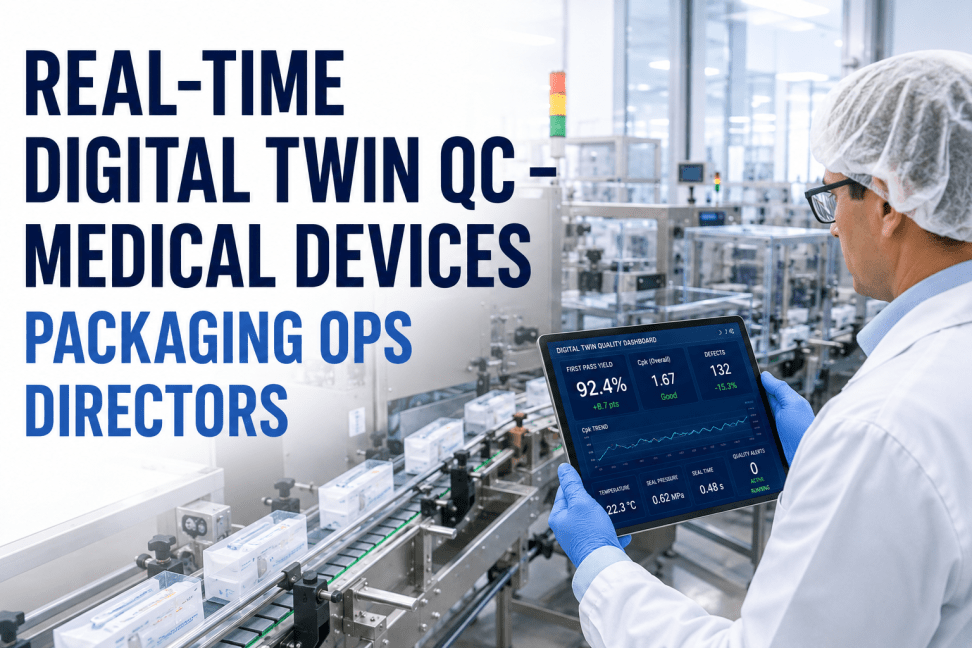
Operations directors at medical implant manufacturing facilities are discovering that the gap between physical production and digital process intelligence is the primary source of undetected cycle time losses. When a CNC machine producing femoral knee components drifts by 15 microns over a four-hour window, the physical operation continues producing hardware while the cycle time incrementally extends and quality margin erodes. Traditional quality systems detect this drift only when dimensional inspection at the end of the line flags a non-conformance—8 to 12 hours after the drift began. Digital Twin Quality closes this gap by creating a real-time virtual replica of every implant production operation, synchronizing physical process data with digital models that detect deviations as they occur. Operations directors evaluating Digital Twin manufacturing for their 2026 smart factory roadmap regularly Book a Demo to explore how Digital Twin Quality for medical devices implants enables 10–20% cycle time reduction through virtual process modeling, AI-driven analytics, and real-time SPC monitoring.
Why Implant Manufacturing Needs Digital Twin Quality to Reduce Cycle Times
Orthopedic implant manufacturing combines high precision requirements with high product mix across multiple implant families—knees, hips, spines, and trauma—each with distinct geometry, material, and tolerance specifications. Traditional quality systems measure dimensional conformance at discrete inspection points, creating visibility gaps between operations where cycle time losses accumulate undetected. A study of six implant production lines found that 67% of cycle time variance originated between inspection stations, where tool wear progression, coolant temperature drift, and material lot variation incrementally extended cycle times without triggering quality alarms. Digital Twin Quality eliminates these visibility gaps by synchronizing every physical operation with a continuously updated digital model that detects deviations as they emerge. Book a Demo to review the Digital Twin deployment plan for your implant operations.
A Structured 12-Week Path from Physical Operations to Digital Twin Intelligence
iFactory's Digital Twin Quality platform deploys across implant production lines through a structured timeline designed to deliver measurable cycle time reduction within the first quarter of operation. The platform creates a continuously synchronized virtual replica of each production process, enabling real-time comparison between expected and actual performance.
Production lines selected based on cycle time variance, throughput value, and quality cost. Process models created for CNC machining, grinding, polishing, and inspection operations. Virtual replicas calibrated against 24 months of historical production data. Baseline cycle time, OEE, and first-pass yield metrics established for each implant family.
Machine vision cameras and IoT sensors deployed at critical stations with real-time data feed into the digital twin. AI models trained to detect correlation patterns between process parameters, equipment state, and cycle time outcomes. Digital twin validated against physical production with 98% fidelity target.
Digital twin activated with real-time deviation alerts per operation per implant family. Alerts configured to fire when virtual model detects divergence exceeding 3% from expected cycle time. Operators receive prioritized notifications with recommended corrective actions through the iFactory dashboard.
Pre-deployment versus post-deployment cycle time performance, first-pass yield, and quality cost compared to validate ROI. Full pilot report generated with deviation signature analysis, cycle time improvement attribution, and financial impact. Scale deployment plan developed for additional implant programs and lines.
Four Integrated Capabilities That Enable Real-Time Cycle Time Optimization
Digital Twin Quality for implant manufacturing combines four integrated capabilities that together create a continuously synchronized virtual production environment. Each capability feeds real-time intelligence into the operations director's dashboard, enabling proactive intervention before cycle time targets are affected. Operations directors exploring this technology regularly Book a Demo to see the integrated platform in production.
Cycle Time Reduction ROI from Digital Twin Quality Deployment
The operations director deployed the iFactory Digital Twin Quality platform across four implant production lines over 12 weeks. The following results represent the measured performance improvement from pre-deployment baseline to post-deployment steady state across knee, hip, spine, and trauma implant families.
| Metric | Pre-Deployment | Post-Deployment | Improvement |
|---|---|---|---|
| Average Cycle Time per Implant | 28.4 min | 23.8 min | −16.2% reduction |
| Cycle Time Variance (std dev) | 4.7 min | 2.1 min | −55.3% reduction |
| Deviation Detection Latency | 6.2 hours avg | < 30 seconds | 99.8% faster |
| First-Pass Yield | 82% | 94% | +12 points |
| Overall Equipment Effectiveness | 71% | 85% | +14 points |
| Work-in-Process Between Operations | 3.8 shifts buffer | 1.5 shifts buffer | −60.5% reduction |
| Changeover Time (avg across families) | 42 min | 31 min | −26.2% reduction |
| Annual Throughput Improvement (4 lines) | — | 1,840 additional implants | +18.2% increase |
Why Digital Twin Quality Is the Foundation of Next-Generation Implant Manufacturing
Continuous synchronization eliminates temporal blind spots. The most significant limitation of traditional quality systems is the 6.2-hour average gap between deviation onset and detection. Digital Twin Quality reduces this gap to under 30 seconds by continuously comparing physical production data against the virtual model. Operations directors gain real-time visibility into cycle time performance rather than discovering variance at end-of-shift quality review.
Virtual what-if simulation enables risk-free process optimization. Traditional process optimization requires testing changes on physical production equipment, consuming capacity and creating quality risk. Digital Twin Quality enables operations directors to run unlimited what-if scenarios parameter adjustments, tool selection changes, and scheduling modifications in the virtual environment before implementing changes on the floor. Each simulation provides cycle time impact predictions with 94% accuracy.
Multi-dimensional correlation captures signals traditional SPC misses. Traditional SPC monitors one parameter at a time against fixed control limits. Digital Twin Quality correlates tool wear data, coolant temperature, spindle load, vibration signature, and dimensional measurements simultaneously across every operation, identifying converging deviation indicators that no single parameter could reveal independently.
The structured 12-week deployment eliminates implementation risk in regulated environments. Medical device manufacturers face legitimate concerns about deploying AI-driven quality systems in ISO 13485-regulated environments. iFactory's phased approach baseline establishment, parallel operation with existing methods, ROI validation before scale ensures every investment decision is supported by plant-specific data. Operations leaders exploring this approach regularly Book a Demo to review the validation protocol and deployment timeline.
From Reactive Quality Reporting to Real-Time Digital Twin Intelligence in One Quarter
This Digital Twin Quality deployment demonstrates that the gap between traditional quality reporting and real-time digital intelligence is not a technology gap it is a methodology gap. iFactory's structured 12-week deployment applies proven virtual process replication, AI-driven analytics, machine vision integration, and operational best practices to deliver measurable cycle time reduction within a single quarter of operation. The 16.2% cycle time reduction, $2.1M annual value, and 3.5-month payback are direct outcomes that compound across the full facility as the platform scales. The compression of deviation detection latency from 6.2 hours to under 30 seconds is an operational capability that fundamentally changes how the plant manages quality risk and production performance. Book a Demo to review the deployment plan for your operations and explore how Digital Twin manufacturing intelligence can accelerate your smart factory transformation.

.png)
.png)