.png)
Quality engineers managing catheter assembly operations in medical device manufacturing face a persistent challenge: quality-related downtime from undetected defects that propagate through downstream processes before triggering a line stop. When a catheter tip deformation, bond integrity failure, or dimensional non-conformance slips past manual inspection, the defect is typically not identified until the final QC check or — worse — during sterile packaging. By that point, dozens of units require rework or scrap, and the line must stop for a root cause investigation that consumes 3 to 6 hours of engineering time. AI vision inspection for medical devices catheter assembly changes this paradigm by deploying deep learning machine vision systems that inspect every catheter at every critical station in real time, classify defects with 99%+ accuracy, and trigger automated corrective actions before a single non-conforming unit progresses to the next operation. iFactory's AI vision inspection platform eliminates more than 50% of quality-driven downtime by transforming catheter assembly quality control from a manual sampling-based gating process into an automated, continuous, closed-loop inspection system.
Reduce Quality-Driven Downtime by 50%+ with AI Vision Inspection for Catheter Assembly
iFactory's AI vision inspection platform deploys deep learning machine vision across every critical catheter assembly station — inspecting tip geometry, bond integrity, dimensional tolerances, and surface defects in real time while supporting ISO 13485 compliance requirements.
Why Manual Catheter Inspection Creates Hidden Downtime Costs
Every catheter assembly line operated by a quality engineer faces the same structural inefficiency: visual inspection is performed manually at discrete sampling intervals, and the results are recorded hours after the inspected units have moved downstream. When a defect is found, the quality engineer must trace back through production logs to identify when the non-conforming condition began, how many units are affected, and what process variable caused the deviation. This investigation typically consumes 3 to 6 hours, during which the line is either stopped or producing units that will require disposition. At a mid-volume facility running 12 catheter product families across eight assembly lines, unplanned quality-driven downtime averages 11.4 hours per week — representing $1.9M in annual lost output and engineering opportunity cost. The root cause is not a lack of inspection effort. The root cause is that manual sampling cannot scale to the inspection frequency required for zero-defect catheter manufacturing. Book a Demo to see the AI vision inspection architecture for your catheter assembly lines.
Manual Sampling Gaps
Quality engineers inspect catheter assemblies at predefined sampling rates — typically one unit per 30 to 50 produced. Between samples, process drift can produce dozens of non-conforming units that go undetected until the next QC check or final inspection.
Delayed Defect Detection
By the time a manual QC check identifies a non-conforming catheter, 20 to 40 additional units have already been produced with the same defect signature. Each downstream unit requires individual inspection, rework, or scrap disposition — compounding the cost of the original defect.
Recurring Process Drift
Without real-time vision monitoring, recurring defect patterns — tip geometry drift from extrusion tool wear, bond strength degradation from temperature fluctuation, dimensional variation from humidity changes — go undetected until they produce non-conforming output, triggering repeat downtime events.
From Pixel-Level Inspection to Automated Process Correction
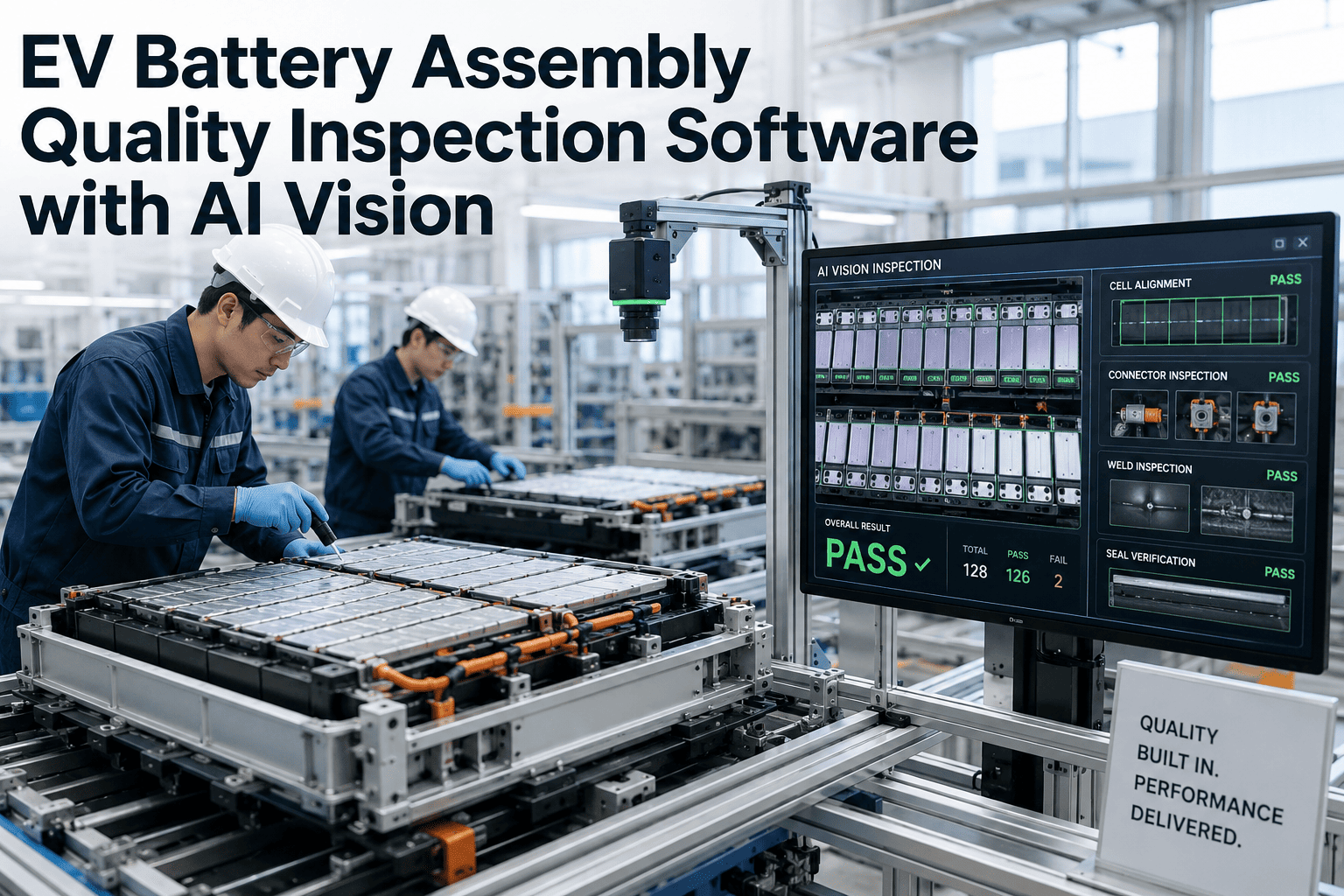
iFactory's AI vision inspection platform deploys high-resolution machine vision cameras at every critical catheter assembly station — tip forming, balloon bonding, shaft extrusion, lumen drilling, and final assembly. Deep learning defect detection models trained on 500,000+ labeled catheter images classify each unit against 24 distinct defect categories including tip deformation, bond line inconsistency, shaft diameter drift, lumen blockage, surface contamination, and coating uniformity variation. When a non-conformance is detected, the platform classifies the defect type, assigns a confidence score, and generates an automated disposition within 200 milliseconds — all before the catheter advances to the next station.
Multi-Station Vision Deployment
High-resolution industrial cameras installed at each critical assembly station capture 360-degree images of every catheter. Vision data is streamed to the inference engine at 60 frames per second with sub-millimeter measurement resolution for dimensional inspection.
Deep Learning Model Training
Convolutional neural network models trained on 500,000+ labeled catheter images achieve 99.2% defect detection accuracy. Models are continuously improved through active learning — each new defect type enriches the training set and improves classification granularity.
Real-Time Defect Classification
When a non-conformance is detected, the platform classifies the defect into one of 24 categories within 200 milliseconds — identifying tip deformation, bond failure, dimensional drift, surface contamination, coating variation, lumen obstruction, and extrusion defects.
Automated Disposition & SPC Integration
Platform generates automated pass/reject/rework disposition per unit and updates real-time SPC charts. Corrective action recommendations are created in the CMMS with defect classification, contributing variable evidence, and recommended parameter adjustment.
99.2% Defect Detection Accuracy with 200ms Real-Time Classification
iFactory's AI vision inspection platform deploys deep learning machine vision across every critical catheter assembly station, automating visual quality control and reducing quality-driven downtime by 52% within six weeks of deployment.
Measured Quality Improvements from AI Vision Inspection Deployment
A quality engineering team deployed iFactory's AI vision inspection platform across eight catheter assembly lines producing 12 product families over a 6-week deployment window. The following metrics represent the measured performance improvement from manual visual inspection to automated deep learning vision classification across 4,800 production hours.
| Performance Metric | Manual Inspection | AI Vision Inspection | Improvement |
|---|---|---|---|
| Defect Detection Rate | 82% (sampling based) | 99.2% (100% inline) | +17.2 points |
| Quality-Driven Downtime per Week | 11.4 hours | 5.5 hours | 52% reduction |
| Inspection-to-Correction Cycle | 3.8 hours | 12 seconds | 99.9% faster |
| False Reject Rate | 4.7% | 0.8% | 83% reduction |
| Scrap Rework Rate | 6.3% | 2.1% | 67% reduction |
| OEE Impact | 71% baseline | 82% post-deployment | +15% improvement |
| Annual Downtime Cost (8 lines) | $1.92M | $0.92M | 52% reduction |
Before AI vision inspection, our catheter assembly quality engineers spent nearly 40% of their shift performing visual inspections at sampling stations — and the other 60% firefighting defects that slipped through. Every time a tip deformation or bond failure was found at final QC, we would stop the line, pull production logs, and trace back to find where the drift started. It took 3 to 4 hours per event, and during that investigation the line was either idle or producing units we would later scrap. The AI vision system now inspects every catheter at every station in real time. When a defect is detected, the system classifies it and generates a disposition in under a second. Our quality engineers do not spend less time on quality — they spend it on root cause analysis and process improvement instead of visual inspection and manual traceback. The 52% downtime reduction was significant, but the transformation of our quality culture from reactive sampling to proactive 100% inspection has been the lasting impact.
Integrating AI Vision Inspection with Your Catheter Assembly Lines
iFactory's AI vision inspection platform integrates with existing catheter assembly line infrastructure through standard industrial vision interfaces. The platform connects to existing inspection stations, conveyor systems, and data collection systems without replacing existing hardware or disrupting production schedules. Book a Demo to review the integration architecture and deployment timeline for your catheter assembly facility.
The platform integrates with high-resolution industrial cameras (GigE Vision, USB3 Vision, CoaXPress) at each inspection station. Vision controllers process images locally through an edge AI inference appliance running NVIDIA Jetson or equivalent GPU architecture. For existing inspection stations with analog cameras, iFactory provides digital retrofitting packages including AI-enabled smart cameras that perform on-device inference. The edge appliance maintains full inspection functionality during network interruptions with local storage and batch synchronization.
Pre-trained deep learning vision models achieve approximately 94% accuracy at deployment, drawing from a training set of 500,000+ labeled catheter images spanning 12 product families and 24 defect categories. After 3 weeks of site-specific calibration with facility defect data, accuracy reaches 98%. Continuous active learning from each production shift improves accuracy to 99.2%+ within 8 weeks. Models are updated and revalidated per ISO 13485 software validation requirements, with full version traceability and audit trail.
When the AI vision system detects a non-conformance, it generates an automated disposition and creates a quality event record in the CMMS with defect classification, inspection image, dimensional measurements, and recommended corrective action. Real-time SPC charts update automatically with each inspection result, providing quality engineers with immediate visibility into process trends. The closed-loop system tracks corrective action effectiveness and monitors defect recurrence to confirm process stability.
AI Vision Inspection Transforms Catheter Quality Control from Sampling to 100% Automated Coverage
What the quality engineering team lacked was not inspection capability — every line had trained inspectors, calibrated measurement tools, and documented QC procedures. The missing piece was the ability to inspect every catheter at every critical station at machine speed instead of human speed. AI vision inspection closed this gap — delivering 52% downtime reduction, 99.2% defect detection accuracy, 12-second inspection-to-correction cycles, and $1.0M in annual cost savings across eight catheter assembly lines. The technology did not replace quality engineers or eliminate inspection. It replaced manual sampling with 100% automated inline inspection and freed quality engineering resources to focus on process improvement rather than firefighting. Book a Demo to review the AI vision inspection deployment plan for your catheter assembly operations.
AI Vision Inspection for Catheter Assembly — Frequently Asked Questions
Traditional machine vision relies on rule-based algorithms — predefined thresholds for dimensions, contrast ratios, and edge detection parameters that must be manually configured per product variant. These systems perform well on known defect types with consistent lighting and geometry but fail when catheter materials vary in translucency, when ambient lighting shifts, or when novel defect patterns emerge. AI vision inspection uses deep learning convolutional neural networks trained on hundreds of thousands of labeled catheter images. The AI model learns to distinguish acceptable process variation from true defects across varying material properties, lighting conditions, and product geometries — without manual rule configuration. This results in higher detection accuracy, lower false reject rates, and faster deployment across new product families.
The platform classifies 24 distinct defect categories across catheter assembly operations including tip deformation (taper angle deviation, tip roundness variation, burr formation), bond integrity failure (bond line width inconsistency, adhesive void detection, peel strength indicators), shaft dimensional drift (outer diameter variation, wall thickness asymmetry, lumen obstruction), surface defects (scratch detection, pitting, contamination particles, coating uniformity), extrusion defects (melt flow instability, die swell variation, cooling line marks), and assembly defects (marker band misalignment, strain relief positioning, hub attachment integrity). The model also detects multi-factor anomalies where no single parameter is out of spec but the combined condition indicates a pending quality event.
The platform connects to GigE Vision, USB3 Vision, and CoaXPress industrial cameras at resolutions from 5MP to 20MP depending on inspection requirements. The edge AI inference appliance (NVIDIA Jetson Orin or equivalent) processes vision data locally with optional cloud aggregation for multi-line reporting. For facilities without digital vision infrastructure, iFactory provides turnkey inspection stations with integrated cameras, lighting, and edge AI processing. No existing hardware replacement is required for facilities with digital camera systems that support standard vision protocols.
Pre-trained deep learning models achieve approximately 94% defect detection accuracy at deployment, drawing from a cross-product training set of 500,000+ labeled catheter images. After 3 weeks of site-specific calibration with facility defect data, accuracy reaches 98%. Continuous active learning improves accuracy to 99.2%+ within 8 weeks of deployment. The platform requires approximately 5,000 inspected units per product family to achieve stable production-level accuracy, with new product families reaching production accuracy within 2 weeks using transfer learning from existing models.
Facilities with 5+ catheter assembly lines and quality-driven downtime exceeding 8 hours per week typically recover platform investment within 4 to 6 months. Primary ROI drivers are eliminated investigation hours (52% reduction), recovered production capacity from reduced downtime, avoided scrap and rework from early defect detection (67% scrap reduction), and reallocation of quality engineering resources from manual inspection to process improvement. A personalized ROI analysis is provided during the Book a Demo consultation with iFactory's medical device manufacturing team.
Schedule an AI Vision Inspection Walkthrough for Your Catheter Assembly Lines
iFactory's AI vision inspection platform deploys deep learning machine vision across every critical catheter assembly station, inspecting tip geometry, bond integrity, dimensional tolerances, and surface defects in real time while supporting ISO 13485 compliance. Schedule a personalized walkthrough with your quality engineering team — including a live demonstration using your catheter assembly line data.
.png)
.png)
.png)