Industry 4.0 Predictive OEE For Medical Devices Catheter Assembly

By Daniel Brooks on June 19, 2026

predictive-oee-medical-devices-catheter-assembly-quality-engineers-defect-prevention-(2)

When a medical device manufacturer producing balloon catheters, diagnostic catheters, and delivery systems across fourteen assembly lines documented a 4.7% overall defect rate—with 62% of defects traced to equipment-related process drift that traditional OEE metrics failed to predict—the quality engineering team recognized that historical OEE calculations could not prevent defects in high-volume catheter assembly. The facility deployed iFactory’s Predictive OEE platform—combining multivariate ML with real-time equipment monitoring and defect prevention analytics—to shift from reactive OEE tracking to proactive quality intelligence. Quality engineers and SPC specialists evaluating next-generation OEE analytics platforms regularly Book a Demo to explore how predictive OEE for medical devices catheter assembly transforms defect prevention and production intelligence.

30–70%
Defect rate reduction achieved through multivariate ML-driven predictive OEE analytics across catheter assembly lines
3.4X
Faster detection of equipment-related quality risks versus traditional OEE dashboards that report after the fact
92%
OEE stability rate achieved through predictive intervention before equipment degradation impacts product quality
85%
Reduction in quality escapes reaching downstream operations through real-time predictive alerts and automated containment

The Defect Prevention Challenge in Catheter Assembly

Catheter assembly operations face a fundamental limitation with traditional OEE: it measures equipment effectiveness historically, reporting downtime, performance, and quality losses after they have already occurred. By the time OEE data signals a problem, defective product may already be in quarantine or downstream. Quality engineers require predictive intelligence that anticipates equipment-related quality risks before defects are produced.

Equipment-Related Process Variability
Extruder temperature fluctuations, bond head wear, and die buildup create gradual process drift that traditional OEE detects only after quality limits are breached. The multivariate nature of catheter assembly—where multiple machine parameters interact with material properties and environmental conditions—requires predictive analytics that correlates these variables with downstream quality.
Reactive OEE Limitations
Traditional OEE calculates availability, performance, and quality from historical production data. A quality loss event appears on the dashboard after the defect has been produced, quarantined, and investigated. This retrospective approach cannot support zero-defect manufacturing initiatives or prevent the compliance burden that follows a quality deviation in ISO 13485-regulated production.
Compliance and Documentation Pressure
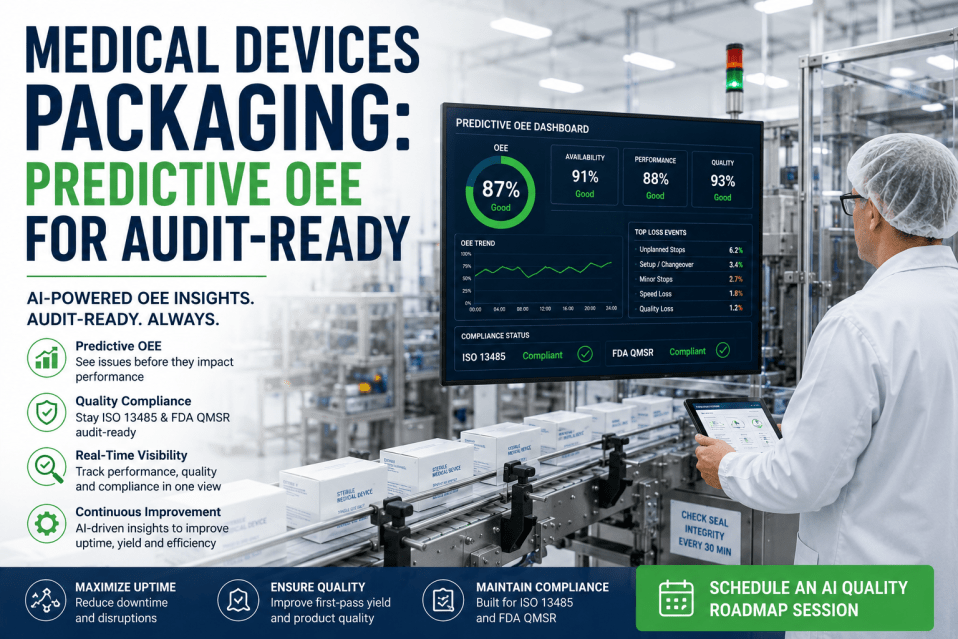
ISO 13485 requires documented evidence of process control and continuous improvement. Quality engineers spend significant effort compiling OEE reports, correlating quality data with equipment performance, and preparing for audits. Predictive OEE automates this documentation while providing the proactive quality intelligence that auditors increasingly expect from modern medical device manufacturers.

How Predictive OEE Transforms Catheter Quality Control

Predictive OEE shifts the quality paradigm from measuring losses after they occur to predicting risks before defects are produced. The iFactory platform combines multivariate machine learning with real-time equipment monitoring to generate predictive quality alerts that enable proactive intervention. Quality teams exploring this capability regularly Book a Demo to review the predictive model architecture and integration workflow.

Continuous
Parameter surveillance across all catheter assembly equipment with predictive OEE overlays

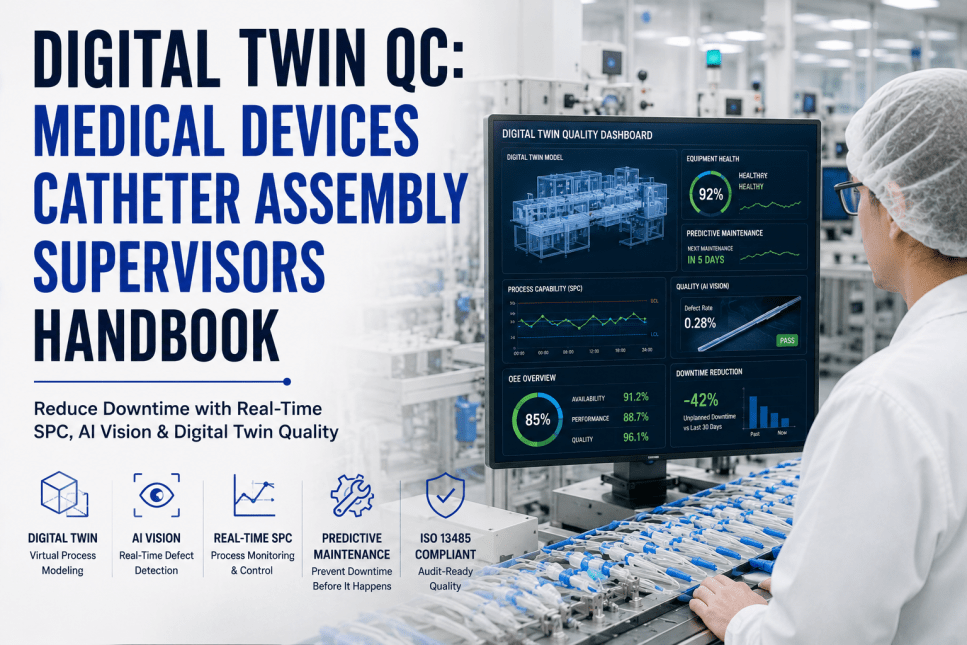
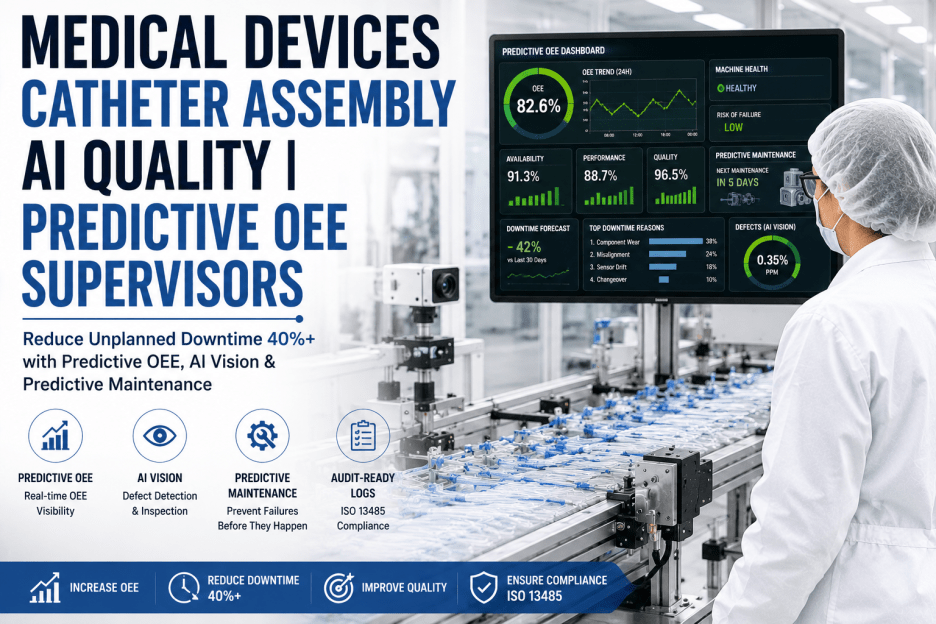
The platform collects and analyzes equipment performance data—including cycle times, temperature profiles, pressure readings, and torque values—from every catheter assembly machine in real time. Predictive OEE overlays display forecasted availability, performance, and quality scores for each production hour, enabling quality engineers to identify equipment at risk of producing defects before the risk materializes. Alerts are prioritized by predicted quality impact and automatically routed to the responsible engineering team.

Multivariate
ML models correlating machine, material, and environmental parameters with quality outcomes

Machine learning models trained on historical production data identify complex correlation patterns between equipment parameters, material lot characteristics, environmental conditions, and defect rates. When the model detects a combination of variables that historically preceded a quality event, it generates a predictive alert 30 to 60 minutes before the projected defect would occur. The platform continuously retrains models as new data accumulates, improving prediction accuracy over successive production cycles.

Audit-Ready
Automated OEE documentation and compliance reporting aligned with ISO 13485 requirements

The platform automatically generates compliance documentation linking predictive OEE data with quality outcomes, equipment performance records, and engineering interventions. Audit-ready reports include predictive alert logs, equipment health trends, defect prevention records, and OEE stability analysis. Quality engineers can demonstrate proactive process control to auditors through documented evidence of predictive interventions that prevented defects before they occurred.

Predictive OEE · Defect Prevention · Medical Devices
Shift from Reactive OEE to Predictive Quality Intelligence
Deploy multivariate ML-driven predictive OEE to reduce defects by 30–70%, improve quality stability, and achieve audit-ready compliance documentation across your catheter assembly operations.

Predictive OEE vs Traditional OEE: Key Differences

The comparison below highlights the critical differences between traditional retrospective OEE and iFactory’s predictive OEE approach for catheter assembly quality control. Review the comparison and Book a Demo to see the platform in action.

Criterion Traditional OEE Predictive OEE
Data Timing Historical — reports after losses occur Forecast — predicts risk before defects
Quality Detection Reactive — after defect produced Predictive — 30–60 min before event
Analysis Method Univariate threshold-based alerts Multivariate ML correlation analysis
Equipment Integration Standalone OEE calculation Integrated with CMMS and MES
Compliance Documentation Manual report compilation Automated audit-ready records
Continuous Improvement Periodic OEE review cycles Real-time predictive insights + retraining

Deployment Framework for Quality Engineers

Deploying predictive OEE in catheter assembly follows a structured methodology designed for medical device quality requirements and minimum production disruption.

01
Data Audit and Equipment Mapping
Quality engineers map all catheter assembly equipment, identify available sensor data streams, and compile historical quality and OEE data. The iFactory platform catalogs existing OEE baselines and defect records.
02
Multivariate Model Configuration
ML models are trained on historical data encompassing equipment parameters, material lot records, environmental conditions, and quality outcomes. Models are validated against known defect events.
03
Predictive OEE Dashboard Setup
Dashboards are configured to display forecasted OEE metrics, predictive quality alerts, and equipment health indicators. Alert thresholds are calibrated based on historical defect patterns.
04
Integration and Workflow Automation
iFactory edge connectors link predictive OEE outputs to existing CMMS, MES, and quality systems. Automated work orders are configured for predictive alerts that exceed configured thresholds.
05
Validation and Continuous Learning
Predictions are validated against actual production outcomes during a parallel-run period. The platform continuously retrains models as new data accumulates to improve forecast accuracy.

What Quality Engineering Leaders Say

We had been tracking OEE for years, but it told us what had already gone wrong. By the time the OEE dashboard showed a quality loss, we had already produced defective catheters that needed quarantine and investigation. The predictive OEE platform changed our approach completely. Now we receive alerts 30 to 60 minutes before equipment conditions would produce a defect. Our quality engineers adjust parameters proactively instead of investigating failures reactively. Within three months, our defect rate dropped from 4.7% to 1.8%, and our OEE stability improved from 74% to 92%. The predictive approach has transformed how we think about quality in catheter assembly.
Director of Quality Engineering
Multi-Line Catheter Manufacturing Facility, ISO 13485 Certified

Conclusion

Traditional OEE measures what has already happened. Predictive OEE anticipates what will happen next. For catheter assembly operations where defect prevention directly impacts patient safety, regulatory compliance, and production efficiency, the difference between reactive and predictive quality intelligence is substantial. By combining multivariate ML, real-time equipment monitoring, and automated compliance documentation through the iFactory platform, quality engineers can reduce defects by 30 to 70%, improve OEE stability above 90%, and build an audit-ready quality framework that supports zero-defect manufacturing objectives. Quality and operations leaders evaluating their OEE strategy are encouraged to Book a Demo to explore how iFactory’s Predictive OEE platform can accelerate their defect prevention and quality intelligence initiatives.
Frequently Asked Questions

Traditional OEE calculates availability, performance, and quality from historical production data after losses have occurred. Predictive OEE uses multivariate machine learning models trained on equipment parameters, material properties, environmental conditions, and historical quality outcomes to forecast future OEE performance. This enables quality engineers to identify equipment at risk of producing defects and intervene proactively, typically 30 to 60 minutes before a quality event would occur.
The platform monitors all equipment parameters that impact catheter quality: extrusion temperature profiles, cooling rates, puller speeds, bond head temperature and pressure, cycle times, torque values, die buildup indicators, and conveyor alignment. These parameters are correlated with material lot properties, cleanroom environmental data, and quality inspection results to identify multivariate patterns that precede defects.
Yes. iFactory’s platform connects to existing CMMS, MES, and quality management systems through standardized APIs and edge connectors. Predictive alerts can automatically generate work orders in the CMMS with asset identification, risk context, and recommended interventions. OEE data flows into existing dashboards and reporting systems, supporting both operational decision-making and regulatory compliance documentation.
Manufacturers typically see measurable defect reduction within the first four to six weeks of deployment as the ML models identify high-risk equipment conditions. The 30 to 70% defect reduction target is typically achieved within three to four months as models mature and quality engineers integrate predictive alerts into their workflow. Continuous model retraining improves prediction accuracy over successive production cycles.
The platform generates automated compliance documentation linking predictive OEE data with quality outcomes, equipment performance records, and engineering interventions. Audit-ready reports include predictive alert logs, equipment health trends, defect prevention records, and OEE stability analysis. Quality engineers can demonstrate proactive process control through documented evidence of predictive interventions that prevented defects before they occurred, exceeding the retrospective documentation approach that traditional OEE provides.
Transform Your Catheter Quality with Predictive OEE Intelligence
iFactory’s Predictive OEE platform combines multivariate ML, real-time equipment monitoring, and automated compliance documentation to reduce defects by 30–70% and improve OEE stability above 90%. Schedule a platform demonstration tailored to your catheter assembly defect prevention requirements.
ML-Driven Predictions
Real-Time Monitoring
Defect Prevention
Audit-Ready Reports
CMMS Integration

Share This Story, Choose Your Platform!