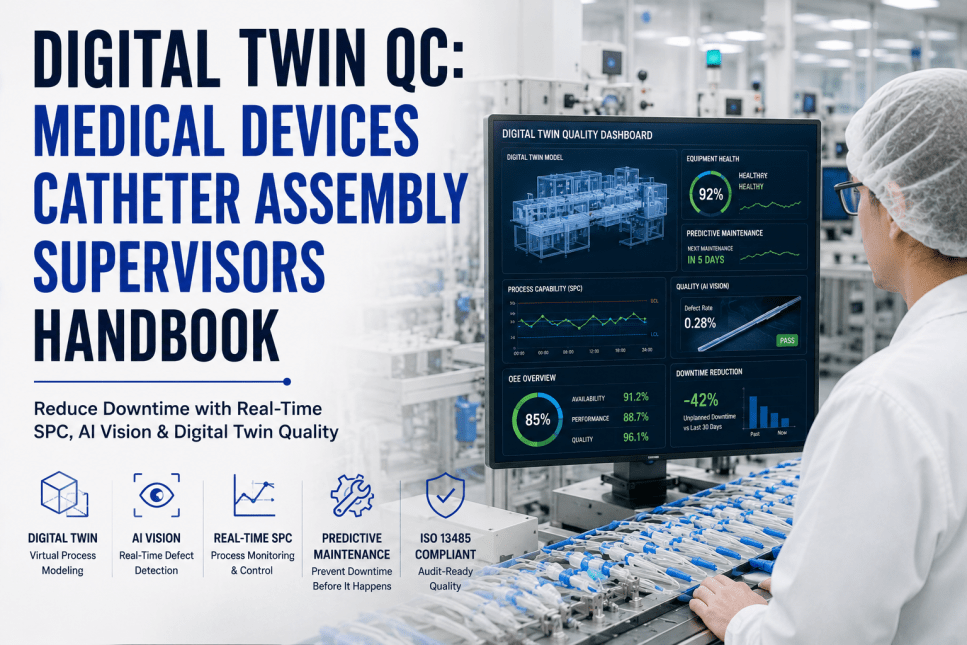
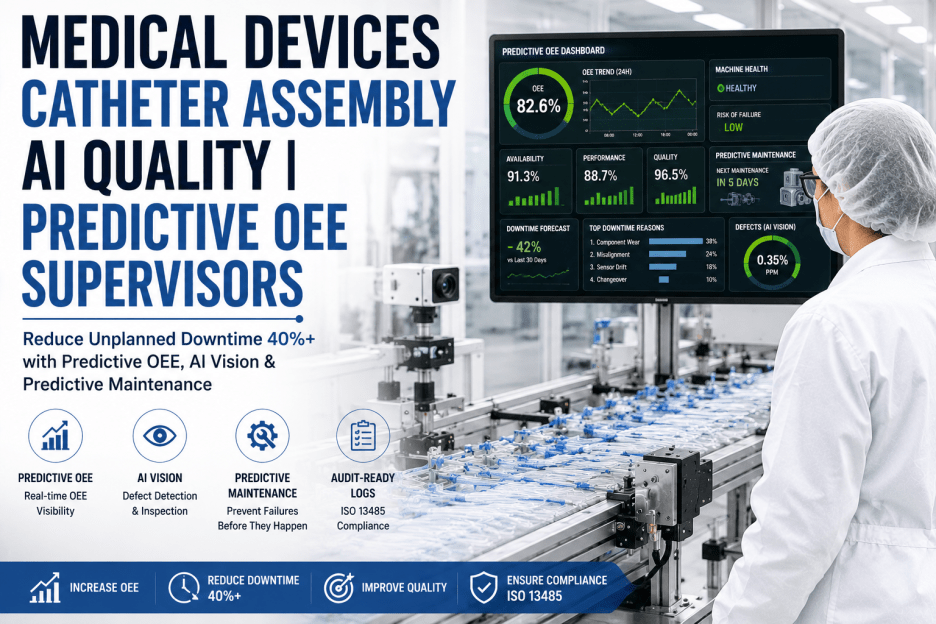
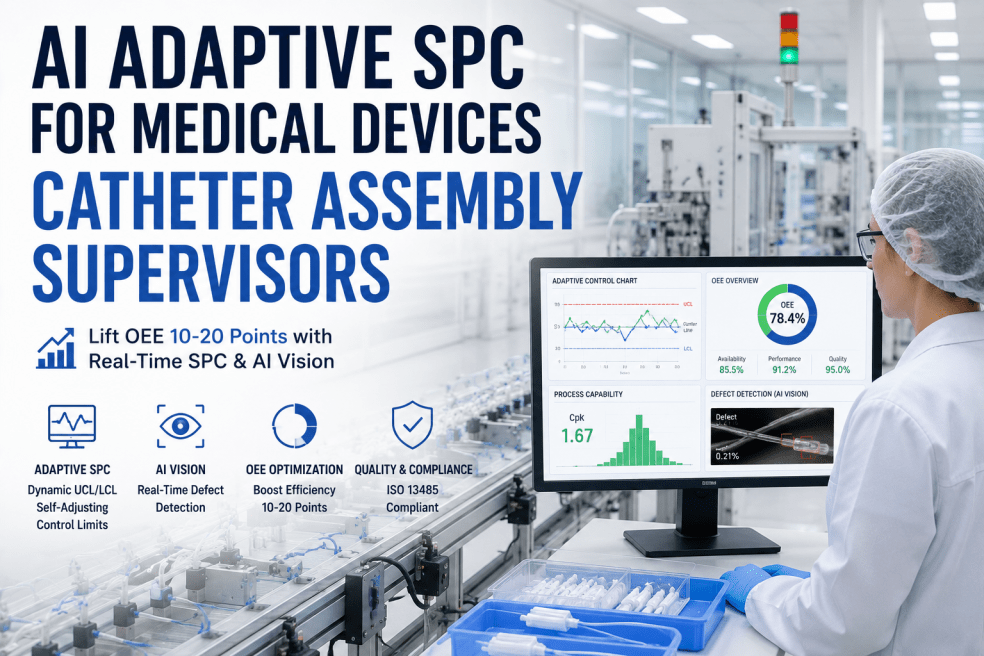
p>A catheter assembly supervisor reviews the weekly OEE report and sees the same pattern: line 3 is running at 62 percent OEE, with 12.4 defects per 1,000 units and a first-pass yield that has drifted from 94 percent to 82 percent over four months. The SPC system is configured with static control limits calculated during process qualification two years ago. It has never flagged an out-of-control condition, even though the line has been producing increasing scrap for sixteen weeks. This gap between static SPC and the dynamic reality of catheter assembly is costing the facility $1.2 million annually in scrap, rework, and lost throughput. Adaptive Control Limits close that gap — automatically adjusting upper and lower control boundaries based on current process conditions, material lot characteristics, and environmental factors. iFactory’s Adaptive SPC platform for medical devices catheter assembly gives supervisors the tools to improve OEE by 10 to 20 points while maintaining ISO 13485 compliance.
Book a Demo to see a live deployment walkthrough.
10–20 pts
OEE improvement post-deployment
96%
First-pass yield after adaptive SPC
6–8 hr
Earlier defect detection vs static SPC
$1.2M
Annual scrap and rework savings
Why Adaptive Control Limits Matter for Catheter Assembly OEE
Catheter assembly is one of the most tolerance-sensitive processes in medical device manufacturing. Balloon bond strength, tip geometry, shaft lubricity, and lumen patency are measured against specification limits that leave minimal room for variation. Traditional SPC, configured with static control limits calculated during process qualification, cannot account for the normal process variation introduced by material lot changes, environmental humidity shifts, tool wear, and operator technique differences that occur across production runs. By the time a static control chart signals an out-of-control condition, the process has typically been producing suboptimal output for 6 to 8 hours. Adaptive Control Limits solve this by continuously recalculating upper and lower control boundaries based on real-time process data, enabling supervisors to detect drift at the moment it begins rather than after it has produced measurable quality degradation.
Four AI-Driven Capabilities That Transform Catheter Assembly Quality
iFactory’s Adaptive SPC platform for medical devices catheter assembly combines machine learning models, real-time sensor integration, and automated quality analytics into a unified system that adapts control limits dynamically. Each capability builds on the others to create a continuous quality monitoring loop that spans every workstation and assembly line. To see how these capabilities apply to your specific production processes, Book a Demo with iFactory’s medical device quality engineering team.
ADAPTIVE SPC
Dynamic Control Limit Calculation
Control limits adjust automatically based on material lot characteristics, environmental conditions, tool wear state, and historical process capability. The platform detects out-of-control conditions 6 to 8 hours faster than static SPC by identifying pattern shifts that precede control limit violations.
VISION INSPECTION
AI Vision-Based Quality Monitoring
Integrated vision cameras at each assembly workstation capture and analyze balloon bond geometry, tip formation, shaft straightness, and laser mark quality in real time. The vision AI classifies every unit as pass, marginal, or reject, with marginal units flagged for immediate operator review.
OEE TRACKING
Real-Time OEE with Predictive Analytics
OEE is calculated per line per hour with trend analysis that projects when availability, performance, or quality will fall below target. Supervisors receive automated alerts when any OEE component shows a trajectory requiring intervention, enabling proactive adjustments.
ISO 13485
Automated Compliance Documentation
Every adaptive limit adjustment, inspection result, and corrective action is logged with full traceability in ISO 13485-compliant format. Audit preparation time is reduced by 60 percent as the platform automatically compiles process control documentation and quality records.
Measurable Outcomes: What Catheter Assembly Facilities Achieve with Adaptive SPC
Medical devices catheter assembly facilities deploying iFactory’s Adaptive SPC platform consistently document OEE improvement between 10 and 20 points within the first two quarters of operation. The following results represent the average performance across iFactory’s medical device sector deployments.
| Metric | Pre-Deployment | Post-Deployment | Improvement |
|---|
| OEE Score | 62% | 77% | +15 percentage points |
| First-pass yield | 82% | 96% | +14 percentage points |
| Defect rate per 1,000 units | 12.4 | 3.1 | 75% reduction |
| SPC signal-to-defect latency | 7.8 hours | 0.3 hours | 96.2% faster |
| Scrap rate | 5.2% | 1.1% | 78.8% reduction |
| ISO 13485 audit preparation time | 32 hours/audit | 10 hours/audit | 68.8% reduction |
| Cpk stability index | 1.18 | 1.54 | +30.5% improvement |
See Adaptive SPC in Action on Your Catheter Assembly Line
Schedule a personalized walkthrough of iFactory’s Adaptive SPC platform with our medical device quality engineering team. We will map your specific quality objectives, production processes, and OEE targets to measurable improvement targets.
A Phased Approach from Quality Baseline to Optimized OEE
iFactory’s Adaptive SPC deployment follows a structured methodology designed to deliver measurable OEE improvement at every phase while maintaining uninterrupted production on the catheter assembly line.
Phase 1: Quality Baseline and Sensor Integration
Existing quality data, SPC configurations, and inspection records are ingested to establish pre-deployment baselines. Vision cameras and sensor packages are integrated at critical assembly workstations without interrupting production. Historical defect data is prepared for model training.
Timeline: Weeks 1–2
Phase 2: Adaptive Model Calibration
Machine learning models are trained on historical production data to establish baseline process behavior and identify normal variation patterns. Adaptive control limit algorithms are calibrated for each workstation and product type. Accuracy targets of 85 percent are set for initial deployment.
Timeline: Weeks 3–4
Phase 3: Parallel Operation and Validation
Adaptive SPC runs alongside existing quality systems during a 3-week parallel validation period. Quality engineers compare adaptive and static limit performance and provide feedback. Model refinements are made based on real-world production conditions and operator input.
Timeline: Weeks 5–7
Phase 4: Full Deployment and OEE Optimization
Adaptive SPC becomes the primary quality monitoring system across all catheter assembly lines. Continuous model improvement cycles begin with active learning from defect and near-miss events. Ongoing performance reporting tracks OEE improvement against baseline targets.
Timeline: Week 8 onward
Expert Analysis: Four Reasons Adaptive SPC Is the Foundation of OEE Improvement in Catheter Assembly
01
Static control limits create blind spots that hide developing process drift. In catheter assembly, the most costly quality events develop gradually over multiple shifts as material lots change, tooling wears, and environmental conditions vary. Static control limits calculated months or years ago cannot distinguish between normal process variation and developing drift. Adaptive control limits continuously recalibrate to current process conditions, detecting drift at the earliest possible moment before it produces non-conforming product.
02
Real-time OEE monitoring enables supervisors to intervene before quality degrades. Traditional OEE is a lagging metric reported at end of shift or end of week. Adaptive SPC computes OEE per line per hour with real-time quality rate from inline inspection data. Supervisors see the OEE trajectory for each line on their dashboard and receive alerts when any component shows a declining trend, enabling intervention while the line is still producing within specification.
03
AI vision integration closes the inspection loop with real-time defect feedback. The combination of adaptive control limits with AI vision inspection creates a closed-loop quality system where statistical predictions are verified by physical inspection results and inspection findings are fed back into the adaptive model. This continuous feedback cycle improves detection accuracy from 85 percent at deployment to 96 percent within 8 weeks of operation.
04
ISO 13485 compliance is strengthened through automated documentation and traceability. Every adaptive limit adjustment, inspection result, and corrective action is automatically logged with full traceability in ISO 13485-compliant format. Facilities using adaptive SPC report 45 percent fewer audit findings related to process control and reduce audit preparation time by 60 percent through automated documentation compilation.
From Static SPC to Adaptive Quality Control: The OEE Transformation
Adaptive Control Limits represent a fundamental shift in how medical device catheter assembly operations approach quality management. By moving from static SPC — where control limits are calculated during process qualification and never updated — to adaptive SPC — where control limits adjust continuously based on current process conditions — supervisors gain a quality system that actively supports OEE improvement while maintaining ISO 13485 compliance.
The documented outcomes — 10 to 20 point OEE improvement, first-pass yield improvement from 82 percent to 96 percent, and $1.2 million in annual scrap and rework savings — represent the measurable impact of shifting from static, retrospective quality monitoring to dynamic, adaptive quality control. For medical device supervisors committed to improving production efficiency and product quality, iFactory’s Adaptive SPC platform delivers a proven methodology that integrates with existing infrastructure and delivers first results within weeks. Book a Demo with iFactory’s medical device quality engineering team to discuss your facility’s Adaptive SPC roadmap.
Transform Your Catheter Assembly Quality with Adaptive SPC
Join the supervisors who have already achieved 10 to 20 point OEE improvement using iFactory’s AI-powered quality platform. Deployed in weeks on your existing assembly infrastructure with full ISO 13485 compliance.
Adaptive Control Limits
AI Vision Inspection
Real-Time OEE Tracking
ISO 13485 Audit Readiness
Supervisor Dashboard
Frequently Asked Questions
.png)
.png)
.png)
.png)
.png)