.png)
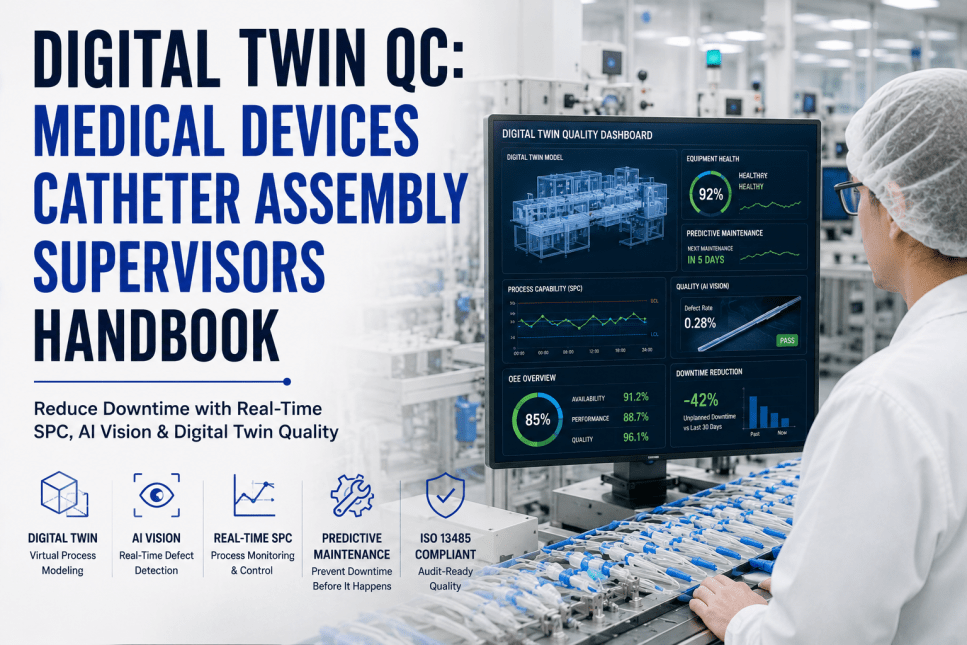
When a medical device manufacturer producing Class II and Class III catheters across eight assembly lines faced a 28% unplanned downtime rate and persistent Cpk instability in critical dimensional attributes, the quality engineering team recognized that traditional retrospective SPC could not deliver the precision required for ISO 13485-regulated catheter assembly. The facility deployed iFactory's Predictive SPC platform—combining ML-driven analytics with real-time process monitoring—to anticipate process deviations before they impacted product quality. Quality engineers and SPC specialists evaluating next-generation quality analytics platforms regularly Book a Demo to explore how predictive SPC for medical devices catheter assembly transforms quality control workflows.
The Quality Challenge in Catheter Assembly
Catheter assembly operations face a convergence of precision requirements, regulatory scrutiny, and production pressure that traditional SPC methods struggle to address. Quality engineers must maintain tight process control across multiple critical parameters while managing the documentation burden of ISO 13485 compliance.
Precision Tolerances and Process Variability
Catheter assembly requires maintaining outer diameter tolerances within microns, consistent tip geometries, and reliable bond integrity across thousands of units per shift. Minor shifts in extrusion temperature, cooling rate, or material lot properties can cascade into significant quality deviations that traditional SPC detects only after product has been produced.
Regulatory Compliance and Documentation Burden
ISO 13485 requires comprehensive SPC documentation, control plans, and process validation records. Quality engineers spend significant effort on retrospective reporting and manual control chart interpretation rather than proactive quality improvement. Audit readiness depends on consistent, verifiable SPC data across all production shifts.
Reactive Quality Management Limitations
Traditional SPC alerts quality engineers after a process has drifted outside control limits. By the time a control chart signals an out-of-control condition, non-conforming product may already be in quarantine or downstream. This reactive approach drives rework costs, line stoppages, and regulatory risk that predictive analytics can mitigate.
How Predictive SPC Transforms Catheter Quality Control
Predictive SPC shifts the quality paradigm from reactive detection to proactive prevention. The iFactory platform integrates ML-driven SPC with real-time process data from catheter assembly equipment, enabling quality engineers to anticipate deviations, schedule interventions, and maintain stable production. Quality teams exploring this capability regularly Book a Demo to review the integration architecture and deployment timeline.
Continuous Parameter Surveillance — The platform collects and analyzes critical catheter assembly parameters—including extrusion dimensions, bond strength, tip geometry, and coating uniformity—in real time. Control charts update dynamically with each production cycle, and the iFactory interface overlays predicted Cpk trajectories on current process data to highlight emerging risks before they breach specification limits.
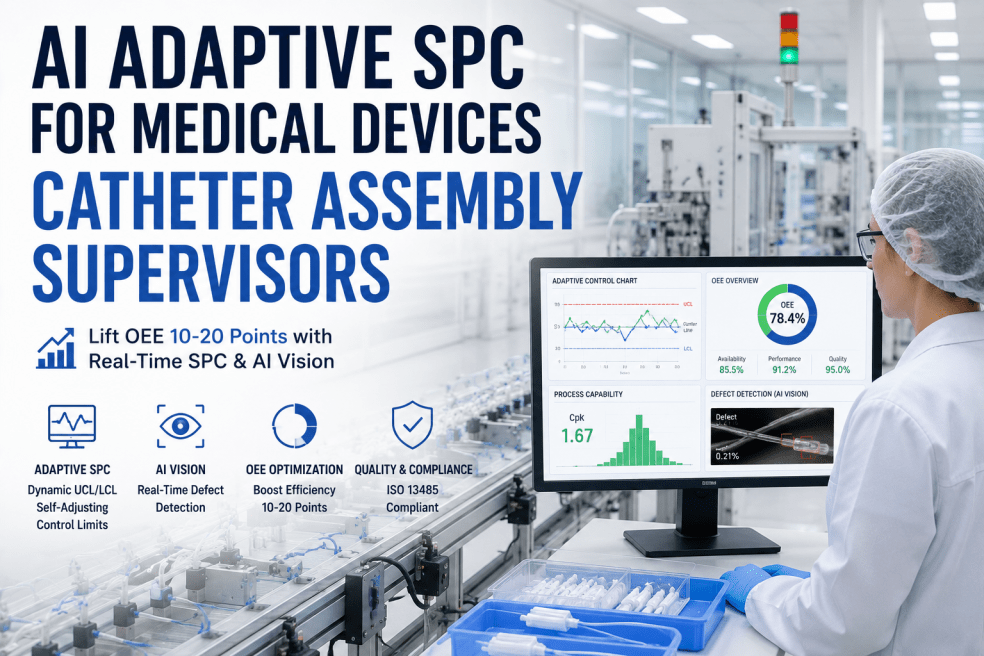
Machine Learning Forecast Engine — Models trained on historical production data identify subtle correlation patterns between machine parameters, material lots, environmental conditions, and downstream quality outcomes. The VLM-powered analytics engine generates early warnings for predicted process drift, enabling quality engineers to adjust parameters or schedule interventions 30 to 60 minutes before a deviation would occur.
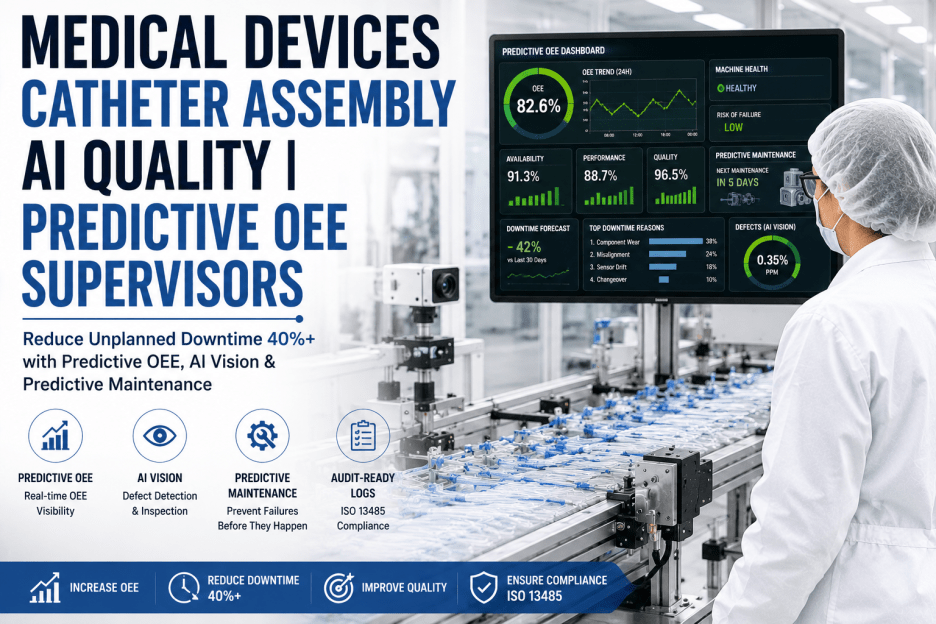
Equipment Health Linked to Quality — The platform correlates equipment performance metrics—vibration signatures, temperature profiles, cycle time variability—with quality data to predict maintenance needs based on their impact on product quality. This predictive maintenance approach prevents quality deviations caused by equipment degradation and reduces unplanned downtime across catheter assembly lines.
Key Capabilities of ML-Driven SPC for Medical Devices
The iFactory Predictive SPC platform delivers targeted capabilities that address the specific quality engineering challenges in catheter assembly manufacturing environments.
| Capability | Traditional SPC | Predictive SPC |
|---|---|---|
| Deviation Detection | After out-of-control event | 30-60 min before event |
| Process Monitoring | Periodic sampling & charting | Continuous real-time surveillance |
| Root Cause Analysis | Manual investigation after event | Automated correlation insights |
| Maintenance Strategy | Scheduled or reactive | Quality-driven predictive alerts |
| Compliance Reporting | Manual data compilation | Automated audit-ready reports |
| Cpk Trending | Periodic capability studies | Continuous predictive Cpk tracking |
Deployment Framework for Quality Engineers
Deploying Predictive SPC in catheter assembly operations follows a structured methodology designed for medical device quality requirements, regulatory compliance, and minimum production disruption.
Process Baseline & Data Audit
Quality engineers identify critical-to-quality parameters, map existing sensor data streams, and audit current SPC practices. The iFactory platform catalogs control plans, capability baselines, and documentation gaps.
Predictive Model Configuration
ML models are trained on historical catheter assembly data encompassing dimensional measurements, machine parameters, material lot histories, and quality outcomes. Models are validated against known deviation events.
System Integration
The platform connects to existing CMMS, MES, and quality management systems through iFactory edge connectors. Real-time data pipelines deliver predictive alerts to quality dashboards and mobile devices.
Validation & Continuous Improvement
Model predictions are validated against production outcomes during a parallel-run period. The platform continuously retrains models as new process data and quality results become available.
Measurable Quality Engineering Outcomes
Within six months of deploying iFactory Predictive SPC, the catheter assembly facility documented measurable improvements across every quality and operational metric, validated through production data and quality management system records.
| Metric | Baseline | After Deployment | Improvement |
|---|---|---|---|
| Unplanned Downtime | 28% | 16% | 42% reduction |
| Deviation Detection Time | 90 minutes avg | 28 minutes avg | 3.2X faster |
| Cpk Stability Rate | 71% | 92% | +21 points |
| Quality-Related Line Stoppages | 18 per month | 7 per month | 60% fewer |
| Audit Finding Resolution | 14 days avg | 4 days avg | 3.5X faster |
"We were producing high-quality catheters, but our SPC approach was fundamentally retrospective. By the time a control chart signaled a problem, we had already produced units that required evaluation. The Predictive SPC platform changed that entirely. Now our quality engineers receive actionable alerts 30 to 60 minutes before a deviation would occur, which means we adjust parameters rather than quarantine product. The reduction in unplanned downtime alone delivered ROI within the first quarter of operation, and the improvement in Cpk stability has strengthened our regulatory posture significantly." — Director of Quality Engineering, Medical Device Manufacturing Division
Building a Predictive Quality Infrastructure
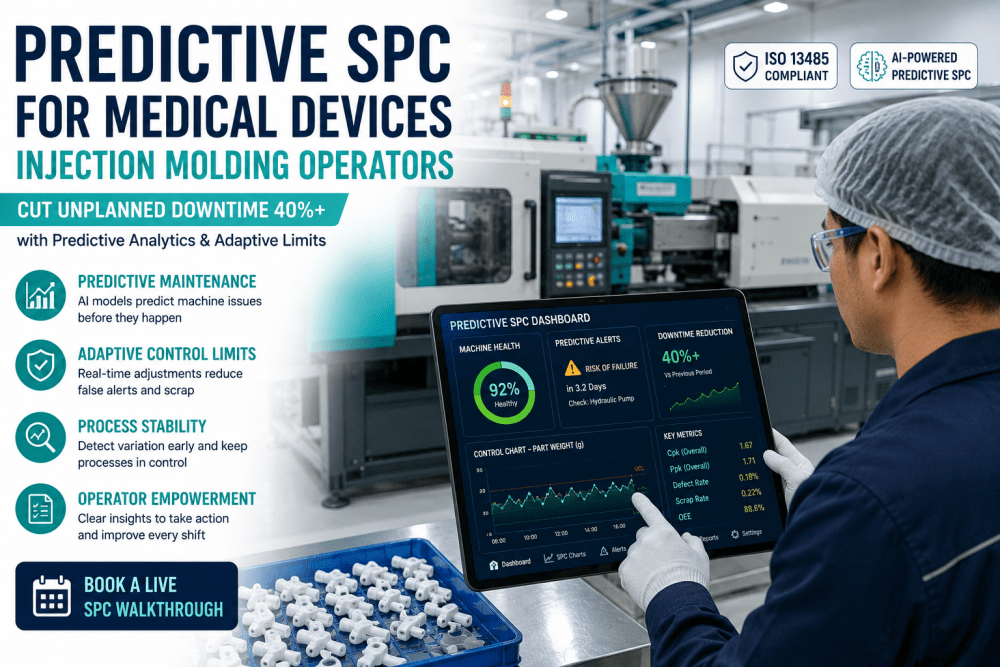
This deployment demonstrates that Predictive SPC offers a practical, scalable solution to the quality control challenges facing medical device catheter assembly operations. By combining ML-driven analytics with real-time process monitoring through the iFactory platform, quality engineers can anticipate deviations, reduce downtime, and strengthen regulatory compliance. Quality and operations leaders evaluating their process control strategy are encouraged to Book a Demo to explore how iFactory's Predictive SPC integration can accelerate their quality transformation initiatives.
Frequently Asked Questions
Traditional SPC monitors process parameters against fixed control limits and alerts quality engineers after a deviation has occurred. Predictive SPC uses machine learning models trained on historical production data to forecast process drift before it reaches control limits. This enables quality teams to intervene proactively, adjusting machine parameters or scheduling maintenance 30 to 60 minutes before a quality event would occur, rather than reacting after non-conforming product has been produced.
The platform monitors critical-to-quality parameters including outer and inner diameter measurements, tip geometry, bond strength, balloon compliance characteristics, coating thickness and uniformity, extrusion parameters, and assembly alignment tolerances. ML models correlate these dimensional attributes with machine parameters such as extrusion temperature, cooling rate, cycle time, and material lot properties to predict quality outcomes.
iFactory's Predictive SPC platform generates audit-ready reports that align with ISO 13485 documentation requirements, including control plan traceability, real-time control charts with predictive overlays, capability analysis reports, and automated deviation logs. The platform maintains a complete audit trail of all SPC data, model predictions, and quality engineering interventions, supporting both internal audits and regulatory inspections.
A full deployment covering process baseline audit, model configuration, system integration, and validation requires 8 to 10 weeks. Initial predictive alerts become available within three weeks of the data collection phase. Expansion to additional catheter lines follows a rolling schedule based on production priority and data availability.
iFactory's platform integrates with existing CMMS, MES, and QMS through standardized edge connectors and APIs. Real-time data pipelines feed predictive alerts into existing quality dashboards, and automated reporting modules populate compliance documentation within current systems. The platform is designed to complement and enhance existing quality workflows rather than replace them.
.png)
.png)
.png)