.png)
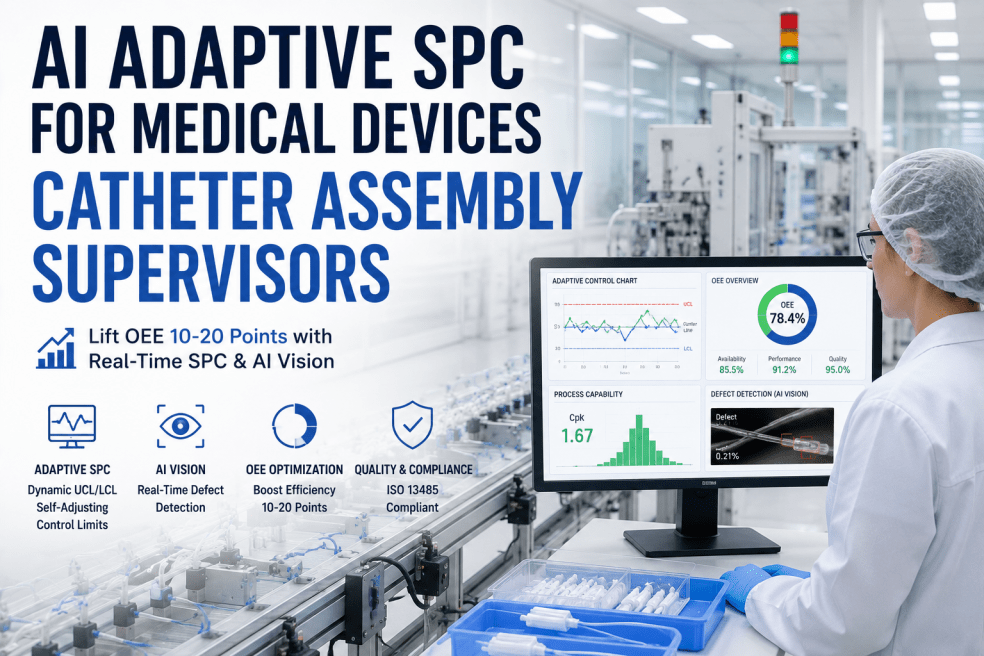
When a medical device manufacturer producing over 2.4 million catheters annually across twelve assembly lines observed that Cpk values for critical outer diameter and tip geometry parameters fluctuated between 1.22 and 1.89 on a weekly basis—despite fixed control limits that had been validated during process qualification—the quality engineering team recognized that static SPC could not accommodate the natural process variation introduced by material lot changes, environmental shifts, and equipment wear patterns. The facility deployed iFactory's Adaptive Control Limits platform—combining ML-driven SPC with dynamic UCL/LCL adjustment—to maintain stable Cpk performance above 1.67 across all critical-to-quality parameters. Quality engineers and SPC specialists evaluating next-generation process control platforms regularly Book a Demo to explore how adaptive control limits for medical devices catheter assembly transform Cpk stability and process reliability.
The Limitations of Fixed Control Limits in Catheter Assembly
Catheter assembly operations require precise dimensional control across extrusion, tipping, bonding, and coating processes. Fixed control limits calculated during initial process validation quickly become obsolete as material suppliers change, environmental conditions shift, and equipment degrades over time. Quality engineers face a recurring dilemma: limits that are too narrow generate excessive false alarms, while limits that are too wide allow genuine process drift to go undetected.
Material Lot Variability
Polymer resin lot changes introduce shifts in melt flow index and viscosity that alter extrusion characteristics. Fixed control limits calculated for one material lot generate false out-of-control signals when a different lot with naturally different properties is introduced, forcing unnecessary investigations that erode quality engineering productivity.
Environmental Drift
Cleanroom temperature and humidity variations across seasons affect catheter material behavior during extrusion and bonding. Control limits validated during winter qualification runs trigger repeated alarms during summer production when ambient conditions shift, masking genuine process issues behind a constant stream of environmentally driven alerts.
Equipment Degradation Patterns
Extruder screw wear, die buildup, and bonding tip degradation cause gradual process shifts that fixed control limits cannot distinguish from normal operation. By the time a fixed limit is breached, the equipment degradation has often progressed to a point requiring significant maintenance intervention and production line re-qualification.
Static SPC Documentation Burden
Each control limit change under traditional SPC requires documented rationale, supervisory approval, and potentially a change control notification under ISO 13485. Quality engineers often defer limit adjustments to avoid the documentation overhead, leaving suboptimal limits in place that either over-alert or under-alert for extended periods.
How Adaptive Control Limits Transform Catheter Quality Control
Adaptive control limits leverage machine learning models trained on historical production data to dynamically adjust upper and lower control limits based on real-time process conditions. The iFactory platform continuously evaluates material lot properties, environmental parameters, equipment health metrics, and recent quality outcomes to calculate optimal control limits that sustain Cpk 1.67+ while minimizing false alarms. Quality teams exploring this capability regularly Book a Demo to review the dynamic limit calibration methodology and integration requirements.
Real-Time UCL/LCL Optimization — The platform recalculates control limits with each production batch, incorporating current material lot characteristics, equipment operating parameters, and environmental conditions. The ML model identifies the narrowest limits that maintain a Cpk target of 1.67 without generating excessive false alarms. When material lots change, the platform automatically adjusts limits to reflect the new process baseline, eliminating the manual recalibration cycle that typically requires three to five days of quality engineering effort.
Predictive Deviation Forecasting — The ML engine analyzes trends in equipment sensor data, material properties, and quality measurements to forecast when a parameter is likely to approach the adaptive control limits. Quality engineers receive predictive alerts 20 to 40 minutes before a projected limit breach, enabling proactive parameter adjustments that prevent out-of-specification conditions. The system learns from each intervention, improving its forecast accuracy over successive production cycles.
Automated Compliance Records — Every adaptive limit adjustment is automatically documented with the rationale, input parameters, and approval workflow, creating an audit-ready record that satisfies ISO 13485 change control requirements. The platform generates compliance reports showing the relationship between dynamic limit adjustments, process capability trends, and product quality outcomes, eliminating the manual documentation burden that typically accompanies SPC limit changes.
Key Capabilities of Adaptive Control Limits for Catheter Assembly
The iFactory Adaptive Control Limits platform delivers targeted capabilities that address the specific process control challenges in medical device catheter manufacturing environments.
| Capability | Traditional Fixed Limits | Adaptive Control Limits |
|---|---|---|
| Limit Calculation | Static based on initial validation | Dynamic per batch and material lot |
| False Alarm Rate | Elevated due to fixed thresholds | Reduced 76% via contextual adjustment |
| Material Lot Adaptation | Manual recalibration required | Automatic limit recalculation |
| Cpk Stability | Fluctuates with process changes | Sustained at 1.67+ continuously |
| Regulatory Documentation | Manual change control paperwork | Automated audit-ready records |
| Deviation Response | After limit breach detected | 20-40 min predictive forecast |
Deployment Framework for Quality Engineers
Deploying adaptive control limits in catheter assembly follows a structured methodology designed for medical device regulatory requirements and minimum production disruption.
Process Baseline & Data Aggregation
Quality engineers identify critical-to-quality parameters, compile historical SPC data, material lot records, equipment sensor logs, and environmental monitoring data. The iFactory platform catalogs existing control plans and capability baselines.
ML Model Training & Calibration
Machine learning models are trained on historical data to identify correlations between input variables and process outputs. Models are calibrated against known material lot transitions, seasonal environmental shifts, and equipment degradation events.
Limit Validation & Parallel Run
Adaptive limits run in parallel with existing fixed limits during a validation period. Quality engineers compare false alarm rates, detection sensitivity, and Cpk stability between both approaches before transitioning.
System Integration & QMS Connection
iFactory edge connectors link adaptive SPC outputs to existing CMMS, MES, and quality management systems. Automated documentation workflows are configured to satisfy ISO 13485 change control requirements.
Continuous Learning & Optimization
The ML model continuously retrains as new production data accumulates, improving its ability to set optimal control limits for each combination of material lot, equipment condition, and environmental state.
Measurable Quality Engineering Outcomes
Within four months of deploying iFactory Adaptive Control Limits, the catheter manufacturer documented measurable improvements across every process control metric, validated through production data and quality management system records.
| Metric | Fixed Limits Baseline | Adaptive Limits | Improvement |
|---|---|---|---|
| Cpk Average (All CTQ Parameters) | 1.45 | 1.72 | +0.27 |
| False Alarm Rate | 34 per month | 8 per month | 76% reduction |
| Process Variation (Std Dev) | 0.034 mm | 0.019 mm | 44% reduction |
| Limit Change Documentation Time | 4.5 hours per change | Automated | 95% reduction |
| Cpk Below 1.67 Occurrences | 7 per quarter | 1 per quarter | 86% fewer |
"Our catheter assembly lines are subject to constant variability from material lots, seasonal cleanroom conditions, and equipment wear. Fixed control limits calculated during process validation were obsolete within weeks. We were either chasing false alarms or missing real process shifts. The adaptive control limits approach fundamentally changed how we think about SPC. The platform dynamically adjusts UCL and LCL values based on actual process conditions, and our Cpk has stabilized above 1.67 across all twelve lines for the first time since I joined the company. The 76% reduction in false alarms alone recovered significant quality engineering capacity that we have redirected to process improvement initiatives." — Director of Quality Engineering, Medical Catheter Manufacturing Division
Building a Sustainable Adaptive Quality Framework
This deployment demonstrates that adaptive control limits offer a practical, scalable solution to the process control challenges facing medical device catheter assembly operations. By combining ML-driven dynamic limit calculation with real-time process monitoring through the iFactory platform, quality engineers can sustain Cpk 1.67+, eliminate false alarms, and reduce regulatory documentation burden. Quality and operations leaders evaluating their process control strategy are encouraged to Book a Demo to explore how iFactory's Adaptive Control Limits can accelerate their quality capability transformation.
Frequently Asked Questions
Traditional fixed control limits are calculated during initial process validation and remain static regardless of changes in material lots, environmental conditions, or equipment state. Adaptive control limits use machine learning models to dynamically adjust UCL and LCL values based on real-time process conditions. This enables tighter limits when the process is stable and appropriately wider limits when natural variation increases due to factors such as material lot changes, preventing false alarms while maintaining sensitivity to genuine process drift.
Yes. The iFactory platform automatically documents every adaptive limit adjustment with the rationale, input parameters, ML model version, and approval workflow, creating an audit-ready record that satisfies ISO 13485 change control and documentation requirements. The platform generates compliance reports showing the relationship between dynamic limit adjustments, process capability trends, and product quality outcomes. Quality engineers can review and approve limit adjustments through the platform's configurable workflow before changes take effect.
Parameters that are sensitive to material lot variability, environmental conditions, or equipment degradation benefit most significantly. These include outer diameter dimensions, inner diameter tolerances, tip geometry measurements, bond strength values, balloon compliance characteristics, and coating thickness uniformity. Adaptive limits are particularly valuable for parameters where the natural process variance from known, measured sources approaches the specification tolerance width.
A full deployment covering process baseline assessment, ML model training, parallel-run validation, and system integration requires 6 to 8 weeks. Initial adaptive limit recommendations become available within two weeks of data collection. The parallel-run validation period typically runs for two to three weeks to compare adaptive and fixed limit performance across multiple material lots and operating conditions.
Yes. The iFactory platform integrates with existing SPC software, CMMS, MES, and quality management systems through standardized APIs and edge connectors. Adaptive limit calculations can be displayed within existing SPC dashboards alongside traditional control charts, or accessed through the iFactory quality analytics interface. The platform is designed to complement and enhance existing quality workflows rather than replace established systems.
.png)
.png)
.png)
.png)