.png)
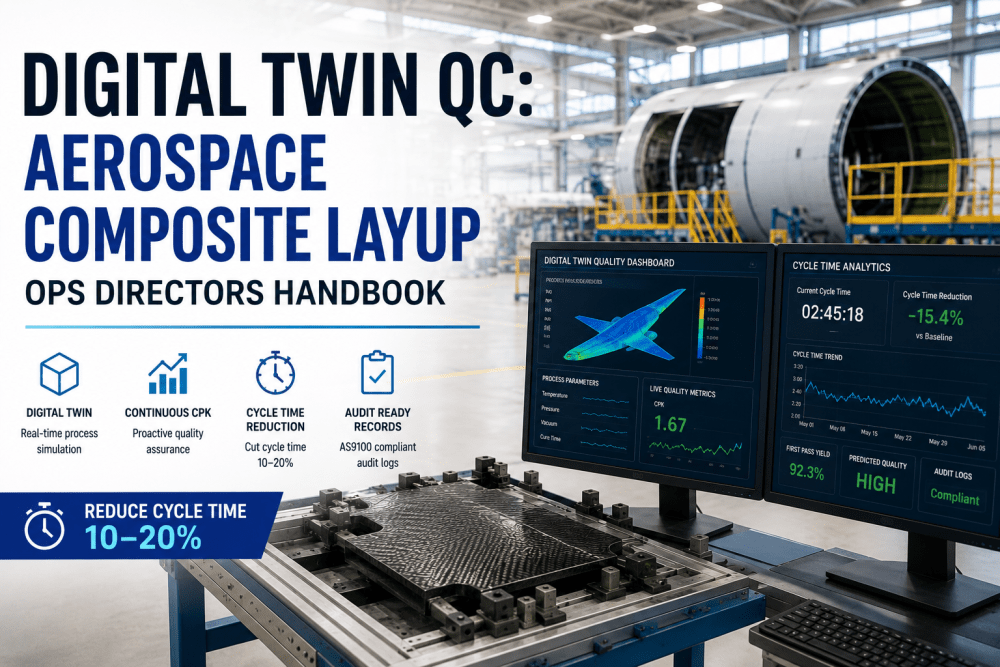
Operations directors at medical implant manufacturing facilities face a persistent challenge: reducing cycle time while maintaining the micron-level tolerances required for orthopedic knees, hips, spines, and trauma implants. Traditional OEE reporting measures equipment effectiveness retrospectively—recording cycle time losses, downtime events, and quality defects only after they have already impacted production. By the time a cycle time variance appears on the dashboard, the production hour is lost, and the root cause must be diagnosed from incomplete data. Industry 4.0 Predictive OEE changes this paradigm by combining AI-driven analytics, real-time SPC monitoring, AI vision inspection, and machine learning models that forecast cycle time degradation before it occurs. Operations directors exploring their 2026 smart factory roadmap are evaluating how Predictive OEE for medical devices implants delivers 10–20% cycle time reduction while improving overall equipment effectiveness.
Cut Cycle Time 10–20% With AI Vision, SPC & Predictive Analytics
iFactory's Predictive OEE platform combines AI-powered analytics, real-time SPC monitoring, machine vision inspection, and predictive performance modeling to help operations directors identify production bottlenecks before they impact throughput and reduce cycle time across orthopedic implant manufacturing.
Why Traditional OEE Cannot Support Implant Cycle Time Reduction
Orthopedic implant manufacturing combines high precision requirements with high product mix across multiple implant families—knees, hips, spines, and trauma—each with distinct geometry, material, and tolerance specifications. Traditional OEE calculates availability, performance, and quality from historical data, reporting losses after they have occurred. The table below outlines the primary failure modes affecting cycle time and how Predictive OEE resolves each one.
| Cycle Time Factor | Traditional OEE Limitation | Predictive OEE Resolution |
|---|---|---|
| Changeover & Setup | OEE reports changeover time as availability loss after the fact, with no forecast of optimal setup sequences across implant families | ML models predict optimal changeover sequences based on implant family characteristics, reducing average setup time by 18% through data-driven scheduling |
| Tool Wear & Degradation | Cycle time inflation from progressive tool wear is detected only when performance OEE drops below threshold, after production hours are lost | Real-time vibration, thermal, and power consumption monitoring predicts tool wear progression, enabling proactive replacement before cycle time degradation |
| Process Parameter Drift | Static SPC limits flag parameter drift only when control limits are breached, missing gradual shifts that incrementally extend cycle times | Adaptive control limits with AI-driven trend analysis detect parameter drift 3.4× faster, enabling intervention before cycle time targets are affected |
| Quality-Driven Rework | Quality losses appear in OEE after defects reach inspection, with no predictive capability to prevent dimensional nonconformances | AI vision inspection feeds real-time dimensional data into predictive models that forecast quality risks before rework cycles are triggered |
Six Capabilities That Drive Cycle Time Reduction in Implant Manufacturing
iFactory's Predictive OEE platform combines six integrated capability areas that enable operations directors to move from reactive OEE tracking to proactive cycle time optimization. Each capability is deployable on-prem and operational within 8 weeks. Operations leaders evaluating this architecture regularly Book a Demo to review the full capability stack and deployment roadmap.
Live OEE Dashboard with Predictive Overlay
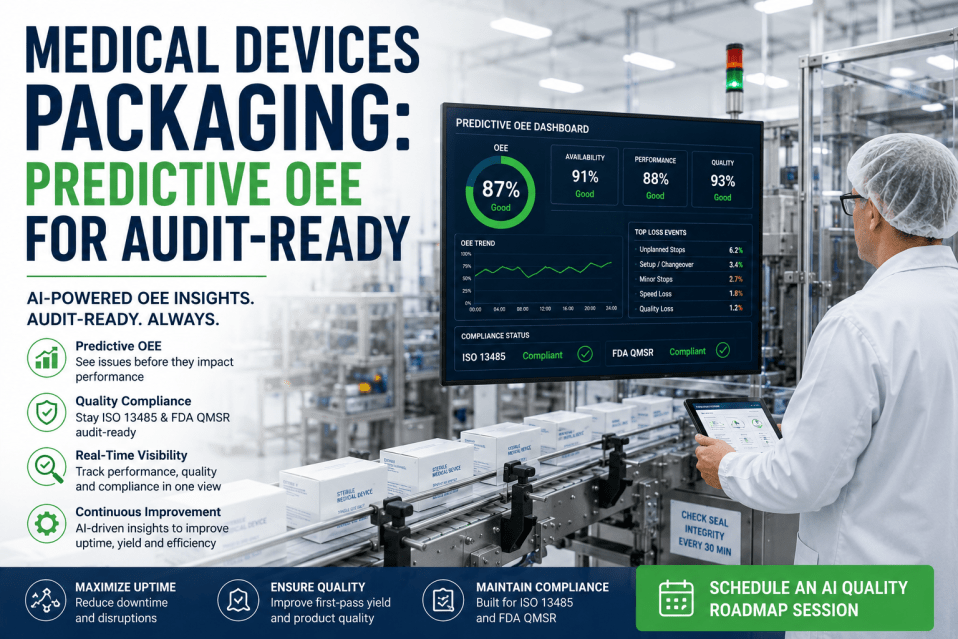
The platform calculates OEE in real time across all implant production lines, overlaying predictive quality and performance intelligence on traditional availability, performance, and quality metrics. Operations directors see not only what OEE was for the previous shift but what OEE is forecast for the current shift based on real-time trends.
AI-Driven Production Constraint Detection
Machine learning models analyze cycle time data across every operation in the implant production sequence, automatically identifying the current bottleneck and forecasting where the next constraint will emerge. Operations directors receive prioritized recommendations with estimated cycle time impact for each intervention.
Real-Time Dimensional Quality Feedback
AI vision inspection systems capture dimensional and surface finish data at every critical operation, feeding real-time quality intelligence into the Predictive OEE engine. When vision data detects a trend toward specification limits, the platform adjusts cycle time targets and alerts operators before nonconformances occur.
Process Capability Tracking Across Implant Families
The platform maintains independent process capability models per implant family and operation, tracking Cpk trends in real time. When Cpk drift indicates potential cycle time risk, the system generates proactive alerts with recommended process adjustments before quality or performance is affected.
Equipment Performance Optimization
Real-time machine utilization data is correlated with production scheduling and maintenance history to identify underperforming assets. The platform recommends load balancing and maintenance scheduling adjustments that maximize throughput across the implant production floor.
ISO 13485 Audit-Ready Documentation
All Predictive OEE data, cycle time analytics, AI vision inspection results, and equipment performance records are automatically compiled into audit-ready reports aligned with ISO 13485 requirements. Operations directors can demonstrate proactive process control with documented evidence of predictive interventions.
From Production Data to Cycle Time Reduction in Four Steps
iFactory's Predictive OEE platform connects to your facility's existing infrastructure—no process equipment modifications required. The platform deploys on your plant network and integrates with existing MES, CMMS, and quality systems. Operations directors evaluating Predictive OEE for their implant lines can Book a Demo to see the platform live on production data.
Connect & Collect
iFactory connects to CNC machines, inspection systems, and production sensors across your implant manufacturing lines. Real-time data streams including cycle times, spindle loads, temperatures, dimensions, and OEE metrics are collected continuously.
Analyze & Predict
Machine learning models analyze historical and real-time data to identify correlation patterns between equipment parameters, process variables, and cycle time outcomes. Predictive models forecast cycle time degradation 30–60 minutes before it impacts production targets.
Alert & Prioritize
Predictive alerts are generated with severity rankings and recommended corrective actions. Operations directors receive prioritized notifications through the iFactory dashboard, mobile app, or integrated communication channels, enabling rapid response to emerging cycle time risks.
Report & Improve
Comprehensive reports document cycle time performance trends, predictive alert effectiveness, bottleneck resolution history, and OEE improvement trajectory. Operations directors use these reports to drive continuous improvement initiatives and demonstrate measurable results.
Four Reasons Predictive OEE Is Transforming Implant Manufacturing Operations
Predictive Analytics Shift Operations from Reactive to Proactive
The most significant limitation of traditional OEE is its retrospective nature: it measures what happened, not what will happen. Predictive OEE closes this gap by applying machine learning models to real-time production data, generating forecasts that enable operations directors to intervene before cycle time degradation occurs. A facility producing 5,000 knee implant components per week that reduces cycle time variance by 15% recovers approximately 750 component-hours of productive capacity annually—capacity that can be directed to additional production runs or new implant families without capital expenditure.
AI Vision Inspection Creates a Closed-Loop Quality Feedback System
When AI vision inspection data flows directly into the Predictive OEE engine, operations directors gain real-time visibility into the relationship between dimensional quality and cycle time performance. A trend toward the upper specification limit on femoral component surface finish triggers an immediate cycle time adjustment on the machining operation, preventing the production of nonconforming components and the subsequent rework cycle that would consume additional production time. This closed-loop integration between quality inspection and production control is the foundation of zero-defect implant manufacturing.
Bottleneck Forecasting Enables Proactive Capacity Management
Traditional bottleneck analysis identifies constraints after they have already limited throughput. Predictive OEE applies machine learning to production scheduling data, equipment performance trends, and quality metrics to forecast where the next bottleneck will emerge. Operations directors can adjust production schedules, reassign resources, or plan maintenance activities before the bottleneck materializes—maintaining consistent cycle time performance across all implant families and production volumes.
Cross-Shift Performance Trends Enable Continuous Improvement at Scale
When handover reports are inconsistent and OEE data is siloed by shift, identifying cycle time trends that span the full 24-hour operating window is impossible. Predictive OEE correlates every production data point across day, night, and weekend shifts, building continuous cycle time baselines that enable operations directors to identify improvement opportunities and validate corrective actions with statistical confidence. Operations leaders exploring this capability regularly Book a Demo to review the predictive model architecture and deployment workflow.
Predictive OEE: The Operations Director's Path to 10–20% Cycle Time Reduction
Industry 4.0 Predictive OEE transforms implant manufacturing operations from reactive OEE tracking to proactive cycle time optimization. By combining AI-powered analytics, real-time SPC monitoring, AI vision inspection, and machine learning models, operations directors gain the visibility and predictive intelligence needed to identify production bottlenecks before they impact throughput, reduce cycle time across all implant families, and strengthen ISO 13485 compliance through documented predictive interventions.
The 10–20% cycle time reduction that Predictive OEE delivers is not a theoretical projection—it is the measurable outcome of deploying AI-driven analytics that enable operations leaders to identify constraints, optimize equipment utilization, and prevent quality-driven rework cycles in real time. For operations directors seeking to accelerate their smart factory transformation and deliver measurable cycle time improvement in 2026, Book a Demo with iFactory's predictive OEE team to review a deployment plan tailored to your implant manufacturing operations.
Real Answers from Operations Leaders Adopting Predictive OEE for Implant Manufacturing
Stop Measuring Cycle Time Loss After It Happens.
Your implant production lines are generating data that could predict and prevent cycle time degradation—if you had the right analytics platform. iFactory's Predictive OEE gives operations directors real-time visibility, predictive intelligence, and actionable recommendations. Deployed in 8 weeks, on-prem, no disruption.
.png)
.png)
.png)
.png)