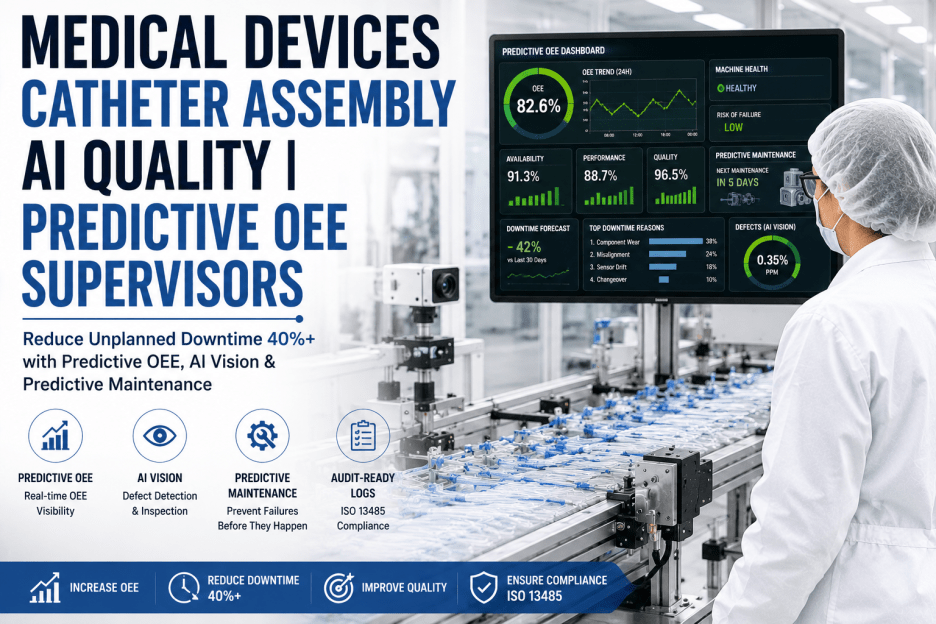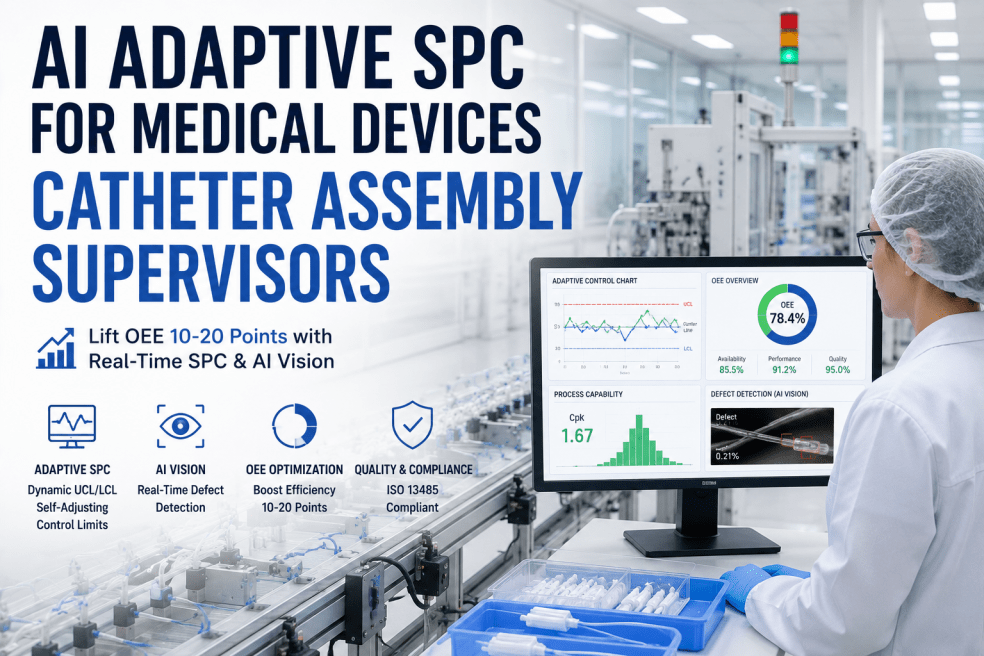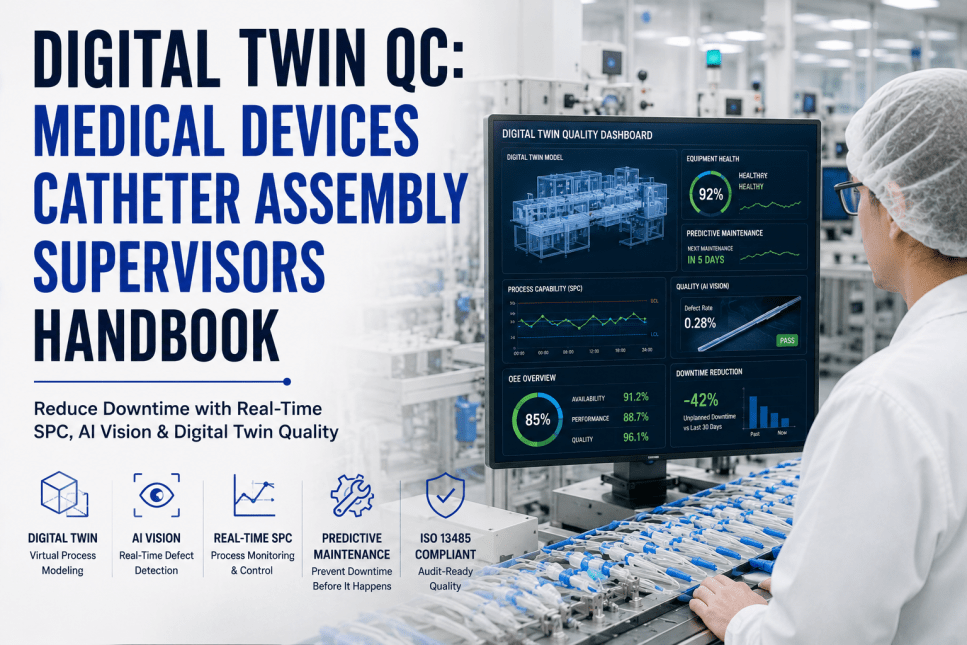
A catheter assembly supervisor receives an alert at 2:00 PM that line 4 has been producing balloon-bond assemblies with sub-optimal tip geometry since the 9:00 AM shift change. The 1-in-50 quality check caught the first non-conforming unit at 11:30 AM, but by then six additional assemblies had moved to downstream stations. This five-hour detection gap is not unusual — it is the baseline for catheter assembly operations relying on manual sampling and end-of-line quality gates. Digital Twin Quality eliminates this latency by creating a real-time virtual replica of every assembly station, simulating optimal performance parameters, and comparing every measurement against the digital model before the assembly proceeds. iFactory’s Digital Twin Quality platform enables catheter assembly supervisors to reduce unplanned downtime by 40% or more, improve equipment reliability, and maintain ISO 13485-compliant production records automatically.
The Unplanned Downtime Challenge in Catheter Assembly Cleanrooms
Catheter assembly depends on precision equipment — tipping machines, bonders, laser markers, balloon formers — where even minor calibration drift or temperature fluctuation produces downstream quality defects. Traditional quality monitoring relies on manual end-of-shift data entry, operator-reported downtime codes, and 1-in-50 sampling inspection. By the time the supervisor reviews the OEE report the following morning, the production loss has already occurred and the root cause is often obscured by incomplete or inaccurate operator entries.
The gap is not data availability. PLCs, sensors, and vision systems generate thousands of data points per minute across every catheter assembly line. The gap is latency — the time between an equipment state change and the supervisor’s awareness of that change. In catheter assembly, that latency averages 3 to 5 hours for critical parameters such as bonder temperature, tipping force, and laser power. In that window, a single drifting station can produce hundreds of non-conforming units. Digital Twin Quality closes this gap by simulating every assembly parameter in real time and alerting the supervisor at the moment a deviation is detected — not hours later at final inspection. Book a Demo to see the Digital Twin Quality architecture for your cleanroom lines.
Digital Twin Quality Architecture for Catheter Assembly Operations
Digital Twin Quality differs from traditional quality control in a fundamental way: instead of measuring the output and sorting good from bad, it creates a real-time virtual model of every assembly station, simulates the optimal parameter envelope for each product serial number under current conditions, and compares every measurement against that simulation before the assembly proceeds to the next station. The digital twin receives data from machine vision cameras, torque sensors, and dimensional measurement systems at tipping, bonding, balloon forming, laser marking, and inspection stations — and compares every reading against the simulated optimal value for that specific serial number under current tool wear, material lot, and environmental conditions.
| Capability Dimension | Traditional Quality Control | Digital Twin Quality | Impact |
|---|---|---|---|
| Detection Timing | End-of-line final inspection | Real-time per-station simulation | Prevents defect propagation |
| Inspection Coverage | Sampling — 1 per 50 units | 100% inline — every unit, every station | Eliminates sampling gaps |
| Root Cause Identification | Manual investigation — 3 to 5 hours | AI-classified within seconds | 5x faster corrective action |
| Process Feedback Loop | End-of-shift report | Real-time closed-loop adjustment | Prevents drift between batches |
| Quality Data Granularity | Batch-level pass or fail | Parameter-level per serial number | Full ISO 13485 traceability |
| Unplanned Downtime Impact | 15–20% of available time lost | 40%+ reduction with predictive alerts | $800K+ annual savings per six lines |
The comparison reveals that Digital Twin Quality does not replace existing inspection equipment — it augments every measurement point with a predictive simulation layer that interprets the data in context. The same camera that captures a balloon bond geometry measurement also feeds that measurement into the digital twin, which compares it against the simulated optimal profile under current temperature and torque conditions. When the measurement diverges from the simulated target, the system alerts before the next assembly enters the station.
Digital Twin Quality Capabilities for Catheter Assembly Operations
iFactory’s Digital Twin Quality platform delivers four integrated capabilities that together create a continuous improvement cycle. Each capability builds on the previous one, with measurable impact at every stage of deployment.
Measured Results — OEE and Quality Improvement from Digital Twin Quality
The supervisor deployed the iFactory Digital Twin Quality platform across six catheter assembly lines over six months. The following metrics represent the measured performance improvement from pre-deployment baseline to post-deployment steady state.
Beyond the headline metrics, the Digital Twin Quality deployment produced structural improvements that compound over time. Detection latency for process state changes dropped from 4.2 hours to under 90 seconds. Rework labor decreased by 61% as fewer assemblies reached downstream stations with developing non-conformances. Expedited material procurement — previously required to replace scrapped components — dropped by 55%. The platform’s machine learning models continue improving with each production cycle, projecting an additional 3–5 OEE points in year two.
Expert Perspective — Digital Twin Quality Changes Quality from a Gate to a Guidance System
Conclusion — Digital Twin Quality Turns Catheter Assembly from Reactive to Predictive Operations
What the supervisor lacked was not inspection equipment — every station had gauges, every line had quality checks, and every non-conformance generated a corrective action record. The missing piece was a system that could simulate the optimal quality outcome before each operation and compare actual results against that simulation in real time. Digital Twin Quality closed this gap — delivering 12-point OEE improvement, $900K net annual savings, 5.2-month payback, and 82% reduction in false alarm investigations. The technology did not change the prints, the tolerances, or the process. It changed when the operator received the information needed to prevent non-conformances — from after the fact to before the operation. Book a Demo to review the Digital Twin Quality deployment plan for your cleanroom operations.
Frequently Asked Questions — Digital Twin Quality for Medical Devices Catheter Assembly
What is Digital Twin Quality and how does it differ from traditional quality control in catheter assembly?
Digital Twin Quality creates a real-time simulation of every assembly station that receives live data from sensors, cameras, and measurement systems at each critical step. Traditional quality control measures the output and sorts conforming from non-conforming hardware after production. Digital Twin Quality predicts the quality outcome before the assembly proceeds to the next station, enabling intervention while the hardware is still within specification.
How does Digital Twin Quality reduce unplanned downtime in catheter assembly operations?
Digital Twin Quality reduces unplanned downtime through two mechanisms. First, real-time simulation detects parameter drift at the station level — temperature decay, force variation, alignment shift — before the assembly progresses to subsequent operations. Second, the predictive analytics engine flags high-risk product serial numbers at each station based on historical patterns correlated with current conditions. The documented deployment reduced unplanned downtime by 40%+.
What sensor and machine vision infrastructure is required for Digital Twin Quality deployment?
The platform integrates with existing inspection equipment — machine vision cameras, torque tools, dimensional gauges, and test systems — through standard interfaces including REST API, OPC-UA, and MQTT. For facilities without inline vision coverage, iFactory’s AI Vision cameras can be deployed at critical stations. The digital twin layer connects through existing plant network infrastructure without replacing legacy MES or CMMS systems.
What is the typical deployment timeline and payback period for Digital Twin Quality in medical device manufacturing?
The documented deployment across six catheter assembly lines achieved full operation within six months with 5.2-month payback. Across medical device deployments, payback ranges from 4 to 8 months. Facilities with OEE below 70% and manual quality data collection achieve the fastest payback. The platform deploys incrementally — pilot, scale, calibrate, optimize — delivering measurable ROI at each phase.
Does Digital Twin Quality support ISO 13485 compliance and audit readiness?
Yes. ISO 13485 requires risk-based thinking and documented evidence of process control and continuous improvement. Digital Twin Quality exceeds these requirements with real-time process simulation, AI-classified quality events, prediction-to-intervention traceability, and audit-ready records with full serial-number correlation. The iFactory platform supports ISO 13485, FDA 21 CFR Part 820, and customer-specific quality system requirements.
.png)
.png)
.png)
.png)
.png)