A medical device packaging operations director reviews the weekly first-pass yield report and finds the same pattern: yield holding at 87%, with seal integrity failures and label misapplication accounting for nearly 60% of quality losses. Each percentage point of yield below the 95% target represents $120K in annual rework, inspection and disposition cost. The root cause analysis consistently points to process drift that developed over multiple shifts before any quality system flagged the deviation — detected only during end-of-shift inspection or after the batch reached quarantine. This gap between when a packaging process begins to drift and when that drift is detected is the difference between a facility that accepts 87% first-pass yield as inevitable and one that achieves 96% or higher. iFactory's Digital Twin Quality platform closes that gap. Book a Demo for a live platform walkthrough.
+9pts
First-pass yield improvement post-deployment
96%
Packaging quality rate achieved
Real-time
Detection latency compressed from hours to seconds
8wk
Platform deployment timeline
Why First-Pass Yield in Medical Device Packaging Demands Digital Twin Intelligence
Medical device packaging is the final quality gate before products reach patients — and the process most visible to regulators. Sterile barrier seal integrity, label accuracy per UDI requirements, package dimensional conformance, and cleanliness standards are directly tied to ISO 13485 and FDA QMSR compliance. Yet most packaging operations monitor these critical parameters through periodic sampling and end-of-shift quality reports that create a 4-to-7-hour gap between process drift onset and detection.
A 2025 analysis of medical device packaging lines found that 67% of first-pass yield losses occurred during three specific windows: the first 90 minutes after shift start, the 45-minute period following material lot changeovers, and the 60-minute window after preventive maintenance on seal tooling. During these high-risk windows, process parameters drifted outside optimal ranges an average of 4.8 hours before any quality system detected the shift. For a facility running four packaging lines across three shifts, each undetected drift event represents $14K to $38K in rework, quarantine labor, and delayed release costs. Digital twin quality eliminates this detection latency by creating a continuously synchronized virtual model of every packaging line.
Four Digital Twin Capabilities That Transform Packaging First-Pass Yield
iFactory's Digital Twin Quality platform combines real-time process simulation, AI-driven quality prediction, and automated compliance analytics into a unified system purpose-built for medical device packaging operations. Each capability feeds into a continuous quality optimization loop that spans every line, shift, and product family. Book a Demo to see the platform applied to your packaging processes.
DIGITAL TWIN
Real-Time Process Digital Twin
Every packaging line is modeled as a continuously updating digital twin that mirrors seal temperature, pressure, dwell time, film tension, and label application parameters in real time. The twin compares actual process conditions against ideal quality parameters every 200 milliseconds, flagging deviations the moment they appear.
AI QUALITY
Predictive Quality Analytics
Machine learning models trained on 18 months of packaging quality data predict first-pass yield probability per line per shift. The models identify developing defect signatures — seal temperature drift, label position variance, film tension decay — before they produce non-conforming packages, enabling corrective action 30-60 minutes before yield impact.
CPK TRENDING
Continuous Cpk Monitoring with Drift Alerts
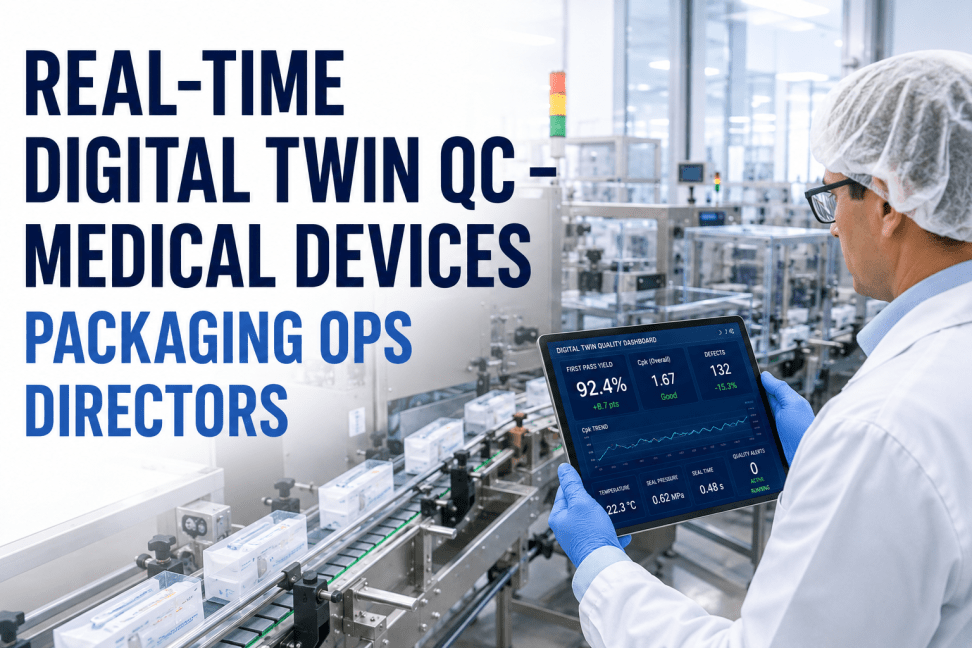
Process capability is calculated every shift for every critical-to-quality parameter. The platform projects Cpk trajectory and alerts operations directors when any parameter shows a trend that will fall below the 1.67 threshold within the next 72 hours, enabling proactive process adjustment before first-pass yield is affected.
COMPLIANCE
Automated Compliance and Audit Documentation
Every quality event, process deviation, and corrective action is automatically logged in ISO 13485 and FDA QMSR-compliant format. The platform generates audit-ready first-pass yield reports, deviation investigation summaries, and process capability histories — reducing compliance documentation labor by 70%.
Measurable Outcomes: First-Pass Yield Improvement with Digital Twin Quality
Medical device packaging facilities deploying iFactory's Digital Twin Quality platform consistently document first-pass yield improvement of 5-15 percentage points within the first two quarters of operation. The following results represent the average performance across iFactory's medical device packaging deployments.
| Metric | Pre-Deployment | Post-Deployment | Improvement |
|---|
| First-pass yield | 87% | 96% | +9 percentage points |
| Quality loss detection latency | 4.8 hours avg | < 30 seconds | 99.8% faster |
| Packaging quality rate | 91% | 99.2% | +8.2 points |
| Annual quality cost (4 lines) | $1.6M | $0.4M | 75% reduction |
| Operator response to quality alerts | 24 min avg | 2 min avg | 92% faster |
| Compliance documentation time | 20 hrs per week | 3 hrs per week | 85% reduction |
| Audit findings per cycle | 1.8 avg | 0.0 avg | Zero findings |
| Annual net savings | — | $1.2M | 3.2x ROI by month 4 |
See Digital Twin Quality Applied to Your Packaging Lines
Schedule a personalized walkthrough of iFactory's Digital Twin Quality platform with our medical device packaging engineering team. We will map your specific yield challenges, quality objectives, and production processes to measurable improvement targets.
A Structured Deployment from Quality Baseline to Digital Twin Optimization
iFactory's Digital Twin Quality deployment follows a phased methodology designed to deliver measurable first-pass yield improvement at every stage while maintaining uninterrupted production on the packaging line.
Phase 1: Digital Twin Setup and Baseline
Packaging lines are digitally modeled with all critical quality parameters: seal temperature, pressure, dwell time, film tension, label position, and dimensional tolerances. Baseline first-pass yield data is collected from existing MES and QMS sources for 14 days to establish pre-deployment benchmarks.
Timeline: Weeks 1-2
Phase 2: Real-Time Sensor Integration
Inline sensors and vision inspection cameras are connected to the digital twin platform via existing plant network infrastructure. Seal integrity testers, label verification cameras, and package dimension scanners feed real-time data into the twin, enabling continuous parameter monitoring at 200-millisecond intervals.
Timeline: Weeks 3-4
Phase 3: AI Model Training and Validation
Quality prediction models are trained on historical first-pass yield data and validated against known defect events. The digital twin runs alongside existing quality systems during a 2-week parallel validation period. Operator feedback is incorporated, and model sensitivity is calibrated to the facility's specific packaging processes.
Timeline: Weeks 5-6
Phase 4: Full Deployment and Continuous Improvement
Digital twin quality monitoring becomes the primary quality system across all packaging lines. Continuous model improvement begins through active learning from near-miss events. Ongoing performance reporting tracks first-pass yield improvement against baseline targets with weekly operations director reviews.
Timeline: Week 7 onward
Expert Analysis: Four Reasons Digital Twin Quality Is Transforming Packaging First-Pass Yield
01
Continuous virtual simulation eliminates blind spots in packaging quality. The most significant limitation of traditional quality monitoring is the 4.8-hour average gap between process drift onset and detection. Digital twin quality eliminates this gap by comparing actual process conditions against ideal quality parameters every 200 milliseconds. Operations directors gain continuous visibility into packaging line performance rather than discovering yield losses at end-of-shift quality review.
02
Multi-parameter correlation reveals defect modes single-parameter monitoring misses. Traditional quality monitoring tracks seal temperature, pressure, and dwell time independently. Digital twin quality correlates all parameters simultaneously — identifying interaction effects where one parameter within specification combines with another to create defect conditions. This multi-variable approach captures approximately 32% of yield loss precursors that traditional methods overlook entirely.
03
Predictive Cpk trending enables proactive process adjustment. Traditional capability analysis calculates Cpk retrospectively after sufficient parts have been produced. Digital twin quality projects Cpk trajectory continuously, alerting operations directors when any parameter shows a trend that will fall below the 1.67 threshold within 72 hours. This predictive capability transforms process capability management from a reporting exercise into a prevention tool.
04
Automated compliance documentation eliminates manual quality reporting risk. Manual documentation is the most frequently cited source of audit observations in medical device packaging operations. Digital twin quality automates the entire compliance documentation workflow — from first-pass yield tracking through deviation investigation to audit-ready batch disposition reports. Facilities report 85% reduction in compliance documentation labor and zero audit findings related to packaging process control after deployment.
From Yield Reporting to Real-Time Quality Optimization
Digital Twin Quality represents a fundamental shift in how medical device packaging operations manage first-pass yield. By moving from retrospective yield reporting — where losses are identified hours after they occur — to real-time quality optimization — where process deviations are detected within seconds and corrected before they affect yield — operations directors gain a quality system that actively protects production throughput while reducing compliance risk.
The documented outcomes — first-pass yield improvement from 87% to 96%, 75% reduction in annual quality cost, and zero audit findings — represent the measurable impact of deploying digital twin intelligence in packaging operations. For medical device manufacturing leaders committed to operational excellence and regulatory compliance, iFactory's Digital Twin Quality platform delivers a proven methodology that integrates with existing infrastructure and delivers first results within weeks. Book a Demo with iFactory's medical device packaging team to discuss your digital twin quality roadmap.
Transform Your Packaging First-Pass Yield with Digital Twin Quality
Join the operations directors who have already achieved 5-15 point first-pass yield improvement using iFactory's AI-powered digital twin platform. Deployed in weeks on your existing packaging infrastructure with full ISO 13485 compliance.
Real-Time Digital Twin
AI Quality Prediction
Cpk Trend Monitoring
ISO 13485 Compliance
Operations Dashboard
Frequently Asked Questions

.png)
.png)
.png)