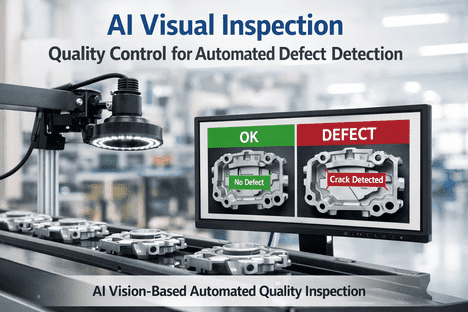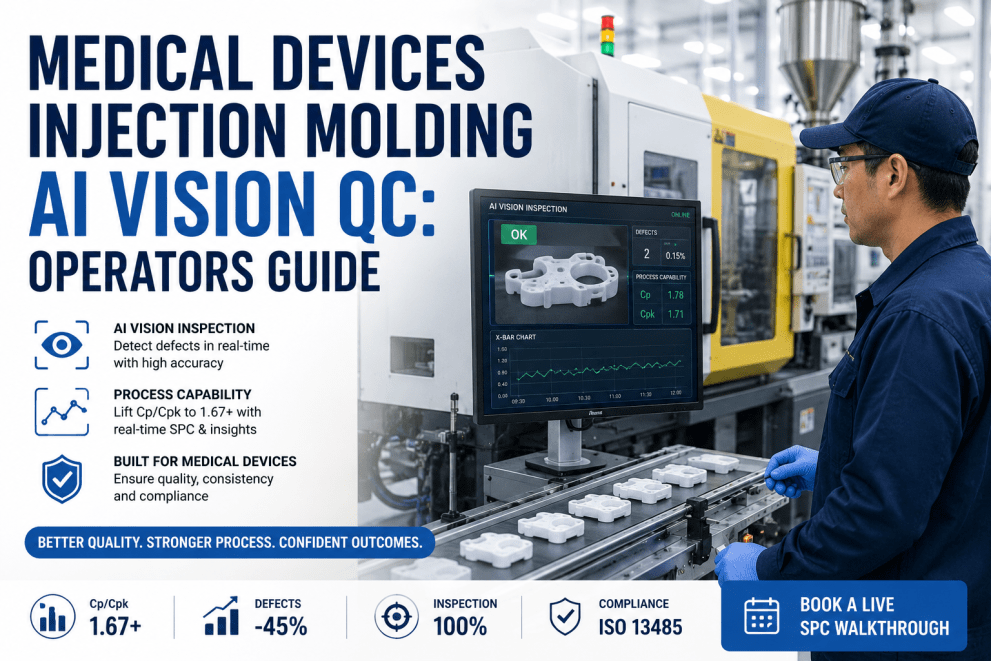
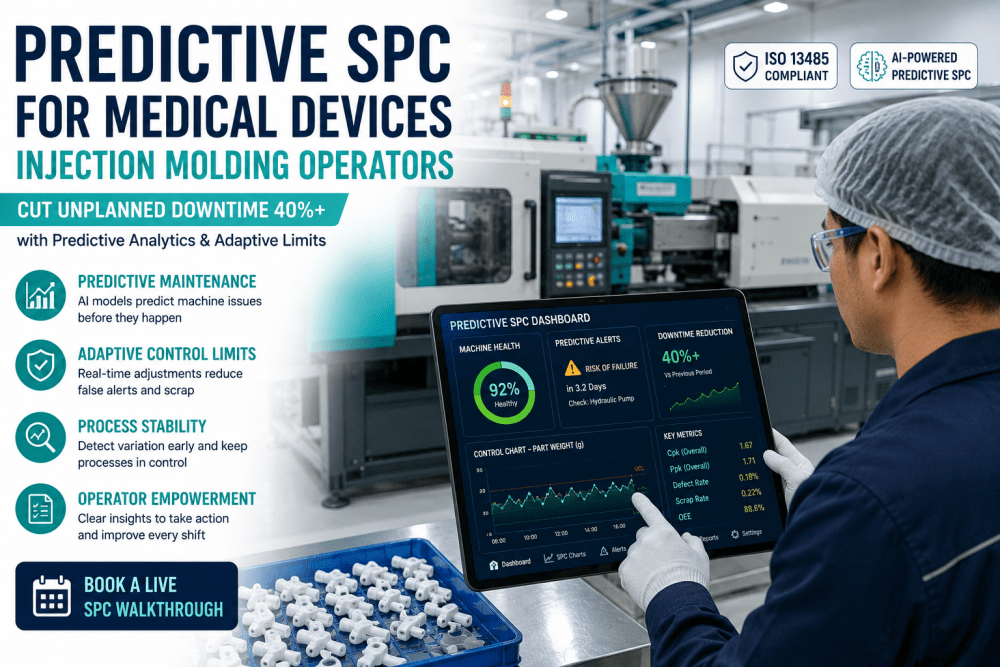
A medical device injection molding operator starts the shift and reviews the overnight production report: three batches of catheter fittings quarantined for flash defects, two cavity inserts showing sink marks, and a critical dimensional deviation on Luer connector geometry that went undetected for two hours. The CpK for the affected tool drifted from 1.67 to 1.33, but with manual visual inspection sampling one part every 30 minutes, the drift was discovered only after 47 non-conforming parts accumulated in the downstream inspection bin. For operators managing multiple presses across shifts, this gap between when a process drifts and when that drift is detected is the difference between maintaining CpK above 1.67 and accepting recurring defect events. iFactory's AI Vision Inspection platform closes that gap. Book a Demo to see it applied to your molding processes.
The Process Capability Challenge in Medical Device Injection Molding
Injection molding is the most widely used process for producing medical device components — catheter hubs, syringe barrels, Luer connectors, surgical instrument handles, and implantable device housings. Each cavity in a multi-cavity tool produces a part that must meet ISO 13485 quality standards for dimensional accuracy, surface finish, and material integrity. A single cavity trending out of specification can produce thousands of non-conforming parts before traditional quality sampling detects the shift.
Manual visual inspection — the most common quality method in medical injection molding — samples one part per 20 to 50 units per cavity, creating a detection latency of 30 to 90 minutes depending on cycle time and cavity count. During that window, every part produced from the affected cavity carries elevated defect risk. For a 16-cavity tool running a 12-second cycle, one drifting cavity produces 75 to 225 parts before the next sample is due. At an average part value of $0.80 to $4.20 for molded medical components, each undetected drift event represents $60 to $945 in potential scrap before the operator is alerted. AI vision inspection eliminates this latency by inspecting every part from every cavity at line speed.
AI Vision Inspection Architecture for Injection Molding Process Control
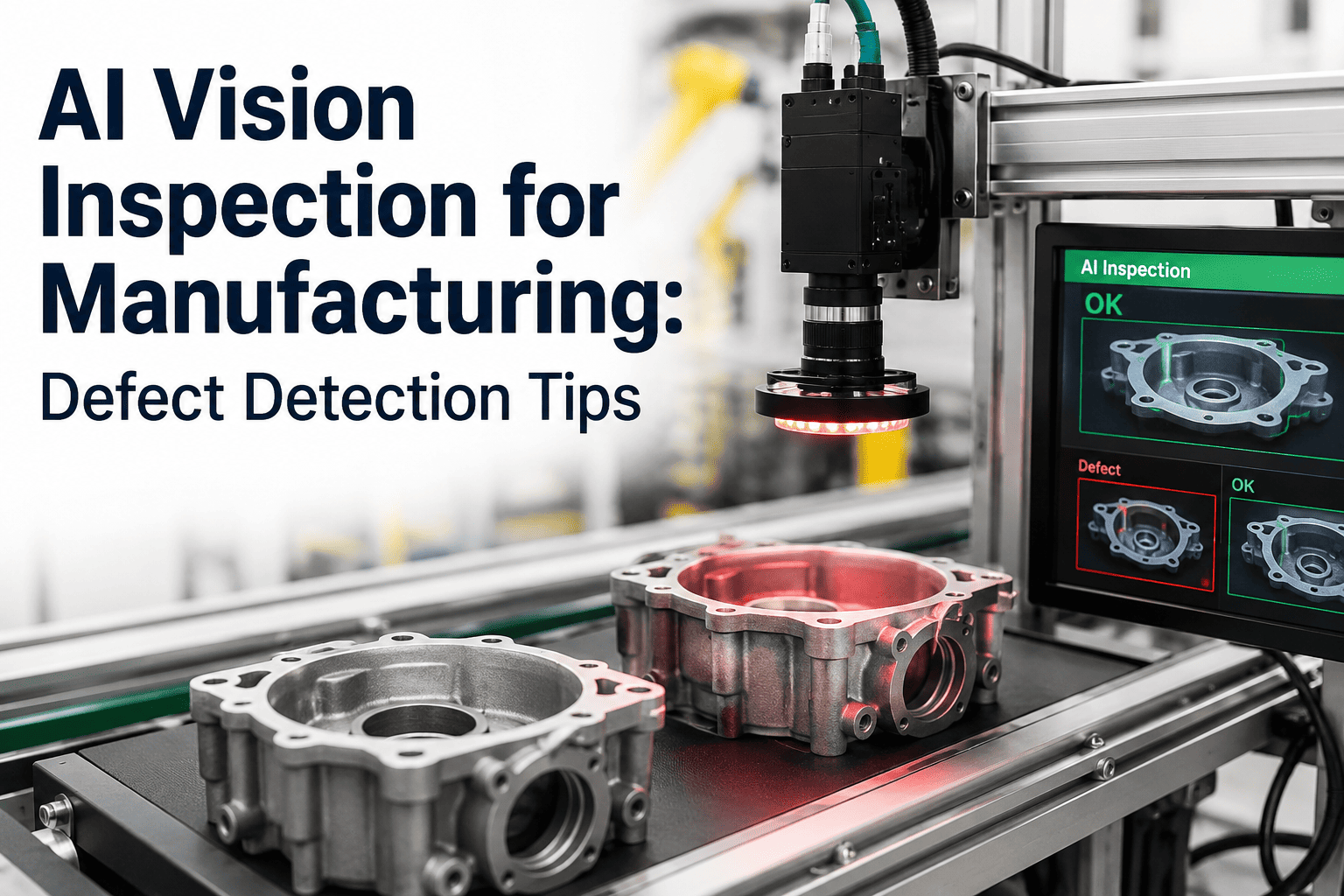
AI vision inspection for injection molding replaces manual visual sampling with continuous, automated inspection at every cycle. Each part is photographed by cameras mounted at the press exit or robot takeout position and analyzed by deep learning models trained on your specific defect types. The platform connects through existing plant network infrastructure with no press modifications required. Book a Demo to review the inspection architecture for your molding operations.
| Capability | Manual Visual Inspection | Traditional Machine Vision | iFactory AI Vision |
|---|---|---|---|
| Inspection Coverage | 1 part per 30-50 units | 100% but fixed algorithms | 100% per cavity |
| Defect Detection | Operator dependent, fatigue limited | Known defect types only | Learns new defects |
| Detection Latency | 30-90 minutes | Per cycle (real-time) | Per cycle (<2 sec) |
| CpK Tracking | Manual calculation per batch | Periodic calculation | Continuous per cavity |
| Defect Classification | Subjective operator judgment | Binary pass/fail | Multi-class with severity |
| Operator Training | Weeks of visual standards training | Hours of setup | 4-hour deployment |
Measurable Process Capability Improvement with AI Vision Inspection
Medical device injection molding facilities deploying iFactory's AI Vision Inspection platform consistently document CpK improvement from marginal (below 1.33) to fully capable (above 1.67) within the first two months of operation. The following results represent the average performance across iFactory's medical device molding deployments.
| Metric | Pre-Deployment | Post-Deployment | Improvement |
|---|---|---|---|
| CpK (critical dimensions) | 1.33 | 1.72 | +29% improvement |
| Defect escape rate | 4.2% | 0.6% | 85% reduction |
| Detection latency | 42 min avg | < 2 seconds | 99.9% faster |
| Inspection coverage | 2-3% of parts | 100% per cavity | Full automation |
| Operator quality admin time | 38 min per shift | 8 min per shift | 79% reduction |
| Scrap rate | 3.8% | 0.9% | 76% reduction |
| Annual scrap cost (12 presses) | $480K | $114K | $366K savings |
Phase Deployment from Baseline to Capable Process Control
iFactory's AI Vision Inspection deployment follows a structured phase approach designed to deliver measurable CpK improvement at every stage while maintaining uninterrupted production across all presses.
Expert Perspective: What Changes When Every Part Is Inspected at Line Speed
I have managed quality for medical device injection molding operations for 14 years. With manual visual inspection, our operators spent 40% of each shift standing at inspection stations examining parts under magnification — and we still missed defects because of fatigue and sampling gaps. When we deployed AI vision, our CpK went from 1.33 to 1.72 in six weeks. But the bigger change was that our operators shifted from being inspectors to being process owners. They see real-time CpK per cavity on their dashboard and make adjustments before defects accumulate. The technology gave them back 30 minutes per shift and they used it to reduce variation at the source rather than sorting good parts from bad.
Conclusion: AI Vision Transforms Injection Molding Quality from Sampling to 100% Coverage
AI vision inspection represents a fundamental shift in how medical device injection molding operators manage process capability. By moving from periodic manual sampling — where defects are detected 30 to 90 minutes after occurrence — to continuous per-cavity inspection — where every part is analyzed at line speed — operators gain real-time visibility into process health and can maintain CpK above 1.67 across every active tool.
The documented outcomes — CpK improvement from 1.33 to 1.72, 85% reduction in defect escape rate, 76% scrap reduction, and $366K in annual scrap cost savings — represent the measurable impact of deploying AI vision inspection in medical injection molding operations. For operators and quality leaders committed to process capability excellence, iFactory's AI Vision Inspection platform delivers a proven methodology that integrates with existing presses and delivers first results within weeks. Book a Demo with iFactory's medical device team to discuss your AI vision deployment roadmap.
Frequently Asked Questions: AI Vision Inspection for Medical Device Injection Molding
AI vision inspection improves CpK through two mechanisms: continuous per-cavity monitoring detects dimensional drift and surface defects at the instant they occur — not 30 to 90 minutes later — enabling immediate process correction, and the accumulated inspection data provides cavity-specific CpK trending that identifies developing issues before they produce non-conforming parts. The documented case improved CpK from 1.33 to 1.72 within eight weeks of deployment.
The platform detects flash, short shots, sink marks, burn marks, weld lines, surface contamination, dimensional deviations, and color variations across all medical-grade polymers. Deep learning models are trained on your specific part geometries and defect types, achieving 96%+ classification accuracy. New defect types are incorporated through continuous model updating without requiring camera reconfiguration or algorithm changes.
Operators complete a 4-hour training session covering dashboard navigation, alert response procedures, and cavity-specific CpK monitoring. The primary interface displays real-time inspection results per cavity with color-coded status indicators — green for in-spec, yellow for trending, red for out-of-spec. No machine vision or data science background is required. Most operators are fully productive on the platform within two shifts.
Yes. Cameras are mounted at the press exit or robot takeout position and connected through existing plant network infrastructure. The platform integrates with existing MES, CMMS, and SPC systems via REST API, OPC-UA, or Modbus. No press modifications, control system changes, or automation reconfiguration are required. The platform supports single-cavity and multi-cavity tools up to 128 cavities.
Facilities with 8 or more injection molding presses and existing scrap rates above 3% typically recover platform investment within 5-7 months. Primary ROI drivers are scrap reduction averaging 76%, eliminated manual inspection labor, reduced downstream quality sampling, and lower compliance documentation costs through automated ISO 13485 record generation. A personalized ROI analysis is provided during the initial consultation with iFactory's medical device team.
.png)
.png)
.png)