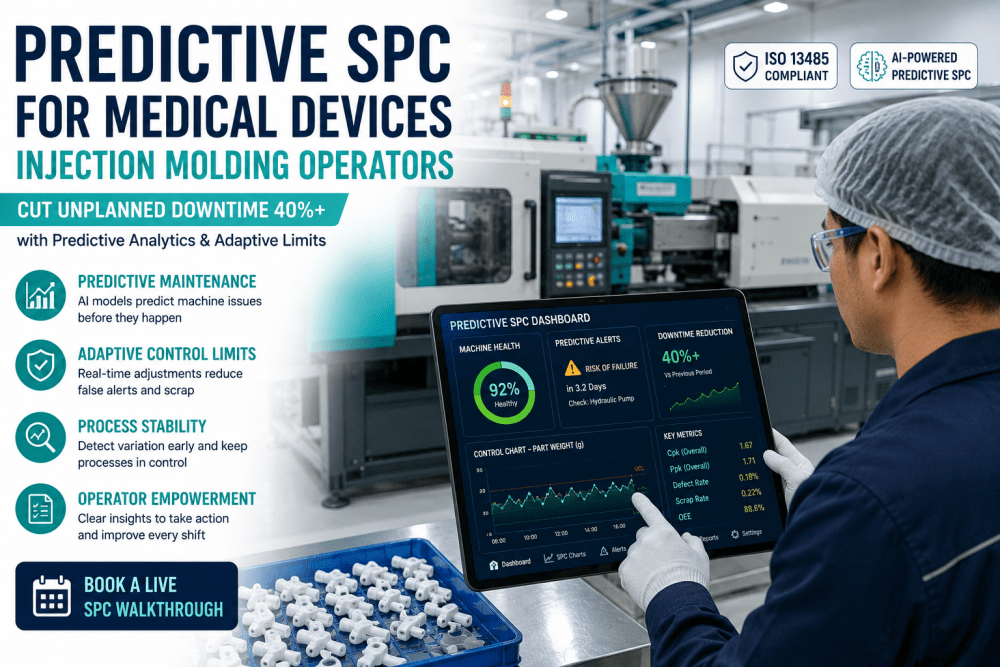
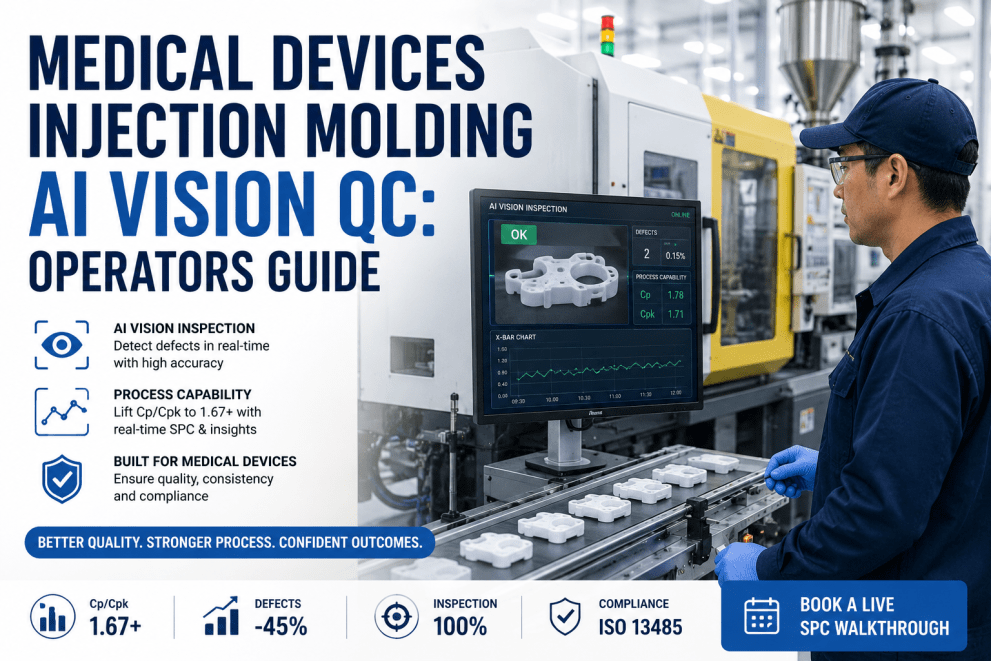
An injection molding operator starts a production run on a medical device mold tool and within 90 cycles notices the cavity pressure trending upward. The machine health dashboard shows nothing unusual. The SPC chart is within control limits. By cycle 240, the trend has crossed the upper control limit — an alert fires, the machine stops, and 160 cycles of production are quarantined for inspection. Root cause: a cooling channel partially blocked by mineral deposit buildup that developed over the previous weekend's idle period, causing the mold temperature to drift one degree per hour until the process went out of spec. This scenario — process drift that develops over hours and is detected only when it breaches static control limits — is the gap that Predictive SPC closes. Instead of discovering a problem after 160 bad cycles, Predictive SPC identifies the cooling channel signature 90 minutes before it affects part quality and alerts the operator to perform preventive maintenance.
The Predictive Maintenance Challenge in Medical Device Injection Molding
Medical device injection molding operates under some of the most demanding quality requirements in manufacturing. Mold cavity dimensions held to micron tolerances, material purity standards tied to ISO 13485, and process validation protocols that require documented statistical control for every critical parameter. Yet the maintenance approach across most facilities remains reactive or calendar-based — responding to machine faults after they cause downtime or performing maintenance at fixed intervals regardless of actual machine condition.
A 2025 analysis of medical device injection molding facilities found that 62% of unplanned downtime events were preceded by measurable process parameter drift that went undetected by traditional SPC systems. The average drift-to-detection window was 3.2 hours — time during which the machine continued producing parts with developing non-conformances. For a facility running twelve molding machines across three shifts, each undetected drift event represents $9,000 to $24,000 in scrap, rework, quarantine labor, and lost production time. Predictive SPC eliminates this detection latency by combining real-time process monitoring with machine learning models that recognize the early signatures of developing faults.
Predictive SPC vs. Traditional SPC — A Capability Comparison for Injection Molding
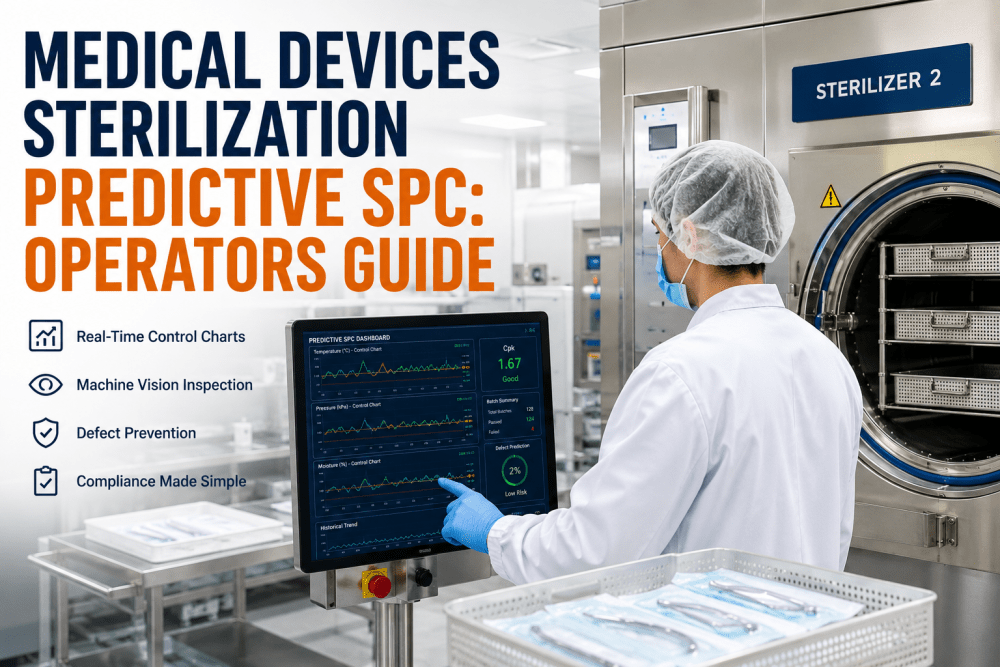
Traditional SPC monitors process outputs against static control limits calculated from historical data. Predictive SPC augments every measurement with ML-driven analysis that detects subtle patterns — cavity pressure trends, temperature gradients, cycle time shifts — that precede both quality defects and machine faults. The following comparison illustrates the capability gap across seven dimensions critical to injection molding operations.
| Capability Dimension | Traditional SPC | Predictive SPC with ML | Maintenance Impact |
|---|---|---|---|
| Detection Timing | After control limit breach | Before defect develops | Prevents unplanned stoppage |
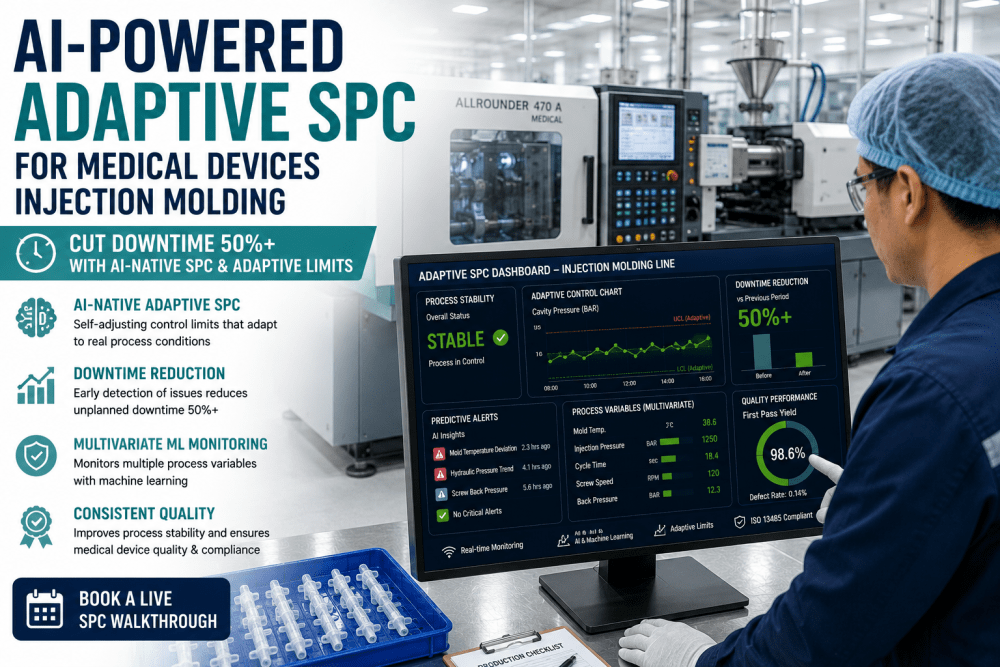
| Control Limits | Static — calculated quarterly | Adaptive — updated per run | 50% fewer false alarms |
| Data Sources | Sample measurements only | Machine sensors + vision + process | Full machine health visibility |
| Fault Prediction | Not available | AI-classified drift signatures | 40%+ downtime reduction |
| Maintenance Trigger | Calendar or breakdown | Predicted condition-based | 3.2x maintenance ROI |
| Operator Response | Review end-of-shift report | Real-time alert per cycle | 87% faster corrective action |
| Compliance Alignment | Manual documentation | Automated ISO 13485 records | 70% less documentation labor |
The comparison shows that Predictive SPC does not replace traditional quality monitoring — it builds on it. Every existing measurement point and SPC chart feeds into the ML models that classify developing patterns. The operator still sees familiar control charts, but those charts now carry predictive annotations: trend projections, risk scores, and specific parameter guidance that indicate not just that a process is drifting but what is causing the drift and when it will reach the specification limit.
Four Predictive SPC Capabilities That Enable Predictive Maintenance
iFactory's Predictive SPC platform delivers four integrated capabilities that create a continuous predictive maintenance cycle for injection molding operations. Each capability builds on the previous one, with measurable impact at every stage of deployment.
Measured Impact — Downtime Reduction and Process Stability with Predictive SPC
The following metrics represent the average performance improvement across medical device injection molding facilities deploying iFactory's Predictive SPC platform. Results are measured from pre-deployment baseline to post-deployment steady state across a minimum of 12 weeks of production data.
Beyond the headline metrics, Predictive SPC deployment produced structural improvements across the molding operation. Detection latency for process state changes dropped from 3.2 hours to under 30 seconds. Scrap rate decreased by 52% as fewer cycles were produced on developing fault conditions. Preventive maintenance labor became predictable and schedulable — 73% of maintenance events shifted from reactive emergency response to planned intervention. The false alarm rate dropped 50% through adaptive control limits, saving operators an average of 14 hours per week previously spent investigating alerts that did not correspond to actual process issues.
Expert Analysis — Four Ways Predictive SPC Transforms Injection Molding Quality and Maintenance
Conclusion — Predictive SPC Turns Reactive Maintenance into Predictive Operations
Predictive SPC for medical device injection molding represents a fundamental shift in how operators manage both quality and maintenance. Traditional SPC told operators when a process had already gone out of control. Predictive SPC tells operators when a process is beginning to drift, what is causing the drift, and when it will reach the specification limit — giving them the information they need to intervene before defects occur and before machines fail. For shop-floor operators and line technicians managing twelve or more injection molding machines in ISO 13485-regulated environments, iFactory's Predictive SPC platform delivers a proven methodology that integrates with existing equipment and delivers measurable results within weeks. Book a Demo with iFactory's medical device manufacturing team to discuss your Predictive SPC deployment roadmap.
Frequently Asked Questions — Predictive SPC for Medical Device Injection Molding
What is Predictive SPC for medical device injection molding?
Predictive SPC combines traditional statistical process control with machine learning models that analyze real-time sensor data from injection molding machines — cavity pressure, mold temperature, injection speed, cooling time, and material flow rate. Unlike traditional SPC that alerts only after a control limit is breached, Predictive SPC identifies developing drift patterns that precede both quality defects and machine faults, enabling operators to intervene before production is affected.
How does Predictive SPC reduce unplanned downtime in injection molding?
Predictive SPC reduces unplanned downtime by detecting the early signatures of developing machine faults — cooling system degradation, heater band failure, hydraulic drift, screw wear — an average of 90 minutes before they cause a process stoppage. The system classifies each drift pattern into specific fault categories with confidence scores and estimated time-to-failure windows, enabling operators to schedule preventive maintenance during planned changeovers rather than responding to emergency breakdowns.
What data sources are required to deploy Predictive SPC on injection molding machines?
The platform integrates with existing machine sensors and controllers through standard interfaces including OPC-UA, REST API, and MQTT. Required data includes cycle-level parameters — mold temperature, cavity pressure, injection speed, hold pressure, cooling time, and material flow rate — available from most modern injection molding machine controllers. For machines without digital sensor output, iFactory's IoT gateway can be installed to capture analog signals from existing transducers.
How quickly can we expect to see unplanned downtime reduction after deployment?
The ML models begin identifying developing drift patterns within the first week of training data collection. Measurable unplanned downtime reduction of 15-20% is typically documented within the first month. The full 40%+ reduction is achieved within 10-12 weeks as models incorporate facility-specific fault signatures and the adaptive control limit engine is calibrated to each machine-mold-material combination in production.
Does Predictive SPC support ISO 13485 compliance documentation?
Yes. All process data, control limit calculations, drift detection events, predictive alerts, and corrective actions are automatically logged with full traceability to production lot and machine serial number. The platform generates audit-ready reports for any date range, machine, or production lot — eliminating manual documentation labor and ensuring consistent compliance with ISO 13485 statistical control requirements.
.png)
.png)
.png)