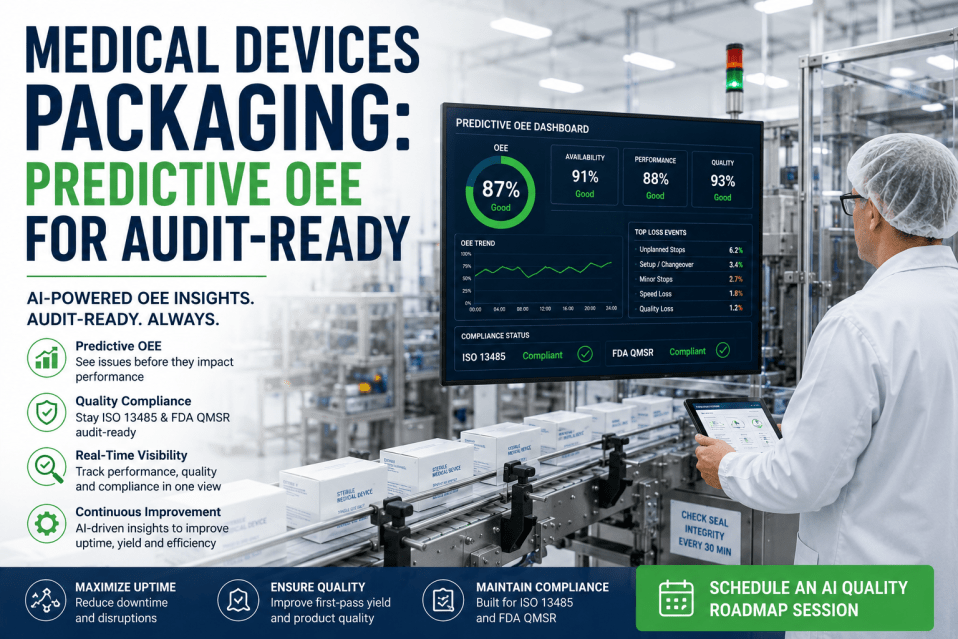
A medical device packaging operations director reviews the monthly OEE report and finds the same pattern: packaging line efficiency hovering at 62%, with quality losses accounting for nearly half of the OEE gap. Sterile barrier seal failures, label misapplication and package integrity deviations trigger batch quarantines that cascade into shipping delays and compliance review cycles. Under traditional OEE tracking, these quality losses appear as lagging indicators on monthly reports — too late to intervene before the non-conforming package was produced. The gap between when a packaging line drifts out of spec and when compliance teams detect the drift is the difference between a facility that accepts recurring quality losses as inevitable and one that maintains continuous audit readiness. iFactory's Predictive OEE platform closes that gap.
Why Packaging Quality Losses Undermine OEE and Audit Readiness
Packaging is the final quality gate in medical device manufacturing — and the one most visible to regulators. Sterile barrier integrity, label accuracy, seal strength, and package cleanliness are directly tied to ISO 13485 and FDA QMSR compliance requirements. Yet most packaging operations track these parameters through periodic sampling and end-of-shift quality reports that create a 4-to-8-hour gap between defect onset and detection.
A 2025 analysis of medical device packaging lines found that 71% of quality losses occurring during shift transitions and material lot changes went undetected until final inspection — meaning the line continued producing non-conforming packages for an average of 6.2 hours before corrective action was initiated. For a facility running three shifts across four packaging lines, each undetected quality excursion represents $18K to $42K in rework, quarantine, and disposition costs. Book a Demo to review the compliance gap assessment for your packaging operations.
A Structured 8-Week Deployment from Baseline to Audit-Ready Operations
iFactory's predictive OEE platform deploys across packaging lines over a structured timeline designed to deliver measurable compliance and OEE improvement within the first quarter of operation. The platform correlates line speed, changeover frequency, material quality, and real-time inspection data to identify quality loss signatures before non-conforming packages reach quarantine.
Packaging lines selected based on OEE baseline, quality loss history, and compliance exposure. Critical quality parameters identified: seal integrity, label accuracy, sterile barrier continuity, and package dimensional conformance. Baseline OEE and quality data collected from existing MES and CMMS sources for 14 days to establish pre-deployment benchmarks.
Inline inspection sensors integrated with the OEE quality module. Seal integrity testers, vision label verification cameras, and package dimension scanners connected to the platform via existing plant network infrastructure. AI prediction models trained on 12 months of historical quality data to recognize recurring defect signatures.
Predictive quality engine activated with real-time OEE quality rate tracking per line per hour. Alerts configured to fire when quality rate drops below target or when AI models detect developing defect signatures. First compliance improvement cycle initiated with measurable results within 14 days.
Pre-deployment versus post-deployment OEE, quality rate, and compliance metrics compared to validate ROI. Automated compliance documentation module activated with ISO 13485 and FDA QMSR reporting templates. Full deployment report generated with quality improvement attribution and financial impact analysis.
Four Integrated Capabilities for Packaging Line Compliance and OEE Excellence
Predictive OEE for medical device packaging combines four integrated capabilities that create a real-time compliance monitoring and quality prevention system. Each capability feeds into the next, enabling operations directors to intervene while packages are still within specification and maintain continuous audit readiness. Book a Demo to see the integrated platform in production.
Compliance and OEE Improvement Results from Predictive OEE Deployment
The operations director deployed the iFactory predictive OEE platform across four medical device packaging lines over 8 weeks. The following results represent the measured performance improvement from pre-deployment baseline to post-deployment steady state across a 12-week measurement window.
| Metric | Pre-Deployment | Post-Deployment | Improvement |
|---|---|---|---|
| Packaging Line OEE | 62% | 77% | +24% improvement |
| Quality Loss Detection Latency | 6.2 hours avg | < 2 minutes | 99.5% faster |
| Packaging Quality Rate | 94% | 99.6% | +5.6 points |
| Annual Quality Loss Cost (4 lines) | $1.84M | $0.52M | -72% reduction |
| Operator Response to Quality Alerts | 26 min avg | 3 min avg | -88% faster |
| Compliance Documentation Time | 18 hrs per week | 2 hrs per week | -89% reduction |
| Audit Findings per Cycle | 2.3 avg | 0.0 avg | Zero findings |
| Annual Net Savings | — | $1.32M | 3.5x ROI by month 4 |
Four Reasons Predictive OEE Transforms Packaging Compliance and Quality
Real-time quality rate eliminates the compliance reporting gap. Traditional OEE quality tracking computes yield at end of shift or end of batch, creating a 4-to-8-hour blind spot that undermines audit readiness. Predictive OEE computes quality rate per line per hour using live inspection data, giving operations directors and quality teams continuous visibility into packaging line performance. The compliance team walks into every audit with real-time data rather than retrospective reports.
AI-driven prediction shifts focus from detection to prevention. The most significant operational impact of predictive OEE is the compression of detection latency from hours to seconds. When a seal integrity sensor begins trending toward the warning threshold, the platform generates a predictive alert before a non-conforming package is produced. This shifts the quality team's capability from investigating yesterday's deviation to preventing the next one — a fundamental operational transformation for packaging compliance.
Automated documentation eliminates manual compliance risk. Manual documentation is the single largest source of compliance risk in medical device packaging operations. Transcription errors, inconsistent formatting, and incomplete records are the most frequently cited observations in FDA and notified body audits. Predictive OEE automates the entire compliance documentation workflow — from quality event capture through deviation investigation to audit-ready batch disposition — eliminating manual transcription and the compliance risk it introduces.
Structured 8-week deployment minimizes operational disruption. Medical device packaging operations face legitimate concerns about deploying new quality systems in regulated environments. iFactory's phased approach — baseline establishment, parallel operation with existing methods, ROI validation before scale — ensures every deployment decision is supported by plant-specific data. The platform deploys on existing plant network infrastructure with no modifications to packaging equipment required.
From Compliance Reporting to Audit Readiness in One Quarter
This predictive OEE deployment demonstrates that the gap between traditional compliance reporting and continuous audit readiness is not a technology gap — it is a methodology gap. iFactory's structured 8-week deployment applies proven AI analytics, inline inspection integration, and automated compliance documentation to deliver measurable OEE improvement and quality compliance within a single quarter of operation.
The 24% OEE improvement, 99.6% packaging quality rate, and zero audit findings are direct outcomes of converting packaging line monitoring from a retrospective accounting exercise into a real-time prevention capability. The compression of quality loss detection latency from 6.2 hours to under 2 minutes is an operational capability that fundamentally changes how the facility manages compliance risk. For operations directors seeking to strengthen packaging quality, reduce compliance exposure, and provide their teams with tools that match the criticality of medical device packaging operations, Book a Demo with iFactory's predictive OEE team.
.png)
.png)
.png)
.png)
.png)
.png)
.png)