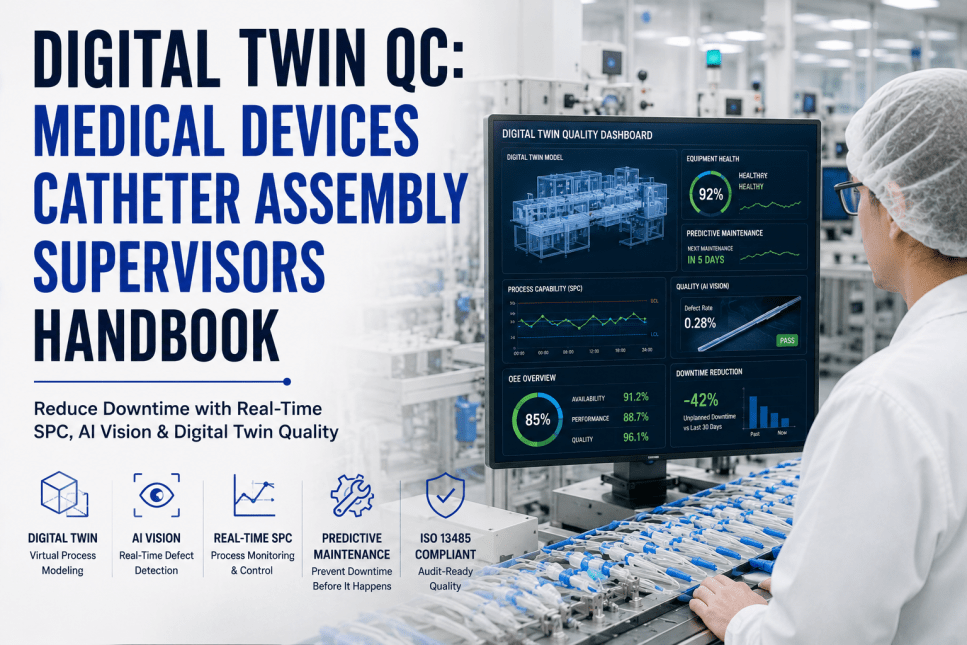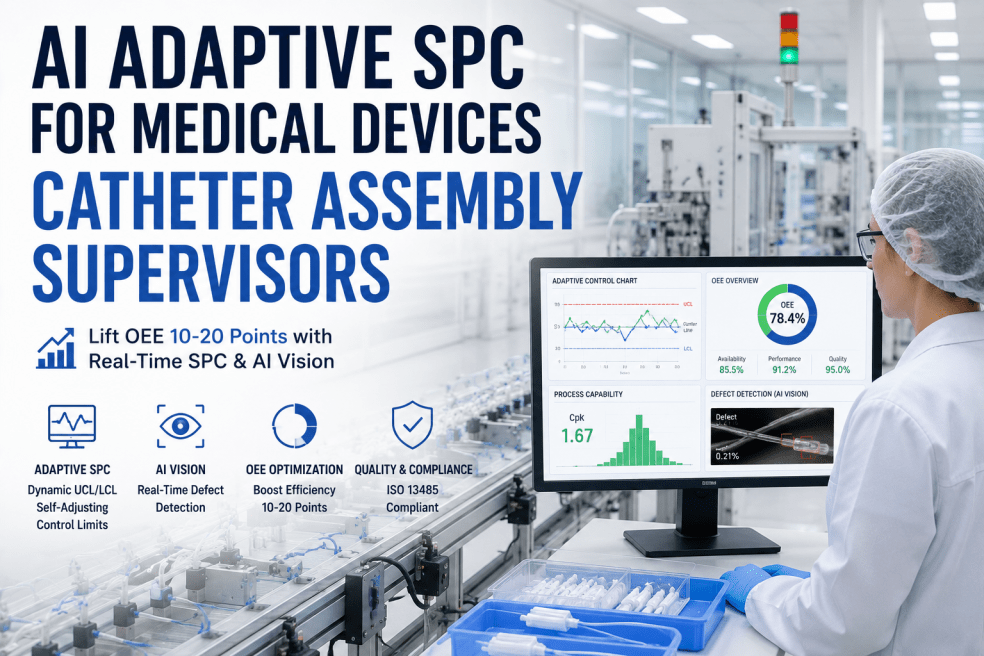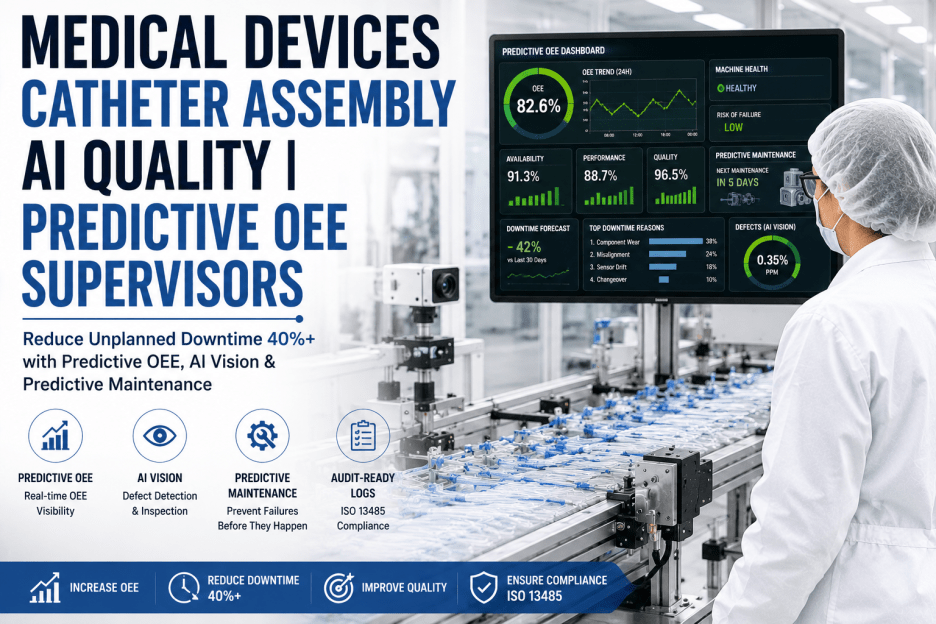
A catheter assembly supervisor reviews the end-of-shift report and sees the same pattern: line 3 experienced 47 minutes of unplanned downtime, but the maintenance team was not notified until 3 hours after the bonder temperature first drifted out of range. The tipping machine on line 2 produced 84 units with unacceptable tip geometry before the 1-in-50 quality check caught the defect. This latency between equipment state change and operator awareness is the hidden cost of reactive maintenance — and it is costing the facility $2.1M annually across six lines. Predictive OEE closes this gap by combining real-time OEE analytics, AI-driven predictive maintenance alerts, and machine vision quality inspection into a single supervisor dashboard that flags anomalies the moment they begin. iFactory AI’s Predictive OEE platform helps catheter assembly supervisors reduce unplanned downtime by 40% or more, improve equipment reliability, and maintain ISO 13485-compliant production records automatically. Book a Demo to see the shift-floor architecture.
The Reactive Maintenance Gap in Catheter Assembly Cleanrooms
Catheter assembly depends on precision equipment — tipping machines, bonders, laser markers, balloon formers — where even minor calibration drift or temperature fluctuation produces downstream quality defects. Traditional OEE tracking relies on manual end-of-shift data entry, operator-reported downtime codes, and after-the-fact spreadsheet analysis. By the time the supervisor reviews the OEE report the following morning, the production loss has already occurred and the root cause is often obscured by incomplete or inaccurate operator entries.
The gap is not data availability. PLCs, sensors, and vision systems generate thousands of data points per minute. The gap is latency — the time between an equipment state change and the supervisor’s awareness of that change. In catheter assembly, that latency averages 3 to 4 hours for critical parameters such as bonder temperature, tipping force, and laser power. In that window, a single drifting station can produce hundreds of non-conforming units. Book a Demo to review the Predictive OEE architecture for your cleanroom lines.
Predictive OEE Architecture — Real-Time Visibility from Sensor to Supervisor
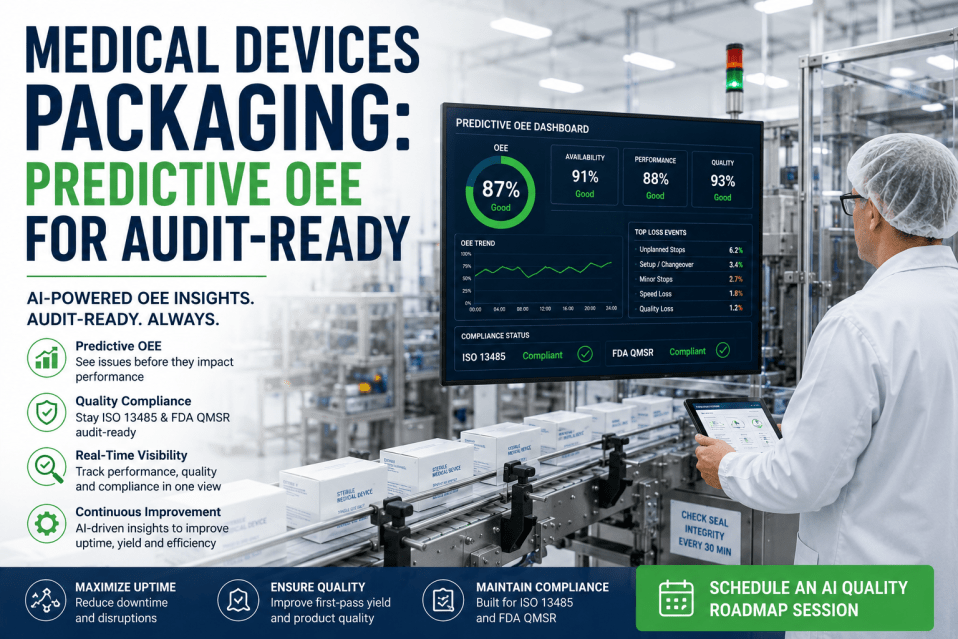
Predictive OEE transforms how catheter assembly supervisors monitor production. Instead of reviewing yesterday’s OEE numbers at the morning stand-up, supervisors see live availability, performance, and quality data per line per hour on a single dashboard. AI models trained on historical failure data predict downtime events before they occur, while machine vision provides continuous 100% inline quality inspection at every critical workstation. The platform connects tipping, bonding, balloon forming, laser marking, and inspection stations into a unified monitoring system with automated alerting and compliance logging.
| Capability | Traditional OEE | iFactory Predictive OEE | Impact |
|---|---|---|---|
| Detection Method | Manual end-of-shift review | Real-time ML anomaly detection | <5 min latency |
| Downtime Classification | Operator-entered codes | Auto-classified by AI models | 90% accuracy |
| Maintenance Trigger | Fixed calendar schedule | Condition-based prediction | 3x PM interval |
| Quality Integration | Separate quality system | Unified OEE + SPC dashboard | Closed loop |
| Audit Trail | Spreadsheet-based logs | Auto-generated compliance records | ISO 13485-ready |
| OEE Accuracy | Estimated ±8% | Verified ±1% | 7x improvement |
AI Vision Integration — Closing the Quality Loop in Real Time
Catheter quality depends on sub-millimeter precision — tip geometry, balloon wall uniformity, bond integrity, shaft lubricity, and laser mark accuracy. Traditional quality control samples 1 in 50 units, leaving a 98% inspection gap that allows drift to propagate across hundreds of units before detection. AI vision closes this gap with continuous 100% inline inspection at every critical workstation, feeding dimensional and visual data directly into the Predictive OEE platform.
When a tipping machine shows cycle-time creep or a bonder temperature drifts toward a control limit, the system alerts the supervisor via the Predictive OEE dashboard before the parameter exceeds tolerance — enabling intervention while hardware is still within specification. Detection time drops from 4.2 hours with manual sampling to under 90 seconds with AI vision. The closed-loop architecture means every inspection result updates the predictive maintenance model, improving alert accuracy over time.
Measured ROI — From Reactive to Predictive Maintenance in Catheter Assembly
The deployment of iFactory Predictive OEE across six catheter assembly lines over seven months produced measurable financial returns. The table below summarizes pre- and post-deployment costs.
| Component | Pre-Deployment | Post-Deployment | Savings | Driver |
|---|---|---|---|---|
| Unplanned Downtime Cost | $1.1M | $450K | $650K | Predictive alerts reduce downtime 40%+ |
| Emergency Maintenance Labor | $480K | $120K | $360K | Condition-based PM replaces reactive repairs |
| Scrap and Rework Cost | $380K | $150K | $230K | AI vision detects drift before defects occur |
| Quality Investigation Labor | $210K | $70K | $140K | Auto-classified events reduce investigation time 66% |
| Platform and Integration Cost | $0 | $480K | ($480K) | Annualized platform license, cameras, and integration |
| Total Net Benefit | $2.17M | $1.27M | $900K | Net annual savings — 1.9x ROI in first year |
Payback for the six-line deployment was 5.2 months. Years two through five project $1.6M net annual savings as platform costs amortize and model accuracy continues improving with accumulated production data.
Expert Perspective — What Changes When Predictive OEE Replaces Reactive Maintenance
I have managed catheter assembly lines for 12 years, and reactive maintenance has always been the accepted norm. We scheduled PMs on fixed intervals, logged downtime in spreadsheets, and discovered most equipment problems after they had already affected production. When we deployed Predictive OEE, unplanned downtime dropped 43% in the first quarter. My team stopped fighting fires every shift and started optimizing processes. The technology gave us back 30 hours per week of supervisor time, and we used every hour to reduce variation at the source. That cultural shift — from reactive to predictive — had more impact on OEE than any productivity initiative in the previous five years.
Conclusion — Predictive OEE Transforms Catheter Assembly from Reactive to Predictive Operations
What the facility lacked was not data or equipment — it was a system that could connect machine signals to supervisor actions in real time. Predictive OEE closed that gap, delivering 12-point OEE improvement, 43% less unplanned downtime, $900K net annual savings, and 5.2-month payback. Not from more maintenance staff or longer shifts, but from an architecture that matches the speed of equipment state changes with human decision-making. For catheter assembly supervisors committed to improving OEE, reducing downtime, and maintaining ISO 13485 compliance, iFactory AI’s Predictive OEE platform delivers measurable results deployed on existing infrastructure with first alerts live within weeks. Book a Demo to review the deployment plan for your cleanroom operations.
.png)
.png)
.png)
.png)