Walk onto any traditional shop floor today and you'll still see it — clipboards on workstations, paper travelers stapled to job kits, operators jotting down cycle times in spiral notebooks, and a supervisor at end-of-shift hunched over a spreadsheet, manually transcribing eight hours of handwritten production data into the ERP. By the time that data reaches the people who need to make decisions, it's already 12 to 24 hours old, riddled with transcription errors, and missing the context that would make it actually useful.
This is shop floor data collection (SFDC) the old way. And in 2026, it is the single largest source of preventable inefficiency in U.S. manufacturing operations. The good news: modern alternatives — IIoT sensors, MES terminals, barcode systems, and automated production tracking — eliminate manual entry entirely while delivering data that is faster, cleaner, and infinitely more actionable. Here's how to make the shift.
23%
Average error rate in manual shop floor data entry
4.2 hrs
Operator time lost per shift to paperwork & data entry
85%
Reduction in data latency with automated SFDC
11 mo
Average payback on modern SFDC deployment
Shop Floor Data Collection & Modern SFDC
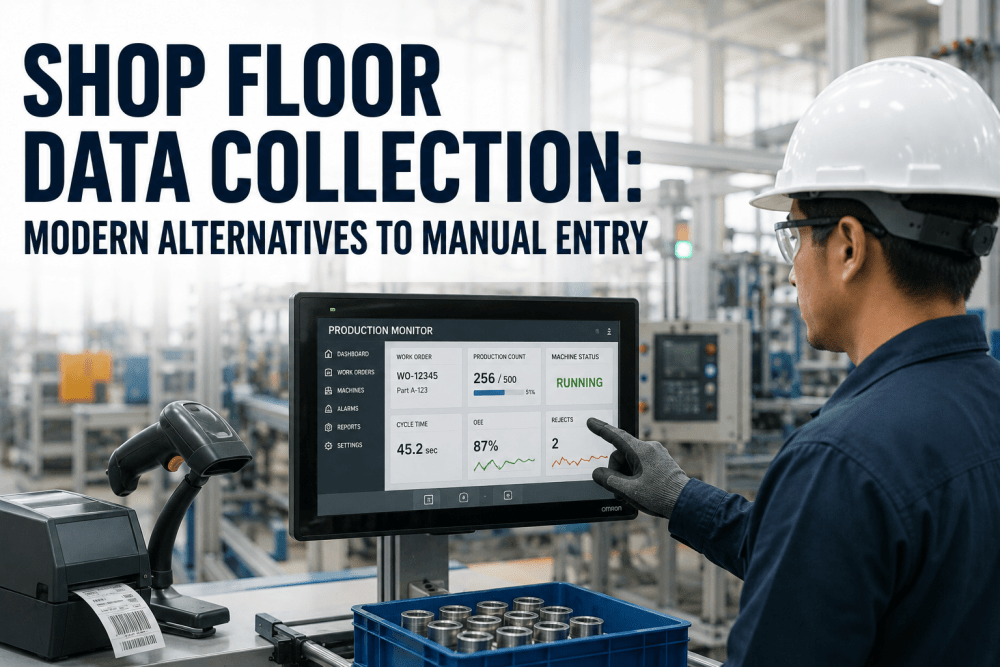
Shop Floor Data Collection: Modern Alternatives to Manual Entry
How IIoT sensors, MES terminals, barcode systems, and automated production tracking replace clipboards and spreadsheets — and turn the shop floor into a real-time, decision-ready data source
Why Manual Data Entry Is Quietly Costing You Margin
Most plant leaders know paper-based and manual SFDC is inefficient — but very few have measured the real cost. It is not just the operator minutes spent filling out forms. It is the supervisor hours spent reconciling them, the planners working from stale information, the maintenance teams chasing failures that were already trending in the data, and the quality issues that get caught at end-of-line instead of in-cycle. Every one of those costs traces back to the same root cause: data that is captured manually, captured late, or never captured at all.
The True Cost of Manual Shop Floor Data Entry — A Hidden P&L Drain
Operator Time
45–60 min lost per shift to paperwork & data forms
Transcription Errors
15–25% of manual entries contain errors
Data Latency
12–24 hour delay before data is usable
Supervisor Overhead
2–3 hrs/day spent reconciling production logs
Lost Traceability
Audits fail when paper records go missing
Stale Decisions
Plans run on yesterday's reality
Quality Gaps
Defects discovered post-shift, not in-cycle
No AI Foundation
Predictive analytics impossible without clean live data
With modern automated SFDC ↓
Outcome
Zero manual entry on the floor
Real-time data, milliseconds latency
Audit-ready traceability built-in
AI & analytics fed by clean live data
Ready to eliminate clipboards from your shop floor? Book a Demo with iFactory's MES team to see automated SFDC in action.
The Five Modern Alternatives to Manual Shop Floor Data Entry
There is no single replacement for manual data entry — there is a stack of complementary technologies, each suited to a different type of data and a different point in the production process. The best deployments combine two or three of these methods, layered into a unified MES platform that contextualises the data as it arrives.
Comparison: Manual SFDC vs Modern Automated SFDC
The gap between paper-based data collection and modern automated SFDC is not incremental — it is generational. Here's how the two approaches compare across the dimensions that actually matter to plant managers, operations directors, and quality leaders.
| Dimension |
Manual / Paper-Based SFDC |
Modern Automated SFDC |
| Data Latency |
12–24 hours after shift |
Real-time, milliseconds |
| Error Rate |
15–25% transcription errors |
Under 1% with validation |
| Operator Effort |
45–60 min per shift on forms |
Under 5 min — mostly scans |
| Traceability |
Partial — paper records get lost |
Complete digital genealogy |
| OEE Accuracy |
Estimated, often inflated 10–15% |
Calculated from sensor data, exact |
| Audit Readiness |
Days to assemble records |
Instant — every event logged |
| AI & Predictive Use |
Not feasible — data too dirty |
Built-in foundation |
| Scalability |
Adds headcount linearly |
Scales without added labor |
Modernise Your Shop Floor Data Collection in 90 Days
iFactory AI's MES Workflow platform combines IIoT sensors, barcode capture, operator terminals, and AI vision into a single intelligence layer — turning your shop floor into a real-time data source from the first shift.
A Phased Roadmap to Replace Manual Entry
Most U.S. manufacturers cannot rip out paper SFDC overnight — and they shouldn't try. The fastest path to value is a phased rollout that delivers measurable wins at each step, builds operator confidence, and uses early data to justify the next investment. Here's the four-phase approach that consistently works.
Phase 1 · Weeks 1–4
Connect the Machines
Start with PLC tag capture and IIoT sensors on your top 5 production assets. Replace estimated downtime and OEE numbers with sensor-driven truth. This phase alone usually exposes 8–12% of "phantom" capacity hidden by manual logging.
Outcome: Real OEE visibility on top assets
Phase 2 · Weeks 5–10
Deploy Operator Terminals
Roll out MES touchscreens at every workstation. Operators clock onto jobs, log scrap with reason codes, and declare downtime in 5 seconds. Paper travelers go away. Supervisors stop reconciling at end-of-shift because the data is already clean.
Outcome: Zero paper at the workstation
Phase 3 · Weeks 11–16
Add Barcode & Material Tracking
Introduce barcode scanning at receiving, kitting, WIP movement, and finished goods. Every part now has a digital genealogy. Material consumption ties automatically to work orders. Inventory accuracy moves from 85% to 99%+.
Outcome: Complete traceability & lot genealogy
Phase 4 · Weeks 17–24
Layer AI Vision & Analytics
With clean real-time data flowing, deploy AI vision at quality stations and unlock predictive analytics on the unified data layer. Defects caught in-cycle, machine failures predicted weeks early, schedules optimised continuously based on live performance.
Outcome: Predictive operations from clean live data
Expert Review: What U.S. Manufacturing Leaders Are Seeing in 2026
The single biggest myth in shop floor modernisation is that operators will resist losing their clipboards. They don't. They resent the clipboards. What they resist is being asked to do double work — entering data into a terminal and filling out the paper form because IT hasn't sunset it yet. The fastest-moving plants we work with eliminate the paper the same day they turn on the terminal. Half-measures kill the project.
Industry analyst commentary on U.S. manufacturing SFDC adoption
Compiled from iFactory deployment data across 200+ North American plants, 2025–2026
Expert Takeaways for U.S. Plant Leaders
1
Sunset paper on day one. Plants running parallel paper and digital systems take 3× longer to see ROI than those that go cold-turkey on paper at terminal launch.
2
Start with downtime, not throughput. Sensor-captured downtime data reveals the hidden capacity, builds the business case for further automation, and wins operator buy-in fastest.
3
Train supervisors first, operators second. The supervisor's behavior change — stopping the end-of-shift reconciliation ritual — is what unlocks the productivity gain.
4
Design for the worst lighting and dirtiest gloves on the floor. If the touchscreen UI fails in those conditions, the whole project fails.
Real-World Scenarios: What Modern SFDC Looks Like in Practice
Scenario
Downtime Investigation
With Manual Entry
Line stopped for 47 minutes during second shift. Operator wrote "machine issue" on the downtime log. By the time the maintenance manager reviews it next morning, no one remembers the specifics.
With Modern SFDC
PLC flags fault code at 23:14. Operator confirms reason on terminal in 8 seconds. Maintenance ticket auto-created, root cause linked, MTTR captured, pattern feeds predictive model.
Resolution insight: next-shift response → next-minute response
Scenario
Scrap Tracking
With Manual Entry
Operators jot scrap counts on paper at end-of-shift, often estimated, sometimes under-reported to avoid scrutiny. Real scrap rate emerges in monthly review — far too late to act.
With Modern SFDC
Operator scans rejected part into terminal, picks reason code from validated list, scrap count auto-increments. Trend dashboard flags abnormal spike within 30 minutes — root cause investigation starts same shift.
Discovery: 30 days → 30 minutes
Scenario
FDA / Regulated Audit
With Manual Entry
Auditor requests batch records for lot #X-2847. Quality team spends 3 days assembling paper travelers, signed forms, and log entries from filing cabinets. Two missing signatures discovered.
With Modern SFDC
Auditor requests lot #X-2847. Quality lead pulls complete digital genealogy in under 60 seconds — every step timestamped, every operator captured, every check verified, fully 21 CFR Part 11 compliant.
Audit prep: 3 days → 60 seconds
Scenario
Shift Handover
With Manual Entry
Outgoing supervisor writes handover notes on a whiteboard. Incoming supervisor interprets them, often misses context. Issues from previous shift recur because they were never properly logged.
With Modern SFDC
Digital shift logbook captures every event of the previous shift — downtime, scrap, quality holds, open actions. Incoming supervisor sees full state in 2 minutes before walking the floor.
Knowledge loss between shifts eliminated
Choosing the Right SFDC Stack for Your Plant
Not every plant needs every technology, and not every technology suits every plant. The right SFDC stack depends on your industry, production type, regulatory requirements, and current digital maturity. Here's a quick framework for sizing the decision.
Which SFDC Technologies Fit Your Plant Profile?
Discrete High-Mix
Build the full stack
Discrete manufacturers with many SKUs, frequent changeovers, and complex routings benefit most from the complete stack — operator terminals for job tracking, barcode for genealogy, IIoT for OEE, vision for quality.
Automotive components, aerospace parts, electronics assembly
Regulated Process
Lead with traceability
FDA, GMP, or USDA-regulated facilities should prioritise barcode and operator terminals with electronic batch records first — the audit and compliance gains pay for the project before throughput benefits arrive.
Pharma, food & beverage, medical devices, cosmetics
Heavy / Continuous
Lead with IIoT & OEE
Plants with large fixed assets, long production runs, and asset-intensive operations get the fastest payback from IIoT sensors driving OEE, energy, and predictive maintenance — terminals matter less than telemetry.
Steel, cement, chemicals, power generation, oil & gas
SMB / Job Shop
Start small, scale up
Smaller manufacturers should start with cloud-based MES terminals and tablet-based forms — minimal capex, fastest deployment, and a foundation that can grow into IIoT and vision later when ROI is proven.
Custom fabrication, contract manufacturing, small CNC shops
iFactory's MES Workflow platform is modular by design — start with the stack that fits today and add layers as your maturity grows.
The Numbers: SFDC Modernisation Impact at a Glance
3–5×
Increase in data accuracy when paper forms are replaced with validated terminal entry and sensor capture
Industry deployment benchmarks, 2025–2026
12%
Average OEE uplift from accurate downtime & cycle data
MES adoption study
40%
Reduction in scrap when defects are caught in-cycle
AI vision deployment data
99%+
WIP & inventory accuracy with barcode tracking
Discrete manufacturing benchmark
60%
Reduction in supervisor administrative time
Plant manager survey, 2025
11 mo
Average payback on full SFDC modernisation
iFactory customer data, 2026
Conclusion: The Shop Floor Is Already Telling You What It Needs
Your machines are generating signals every millisecond. Your operators know exactly where time is being lost. Your quality stations see every defect. The question isn't whether the shop floor has the data — it's whether your operation is set up to capture, contextualise, and act on it. Manual entry was the best available answer for decades. In 2026, it is the limiting factor between you and the next level of operational performance.
Modern shop floor data collection is no longer an IT project — it's an operational imperative. The plants that have already made the shift are running with lower scrap, higher OEE, faster audits, and clean data feeding the AI models that will define the next decade of manufacturing competitiveness. The good news is the path forward is well-mapped, the technology is mature, and the payback periods are measured in months, not years.
iFactory AI's MES Workflow platform is purpose-built for this transition — combining IIoT capture, barcode scanning, MES operator terminals, AI vision, and mobile data collection into a single unified layer that delivers value from the first shift it goes live. Whether you're a discrete high-mix plant, a regulated process facility, or a job shop just starting the digital journey, the right stack exists for your operation. Book a Demo to see what your shop floor data could look like.
Frequently Asked Questions
What exactly is shop floor data collection (SFDC), and how is it different from MES?
Shop floor data collection is the set of methods and technologies used to capture production data — cycle times, downtime, scrap, material movement, quality results, operator activity — directly from the manufacturing floor. MES (Manufacturing Execution System) is the broader platform that consumes that data and uses it to execute, monitor, and analyse production. Put simply: SFDC captures the data, MES turns it into action. Modern MES platforms like iFactory's include SFDC capabilities natively, so the two are increasingly delivered as one unified solution rather than separate systems.
Do we have to replace all our existing equipment to deploy modern SFDC?
No. The majority of equipment installed in U.S. plants over the past 15 years already has PLCs that can be tapped non-invasively using OPC-UA, Modbus, or MQTT — no equipment replacement required. For older equipment without modern protocols, edge gateways can read signal data from existing I/O. For machines with no electronic output, simple sensors (vibration, current, optical) can be retrofitted to capture run state. A good MES partner will inventory your existing equipment and design a connectivity plan that maximises reuse and minimises capex.
How long does it take to deploy automated SFDC at a typical U.S. plant?
A phased rollout typically takes 16–24 weeks to reach full coverage across a single plant, but value starts arriving much sooner. The first phase — connecting top assets for IIoT-driven OEE — usually goes live within 4 weeks. Operator terminals follow in weeks 5–10, barcode tracking in weeks 11–16, and AI vision and analytics in the final phase. Most plants see measurable OEE improvements within 60 days and full payback within 11 months. Cloud-based MES platforms accelerate deployment significantly versus on-premise implementations.
How do operators typically react to losing their paper forms?
The most common reaction is relief, not resistance — provided the new system is genuinely easier than the old one. Paper forms are universally disliked because they're tedious, error-prone, and never get reviewed. A well-designed touchscreen terminal lets an operator log a downtime event in 8 seconds versus 90 seconds of paperwork. The friction point is usually not the operator but the supervisor whose end-of-shift reconciliation ritual disappears — that role needs redefinition during the change management phase. Plants that invest in training and sunset paper on day one consistently report high operator satisfaction with the new tools.
Will modern SFDC give us the foundation for predictive maintenance and AI?
Yes — and this is one of the strongest arguments for moving away from manual entry. AI and predictive analytics require clean, high-frequency, contextualised data. Manual data entry cannot provide any of those qualities at scale. Once you have IIoT sensors capturing equipment telemetry continuously, MES terminals capturing operator and quality events in real time, and barcode systems creating complete genealogies, you have the data foundation for predictive maintenance, quality prediction, demand forecasting, and prescriptive analytics. Modernising SFDC isn't just an operational improvement — it's the prerequisite for every AI initiative that comes after.
iFactory AI · MES Workflow Platform
Replace Manual Entry. Unlock Real-Time Operations.
iFactory AI's MES Workflow connects every data source on your shop floor — PLCs, sensors, scanners, terminals, and vision systems — into a single intelligence layer that feeds your operations team the data they need, when they need it, with zero manual entry required.