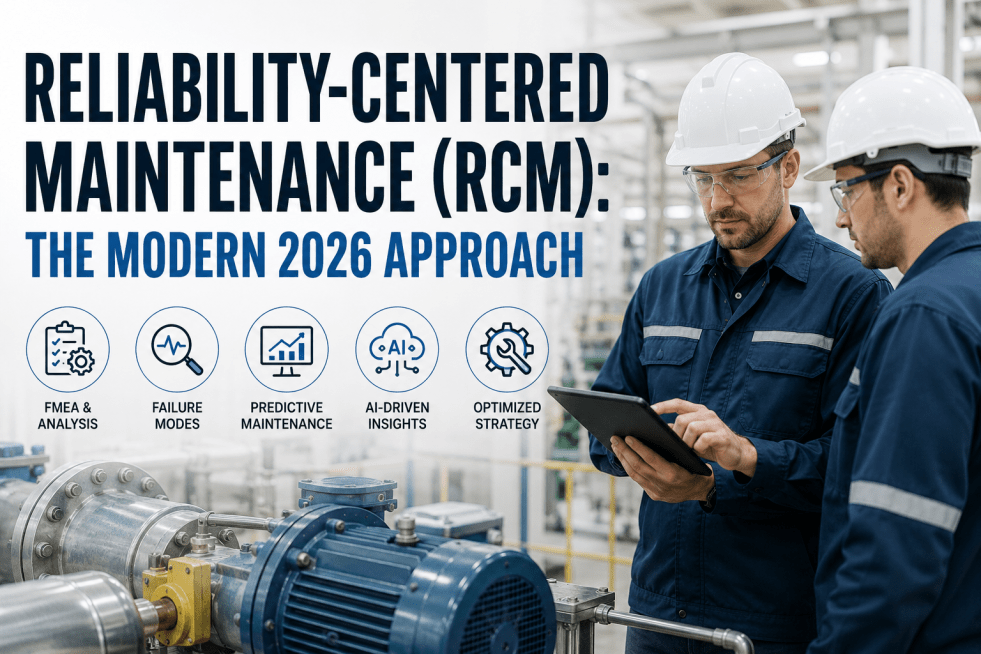
Reliability-Centered Maintenance (RCM) is not a maintenance schedule — it is a structured decision framework that determines the most cost-effective maintenance strategy for every asset in your facility based on how and why it fails, and what the operational consequences of that failure actually are. In 2026, plants that apply RCM correctly are not just reducing unplanned downtime — they are fundamentally changing how maintenance resources are allocated, how FMEA findings translate to work orders, and how AI-driven predictive data feeds back into living maintenance strategies. This guide delivers a technically precise, operationally grounded framework for implementing RCM across U.S. manufacturing facilities — from the FMEA-driven analysis phase to AI-assisted failure mode prioritization and continuous strategy optimization. Book a free demo to see how iFactory's predictive maintenance platform accelerates your RCM program today.
What RCM Actually Is — And What Most Plants Get Wrong
Reliability-Centered Maintenance was formalized by United Airlines engineers Stanley Nowlan and Howard Heap in their 1978 report for the Department of Defense, later codified as SAE JA1011 and JA1012. The core insight was counterintuitive for its time: most equipment failures are not age-related. The famous "bathtub curve" applies to fewer than 20% of industrial components. For the other 80%, failure probability is either random with time or actually decreases as the equipment operates through its early life. Applying time-based preventive maintenance schedules to these components wastes resources and, in some cases, introduces failure by forcing unnecessary disassembly and reassembly.
The most common mistake plants make with RCM is treating it as a maintenance interval optimization project — adjusting PM frequencies without working through the structured FMEA logic that RCM requires. True RCM asks seven specific questions for every asset and every function it performs: What does it do? What happens when it fails? What causes that failure? What are the consequences? Can the failure be detected before it occurs? What is the most effective response? And what happens if no proactive task is economically justifiable? Skipping this logic and jumping to interval tables produces a leaner PM schedule, but not an RCM-based maintenance strategy.
The Seven RCM Questions: A Structured Walk-Through
The RCM analysis process is not a checklist — it is a sequential decision logic that must be applied function by function, failure mode by failure mode. Each answer to one question shapes which options are available in the next. The following framework maps the seven questions to the analytical steps, decision criteria, and maintenance task outputs they produce in practice at U.S. manufacturing facilities.
What are the functions and performance standards of the asset in its current operating context?
Every RCM analysis begins with a precise functional statement — not a description of what the equipment is, but what it must do and to what standard. A centrifugal pump does not simply "pump fluid." In its operating context, it must deliver 1,200 GPM of cooling water at 85 PSI differential with less than 0.3% particulate contamination. Performance standards must be quantitative and context-specific. Primary functions describe the purpose for which the asset was acquired. Secondary functions — structural integrity, containment, control, safety, appearance — are equally critical and frequently overlooked in FMEA worksheets.
In what ways can it fail to fulfill its functions? (Functional Failures)
A functional failure is defined as the inability of an asset to fulfill a function to the required performance standard. Critically, there are two categories: total loss of function (the pump delivers no flow) and partial loss of function (the pump delivers 600 GPM where 1,200 is required). Both are functional failures. The pump that runs but underperforms is as problematic from a process standpoint as one that stops entirely, yet partial failures are consistently underrepresented in conventional CMMS-based PM programs.
What causes each functional failure? (Failure Modes)
Each functional failure has one or more failure modes — the specific physical events that cause the functional failure. For the underperforming pump: impeller wear, seal leakage causing internal recirculation, suction cavitation from system head changes, or bearing wear causing shaft deflection. Each failure mode must be described at the level of detail that determines the maintenance task. "Bearing failure" is insufficient. "Roller element bearing failure due to lubricant contamination from seal ingress" identifies a specific cause that dictates a specific detection method and proactive response.
What happens when each failure occurs? (Failure Effects)
Failure effects describe what actually happens in the plant when a failure mode occurs — not what could theoretically happen, but what does happen. Effects must include evidence that the failure has occurred, ways it threatens safety or the environment, ways it affects production or operations, and physical damage caused. Failure effects are the factual foundation for consequence evaluation. They must be written by people who have witnessed or can credibly describe actual failure events — not constructed theoretically from equipment manuals.
How does each failure matter? (Failure Consequences)
RCM classifies consequences in a strict priority hierarchy: safety and environmental consequences first (failures that could injure or kill people, or violate environmental regulations), then operational consequences (failures that affect output, quality, or cost while the plant continues to operate), then non-operational consequences (failures that only incur direct repair costs). The consequence category determines how much spending on proactive maintenance is economically justifiable. A failure with safety consequences justifies any technically feasible proactive task. A failure with non-operational consequences only justifies a task whose cost is less than the direct repair cost it prevents.
What can be done to predict or prevent each failure? (Proactive Tasks)
Proactive tasks in RCM fall into three categories, evaluated in a specific priority order. Condition-based tasks (on-condition maintenance) monitor a parameter that changes as the failure develops — vibration amplitude, lubricant particle count, infrared temperature signature, ultrasonic emission — and are preferred because they allow intervention based on actual asset condition rather than elapsed time. Time-based restoration and discard tasks are applicable only when a clear age-related failure pattern exists (P-F interval that correlates with operating cycles or calendar time). Failure-finding tasks apply specifically to hidden failures — components that fail without any apparent effect until a demand is placed on them.
What if no suitable proactive task can be found? (Default Actions)
When no technically feasible or economically justifiable proactive task exists, RCM prescribes a specific default action based on consequence category. For safety or environmental consequences, if no proactive task is available, the design must be changed — the failure is unacceptable by definition and operational or design modification is mandatory. For operational consequences, run-to-failure is acceptable only if the operational cost of the failure is less than the cost of prevention. For non-operational consequences, run-to-failure is the default when repair costs are lower than prevention costs. "No scheduled maintenance" is a deliberate, analyzed decision in RCM — not an oversight.
RCM Maintenance Task Selection: Decision Logic and Priority Matrix
Not all maintenance tasks are created equal, and RCM provides a rigorous framework for selecting the right task type for each failure mode. The decision is driven first by technical feasibility — can this task actually detect or prevent the failure — and then by economic justifiability — does the benefit of the task outweigh its cost given the failure's consequence category. The matrix below maps failure consequence categories against the applicable task types and the decision criteria that govern selection. Book a demo to see how iFactory's FMEA module automates this decision logic across your asset register.
| Consequence Category | Condition-Based Task | Time-Based Task | Failure-Finding | Default Action | Justification Threshold |
|---|---|---|---|---|---|
| Safety / Environmental (Hidden) | Preferred | If P-F known | Mandatory | Redesign Required | Any technically feasible task |
| Safety / Environmental (Evident) | Preferred | If P-F known | Not Applicable | Redesign Required | Any technically feasible task |
| Operational (Hidden) | Preferred | If cost-effective | Required | Run-to-Failure + Spares | Task cost < combined failure cost |
| Operational (Evident) | Preferred | If cost-effective | Not Applicable | Run-to-Failure + Spares | Task cost < operational loss + repair |
| Non-Operational (Hidden) | If economical | If economical | Required | Run-to-Failure | Task cost < direct repair cost only |
| Non-Operational (Evident) | If economical | If economical | Not Applicable | Run-to-Failure | Task cost < direct repair cost only |
RCM vs. Traditional Time-Based PM vs. Run-to-Failure: A Structural Comparison
Understanding precisely where conventional maintenance programs fail — and why RCM produces different outcomes — is essential for building internal support for RCM investment. The comparison below is grounded in the structural differences between the three approaches as they perform across the dimensions that matter most to maintenance and operations leadership.
AI-Driven RCM in 2026: How Predictive Analytics Accelerates the Program
Traditional RCM analysis relies almost entirely on historical failure records, engineering judgment, and operator experience captured in facilitated FMEA workshops. This approach is rigorous but slow — a comprehensive RCM analysis for a complex asset like a gas turbine compressor train can require 6–18 months of workshop time before a single task change is implemented. In 2026, AI-assisted failure mode analysis and continuous condition monitoring data have fundamentally changed the speed and precision with which RCM programs can be developed, validated, and kept current.
The most significant contribution of AI to RCM is not replacing the analysis — it is accelerating the P-F interval characterization process. Identifying how far in advance a specific failure mode can be detected before functional failure occurs has historically required years of failure data collection. AI-driven anomaly detection on continuous sensor streams can identify degradation signatures weeks or months before the failure, effectively measuring P-F intervals in real time across every instrumented asset simultaneously. This data feeds directly back into the RCM consequence assessment and task selection decisions.
Automated Failure Mode Identification
AI pattern recognition applied to historical CMMS work order data, vibration signatures, and process historian records can identify recurring failure patterns and candidate failure modes that are underrepresented in manual FMEA workshops. Work orders described as "bearing replacement" across multiple assets can be clustered and traced to common root causes — lubricant contamination, misalignment, or overload — that map to specific FMEA entries requiring condition-based monitoring tasks.
P-F Interval Characterization from Sensor Data
The P-F interval — the period between when a potential failure becomes detectable and when functional failure occurs — is the foundation for setting condition-based task intervals. AI models trained on vibration, temperature, ultrasonic, and process data can identify the earliest detectable deviation from normal behavior, effectively measuring P-F intervals on live assets without waiting for catastrophic failures to occur. This allows condition-based task intervals to be set with statistical confidence rather than engineering estimation.
Dynamic Consequence Recalculation
As production schedules, operating modes, and maintenance staffing change, the operational consequences of specific failure modes change with them. An AI-integrated RCM platform can recalculate consequence severity dynamically — a failure mode that was non-operational during a plant shutdown period becomes critical during peak production — adjusting alert thresholds and escalation urgency in real time without manual FMEA worksheet updates.
RCM Living Program Feedback Loop
A fundamental requirement of SAE JA1011-compliant RCM is that the program be reviewed and updated when actual failure experience deviates from predictions. AI-driven analytics create an automatic feedback loop by continuously comparing predicted failure modes and intervals against actual failure events recorded in the CMMS. When a failure mode occurs that was not predicted, or occurs outside the P-F interval that was assumed, the system flags the FMEA entry for review — keeping the RCM analysis current without manual audit cycles.
RCM Implementation Roadmap: From Asset Register to Living Program
Full-facility RCM implementation is a multi-year program. The most successful deployments use a criticality-prioritized phased approach, achieving measurable ROI from the highest-consequence assets in Phase 1 before expanding to the broader asset register. The roadmap below represents best practice for a U.S. continuous-process manufacturing facility with 500–2,000 assets under management. Book a demo to see how iFactory's platform supports each phase with integrated FMEA tools and predictive analytics.
Asset Criticality Ranking and Scope Definition
Before any FMEA worksheet is opened, every asset in the facility must be ranked by its criticality — the combined effect of failure consequence severity and failure probability. Criticality matrices typically score safety impact, environmental impact, production impact, and asset replacement cost on a 1–5 scale. Assets scoring in the top 20% of criticality should receive full RCM analysis. The remaining 80% can be addressed with streamlined maintenance strategy reviews or retained on existing PM schedules until RCM bandwidth expands. Attempting full RCM across the entire asset register simultaneously is the most common cause of RCM program failure.
RCM Analysis Team Formation and Facilitation
RCM analysis is a team exercise, not a desk study. The analysis team for each asset or system should include the asset operator (who knows the operating context), the craft technician responsible for maintenance (who knows the failure modes), the process engineer (who understands functional consequences), and a reliability engineer or RCM facilitator (who guides the decision logic). External RCM facilitators with SAE JA1011 experience are strongly recommended for the first analysis cycle — the most common errors in FMEA worksheets come from teams working through the seven questions without experienced facilitation.
FMEA Worksheet Completion and Task Selection
The FMEA worksheet is the primary output of the RCM analysis — a structured record of every function, functional failure, failure mode, failure effect, consequence category, and selected maintenance task for every covered asset. Task selection follows the decision logic described earlier: condition-based tasks are evaluated first, time-based tasks second, failure-finding tasks for hidden failures, and default actions where no proactive task is justified. Each selected task must have a defined task interval, responsible craft, required resources, and acceptance criteria. Tasks without these attributes cannot be effectively executed or measured.
Condition Monitoring Infrastructure and CMMS Integration
Condition-based tasks require condition monitoring infrastructure. For each failure mode assigned a condition-based task, the relevant sensor type, measurement frequency, alert thresholds, and alert routing must be specified and installed. Vibration sensors, oil analysis sampling points, thermal imaging access panels, and ultrasonic monitoring positions must be physically installed or confirmed as available. All tasks — condition-based, time-based, and failure-finding — are loaded into the CMMS with the correct task frequencies, resource assignments, and measurement fields. iFactory's CMMS integrates directly with sensor telemetry so that condition-based task triggers are generated automatically when monitored parameters reach alert thresholds.
Performance Measurement and Living Program Review
RCM effectiveness is measured against three primary KPIs: mean time between failures (MTBF) for covered assets versus pre-RCM baseline, percentage of maintenance hours spent on proactive versus reactive work (target: greater than 70% proactive within 36 months of implementation), and total maintenance cost per unit of production output. Formal living program reviews should be conducted annually, or immediately following any failure event that was not predicted by the FMEA — which represents evidence that the analysis requires updating. RCM is not a one-time project; it is a continuous improvement program anchored in a structured analytical framework.
Quantifying the RCM ROI: Investment vs. Reliability Outcomes
The financial case for RCM investment is well-established across U.S. industry. The primary value drivers are reduction in unplanned downtime events, reduction in total PM labor hours through elimination of unjustified tasks, reduction in maintenance-induced failures, and extension of asset service life through optimized intervention timing. The cost structure for RCM implementation varies by facility size and analysis depth, but the payback profile is consistently favorable for facilities with more than $500K in annual maintenance spending.
Expert Review: What Reliability Engineers Say About RCM in 2026
The biggest shift I have seen in the last three years is how AI-assisted condition monitoring has changed the P-F interval conversation. We used to estimate P-F intervals from engineering tables and hope they were conservative enough. Now we have six months of vibration trend data on every rotating asset that tells us exactly how early we can detect each failure mode in our specific operating environment. Our RCM task intervals are based on actual measured P-F data, not OEM estimates. The accuracy improvement in intervention timing alone has extended average asset life by 22% across our compressor train fleet.
We made the classic mistake on our first RCM implementation — we treated it as a PM optimization project and adjusted intervals without working through the seven questions. The result was a leaner PM schedule that still failed to predict the failures that were costing us the most money, because those failures were random-pattern, not age-related. The second implementation, done correctly with facilitated FMEA workshops and consequence evaluation, identified 14 failure modes that were completely unaddressed by our previous program. Twelve of those 14 were the root causes of our highest-cost reactive events. That analysis paid back its cost inside four months.
Conclusion: From Maintenance Schedules to Maintenance Intelligence
Reliability-Centered Maintenance is the most rigorous framework ever developed for answering the question that every maintenance organization ultimately faces: for each failure mode, in each operating context, what is the most effective thing we can do — and is doing something more effective than doing nothing? The seven-question logic, the consequence hierarchy, the P-F interval framework, and the living program requirement are not administrative overhead. They are the analytical structure that separates maintenance strategies that improve asset reliability from those that merely consume maintenance budget.
In 2026, the combination of AI-driven condition monitoring, predictive analytics, and integrated CMMS platforms has removed the primary barrier to RCM adoption — the time and cost of building and maintaining the analytical foundation. P-F intervals can now be measured from sensor data rather than estimated from tables. Failure mode patterns can be identified from work order history rather than constructed entirely from engineering judgment. And the living program feedback loop — historically the most difficult requirement to sustain — can be automated through real-time deviation tracking between predicted and actual failure behavior. The manufacturing facilities achieving best-in-class reliability metrics in 2026 are not doing so with better technicians or more maintenance budget. They are doing so with better analytical frameworks applied consistently, supported by the AI tools that make those frameworks economically executable at scale.
Frequently Asked Questions: Reliability-Centered Maintenance
RCM2 is a branded methodology developed by John Moubray that operationalized and extended the original Nowlan-Heap framework with additional guidance on default actions, hidden failure analysis, and the living program concept. The core analytical logic is identical — both follow the seven-question framework and the consequence hierarchy. The practical distinction is that RCM2 provides more prescriptive guidance on default actions and hidden failure task intervals, which many practitioners find valuable. For SAE JA1011 compliance, both methodologies qualify if they satisfy the standard's seven criteria for RCM processes. For most U.S. industrial implementations, the methodology name matters less than the rigor with which the seven questions are applied and the quality of the facilitation used.
The failure-finding task interval for a hidden failure mode is calculated from the desired availability of the protective function and the mean time to failure of the protected function (the failure mode that the protective device is designed to respond to). The formula is: FFI = (2 × desired availability of protective function) × MTTF of protected function. For example, if a safety relief valve has a MTTF of 10 years and you need 99.9% availability when demanded, the failure-finding interval is approximately 0.02 years — roughly 7 days. In practice, many plants use simplified availability targets (99% or 99.9%) and round to practical inspection intervals. The key requirement is that the interval is derived from a quantified availability target, not set arbitrarily.
For a first RCM implementation, scope should be limited to the top 10–15% of assets by criticality score — typically 3–5 complete systems or subsystems at a continuous-process facility. This scope is sufficient to generate measurable reliability improvements and ROI within 12–18 months, build internal analytical capability through hands-on FMEA experience, and demonstrate program value to leadership before requesting the investment required for full-facility coverage. Attempting to analyze all assets simultaneously in the first cycle is the most common cause of RCM implementation stall — the program runs out of facilitation capacity and organizational energy before producing measurable results.
CMMS work order history is sufficient to complete the FMEA worksheet and initial task selection — you do not need sensor data to perform the RCM analysis itself. Work order history informs failure mode identification, frequency estimation, and consequence documentation. However, sensor data becomes critical for executing condition-based tasks after analysis is complete. If your FMEA identifies vibration monitoring as the appropriate task for a bearing failure mode, you need sensors to execute that task. Many facilities complete a full RCM analysis using only CMMS data and operator experience, then use the resulting task list to prioritize sensor investment — which is a more cost-effective sequence than instrumenting assets before knowing which failure modes matter most.
RCM and ISO 55000 are complementary — they operate at different levels of the asset management hierarchy. ISO 55000 provides the governance framework for asset management: objectives, risk policy, value realization, and organizational accountability. RCM provides the technical methodology for determining what maintenance activities should be performed to deliver the reliability outcomes required by the asset management plan. ISO 55000 requires that maintenance strategies be justified against organizational risk appetite and asset criticality; RCM provides exactly that justification through its consequence evaluation framework. Facilities with mature ISO 55000 programs typically find that RCM fills the technical methodology gap that the standard requires but does not itself prescribe.