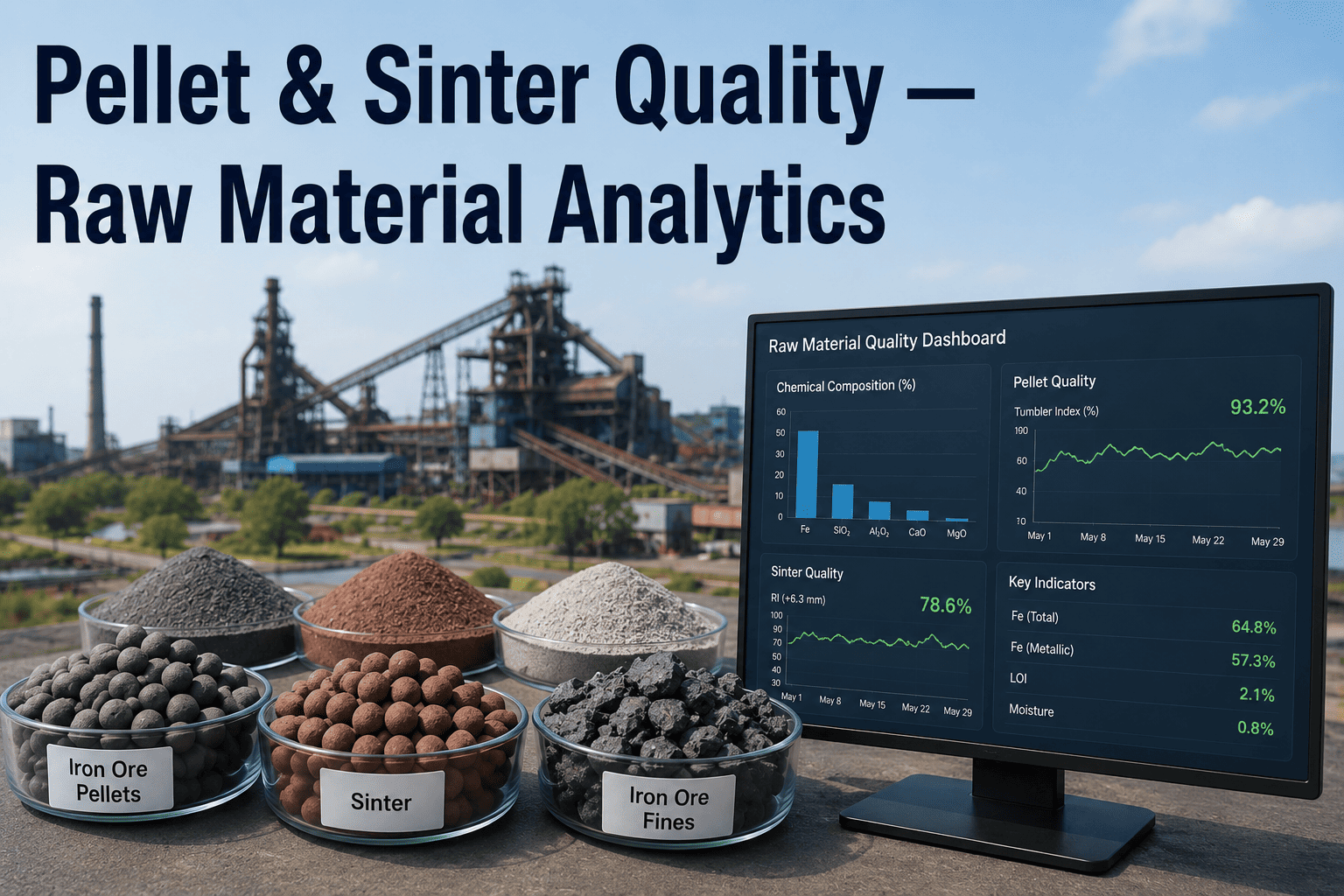
In the high-stakes world of integrated steelmaking, the quality of upstream raw materials—specifically iron ore pellets and sinter—directly determines blast furnace performance, hot metal chemistry, and overall plant profitability. Traditional lab-based quality checks for cold crushing strength, sinter basicity, and tumble index introduce delays that force operators to react to off-spec material rather than prevent it. At iFactory, we deploy AI-driven predictive analytics that fuse real-time sensor data with historical quality records to forecast pellet induration outcomes and sinter machine productivity with unprecedented accuracy. By continuously optimizing iron ore blending, flux proportion, and return fines management, our platform enables steel plants to cut coke rate by 3–5%, reduce raw material variability, and stabilize blast furnace burden design. This long-form guide provides a deep technical exploration of how advanced analytics transforms pellet and sinter quality control, from green ball formation to final burden charging. Book a Demo to see how iFactory can elevate your raw material analytics.
Master Pellet & Sinter Quality with AI-Driven Analytics
Achieve consistent blast furnace burden quality and reduce coke consumption by 3–5% through real-time raw material optimization.
Transform Your Raw Material Quality Control
Leverage AI to predict cold crushing strength, sinter basicity, and tumble index before material reaches the blast furnace.
The Critical Role of Pellet Quality in Blast Furnace Efficiency
Iron ore pellets are a primary feed for modern blast furnaces, and their physical and metallurgical properties—especially cold crushing strength (CCS), porosity, and reducibility—directly influence gas distribution, permeability, and overall furnace stability. Substandard pellets lead to excessive fines generation, increased coke consumption, and inconsistent hot metal quality. Traditional quality assurance relies on periodic lab sampling, which introduces a lag of several hours between production and quality feedback. This delay prevents real-time corrective action, resulting in significant yield losses. Advanced AI models trained on historical production data can predict CCS with over 90% accuracy by analyzing green ball moisture, binder dosage, induration temperature profile, and ore chemistry in real time. This enables operators to adjust parameters instantly, ensuring consistent pellet quality and optimal blast furnace performance.
Cold Crushing Strength Prediction
AI models analyze green ball properties, induration temperature, and residence time to forecast CCS in real time, allowing immediate adjustments to balling and firing parameters. This reduces off-spec pellet generation by up to 20%.
Tumble Index Optimization
By correlating ore mineralogy, binder type, and induration conditions, predictive algorithms optimize tumble index (TI) to exceed 94% target, minimizing fines during handling and transportation.
Porosity & Reducibility Control
Real-time models adjust induration cycle to achieve target porosity (25-30%) and reducibility index (>65%), ensuring optimal gas-solid contact in the blast furnace shaft.
Green Ball Quality Monitoring
Vision-based sensors combined with AI classify green ball size distribution, moisture content, and strength, enabling proactive correction before induration.
Sinter Plant Analytics: From Basicity Control to Productivity
Sinter quality is defined by its basicity (CaO/SiO2 ratio), FeO content, and mechanical strength (tumble index). Variations in sinter chemistry directly impact blast furnace slag volume, desulfurization efficiency, and fuel rate. Traditional sinter basicity control relies on offline XRF analysis with a 1-2 hour lag, leading to significant deviations from target. AI-driven analytics integrate real-time weigh feeders, moisture sensors, and strand speed data to predict sinter basicity and FeO content every minute. This allows automatic adjustment of flux proportion (limestone, dolomite, quartzite) and coke breeze rate, maintaining basicity within ±0.02 of setpoint. Consequently, sinter machine productivity improves by 5-8%, return fines rate drops by 15%, and blast furnace operation stabilizes.
Real-Time Basicity Prediction
Machine learning models ingest feed rates, moisture, and chemical assays to forecast sinter basicity and FeO content with a 2-minute lead time, enabling closed-loop control of flux feeders.
Return Fines Optimization
By predicting sinter strength (tumble index) from strand speed, bed depth, and coke rate, AI minimizes return fines generation, reducing material handling costs and improving yield.
Sinter Machine Productivity
AI models optimize strand speed, bed height, and ignition temperature to maximize sintering rate while maintaining quality, boosting throughput by 5-8%.
Iron Ore Blending: The Foundation of Consistent Burden Quality
Blast furnace burden quality begins with iron ore blending. Variations in ore chemistry—particularly alumina/silica ratio, loss on ignition (LOI), and particle size distribution—propagate through the pelletizing and sintering processes, ultimately affecting hot metal silicon and sulfur levels. Traditional blending relies on stockpile layering and periodic sampling, which cannot compensate for rapid changes in ore supply. AI-driven blending optimization uses real-time ore assay data, inventory levels, and cost constraints to compute the optimal blend that meets target chemistry while minimizing raw material cost. This dynamic approach reduces alumina-silica ratio variability by 30%, stabilizes sinter basicity, and lowers coke rate. The system continuously learns from downstream quality feedback, improving its predictions over time.
| Parameter | Traditional Control | AI-Driven Control | Improvement |
|---|---|---|---|
| Alumina/Silica Ratio | ±0.15 | ±0.05 | 67% reduction in variability |
| Sinter Basicity | ±0.05 | ±0.02 | 60% tighter control |
| Cold Crushing Strength | ±50 kg/pellet | ±15 kg/pellet | 70% improvement |
| Coke Rate | Baseline | 3-5% lower | Direct cost savings |
| Return Fines Rate | 12-15% | 8-10% | 30-40% reduction |
Flux Proportion Optimization for Sinter Basicity Control
Fluxes—limestone, dolomite, quartzite, and olivine—are added to the sinter mix to achieve the target basicity (typically 1.8-2.2 for acid sinters, higher for fluxed sinters). The proportioning of these fluxes must account for their variable chemical composition and reactivity. Traditional proportioning uses fixed ratios based on average assays, leading to basicity swings when ore chemistry changes. AI models continuously optimize flux proportions using real-time XRF data from weigh feeders and moisture sensors, ensuring that the sinter basicity remains within ±0.02 of the target. This reduces slag volume variability in the blast furnace, improves desulfurization, and lowers flux consumption by 5-7%. The model also predicts the impact of flux changes on sinter strength and reducibility, maintaining overall quality.
Limestone & Dolomite Ratio
AI adjusts CaO/MgO ratio to maintain target basicity while optimizing slag fluidity and desulfurization capacity.
Quartzite Addition
When silica is low, quartzite is added to adjust basicity; AI predicts the exact amount needed to avoid overcorrection.
Olivine for MgO
Olivine provides MgO to improve slag properties; AI optimizes its addition to balance basicity and viscosity.
Return Fines Management: Closing the Loop
Return fines—undersized sinter and pellets—are a costly byproduct that must be recycled back into the process. Their generation rate is a direct indicator of upstream quality issues. AI analytics correlate return fines rate with specific process parameters such as bed permeability, coke rate, and moisture content, enabling operators to identify root causes in real time. By predicting return fines generation 30 minutes ahead, the system recommends adjustments to strand speed, ignition temperature, or flux ratio to prevent quality excursions. This closed-loop control reduces return fines rate from 12-15% to 8-10%, improving overall plant yield and reducing energy consumption for remelting.
Alumina-Silica Ratio Control: A Critical Quality Lever
The alumina-to-silica (Al2O3/SiO2) ratio in the blast furnace burden strongly influences slag volume, viscosity, and desulfurization efficiency. High alumina content increases slag viscosity, requiring higher coke rates to maintain fluidity. AI models predict the Al2O3/SiO2 ratio from ore blend composition and adjust flux additions to keep it within the optimal range (0.3-0.5 for typical operations). This reduces slag volume by 5-10% and lowers coke rate by 2-3%. The system also accounts for the alumina contribution from coke ash, providing a holistic burden chemistry optimization.
Implementation Roadmap for AI-Driven Raw Material Analytics
Data Integration
Connect to existing PLCs, weigh feeders, XRF analyzers, and lab databases to ingest real-time process data.
Model Training
Train AI models on historical data to predict CCS, tumble index, basicity, and return fines rate.
Closed-Loop Control
Deploy models to automatically adjust flux proportions, strand speed, and induration temperature.
Continuous Learning
Models continuously update with new data, improving accuracy and adapting to ore supply changes.
Ready to Optimize Your Raw Material Quality?
Implement AI-driven pellet and sinter quality control to reduce coke rate and improve blast furnace performance.
Iron Ore Assay Monitoring: Real-Time Quality Visibility
Accurate and timely iron ore assays are the backbone of raw material quality control. Traditional lab assays take 4-8 hours, causing significant delays in process adjustments. iFactory integrates online XRF analyzers, NIR sensors, and LIBS systems to provide real-time elemental analysis of Fe, SiO2, Al2O3, CaO, MgO, P, S, and LOI. AI models fuse this data with historical lab results to validate sensor readings and detect drift, ensuring reliable quality data. Operators gain a live dashboard of incoming ore quality, enabling proactive blend adjustments and reducing the risk of off-spec burden. This real-time visibility improves blast furnace stability and reduces hot metal chemistry variability by 25%.
Pellet Induration Optimization: Energy and Quality Balance
The induration process—drying, preheating, firing, and cooling—consumes significant energy and determines final pellet quality. AI models optimize the temperature profile and residence time in each zone to achieve target CCS while minimizing fuel consumption. By predicting the impact of green ball moisture, binder content, and ore chemistry on induration behavior, the system adjusts firing temperature and strand speed in real time. This reduces energy consumption by 5-8% and improves pellet quality consistency. The model also detects anomalies in induration (e.g., ring formation, uneven firing) and alerts operators before they cause quality issues.
Blast Furnace Burden Design: The Ultimate Quality Target
All upstream raw material quality optimization ultimately serves the goal of designing a blast furnace burden that maximizes productivity and minimizes cost. AI-driven burden design models consider pellet CCS, sinter basicity, lump ore chemistry, and coke quality to compute the optimal mix for each furnace campaign. The system predicts hot metal silicon, sulfur, and temperature based on burden composition and operating parameters, enabling operators to adjust burden design proactively. This reduces silicon variability by 30% and lowers coke rate by 3-5%, translating to millions in annual savings for a typical integrated steel plant.
Frequently Asked Questions
How does AI predict cold crushing strength of pellets in real time?
AI models are trained on historical data linking green ball properties (moisture, size, binder content) and induration conditions (temperature profile, residence time) to final CCS. Real-time sensor data is fed into the model, which outputs a predicted CCS value every minute. This allows operators to adjust balling parameters or firing temperature before pellets exit the induration machine, preventing off-spec production. The system continuously learns from lab measurements to improve accuracy. Book a Demo to see a live implementation.
What is the typical accuracy of AI-based sinter basicity prediction?
Our AI models achieve sinter basicity prediction accuracy within ±0.02 of the lab-measured value, with a lead time of 2-3 minutes. This is achieved by fusing real-time weigh feeder data, moisture sensors, and online XRF analysis. The model is trained on site-specific data and continuously updated to account for changes in ore supply and plant conditions. This level of accuracy enables closed-loop control of flux feeders, maintaining basicity at target consistently. Contact Support for more technical details.
Can AI help reduce return fines in the sinter plant?
Yes, AI models predict the tumble index and return fines rate based on strand speed, bed depth, coke rate, and moisture content. By adjusting these parameters in real time, the system reduces return fines generation by 15-30%. The model also identifies the root cause of high return fines, such as poor bed permeability or uneven ignition, enabling targeted corrective actions. This improves sinter yield and reduces energy consumption for reprocessing. Book a Demo to learn more.
How does AI optimize iron ore blending for blast furnace burden?
AI blending optimization uses real-time ore assay data, inventory levels, and cost constraints to compute the optimal blend that meets target chemistry (Al2O3/SiO2 ratio, basicity, LOI) while minimizing raw material cost. The system considers multiple ore sources and their variability, updating the blend recommendation every hour. This reduces chemistry variability by 30% and lowers coke rate by 2-3%. The model also predicts the impact of blend changes on downstream pellet and sinter quality. Contact Support for a case study.
What ROI can a steel plant expect from implementing these analytics?
Typical ROI includes a 3-5% reduction in coke rate (saving $2-5 million annually for a 3 Mtpa plant), 15-30% reduction in return fines (saving $1-2 million), and 5-8% increase in sinter machine productivity. Additionally, improved blast furnace stability reduces refractory wear and maintenance costs. The payback period is typically 6-12 months. Book a Demo to get a customized ROI assessment.
Transform Your Raw Material Quality with iFactory
Deploy AI-driven analytics to optimize pellet and sinter quality, reduce coke rate, and improve blast furnace performance.