On July 6, 1988, an explosion on the Piper Alpha oil platform killed 167 workers. The root cause was not a mechanical failure — it was a permit-to-work system that failed to communicate the state of partially disassembled equipment during a shift handover. Decades later, the same failure pattern persists across industrial facilities worldwide. PTW system failures were identified as the root cause in nearly 7% of all process safety accidents in a major 25-year study covering over 600 incidents. According to the National Safety Council, 33% of workers report being exposed to permit-to-work failures, and 14% say PTW failure directly caused or contributed to a serious injury at their workplace. The mean probability of human error in paper-based PTW systems is 11% per permit cycle — with flammable gas testing errors reaching 50.7%. The UK Health and Safety Executive concluded that the most significant cause of maintenance-related accidents in the chemical industry was the failure to implement effective permit-to-work systems. Paper permits do not prevent accidents — they document intentions. Digital PTW systems enforce them. iFactory deploys AI-powered Permit to Work systems for industrial and steel plant environments — book a 30-minute consultation to see how digital PTW transforms your safety operations.
Digital Permit to Work System
Paper Permits
Document Intentions.
Digital PTW Enforces Safety.
AI-Powered Work Permit Lifecycle Management for Hot Work, Confined Space, Electrical Isolation, LOTO & Height Work in Industrial Environments
Book a Free Consultation
7%
Of Process Safety Accidents Traced to PTW Failures
11%
Mean Human Error Probability in Paper PTW Systems
33%
Of Workers Report Exposure to PTW Failures
80%+
Of Chemical Industry Accidents Linked to Human Error
Why Paper Permits Fail — and What Replaces Them
A paper permit is a snapshot of intentions at a single moment in time. It cannot enforce compliance after it is signed. It cannot detect that a second permit has been issued for conflicting work in the same zone. It cannot alert anyone when a permit expires while workers are still inside a confined space. These are not edge cases — they are the systemic failures that accident investigators find with depressing regularity across every industry, every geography, and every organizational size.
Paper-Based PTW
Permits completed with missing fields — incomplete hazard identification goes undetected until an incident investigation
Copy-paste risk assessments reused from previous permits without task-specific hazard review
Permit shopping — worker refused by one issuer approaches a less rigorous issuer for the same work
No visibility into simultaneous operations (SIMOPs) — conflicting permits issued in the same work zone
Expired permits remain in workers' pockets — no automatic closure or escalation mechanism
Shift handover gaps — incoming shift unaware of active permits, isolations, or partially completed work
iFactory Digital PTW
Mandatory field validation — permit cannot be submitted until every hazard, control measure, and PPE requirement is completed
AI-generated risk assessments based on permit type, work location, weather, and active SIMOPs — unique per task
Single-source permit registry prevents duplicate issuance — system flags conflicting requests automatically
Real-time SIMOP detection — alerts issuers when new permits conflict with active work in the same zone
Automatic expiry enforcement — workers and supervisors alerted before expiry, permit auto-locks after deadline
Live permit dashboard shows every active permit, isolation, and work zone to incoming shift — zero handover gaps
Eight Permit Types, One Unified System
Every high-risk industrial activity requires a different permit type with specific hazard controls, PPE requirements, and approval chains. Managing these as separate paper forms creates silos. iFactory unifies all permit types into a single digital platform where every permit is linked to a work location, a risk assessment, active isolations, and the real-time status of every other permit on site.
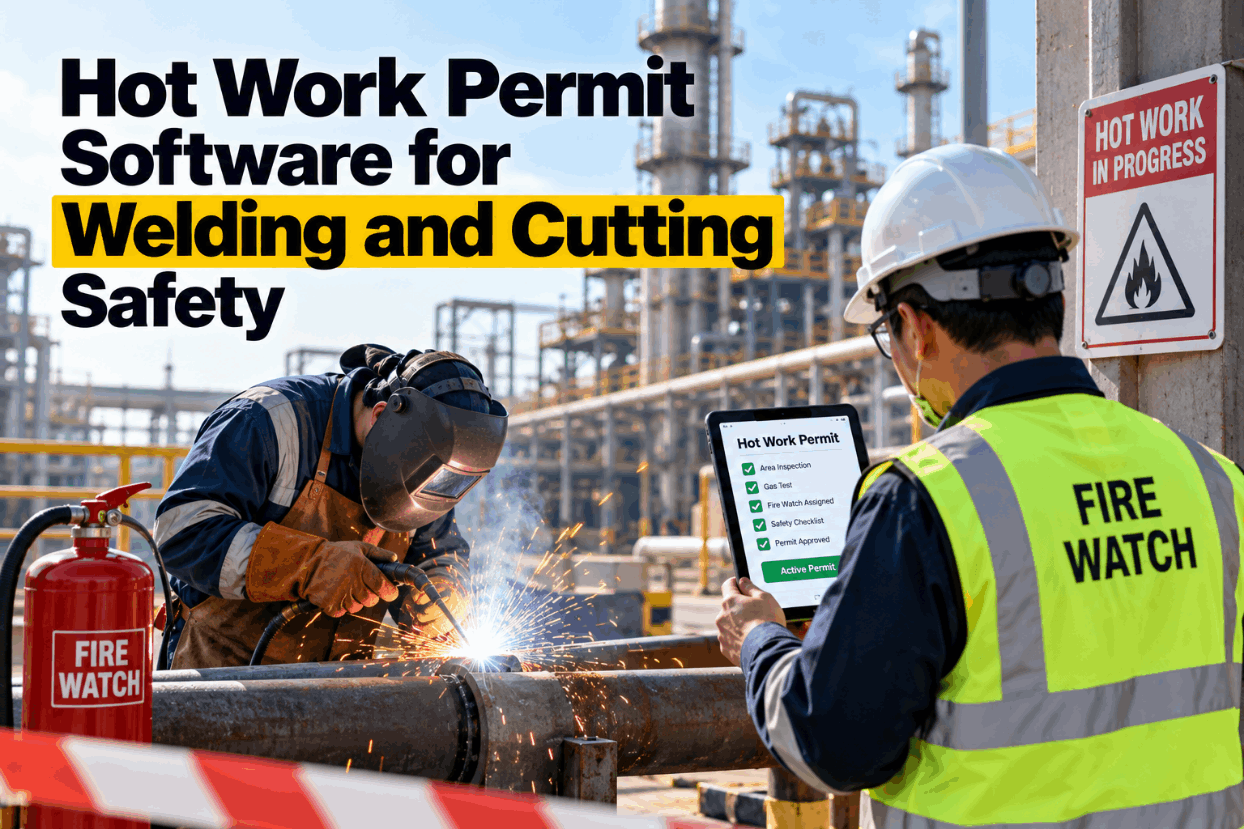
Hot Work Permit
Welding, cutting, grinding, brazing — any spark-producing activity near flammable materials. AI checks ambient gas readings from integrated sensors before approval and monitors continuously during work.
Confined Space Entry
Tanks, vessels, silos, manholes — spaces with limited egress and potential atmospheric hazards. System enforces gas testing, standby rescue, and continuous atmospheric monitoring via IoT integration.
Electrical Isolation
Work on or near energized equipment. Digital permit linked to LOTO procedures with verification steps for isolation confirmation, testing, and re-energization authorization.
Lockout Tagout (LOTO)
Mechanical, pneumatic, hydraulic, and thermal energy isolation. System tracks every lock, every tag, every authorized worker — and blocks permit closure until all locks are removed and verified.
Work at Height
Scaffolding, elevated platforms, roof access, crane operations. AI checks weather conditions (wind speed, precipitation) and flags when environmental limits exceed safe thresholds for elevated work.
Excavation & Ground Work
Digging, trenching, and ground penetration near underground utilities. Permit enforces utility survey completion, shoring requirements, and depth-triggered PPE escalation.
Radiography & NDT
Industrial radiography, X-ray testing, and non-destructive examination near operational areas. System enforces exclusion zone definition, barrier placement, and exposure time limits.
General Work Permit
Non-routine maintenance, contractor entry, equipment modification, and any activity deviating from standard operating procedures. Configurable hazard checklists and approval chains per activity type.
The Digital PTW Lifecycle: From Request to Close-Out
Every permit follows a six-stage lifecycle. Skipping any stage has killed workers. iFactory enforces every stage digitally — with mandatory completions, role-based approvals, geo-tagged timestamps, and automated escalations that make shortcuts physically impossible within the system.
01
Request & Hazard ID
Worker or supervisor initiates permit via mobile app. AI pre-populates hazard checklist based on permit type, location, and historical incident data for that zone. All mandatory fields enforced before submission.
02
Risk Assessment
AI generates task-specific risk assessment incorporating active SIMOPs, weather conditions, equipment status, and any open incident reports for the work area. No copy-paste — every assessment is unique.
03
Approval & Authorization
Role-based approval chain routes permit to qualified issuers. System blocks approval if conflicting permits exist, required isolations are incomplete, or safety conditions are unmet. Digital signatures with timestamp.
04
Execution & Monitoring
Work proceeds under active permit. IoT sensors feed real-time data — gas levels, temperature, wind speed — with automatic alerts if conditions change. Geo-tagged worker location confirms presence in permitted zone.
05
Handback & Verification
Work area restored, isolations removed, tools accounted for. Photo evidence of site condition required. System verifies all LOTO locks removed before handback acceptance.
06
Close-Out & Audit Trail
Permit formally closed with complete audit trail — every action, every approval, every sensor reading, every timestamp preserved. Feeds into compliance reporting and incident analytics for continuous improvement.
What Makes iFactory Different
AI-Powered Risk Intelligence
The system does not just digitize paper forms — it generates intelligent risk assessments by analyzing permit type, work location history, concurrent activities, weather data, and equipment condition. Every permit gets a unique, context-aware hazard profile that evolves with site conditions.
SIMOP Conflict Detection
When a hot work permit is requested 50 meters from an active confined space entry, the system flags the conflict before approval — not after an incident. Real-time spatial awareness across all active permits prevents the most dangerous category of PTW failure.
IoT & Sensor Integration
Connect gas detectors, atmospheric monitors, weather stations, and access control systems directly into the permit workflow. If a gas reading exceeds threshold while a hot work permit is active, the system triggers an immediate alert to the permit holder, issuer, and safety team.
Mobile-First, Field-Ready
Create, approve, monitor, and close permits from any mobile device — in the field, at the work face, on the platform. Offline capability ensures functionality in areas with limited connectivity. Photo capture, geo-tagging, and digital signatures built into every workflow step.
Frequently Asked Questions
What permit types does the system support?
iFactory supports all standard industrial permit types including hot work, confined space entry, electrical isolation, lockout tagout (LOTO), work at height, excavation, radiography/NDT, and general work permits. Each permit type has configurable hazard checklists, PPE requirements, and approval chains. New permit types can be created and configured without code changes.
How does the system prevent permit shopping and duplicate issuance?
Every permit request enters a centralized registry. If a worker is refused a permit and approaches a different issuer, the system shows the previous refusal with reason. Duplicate permits for the same work scope, location, and time window are automatically flagged. All issuers see the complete permit history for any worker or work zone before making authorization decisions.
Can the platform integrate with our existing safety and access control systems?
Yes. iFactory integrates with gas detection systems, atmospheric monitors, weather stations, access control (turnstiles, RFID), CCTV, and existing SCADA/DCS infrastructure via standard protocols including MQTT, REST APIs, and OPC-UA. It also connects to ERP and CMMS platforms for work order linkage, ensuring that maintenance activities and their associated permits are tracked in a single system.
What audit trail does the system maintain?
Every action in the permit lifecycle is recorded with a geo-tagged, time-stamped audit trail — including permit creation, hazard identification entries, risk assessment generation, approval decisions, rejection reasons, condition changes, sensor readings during execution, handback verification photos, and formal close-out. This complete trail satisfies regulatory audit requirements and provides investigation-ready data in the event of an incident.
Your Workers Deserve More Than a Paper Form Between Them and a Hazard.
iFactory deploys AI-powered digital Permit to Work systems for industrial and steel plant environments — enforcing every safety step, detecting every conflict, and creating an unbroken audit trail from request to close-out. Every permit tracked. Every hazard controlled. Every worker protected.