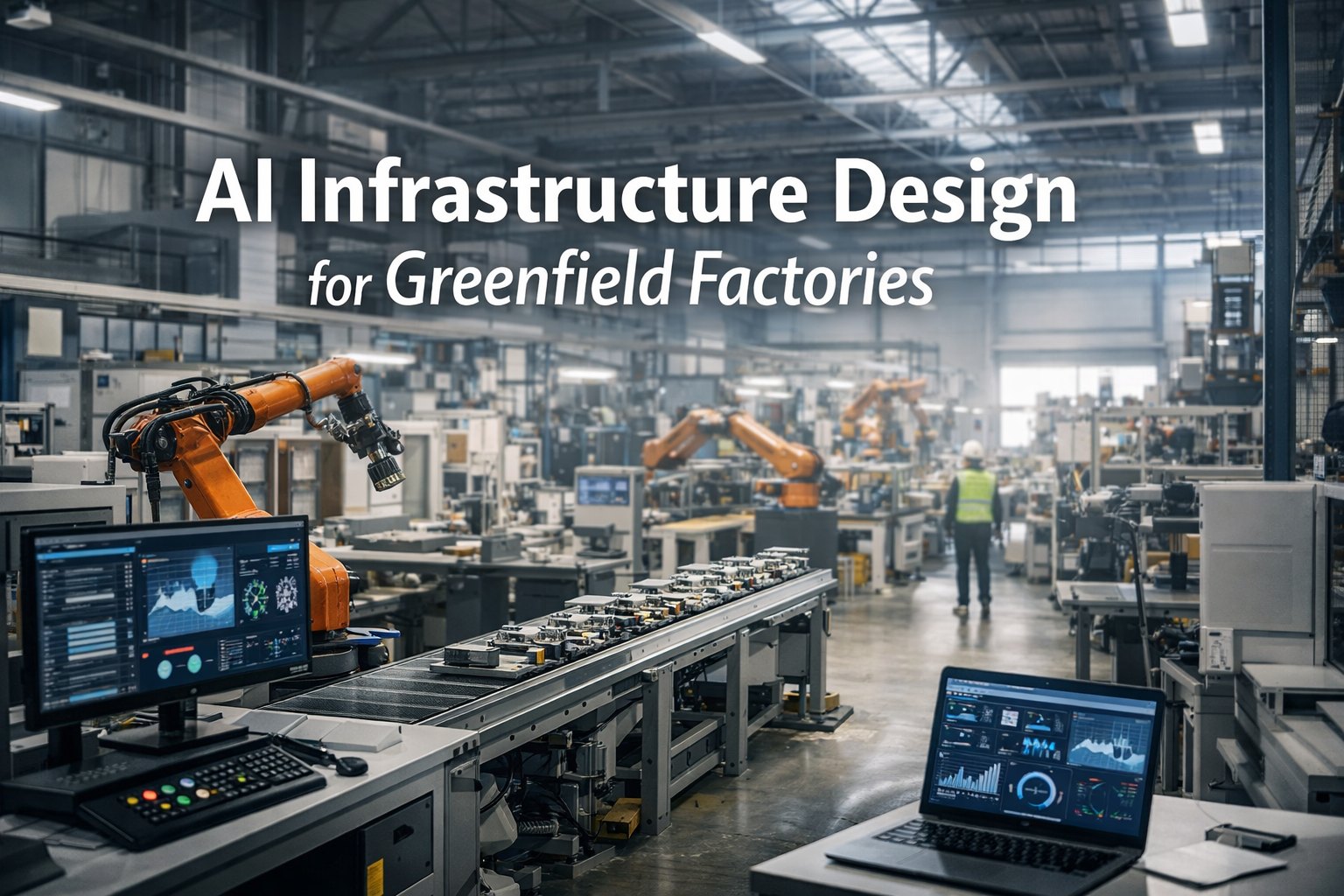
A $200M greenfield factory without AI-ready infrastructure is a $200M legacy plant on day one. By 2026, 75% of enterprise data is created and processed outside traditional data centers. Your factory floor will generate terabytes daily — from vibration sensors, vision cameras, PLCs, quality systems, and autonomous robots. If the infrastructure to collect, move, process, and act on that data is not designed into the blueprint, every AI initiative you attempt later becomes a costly, compromised retrofit. This guide shows exactly how to architect AI-ready infrastructure for greenfield factories — from the sensor layer to the edge, from the Unified Namespace to the digital twin. Book a free consultation to design your AI infrastructure before breaking ground.
The $10M Mistake: Building a Factory Without an AI Data Strategy
Most greenfield projects plan power, plumbing, and production lines meticulously — then treat data infrastructure as an IT afterthought. The result is predictable: siloed PLCs speaking OPC UA, an MES running on SQL, an ERP in the cloud, maintenance logs in spreadsheets, and sensor data going nowhere. When the CEO asks for predictive maintenance or AI-driven quality control 18 months after commissioning, the answer is always the same — "We need to redesign the network first." That redesign costs 3–5x what it would have cost to design it right from the blueprint.
Planning a greenfield factory? Get a free AI infrastructure assessment — we will map your data architecture before construction begins, saving millions in retrofit costs.
The 5-Layer AI Infrastructure Stack
AI-ready factory infrastructure is not a single technology — it is a complete stack, designed as a system. Each layer depends on the layer below it. Skip a layer, and every layer above it fails. Here is the architecture that leading greenfield factories are deploying in 2026.
Predictive maintenance, AI vision inspection, digital twins, autonomous scheduling, energy optimization, agentic AI agents that reason and act on production data in real time. This is where ROI is generated.
The single event-driven data bus (UNS) connecting every sensor, PLC, MES, ERP, CMMS, and AI model. MQTT/Sparkplug B as the backbone. Without this layer, AI models lack the context to reason — a temperature reading without batch, load state, and maintenance history is just a number.
GPU-accelerated edge servers (NVIDIA Jetson, industrial GPUs) running AI inference at sub-millisecond latency. 200–500 sq ft of climate-controlled space near the production floor. Cooling designed for 15–30 kW per rack. Real-time decisions without cloud dependency.
Segmented industrial Ethernet and private 5G for real-time automation. OPC UA, MQTT, and Modbus protocols for interoperability. High-bandwidth fiber connectivity. Network slicing for QoS guarantees. IEC 62443 zone/conduit architecture built in.
Vibration, temperature, pressure, current, humidity, flow — IoT sensors at $0.10–$0.80/unit making comprehensive instrumentation affordable. Smart PLCs with built-in connectivity. Vision cameras. Barcode/RFID readers. The raw data foundation everything else depends on.
The Unified Namespace: The Brain of Your AI Factory
The single most important infrastructure decision for any AI-ready factory is the Unified Namespace (UNS). This is the event-driven data layer that connects every system — from a vibration sensor on a pump to an AI model predicting remaining useful life to the CMMS generating the work order. Without a UNS, your factory is a collection of data silos. With it, your factory becomes an intelligent organism.
What AI Infrastructure Enables
Designing AI infrastructure into the blueprint is not a theoretical exercise — it directly enables the AI applications that deliver measurable ROI from day one. Here are the six highest-impact capabilities that AI-ready infrastructure unlocks.
Vibration, temperature, and current sensors feed edge AI models that predict equipment failure 60–90 days in advance. Automated work orders in the CMMS. $1.2–3.5M annual savings per facility.
Camera systems running deep learning models at the edge detect surface defects, assembly errors, and contamination at production speed. 37% defect reduction within the first year.
Virtual replicas of every machine and production line, continuously synchronized with real-time sensor data. Test changes virtually before touching hardware. Compress commissioning timelines.
AI monitors compressed air, HVAC, motor loads, and production scheduling to eliminate energy waste in real time. WAGES KPIs tracked continuously for ESG compliance.
Real-time scheduling, changeover optimization, and bottleneck detection powered by AI analysis of the complete production data stream through the UNS.
Autonomous agents that reason across multiple data sources, adjust parameters, schedule maintenance, optimize energy, and escalate anomalies — without human intervention in the loop.
Your AI Strategy Is Only as Good as Your Infrastructure
iFactory designs the complete AI data stack — from sensor selection to UNS architecture to edge compute sizing — so your greenfield factory is AI-ready from commissioning day one.
Greenfield AI Infrastructure: Phase-by-Phase
AI infrastructure must be designed, procured, installed, and validated alongside the physical factory build — not after. Here is how the AI infrastructure timeline maps to your greenfield construction phases.
Define the 5-layer stack. Design UNS topic hierarchy. Size edge compute rooms (200–500 sq ft, 15–30 kW/rack cooling). Specify network segmentation and IEC 62443 zone/conduit model. Select sensor types per asset criticality. Define data flow architecture.
Require OPC UA / MQTT connectivity from all equipment vendors. Specify smart PLCs with built-in data publishing. Procure edge servers with GPU acceleration. Select CMMS, MES, and analytics platforms with UNS integration capability.
Build segmented network backbone with fiber and private 5G. Install edge compute room with dedicated cooling and fire suppression. Run cable pathways for sensor networks. Install power infrastructure for 2–3x typical AI compute loads.
Deploy UNS broker (MQTT/Sparkplug B). Configure OPC UA connectors to PLCs. Install edge AI runtime and model deployment pipeline. Connect MES, ERP, and CMMS to the UNS. Deploy SIEM for security monitoring.
Train and deploy initial AI models (predictive maintenance, vision inspection, energy optimization). Validate data flows end-to-end. Load-test edge compute. Run digital twin sync verification. Conduct security penetration testing.
Edge Computing: The Engine Room of Factory AI
Cloud computing is essential for model training, long-term analytics, and cross-plant benchmarking. But production-critical AI decisions — reject a defective part, stop a failing motor, adjust a recipe parameter — cannot wait for a round trip to the cloud. Edge computing brings AI inference directly to the factory floor with sub-millisecond latency, zero cloud dependency, and complete data sovereignty.
How iFactory Designs AI Infrastructure for Greenfield
iFactory does not sell AI infrastructure hardware. We design the complete data architecture that makes every AI application possible — then ensure it is built correctly during construction, validated during commissioning, and continuously optimized during operations.
We design your Unified Namespace topic hierarchy, define data models, and specify the MQTT/Sparkplug B infrastructure that connects every system in your factory.
We calculate GPU requirements, cooling loads, rack density, and power needs based on your specific AI workloads — vision inspection, predictive maintenance, digital twins.
We specify which sensors go on which assets, at what sampling rates, feeding which AI models — ensuring comprehensive instrumentation without unnecessary cost.
IEC 62443 zone/conduit design, private 5G planning, industrial Ethernet topology — security and performance designed together, not bolted on.
Predictive maintenance, vision inspection, digital twins, energy optimization, agentic AI — prioritized by ROI, with infrastructure requirements mapped to each phase.
End-to-end data flow testing, edge compute load testing, AI model validation, security penetration testing — your AI infrastructure verified before production starts.
Need your AI infrastructure designed before breaking ground? Book a free architecture session — we will map your 5-layer stack, size your edge compute, and define your UNS in a single engagement.
Frequently Asked Questions
Design AI Into the Blueprint. Not Into the Budget Overrun.
iFactory architects the complete AI data stack for greenfield factories — UNS, edge compute, sensor strategy, and AI application roadmap — so your plant is intelligent from day one.