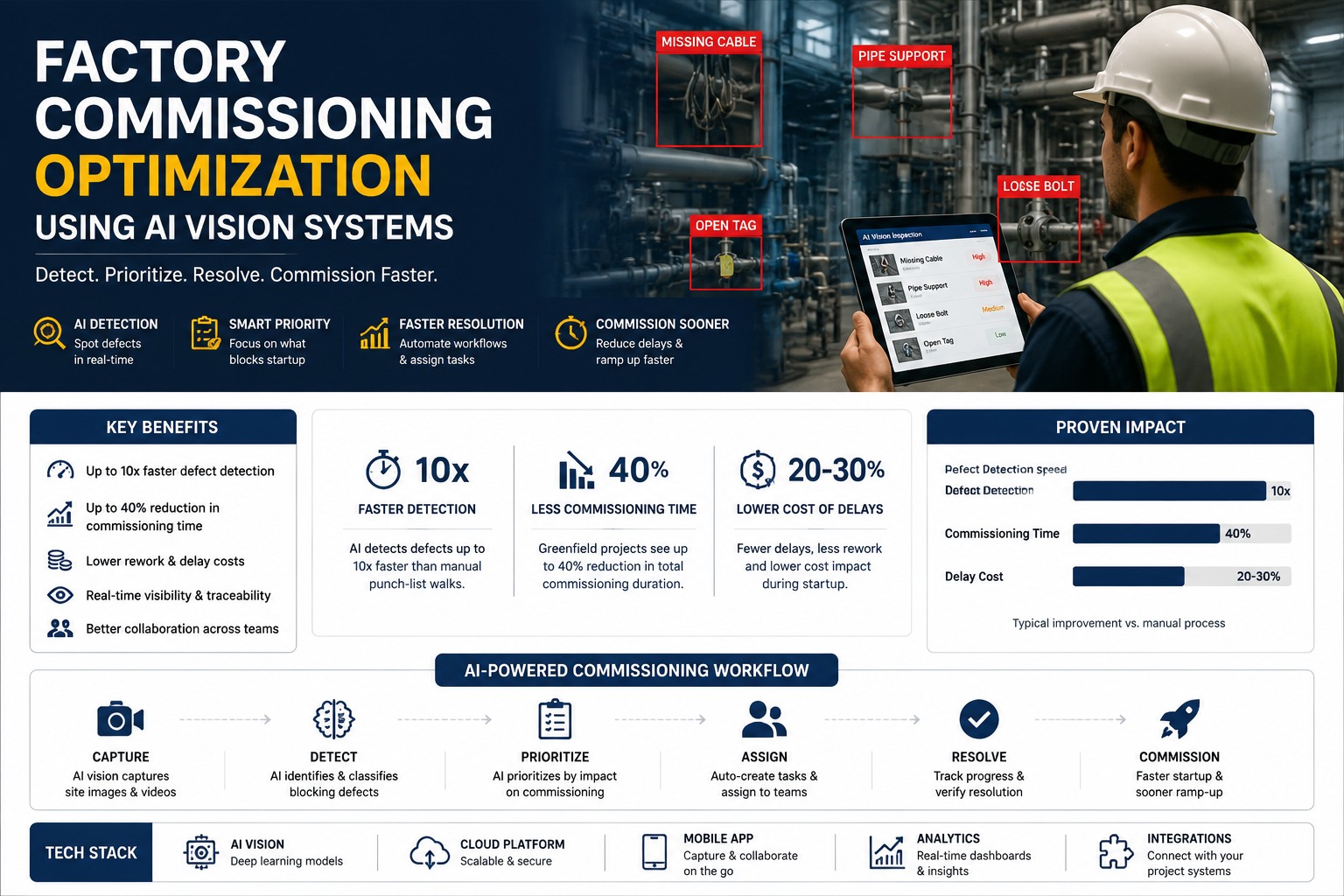
Commissioning is where greenfield projects succeed or fail. The facility is built, equipment is installed, labor is on-site — and every day of delay costs $50K-$500K depending on scale. Yet 70% of commissioning delays trace to control software errors, and cascade effects turn a single unresolved issue into weeks of downstream delays: loop checks can't proceed until I/O is verified, functional testing waits for loop checks, operator training requires functional systems, and startup depends on trained operators. The difference between a 4-week and a 14-week commissioning timeline is not luck — it's structured FAT/SAT execution, AI-assisted validation, and digital twin testing that catches 80%+ of issues before they reach the factory floor. This guide walks through every stage of greenfield commissioning — from virtual FAT through production qualification — with the checklists, test protocols, and AI accelerators that deliver first-time-right startup. Book a consultation to scope your commissioning plan.
Pre-Commissioning Planning
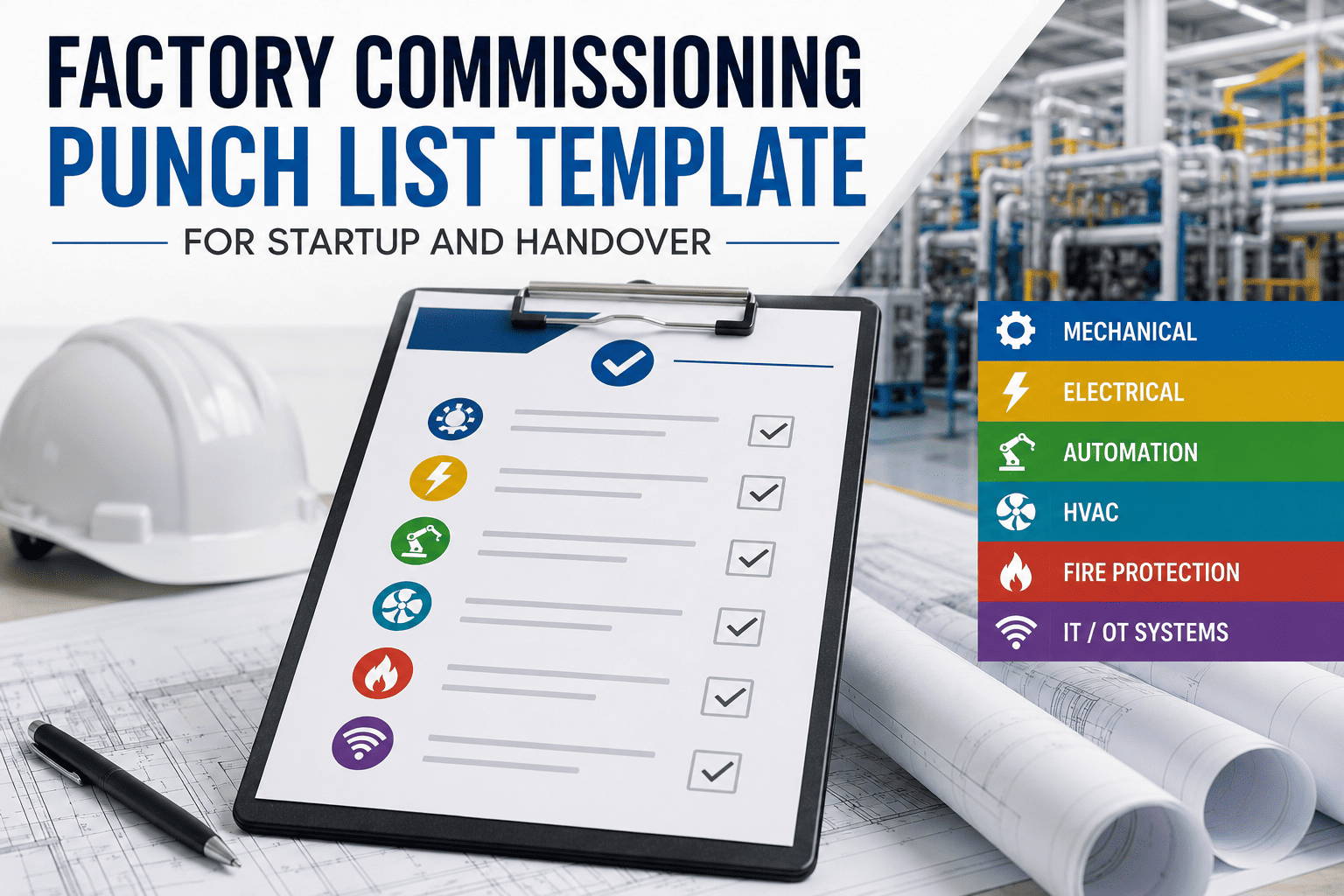
12–8 weeks before physical commissioningCommissioning success is determined by planning quality — not testing speed. Pre-commissioning defines every test procedure, acceptance criterion, responsibility assignment, and documentation requirement before a single system is energized. The Commissioning and Qualification (CQV) plan must be adjusted based on reliance on third parties, vendor expertise, regulatory requirements, and the interplay between FAT, SAT, and IQ/OQ/PQ.
Virtual Commissioning (Digital Twin Testing)
8–4 weeks before physical commissioningVirtual commissioning tests the actual PLC code and robot programs against a physics-accurate digital twin before equipment arrives on-site. Research shows this can save up to 75% of commissioning time. The virtual model responds to PLC outputs and generates sensor inputs exactly as the physical system would — every interlock, sequence, and safety check is tested against real control logic. Projects that include virtual commissioning consistently achieve 3-5% cycle time accuracy on the first physical run.
Planning your commissioning phase? Book a 30-minute consultation to scope your virtual commissioning and CQV plan with our greenfield specialists.
Factory Acceptance Testing (FAT)
At vendor facility, before shipmentFAT is the quality gate between build and delivery — performed at the vendor's facility to verify that equipment meets design, functional, and compliance requirements before shipping. It is not a demo; it is an execution of approved protocols with pass/fail criteria, controlled deviations, and signed results. Identifying issues at the vendor's site costs a fraction of resolving them on-site. FAT also provides the opportunity for the owner's team to train alongside the vendor's expert teams — knowledge transfer that is critical for long-term commissioning success.
| FAT Test Domain | What's Verified | Pass Criteria | Typical Duration |
|---|---|---|---|
| Documentation Review | Drawings, P&IDs, hardware/software specs, certificates | All docs match approved design; no gaps | 0.5–1 day |
| Visual & Dimensional Inspection | Physical construction, materials, dimensions, finish quality | Within tolerances per spec; no visible defects | 0.5–1 day |
| I/O Verification | Every signal type, scaling, engineering units, alarm setpoints, fail-safe states | 100% of I/O points verified individually | 1–3 days |
| Control Logic Testing | Sequences, interlocks, control loops, manual/auto switching, PID tuning | All sequences complete without error; interlocks verified | 2–5 days |
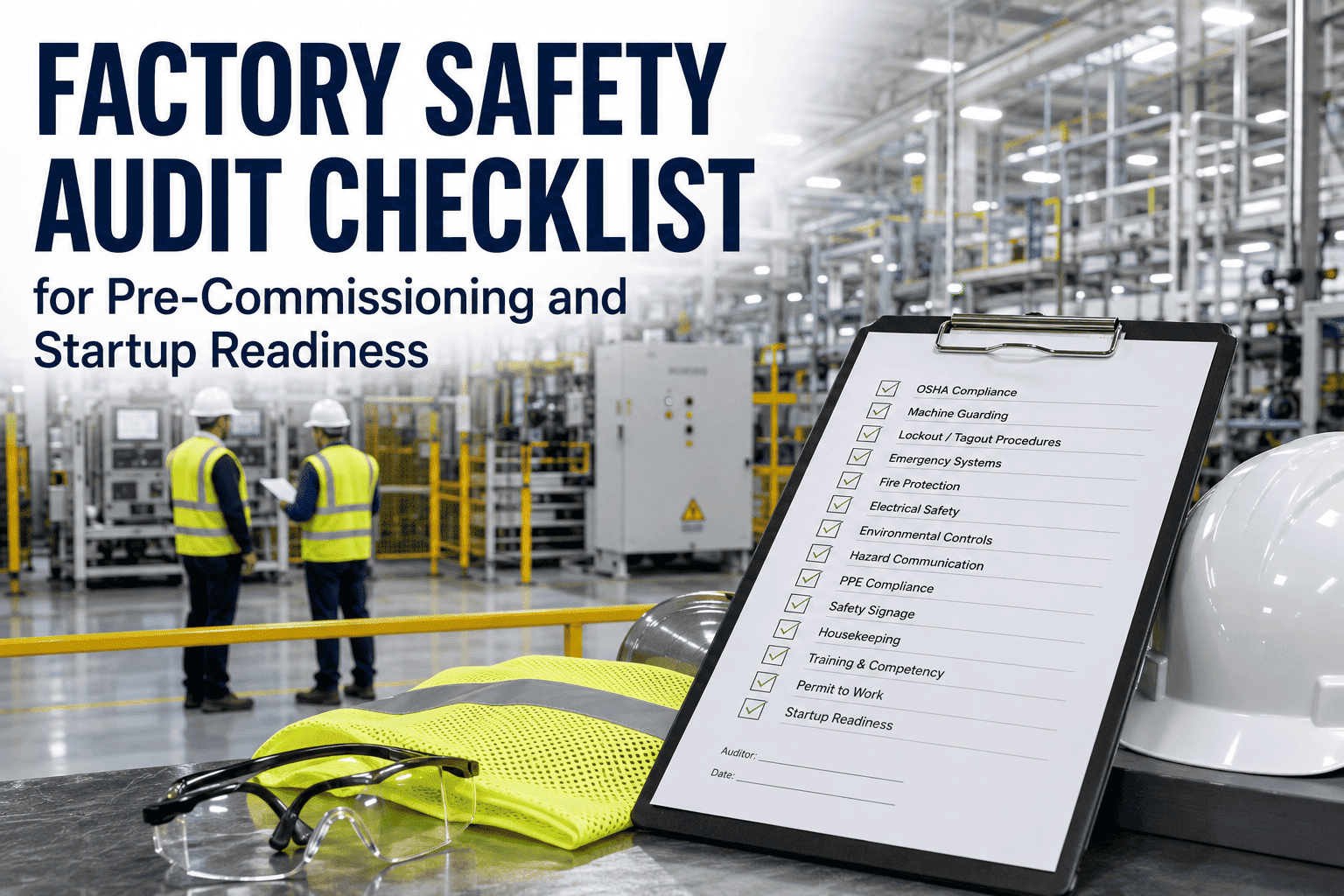
| Safety System Testing | E-stops, light curtains, safety interlocks, zone logic | All safety functions verified; fail-safe confirmed | 1–2 days |
| HMI/SCADA Verification | Screen layouts, alarm management, mode transitions, data logging | All screens functional; alarms trigger correctly | 1–2 days |
| Performance/Load Testing | Operation under rated or simulated load conditions | Parameters within spec under load | 1–3 days |
Site Acceptance Testing (SAT)
At your facility, post-installationSAT verifies that equipment delivered and installed at your site functions correctly in the actual operating environment — which differs from the vendor's facility in temperature, humidity, utility supply, vibration, and electromagnetic interference. SAT re-confirms critical FAT results and adds site-specific tests: utility connections, network integration, interface verification with adjacent systems, and environmental performance. A passed FAT does not guarantee a flawless installation — transport damage, utility gaps, and site-specific conditions can introduce new issues.
System Integration Testing
1–4 weeks post-SATIntegration testing verifies that all equipment, control systems, and software platforms work together as a unified production system — not just individually. Field devices must be correctly reflected on dashboards and controllable from central locations. MES, ERP, CMMS, SCADA, and AI platforms must receive and process data correctly through the Unified Namespace. This is the stage where system-level issues surface: communication timing, data format mismatches, handshake failures, and network bottlenecks.
Approaching integration testing? Schedule an integration readiness review — we'll verify your UNS connectivity, CMMS configuration, and system-level test plan before you begin.
Production Qualification (IQ/OQ/PQ)
2–8 weeks post-integration testingFor regulated industries (pharma, food, medical devices), production qualification follows IQ/OQ/PQ protocols. For non-regulated manufacturing, this stage validates that production output consistently meets quality targets, dimensional tolerances, and customer specifications at progressively increasing volumes. FAT and SAT documentation can be leveraged to support IQ and OQ — avoiding unnecessary repetition and compressing the qualification timeline.
| Qualification Stage | Purpose | What's Verified | Leveraged From |
|---|---|---|---|
| IQ (Installation Qualification) | Equipment installed per design specifications | Physical installation, utility connections, as-built vs. design | SAT documentation (installation verification) |
| OQ (Operational Qualification) | Equipment operates within design parameters | Functional performance, operating ranges, alarm responses | FAT/SAT results (control logic, I/O, safety tests) |
| PQ (Performance Qualification) | Equipment produces product meeting specifications | Process capability (Cpk), product quality, consistency over time | Integration testing data (end-to-end production runs) |
Handover to Operations
Upon successful qualificationHandover transitions the facility from "project mode" to "operations mode." This is not a single event — it's a structured transfer of ownership covering documentation, training, maintenance systems, and operational procedures. The digital twin transitions from a commissioning tool to a living operational asset. CMMS shifts from configuration to active maintenance management. The project team's knowledge must be formally captured and transferred to the operations team.
First-Time-Right Commissioning Starts with the Right Plan
iFactory provides AI-assisted commissioning support — from virtual FAT through production qualification and handover. Every stage planned, every test tracked, every issue resolved before it cascades.
Frequently Asked Questions
Every Day of Commissioning Delay Costs $50K–$500K
Virtual commissioning, structured FAT/SAT, and AI-assisted validation compress your timeline by 40-75%. Don't debug on the factory floor — debug in the digital twin.