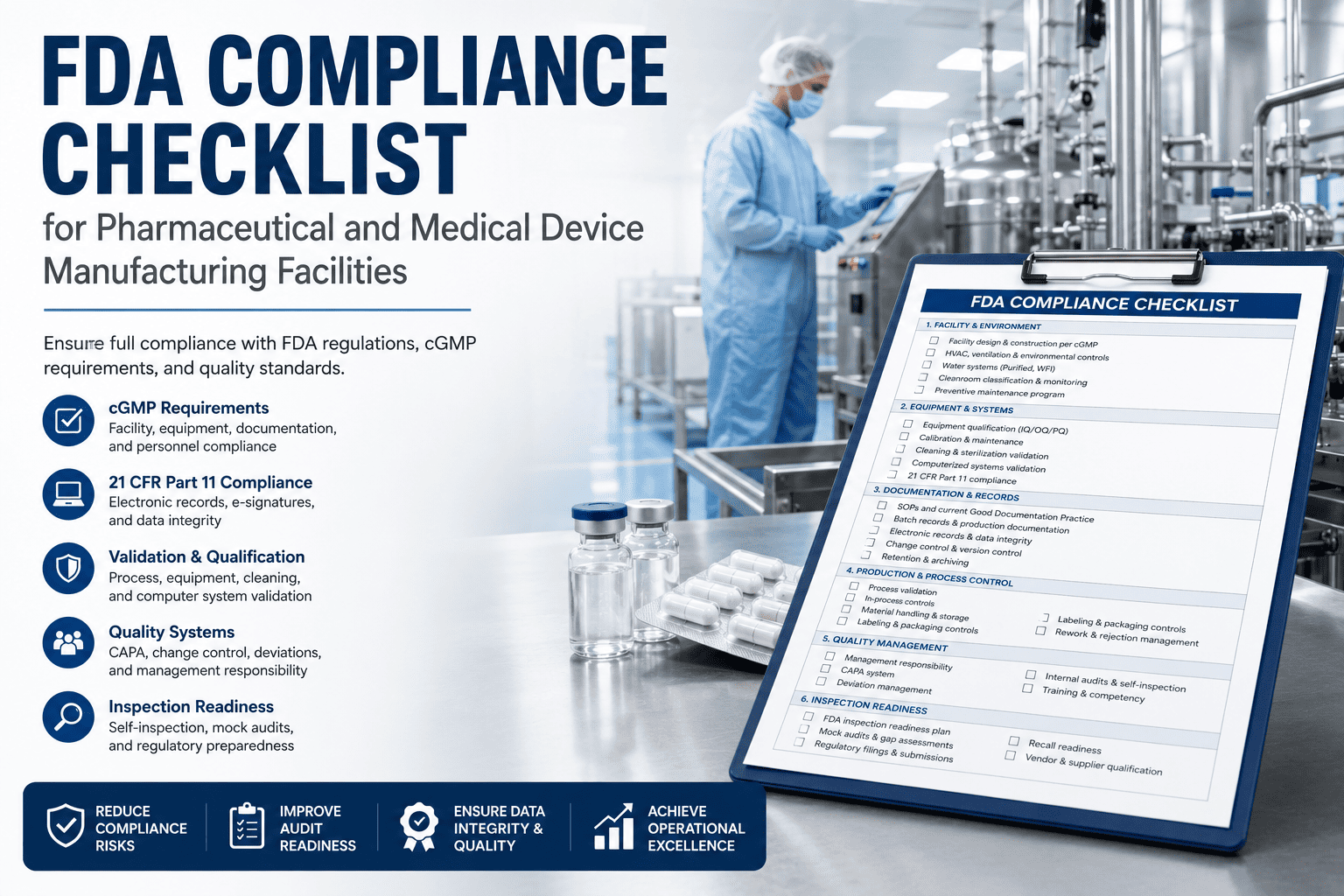
Data Integrity and Audit Trail Architecture for Regulated Greenfield Factories
By will Jackes on April 7, 2026
In 2024 alone, the FDA issued 105 quality-related warning letters — an 11% increase from the prior year — with data integrity deficiencies cited in the majority of drug GMP cases. Shared passwords, deleted chromatography peaks, disabled audit trails, unvalidated spreadsheets used for critical calculations. These aren't edge cases; they're the pattern. Every one of those findings traces back to a single architectural failure: data integrity was treated as a documentation task instead of a system design requirement. For greenfield factories in pharma, biotech, and medical devices, there is exactly one window to get this right — before the first electronic record is generated. This is the architecture guide for building 21 CFR Part 11, ALCOA+, and GAMP 5 compliance into your regulated factory from the foundation up.
Compliance Architecture
Data Integrity & Audit Trail Architecture for Regulated Greenfield Factories
Build 21 CFR Part 11, ALCOA+, and GAMP 5 compliance into every electronic record, signature, and batch record — from day one, not year three.
FDA quality warning letters issued in FY2024 alone
62%
Of drug quality inspections targeted foreign facilities for DI gaps
60%+
Of global GMP non-compliance findings are data integrity failures
2026
EU Annex 11 revision expected to finalize with stricter audit trail rules
Sources: FDA Warning Letters FY2024 / SciLife / MHRA / ECA Academy / IntuitionLabs Analysis
Why Data Integrity Is the #1 Regulatory Risk in 2026
Data integrity remains the FDA's most significant compliance focus area heading into 2026. The EU's draft revision of Annex 11 — expected to finalize mid-2026 — expands emphasis on lifecycle traceability, mandates that audit trails must be always on and locked, and introduces mandatory multi-factor authentication. The new Annex 22 on AI signals that even machine-learning outputs in regulated environments will need full auditability. For greenfield teams, this means every system — LIMS, MES, ERP, QMS, SCADA — must be architected for immutable audit trails, unique user attribution, and electronic signature compliance before a single batch record is created.
Warning Letters
Public, reputation-damaging FDA actions that can trigger import bans, product seizures, and withheld approvals
Consent Decrees
Court-ordered compliance mandates that can cost $100M+ in remediation and halt production for years
483 Observations
Inspection findings that flag disabled audit trails, shared logins, deleted records, and unvalidated systems
Product Recalls
Data fabrication or integrity failures can force batch recalls and jeopardize patient safety
The ALCOA+ Framework: Your Audit Checklist in 9 Words
ALCOA+ is the universal language FDA and EMA inspectors use to judge whether your records can be relied upon. Every electronic record in a regulated factory — batch records, lab results, environmental monitoring, equipment logs — must satisfy all nine attributes. Failure on any single attribute can trigger a data integrity finding.
A
Attributable
Every entry traces to a unique user ID with date, time, and system identification
L
Legible
Human-readable now and in the future — format, metadata, and context preserved
C
Contemporaneous
Recorded at the time the activity is performed — no backdating, no transcription lag
O
Original
First capture preserved — raw data, metadata, and audit trails intact as source of truth
A
Accurate
Error-free, verified calculations from calibrated instruments with complete change history
+C
Complete
All data retained — including failed tests, OOS results, reprocessed runs, and metadata
+C
Consistent
Chronological, properly sequenced with synchronized clocks across all systems
+E
Enduring
Retained in validated, durable storage for the full regulatory retention period
+A
Available
Retrievable on demand for review, audit, or inspection within minutes — not days
The Compliance Architecture: 5 Layers of Data Integrity
A compliant regulated factory isn't built by validating individual systems in isolation — it's built by designing a unified data integrity architecture that connects every layer from sensor to signature. Each layer addresses a specific regulatory requirement, and gaps at any level create systemic audit exposure.
05
Audit Trail Review & Regulatory Reporting
Periodic, risk-based review of audit trail entries. Automated anomaly flagging. Inspection-ready export to FDA, EMA, and MHRA formats. CAPA linkage to deviations.
21 CFR 11.10(e) / Annex 11 Clause 9 / GAMP 5 O7
04
Electronic Signatures & Approval Workflows
Two-factor authentication. Signature manifestation (name, date/time, meaning). Non-repudiation controls. Linked signatures that cannot be severed from the record.
21 CFR 11.50 / 11.70 / 11.100-11.300
03
Immutable Audit Trail Engine
Secure, computer-generated, time-stamped logs capturing who changed what, when, and why — for every creation, modification, and deletion. Always on, tamper-evident, never overwritable.
Unique user IDs — no shared accounts. Role-based access control (RBAC). Password complexity, expiration, and lockout policies. Privileged access monitoring for system administrators.
21 CFR 11.10(d) / 11.300 / Annex 11 Clause 12
01
System Validation & GAMP 5 Lifecycle
Risk-based validation (IQ/OQ/PQ) per GAMP 5 categories. URS through risk assessment to testing. Ongoing verification after upgrades. Documented evidence that critical controls are effective.
Where Systems Meet Compliance: The Regulated Factory Stack
21 CFR Part 11 implementation is most effective where the data is generated. Each system in a regulated factory has specific audit trail, electronic signature, and validation requirements — and the connections between systems create the highest-risk data integrity exposure.
Scroll to see full table
System
Audit Trail Focus
E-Signature Scope
Key Risk
MES / eBR
Batch records, operator inputs, timestamped process steps
GAMP 5: Risk-Based Validation for Greenfield Systems
GAMP 5 — now in its Second Edition, aligned with the FDA's finalized Computer Software Assurance (CSA) guidance from September 2025 — provides the validation framework for every computerized system in a regulated factory. The core principle is critical thinking: validate most intensively where risk to data integrity, patient safety, or product quality is highest. For greenfield builds, this means designing validation into the system selection process — not bolting it on after installation.
1
User Requirements Specification
Define what each system must do for data integrity — audit trail behavior, access control rules, e-signature requirements, retention periods
2
Risk Assessment
Classify each system by GAMP 5 category (1-5). Map critical functions to patient safety and data integrity risks. Focus testing resources where impact is highest.
3
IQ / OQ / PQ Execution
Test that critical fields generate audit entries when changed. Verify boundary cases — what happens when audit trail storage fills or system time changes.
4
Ongoing Verification & Change Control
Periodic review after upgrades, patches, and configuration changes. Formal change management for any audit trail or access control modification.
The compliance landscape in 2026 is one where data integrity is front-and-center and evolving rapidly. The EU's draft revision of Annex 11, the FDA's CSA guidance, and the introduction of Annex 22 on AI all signal a regulatory environment that is simultaneously tightening expectations and modernizing its approach. Companies that embrace these technologies can automate away a huge compliance burden while gaining business benefits — faster audits, easier troubleshooting, and more reliable data for decision-making.
iFactory deploys CMMS, maintenance tracking, and IoT infrastructure with built-in audit trails, electronic signatures, and GAMP 5-aligned validation — purpose-built for regulated pharma, biotech, and medical device manufacturing.
Audit trail coverage across all work orders and asset records
21 CFR
Part 11 compliant electronic records and signatures
GAMP 5
Risk-based validation documentation and lifecycle support
ALCOA+
All 9 data integrity attributes embedded in system design
Frequently Asked Questions
What is 21 CFR Part 11 and which systems does it apply to?
21 CFR Part 11 is the FDA regulation governing electronic records and electronic signatures. It applies to any system used to create, modify, maintain, or transmit records required under FDA regulations — including MES, LIMS, QMS, ERP, SCADA, and CMMS in pharmaceutical, biotech, and medical device manufacturing. Book a demo to see Part 11-compliant CMMS in action.
What are ALCOA+ principles and why do they matter for factory design?
ALCOA+ defines nine attributes that make regulated data trustworthy: Attributable, Legible, Contemporaneous, Original, Accurate, Complete, Consistent, Enduring, and Available. For greenfield factories, ALCOA+ must be designed into every electronic system from the start — inspectors use these principles as their audit checklist for evaluating data integrity.
What is GAMP 5 and how does it relate to system validation?
GAMP 5 is the ISPE framework for risk-based validation of computerized systems in regulated industries. Its Second Edition, aligned with the FDA's 2025 CSA guidance, emphasizes critical thinking — validating most intensively where risk to data integrity and patient safety is highest. Schedule a demo to review our validation approach.
What are the most common FDA data integrity findings in manufacturing?
The most cited findings include shared user accounts and passwords, disabled or unreviewed audit trails, deleted analytical data and chromatography peak manipulations, unvalidated spreadsheets for critical calculations, and incomplete change control histories. Each traces back to a system architecture failure.
How should CMMS data integrity be handled in a regulated factory?
CMMS in regulated environments must provide immutable audit trails for every work order, calibration record, and asset change. Electronic signatures for maintenance sign-off and calibration verification. Role-based access control. And validated data retention for FDA and EU requirements. Book a free CMMS compliance assessment.
Compliance by Design
Don't Retrofit Compliance — Architect It
iFactory's regulated industry deployment ensures every maintenance record, calibration event, and asset change meets 21 CFR Part 11, ALCOA+, and GAMP 5 requirements — with audit trails that survive any inspection.