Manufacturing accounts for nearly a quarter of global carbon emissions — yet fewer than 12% of factories have a formal net zero roadmap in place. The gap isn't ambition; it's architecture. Most sustainability programs bolt carbon tracking onto legacy systems that were never designed to measure energy at the granularity net zero demands. AI changes the equation entirely — not by adding another reporting layer, but by embedding real-time energy intelligence into every production decision, every shift, every machine cycle. Factories that treat decarbonization as an operational system rather than a compliance exercise are cutting energy costs 20–30% while hitting ESG targets years ahead of schedule. Here is how the next generation of net zero factories is being designed — and what your plant can do right now to close the gap.
AI-Powered Sustainability
Net Zero Factory Design: AI Energy Management & ESG Compliance
From carbon tracking to Scope 1, 2, 3 reporting — build a factory that optimizes energy, meets ESG mandates, and turns sustainability into a competitive advantage.
30–50%
Energy & waste reduction with AI-driven smart manufacturing
$2T/yr
Global savings potential from available energy efficiency tech by 2030
83%
Of institutional investors now factor ESG into investment decisions
2026
California SB 253 requires Scope 1 & 2 emissions disclosure this year
Sources: S&P Global · WEF / PwC · Environmental Chemistry Letters · California Climate Accountability Act
Why Net Zero Is Now a Manufacturing Imperative
The regulatory clock is no longer theoretical. California's SB 253 requires companies with over $1 billion in revenue to disclose Scope 1 and 2 emissions starting in 2026, with Scope 3 reporting following in 2027. The EU's Corporate Sustainability Reporting Directive covers tens of thousands of companies. Investor pressure has reached a tipping point — BlackRock, managing over $10 trillion in assets, now requires portfolio companies to provide comprehensive climate disclosures. For manufacturers, this means energy and emissions data must be audit-ready, real-time, and traceable across every production line — not buried in quarterly spreadsheets.
Regulatory Mandates
CA SB 253/261, EU CSRD, SEC climate rules — mandatory emissions disclosure is live or imminent across major markets in 2026.
Investor Pressure
83% of institutional investors factor ESG into decisions. Non-disclosure risks divestment, higher capital costs, and exclusion from procurement.
Energy Cost Surge
Industrial electricity prices rose 18.3% YoY in key U.S. manufacturing corridors — translating to $4.2B in incremental annual costs for Tier-1 facilities.
Supply Chain Expectations
Scope 3 covers 70–90% of most corporate carbon footprints. Your customers' ESG reports depend on your emissions data.
Scope 1, 2, 3: What Every Manufacturer Must Track
The GHG Protocol divides emissions into three scopes. Most manufacturers handle Scope 1 and 2 adequately — but Scope 3 is where compliance programs stall and where AI delivers the most value. Understanding all three is the foundation of any net zero strategy.
Scope 1 — Direct Emissions
Emissions from sources you own or control: on-site boilers, furnaces, fleet vehicles, process chemicals, and fugitive emissions from refrigerants or gas leaks. AI monitors combustion efficiency in real time and flags anomalies that spike emissions before they compound.
Scope 2 — Purchased Energy
Emissions from electricity, steam, heating, and cooling you buy. AI-driven load shifting and peak shaving can cut Scope 2 by 15–25% — running energy-intensive processes when grid carbon intensity is lowest and renewable supply is highest.
Scope 3 — Value Chain
Everything else: raw material extraction, supplier manufacturing, transportation, product use, and end-of-life disposal. Scope 3 typically represents 70–90% of a manufacturer's total footprint. AI automates supplier data collection, spend-based estimation, and category-level tracking across all 15 GHG Protocol categories.
Need help mapping your Scope 1, 2, 3 emissions architecture? Book a free carbon tracking demo.
How AI Drives Net Zero: The 5-Layer Energy Intelligence Stack
A net zero factory doesn't run on good intentions — it runs on a layered intelligence system that connects sensors to decisions to outcomes in real time. Each layer builds on the one below it. Skip a layer and the system produces dashboards instead of results.
Layer 5
ESG Reporting & Compliance Automation
Auto-generate audit-ready reports aligned to GHG Protocol, CSRD, SB 253, TCFD, and SASB. Map emissions data to Scope 1, 2, 3 categories with full traceability.
Layer 4
Carbon Tracking & Digital Twin Simulation
Digital twins model energy flows across your entire facility — simulating "what-if" scenarios for fuel switching, PPA integration, or process redesign before committing capital.
Layer 3
Predictive Optimization & Load Management
ML models predict energy demand per shift, per line, per machine — enabling peak shaving, load shifting to low-carbon grid windows, and demand-response participation.
Layer 2
AI Analytics & Anomaly Detection
AI identifies energy waste patterns — compressed air leaks, HVAC inefficiency, idling equipment, suboptimal combustion — and triggers corrective actions automatically.
Layer 1
IoT Sensor Foundation & Real-Time Metering
Sub-meter level energy monitoring across every circuit, machine, and process. Temperature, vibration, pressure, flow — all streaming to a unified data lake.
Real Impact: AI Energy Management by the Numbers
The business case for AI-driven energy management isn't theoretical — it's documented across hundreds of implementations. Here's what leading manufacturers are achieving right now.
Waste & Emissions Reduction
Unplanned Downtime Reduction
Sources: WEF Global Lighthouse Network, S&P Global Sustainable1, Environmental Chemistry Letters, Deloitte Smart Manufacturing Survey 2025
The ESG Compliance Landscape in 2026
ESG reporting has shifted from voluntary to mandatory across most major economies. For manufacturers, the challenge isn't whether to report — it's building the data infrastructure to report accurately, consistently, and at audit-grade quality across multiple jurisdictions simultaneously.
Navigating multi-jurisdictional ESG compliance? Talk to our compliance integration team.
Designing the Net Zero Factory: From Blueprint to Operation
Net zero isn't a retrofit — it's a design philosophy that must be embedded from the earliest planning stages. The most successful implementations follow a structured pathway that connects energy infrastructure decisions to operational AI systems to compliance reporting in a single integrated loop.
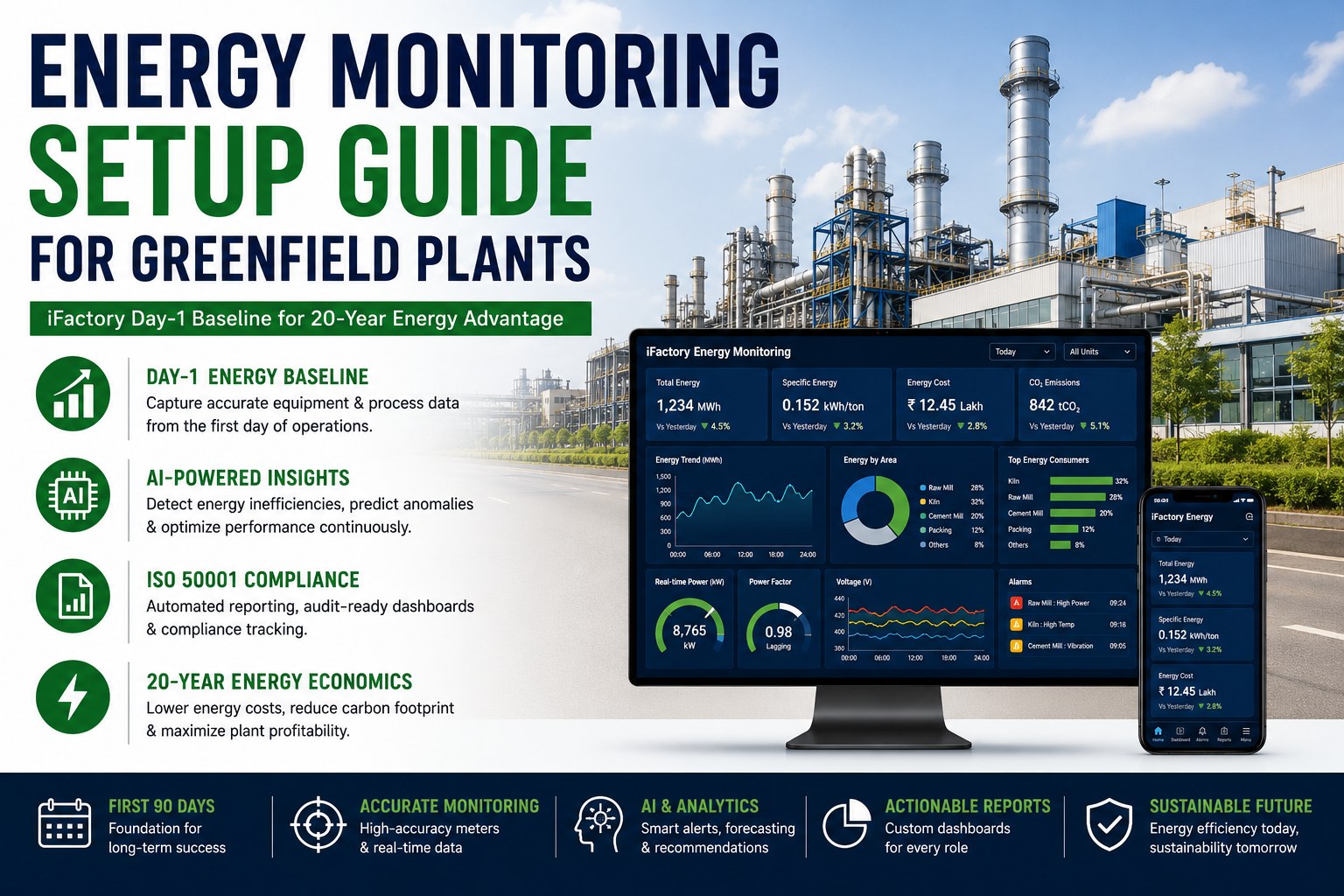
Deploy IoT energy meters at sub-circuit level across all production lines
Establish Scope 1, 2, 3 emissions baseline using GHG Protocol methodology
Map energy consumption patterns by shift, line, and equipment category
Identify top 20% of energy consumers and waste contributors
Activate AI anomaly detection for energy waste — compressed air leaks, HVAC drift, idling equipment
Implement predictive load management and peak shaving algorithms
Build digital twin for energy flow simulation and scenario planning
Integrate renewable energy sources (solar, PPA) into load balancing logic
Auto-generate ESG reports mapped to CSRD, SB 253, GRI, TCFD, and SASB frameworks
Implement audit trail with full data lineage for third-party assurance
Activate Scope 3 supplier data collection and spend-based estimation models
Publish carbon dashboard for investor and stakeholder transparency
Set science-based targets and track progress against net zero milestones
Use digital twin "what-if" modeling for fuel switching, electrification, and circular economy decisions
Expand AI optimization to Scope 3 — supplier scorecards, logistics routing, end-of-life tracking
Compound gains: AI models improve with every production cycle, deepening savings over time
Smart manufacturing that uses AI to find efficiencies in factory processes can cut energy consumption, waste, and carbon emissions as much as 30% to 50% compared with traditional processes. Companies relying on AI to solve decarbonization challenges will need to be cautious of the rebound effect — but the data is clear: embedded intelligence delivers sustained reduction, not just temporary gains.
-- S&P Global Sustainable1 Analysis, 2025
Ready to design your net zero pathway? Schedule a free energy intelligence demo.
Start Your Net Zero Journey
Turn Energy Data Into Decarbonization Results
iFactory deploys AI-powered energy management, carbon tracking, and ESG reporting infrastructure alongside your CMMS and IoT systems — so your factory meets compliance deadlines while cutting energy costs from day one.
95%
Of predictive maintenance adopters report positive ROI
10x
Return documented by U.S. DOE from AI-driven predictive maintenance
12-24
Months to full ROI on smart factory investments
25%
Energy reduction achieved by WEF Lighthouse factories
Frequently Asked Questions
What is a net zero factory and how does AI help achieve it?
A net zero factory balances its total greenhouse gas emissions to zero through a combination of energy efficiency, renewable energy, and carbon offsets. AI accelerates this by monitoring energy consumption at the machine level in real time, predicting demand patterns, optimizing load distribution, and automating carbon tracking across Scope 1, 2, and 3 — eliminating the manual data collection that slows most sustainability programs.
Book a demo to see how it works.
What ESG regulations affect manufacturers in 2026?
The most immediate are California's SB 253, which requires Scope 1 and 2 emissions disclosure in 2026 for companies with $1B+ revenue, and SB 261 for climate-related financial risk reporting. The EU CSRD mandates comprehensive ESG disclosure for large companies. SEC climate rules remain stayed pending litigation but could take effect under future leadership. Manufacturers operating globally need data systems that satisfy multiple frameworks simultaneously.
How much can AI-driven energy management actually save a factory?
Documented results from WEF Lighthouse factories and peer-reviewed research show 20–30% energy cost reduction, 30–50% waste and emissions reduction, and 35–45% fewer unplanned downtime events. Most manufacturers achieve full ROI within 12–24 months, with initial benefits visible within 3–6 months of sensor deployment.
Schedule a demo to model your savings.
What is the difference between Scope 1, 2, and 3 emissions?
Scope 1 covers direct emissions from owned sources — boilers, furnaces, vehicles. Scope 2 covers indirect emissions from purchased electricity and energy. Scope 3 covers everything in your value chain — supplier manufacturing, transportation, product use, and disposal. Scope 3 typically represents 70–90% of a manufacturer's total carbon footprint and is the hardest to measure without AI-powered data collection and estimation models.
How long does it take to implement an AI energy management system in a factory?
A phased implementation typically takes 6–9 months to reach full compliance-ready operation: 1–3 months for sensor deployment and baseline measurement, 3–6 months for AI optimization activation, and 6–9 months for ESG reporting automation. The system compounds its value over time as AI models learn your facility's unique energy patterns.
Book a free assessment to scope your timeline.
The Future Is Measurable
Your Factory's Carbon Footprint Is Your Next Competitive Advantage
iFactory connects energy monitoring, AI optimization, predictive maintenance, and ESG reporting into a single operational system — so you don't just comply with net zero mandates, you profit from them.
$34B+
AI in manufacturing market size in 2025, growing at 35% CAGR
86%
Of employers view AI as dominant driver of business transformation
$850B+
Manufacturing projects announced since 2021 driven by reshoring
2030
Reasonable assurance required for CA Scope 1 & 2 emissions data