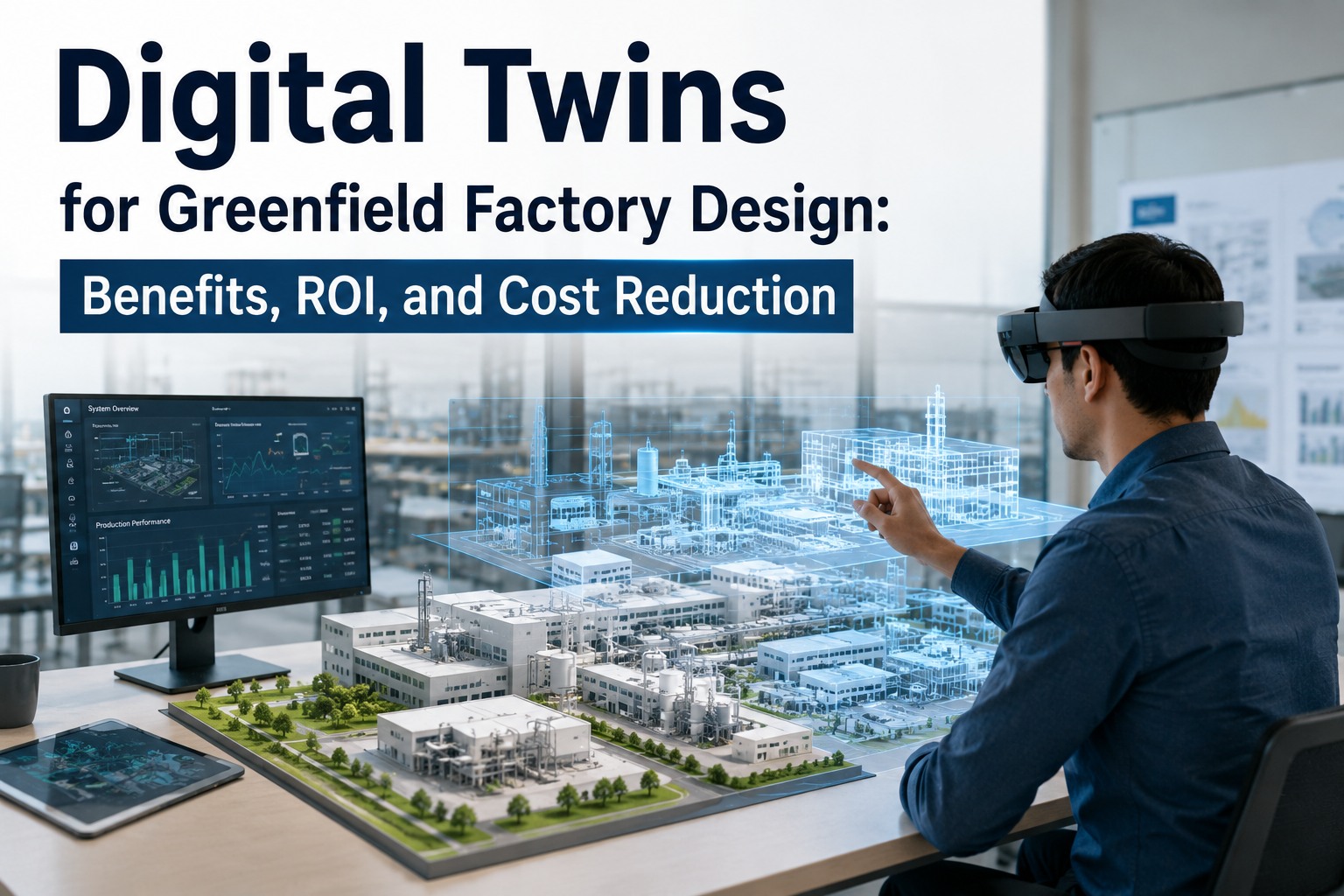
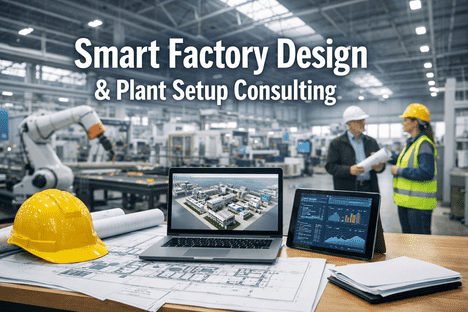
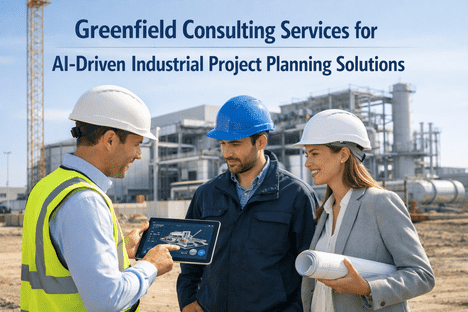
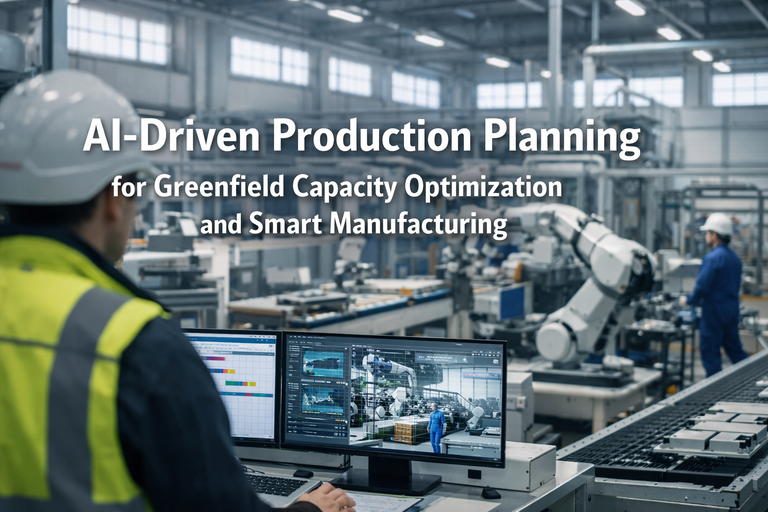
A semiconductor manufacturer committed $4.2 billion to a greenfield fabrication plant in Arizona. Eighteen months into construction, the project was 23% over budget and six months behind schedule — driven by design change orders, equipment integration failures during commissioning, and a facility layout that simulation would have flagged before concrete was poured. Post-mortem analysis showed that 80% of the cost overruns originated in decisions made during the first 90 days of planning. The lesson is brutal and universal: in greenfield manufacturing, the planning phase determines everything. AI-driven digital transformation ensures you get those first 90 days right — because you cannot afford to get them wrong.
AI-Powered Greenfield Planning & Digital Transformation
Greenfield Industrial Consulting with AI-Driven Digital Transformation
How AI simulation, digital twins, and predictive planning eliminate the cost overruns, timeline delays, and integration chaos that plague greenfield factory projects
70%+
Of large capital projects exceed their budget (McKinsey)
Preventable With AI
52%
Commissioning time saved through digital twin simulation
Proven Results
Why Most Greenfield Projects Fail Before Construction Starts
The problem with greenfield manufacturing projects is not construction. It is planning. Decisions made in the first 90 days — facility layout, technology architecture, equipment selection, utility design — lock in 80% of the project's total cost. Yet most project teams make these decisions with spreadsheets, assumptions, and conference room debates. AI changes the foundation of how greenfield projects are planned, simulated, and executed.
The Four Failure Modes of Traditional Greenfield Planning
1
Layout Decisions Based on Intuition
Factory layouts designed in 2D CAD or conference room sketches miss material flow conflicts, utility bottlenecks, and maintenance access gaps that only surface during commissioning — when fixing them costs 10–50x more than catching them in simulation.
2
Technology Integration as Afterthought
SCADA, MES, ERP, CMMS, IoT, and AI systems are selected independently and expected to integrate during commissioning. This is the number one cause of commissioning delays — systems that were never tested together failing in combination.
3
Budget Drift Without Predictive Visibility
McKinsey data shows the average capital project runs 60% over schedule and over 70% over budget. Without AI-powered predictive budgeting and real-time progress tracking, cost overruns compound silently until they become unrecoverable.
4
Building Yesterday's Factory
A greenfield facility built without AI-native architecture from day one will cost 5–10x more to retrofit later. Every new factory built in 2026 should be digital-first — but most projects still treat technology as an add-on rather than foundation.
Planning a greenfield facility? Book a free consultation to identify the biggest risks in your current plan.
What AI-Driven Greenfield Consulting Delivers
AI transforms every phase of the greenfield journey — from site selection and layout optimisation through construction management and commissioning. The core principle is simple: simulate everything digitally before building anything physically. Every decision is validated by data. Every system is tested virtually. Every risk is identified before it becomes a cost.
3D layout modelling
Material flow simulation
Throughput analysis
Bottleneck detection
Utility routing
What AI Does
Simulates hundreds of factory layout configurations in a digital twin — optimising equipment placement, material flow, maintenance access, and utility routing before a single dollar is spent on construction.
Proven Impact
Catches 90% of layout issues before physical build. Over 4,200 digital twin deployments in 2025.
Logistics modelling
Labour analysis
Utility capacity
Regulatory mapping
TCO forecasting
What AI Does
Analyses 50+ site parameters simultaneously — logistics access, utility infrastructure, labour availability, regulatory zones, environmental risk, and 20-year total cost of ownership — producing data-ranked site recommendations.
Proven Impact
Eliminates site selection bias. Prevents costly relocations driven by overlooked constraints.
System integration testing
Protocol validation
Automation debugging
Control logic testing
Edge case simulation
What AI Does
Tests and debugs your entire technology stack — SCADA, PLC, MES, ERP, IoT, AI vision — in the digital twin before physical installation. Every protocol handshake is validated. Every integration point is proven.
Proven Impact
52% reduction in commissioning time. 67% fewer startup errors documented.
Cost forecasting
Milestone tracking
Risk scoring
Change order impact
Contingency modelling
What AI Does
AI continuously forecasts cost trajectories and schedule risks based on real-time progress data — flagging overrun risks weeks before they materialise and quantifying the impact of every proposed change order.
Proven Impact
Prevents the silent budget drift that causes 70%+ of large projects to exceed budget.
IIoT blueprint
Edge computing design
5G/wireless planning
Cybersecurity framework
Data architecture
What AI Does
Designs the digital infrastructure from day one — IIoT sensor networks, edge computing nodes, 5G connectivity, cybersecurity layers, and data pipelines — so your factory is AI-ready at commissioning, not years later.
Proven Impact
78% of greenfield projects now implement 5G. AI-native facilities achieve 23% higher OEE.
Production ramp planning
Yield optimisation
Workforce training
OEE baselining
Continuous improvement
What AI Does
AI manages the ramp-up from commissioning to full production — optimising yield curves, training operators with AI-guided systems, baselining OEE targets, and establishing the continuous improvement loop from day one.
Proven Impact
20% faster ramp-up to full production documented with digital twin-guided commissioning.
The AI-Driven Greenfield Journey
A greenfield project is not a single event — it is a 3–5 year journey through four distinct phases. AI transforms each phase by replacing assumptions with simulation, reactive management with predictive control, and siloed planning with integrated digital orchestration.
Four Phases of AI-Powered Greenfield Delivery
Plan
Strategy & Design (6–12 mo)
Site selection, feasibility analysis, factory layout simulation, technology architecture design, and predictive budgeting — all validated in the digital twin before commitment.
Build
Execution & Construction (12–36 mo)
AI-monitored construction with real-time progress tracking, predictive schedule management, equipment procurement optimisation, and quality verification at every milestone.
Launch
Commissioning & Startup (6–12 mo)
Virtual commissioning eliminates integration surprises. Systems are proven in the digital twin before physical startup. Ramp-up is guided by AI yield optimisation and operator training.
Optimise
Operations & Improvement (Ongoing)
Predictive maintenance, AI quality inspection, energy optimisation, and continuous process improvement from day one — your factory gets smarter every day it operates.
Build the Factory Right the First Time
iFactory's AI-powered greenfield consulting eliminates the cost overruns, timeline delays, and integration failures that plague traditional projects. Simulate everything. Validate everything. Build with certainty.
The Cost of Getting It Wrong
Greenfield projects are the largest capital commitments manufacturers make. The difference between a well-planned AI-driven project and a traditional one is measured in hundreds of millions of dollars — and years of competitive advantage gained or lost.
Budget Overruns
Over 70% of large capital projects exceed their budget. Average cost overruns reach $1.3 billion for mega-projects. Design changes during construction cost 10–50x more than changes caught in simulation.
70%+ over budget
Schedule Delays
60% of capital projects exceed their schedule. Greenfield manufacturing plants take 3–5 years from planning to production. Every month of delay costs lost revenue, extended financing, and competitive positioning.
60% over schedule
Retrofit Penalty
AI-native capabilities built into a greenfield design cost a fraction of retrofitting them later. Implementing IoT, digital twins, and AI vision after construction costs 5–10x more than designing them in from day one.
5–10x retrofit cost
Total Risk Without AI Planning
Budget overruns, schedule delays, integration failures, and technology debt compound into hundreds of millions in preventable losses — before accounting for the competitive damage of a late, over-budget launch.
$100M–$1.3B at risk
The AI Greenfield Technology Stack
Building a smart factory from scratch requires a technology architecture designed for intelligence from the ground up. Here are the five layers that transform a greenfield facility from a conventional plant into an AI-powered, continuously self-improving operation.
Layer 1
IIoT Sensor Network
Designed into the facility blueprint from day one — vibration, temperature, pressure, flow, and environmental sensors on every critical asset. 1,500+ connected devices per production line in modern greenfield facilities, connected via 5G or advanced wireless infrastructure.
Layer 2
Edge Computing Infrastructure
GPU-accelerated edge nodes deployed at process-critical points for sub-5ms latency. 72% of new automation projects specify edge-native components. Local inference ensures autonomous operation continues through network outages.
Layer 3
Digital Twin Platform
A living virtual replica of the entire facility — used for layout simulation during planning, virtual commissioning before startup, and real-time operational optimisation once production begins. The digital twin market is projected to grow from $24.5 billion to over $155 billion by 2030.
Layer 4
AI Analytics & Intelligence
Predictive maintenance, computer vision inspection, scheduling optimisation, energy management, and quality intelligence — all running on production data from day one, improving with every cycle.
Layer 5
Unified Operations Platform
MES, ERP, CMMS, SCADA, and quality systems integrated through a single data architecture. No silos, no manual data transfer, no integration gaps. Every system speaks to every other system — because it was designed that way from day one.
See how iFactory designs AI-native greenfield architecture. Schedule a free planning consultation.
Documented Greenfield Results
Industries Building AI-Native Greenfield Facilities
The greenfield investment wave is being driven by reshoring, supply chain diversification, and the transition to next-generation products. Every sector building new capacity in 2026 faces the same choice: build a conventional factory that will need costly upgrades within 3 years, or build an AI-native facility that improves itself from day one.
Semiconductor & Electronics
New fabs require extreme precision, cleanroom control, and process integration that only digital twin-designed facilities can achieve. Semiconductor greenfield announcements rose 35% in value in 2025, led by massive US investments.
Largest greenfield investment sector — AI simulation essential for fab layout optimisation
EV & Battery Manufacturing
Gigafactory-scale facilities for battery cell production, pack assembly, and EV manufacturing. These facilities demand AI-native quality inspection, thermal management, and predictive maintenance from first production day.
Digital twins reduce battery cell ramp-up time by 20% in greenfield gigafactories
Steel & Process Industry
New hydrogen-DRI plants, electric arc furnace facilities, and green steel operations designed for sustainability from the ground up. Digital twins simulate raw material logistics, meltshop operations, and carbon capture before construction.
Sustainability by design — carbon-neutral operations engineered into the facility blueprint
Pharma & Food Manufacturing
Regulated facilities requiring validated processes, full traceability, and GMP compliance from commissioning. AI-native architecture ensures regulatory compliance is built into the system architecture, not bolted on after construction.
Compliance by design — every process validated digitally before physical commissioning
Frequently Asked Questions
When should AI greenfield consulting start in the project lifecycle?
Day one. The planning phase determines 80% of a greenfield project's total cost, and AI delivers the most value during this phase — through layout simulation, site selection analysis, technology architecture design, and predictive budgeting. Engaging AI consulting after construction begins means the highest-impact decisions have already been locked in without data-driven validation.
How does a digital twin reduce greenfield project risk?
The digital twin creates a virtual replica of your entire facility — layout, equipment, material flow, utility routing, and technology systems. You simulate hundreds of configurations, test system integration virtually, and identify bottlenecks before construction begins. This catches 90% of layout issues, reduces commissioning time by 52%, and cuts startup errors by 67% — all without spending a dollar on physical changes.
What does AI-native factory architecture mean?
AI-native means the digital infrastructure — IoT sensors, edge computing, data pipelines, connectivity, and cybersecurity — is designed into the facility from the first architectural drawing, not retrofitted later. AI-native greenfield facilities achieve 23% higher OEE than conventional builds and avoid the 5–10x cost premium of adding these capabilities after construction.
How long does a greenfield project take with AI-driven planning?
Greenfield projects typically span 3–5 years from planning to full production. AI-driven planning does not shorten the physics of construction — but it dramatically reduces the delays that cause projects to exceed timelines. Virtual commissioning alone saves 6–8 weeks per project. AI-guided ramp-up reaches full production 20% faster. The net effect is on-time, on-budget delivery instead of the 60% schedule overrun that is the industry norm.
Can iFactory support greenfield projects across different industries?
Yes. iFactory's greenfield consulting platform supports semiconductor, automotive, EV/battery, steel, pharma, food and beverage, aerospace, and general manufacturing. The AI simulation engine adapts to your specific production requirements, regulatory environment, and technology stack — providing industry-specific optimisation within a proven, cross-sector delivery framework.
Build It Right. Build It Once. Build It With AI.
Your greenfield project is too important and too expensive to plan with spreadsheets and assumptions. AI simulation, digital twins, and predictive planning ensure every decision is validated before a single dollar is committed. Find out how.