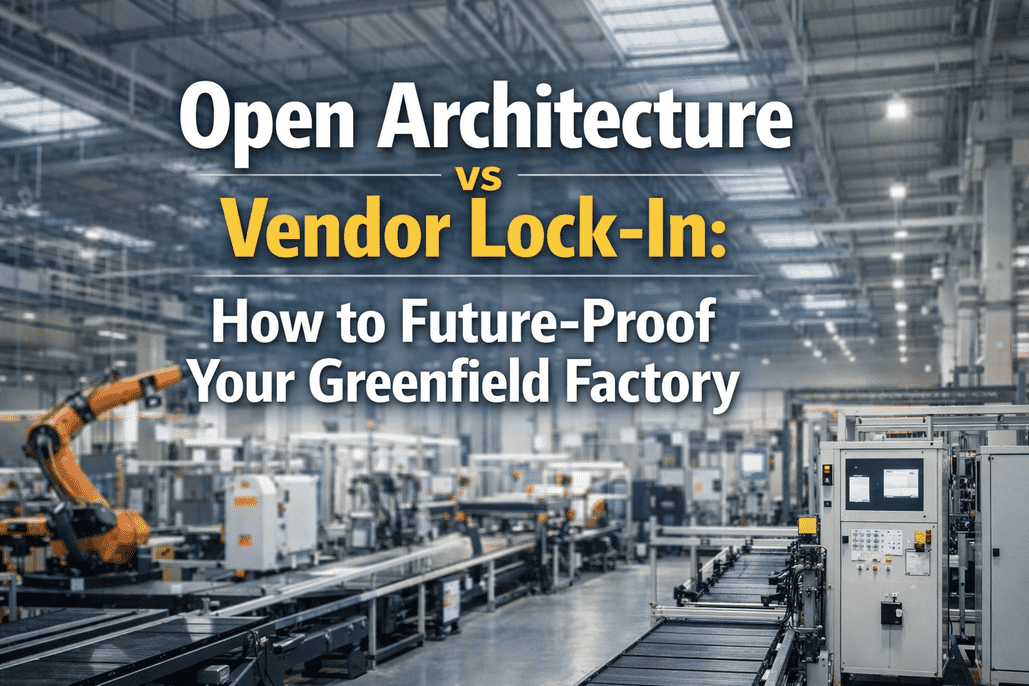
Most factories are still stuck with isolated data silos and point-to-point integrations — even brand-new ones. The reason: vendor lock-in decisions made during procurement that seemed harmless at the time but compound into millions in integration costs, limited flexibility, and dependency on a single vendor's roadmap for the next 20+ years. Proprietary extensions that block real compatibility. Activation licenses required for protocols that should be standard. Custom APIs that only work within one vendor's ecosystem. Every one of these creates a tax on your factory's future. The alternative is open architecture: open protocols (OPC UA, MQTT), API-first platforms, Unified Namespace, and software-defined automation that lets you add, replace, or upgrade any component without re-engineering the entire system. The Industry 4.0 market is growing from $551B to $1.6T by 2030 — and the winners will be factories that can adopt new technology at the speed of software, not the speed of vendor contracts. This guide shows you how to design for openness from day one. Book a consultation to review your architecture strategy.
Open Architecture vs. Vendor Lock-In: The Core Trade-Off
The greenfield advantage: you get to choose openness from the start. Brownfield facilities spend $2-10M retrofitting open architecture over locked systems. Greenfield facilities embed it at design cost — a fraction of the retrofit price.
The Open Protocol Stack: OPC UA + MQTT + Sparkplug B
The modern open factory doesn't choose between OPC UA and MQTT — it uses both, at different layers. OPC UA is the machine's dictionary (rich, semantic, model-centric). MQTT is the cloud's envelope (lightweight, scalable, event-driven). Together with Sparkplug B (which adds structure and state management to MQTT), they form the backbone of the Unified Namespace.
| Attribute | OPC UA | MQTT (+ Sparkplug B) | Best Practice |
|---|---|---|---|
| Architecture | Client/Server (+ PubSub in Part 14) | Publish/Subscribe via broker | OPC UA local, MQTT for distribution |
| Data Modeling | Rich semantic information model with metadata, units, types | Raw transport; Sparkplug B adds structure and schema | OPC UA defines the model; MQTT transports it |
| Overhead | Kilobytes (certificate handshake, secure channel setup) | 2-byte minimum header; sub-100 byte typical packets | MQTT for bandwidth-constrained or high-frequency data |
| Best For | Machine-to-machine, PLC-to-SCADA, local cell control | Edge-to-cloud, enterprise integration, AI/ML data pipelines | OPC UA at Levels 0-2; MQTT at Level 3+ and cloud |
| Cloud Support | Limited native cloud integration | Native protocol for AWS IoT, Azure IoT, Google Cloud IoT | MQTT for all cloud and enterprise connectivity |
| AI/ML Readiness | Not designed for ML data pipelines | Designed for high-volume, multi-consumer streaming | MQTT feeds AI; OPC UA provides context |
| Device Support | Embedded in most major PLCs (often license-gated) | Requires gateway for most PLCs; native on IIoT devices | Edge gateway bridges OPC UA to MQTT |
| Standard | IEC 62541 (OPC Foundation) | OASIS MQTT 5.0 + Eclipse Sparkplug B | Both are open, license-free standards |
Designing your factory's data architecture? Schedule a free architecture review — we'll map OPC UA, MQTT, and UNS to your specific equipment, PLCs, and enterprise systems.
The Unified Namespace: Your Factory's Single Source of Truth
The Unified Namespace (UNS) is the architectural pattern that makes open architecture real. It's a single, event-driven data bus — organized as a hierarchical topic tree (site/area/line/cell/tag) — where every system publishes once and any consumer subscribes. No point-to-point integrations. No data silos. No vendor-specific middleware.
Without UNS, adding a new AI model or switching your MES vendor requires months of integration work. With UNS, the new system subscribes to the existing topic tree and starts consuming data immediately. This is the architectural difference between a factory that adopts agentic AI in weeks versus one that takes 18 months.
The 6 Vendor Lock-In Traps (And How to Avoid Them)
Proprietary Fieldbus Protocols
Some vendors require proprietary communication protocols between their PLCs and I/O modules. Switching to a different PLC vendor means replacing the entire fieldbus — not just the controller. Always specify OPC UA native or require gateway support at procurement.
Require OPC UA server on every PLC; specify open fieldbus (EtherNet/IP, PROFINET, EtherCAT)License-Gated Protocol Activation
Major PLC manufacturers embed OPC UA but charge license fees to activate it. A $5K PLC with a $2K OPC UA license adds 40% to cost — and if you skip the license, your "open" PLC becomes a proprietary endpoint. Budget for protocol activation at procurement.
Include OPC UA license cost in equipment specs; negotiate bulk activation with PLC vendorProprietary MES/SCADA Data Formats
MES and SCADA platforms that store data in proprietary formats or databases create lock-in at the application layer. Switching systems requires data migration, re-mapping, and often losing historical context. Specify platforms with open data export and standard APIs.
Require REST/GraphQL APIs, standard SQL databases, and UNS-compatible data publishingSingle-Vendor Robot Ecosystems
Choosing one robot OEM for an entire facility locks your automation capability to that vendor's product line, programming environment, and support infrastructure. Multi-vendor robot strategies with cross-platform simulation tools (RoboDK supports 500+ models) preserve flexibility.
Use cross-platform offline programming; specify standard I/O interfaces for all robot cellsCloud-Specific IoT Platforms
Building your entire data pipeline on AWS IoT Core, Azure IoT Hub, or Google Cloud IoT creates cloud vendor dependency. If pricing changes or you need multi-cloud, migration is painful. Design for cloud-agnostic edge processing with MQTT as the transport layer.
Process at edge first; use standard MQTT to any cloud; avoid cloud-specific device SDKsProprietary AI/Analytics Platforms
AI platforms that require proprietary data ingestion formats or only work with their own sensor hardware create a closed AI loop. If the vendor's models don't improve or their pricing changes, you're stuck. Use open ML frameworks (TensorFlow, PyTorch) with UNS data feeds.
Separate data collection (UNS) from model training (open ML); own your trained modelsUnsure if your current vendor selections create lock-in risk? Book a free vendor architecture review — we'll assess your PLC, MES, SCADA, and AI stack for openness and interoperability.
Open Architecture Decision Framework: What to Specify at Each Phase
| Greenfield Phase | Open Architecture Decision | Specification Requirement | Lock-In Risk if Skipped |
|---|---|---|---|
| Factory Design (Step 3) | UNS topic tree and data architecture | Define namespace hierarchy; select MQTT broker; plan edge gateway topology | IT/OT silos embedded into building design |
| Equipment Procurement (Step 4) | OPC UA and open protocol requirements in equipment specs | Mandate OPC UA server (licensed and active) on all PLCs; require standard I/O | Proprietary protocols locked into equipment orders |
| MES/ERP Selection (Step 4) | API-first platform with open data formats | REST/GraphQL APIs, standard SQL, UNS publishing capability, no proprietary lock | Application-layer lock-in for 10-15 years |
| Robot Selection (Step 4) | Multi-vendor strategy with cross-platform tools | Standard I/O interfaces; offline programming compatibility; no vendor-exclusive cells | Single-OEM dependency for all future automation |
| AI/Digital Platform (Step 3-6) | Open ML frameworks, UNS data feeds, model portability | TensorFlow/PyTorch/ONNX models; MQTT data ingestion; customer owns trained models | AI vendor lock-in; cannot retrain or port models |
| Commissioning (Step 7-8) | Validate interoperability across all vendors | Integration test plan covering OPC UA, MQTT, API connectivity across full stack | Discover integration failures at the most expensive phase |
Design for Openness from Day One
iFactory's greenfield consulting ensures every vendor selection, protocol decision, and platform choice is evaluated for openness, interoperability, and long-term flexibility — so your factory never gets trapped.
Frequently Asked Questions
The Most Expensive Decision You'll Make Is the One That Locks You In
Open architecture costs marginally more at procurement and saves exponentially more over 20 years. Don't let a vendor's short-term discount become your long-term constraint.