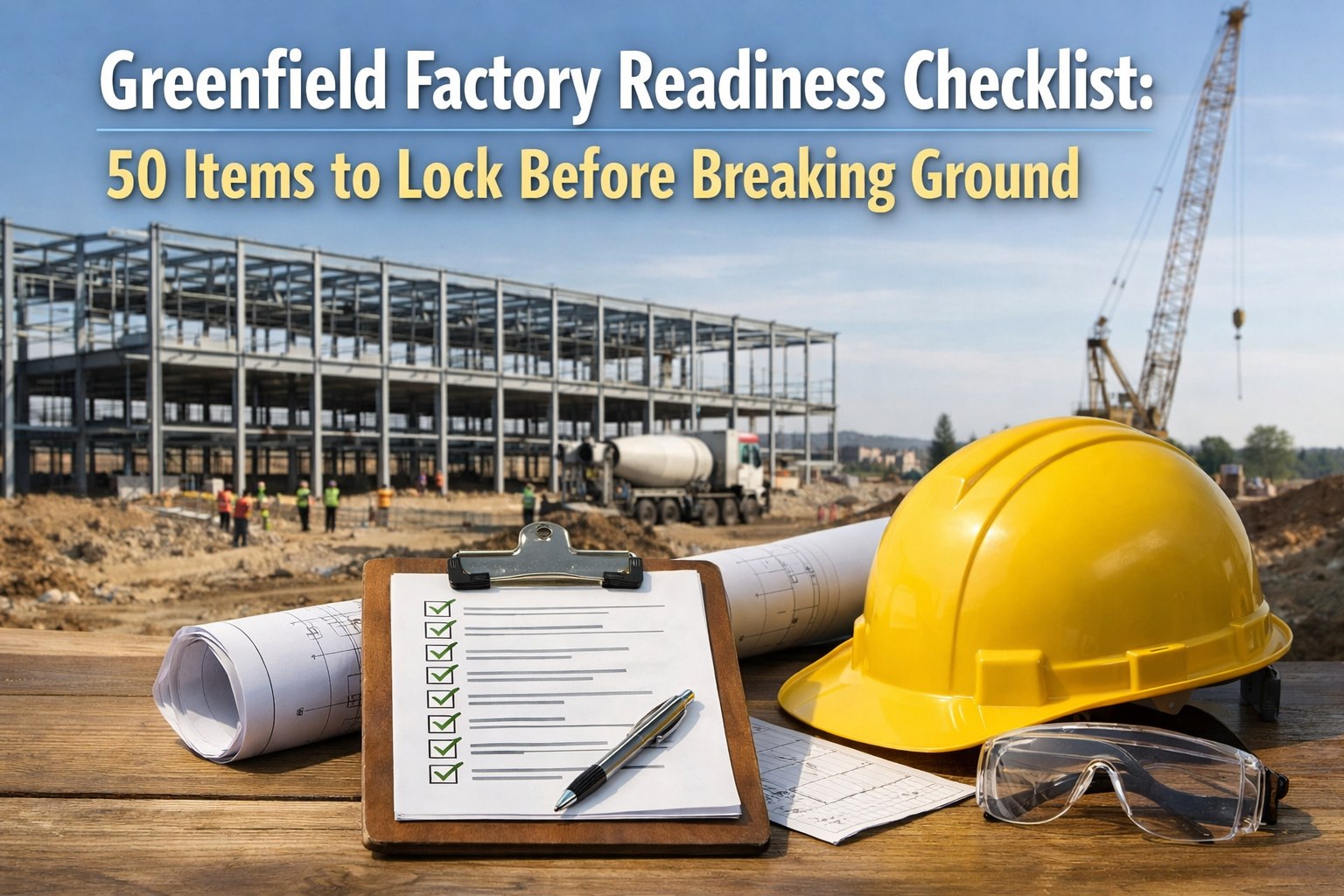
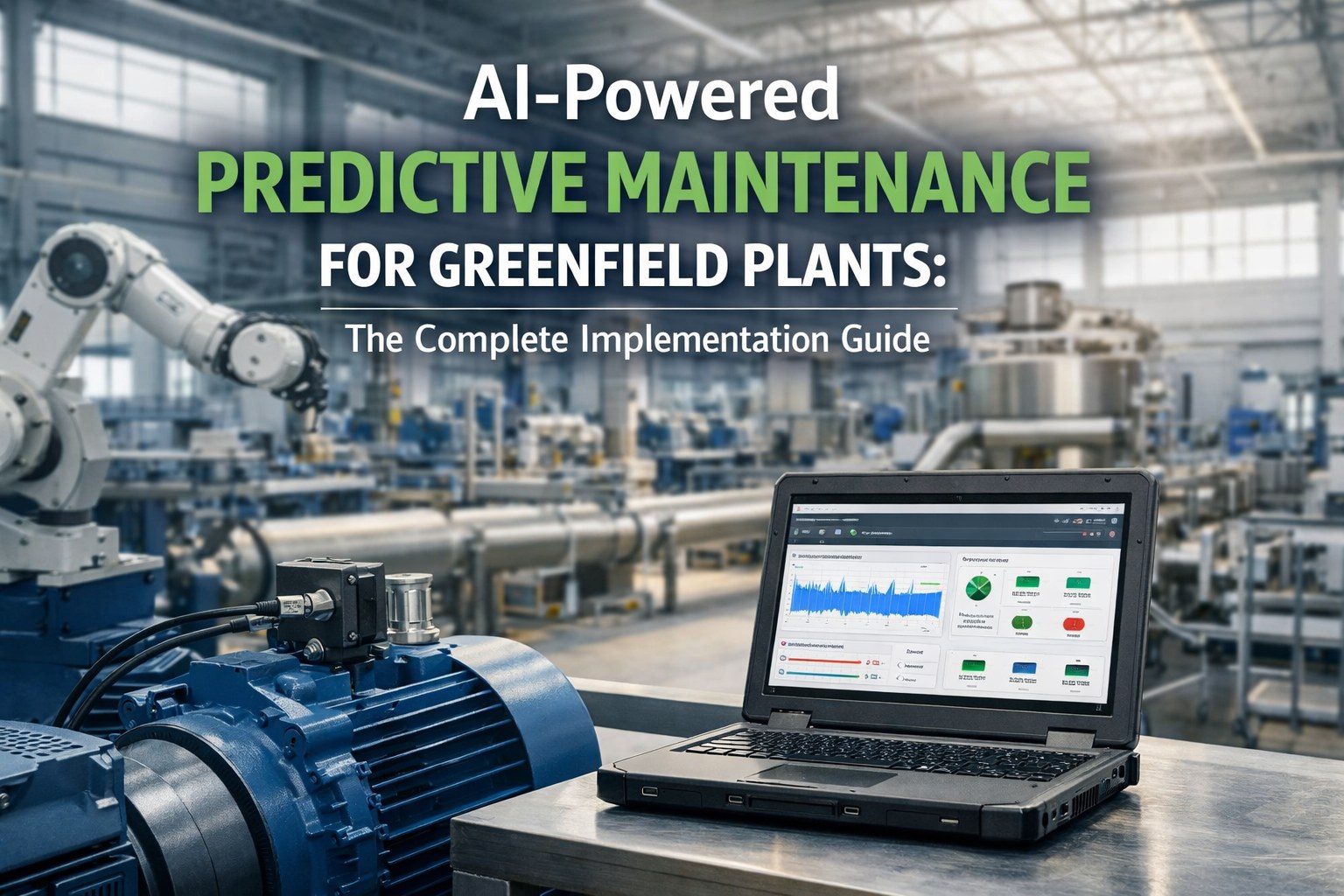
The predictive maintenance market is racing past $10 billion in 2024 and heading toward $47 billion by 2029 — but most first-year PdM programs fail to deliver ROI. Not because the AI doesn't work. Because the factory wasn't ready. Sensors installed in the wrong places. Data pipelines that don't reach the CMMS. Maintenance teams trained on reactive firefighting, not predictive analytics. This checklist walks greenfield factory leaders through every readiness gate — so your PdM program generates value from week one, not year two.
PREDICTIVE MAINTENANCE READINESS CHECKLIST
$10.9B
Predictive Maintenance Market Size (2024)
25%+
Market CAGR Through 2030
3-5x
Reactive vs. Planned Maintenance Cost
85-95%
AI Failure Prediction Accuracy
Why greenfield PdM readiness is different: Brownfield factories retrofit sensors onto aging equipment and fight legacy data silos. Greenfield gives you a once-in-a-decade chance to specify sensor mounting points, network infrastructure, and CMMS integration in your equipment procurement contracts — before a single machine is installed. Use this checklist during construction to ensure every prerequisite is in place before commissioning day.
Your PdM Readiness Score: Where Do You Stand?
Predictive Maintenance Maturity Levels
Level 1: Reactive
Fix it when it breaks. No sensors, no data, no visibility into equipment health until failure occurs.
Level 2: Preventive
Time-based schedules. You replace parts on a calendar — whether they need it or not. Better, but wasteful.
Level 3: Condition-Based
Sensors monitoring key parameters. You act when thresholds are breached. Good — but still reactive to symptoms.
Level 4: Predictive (AI-Powered)
ML models analyze sensor data to predict failures days or weeks ahead. CMMS auto-generates work orders. This is the target.
This checklist gets you to Level 4. Each section below represents a readiness gate. Complete all six, and your greenfield factory launches with AI-powered predictive maintenance from day one — not as a retrofit project two years later.
The 6-Gate PdM Readiness Checklist
Before selecting a single sensor, identify which assets actually warrant predictive monitoring. Not every motor, pump, or conveyor justifies PdM investment. Focus on assets where unplanned failure causes the most damage — production line stoppage, safety risk, regulatory non-compliance, or cascading downstream failures.
Complete a criticality analysis ranking every asset by failure consequence (production impact, safety, cost, repair lead time)
Map failure modes for top-20% critical assets: bearing wear, overheating, vibration drift, pressure loss, lubrication degradation
Define which condition monitoring technique applies to each failure mode (vibration, thermal, acoustic, oil analysis, current signature)
Document MTBF (Mean Time Between Failure) targets and MTTR (Mean Time To Repair) expectations per asset class
Identify pilot assets for Phase 1 PdM deployment — start with 3-5 high-criticality machines, not the entire plant
Sensors are the foundation of predictive maintenance — and the most common failure point. Wrong sensor type, wrong mounting location, or wrong sampling rate, and your AI models get garbage data that produces garbage predictions. Greenfield advantage: you specify sensor requirements in OEM procurement contracts, so equipment arrives sensor-ready.
Specify sensor types per asset: vibration (accelerometers), temperature (RTD/thermocouple), pressure transducers, current clamps, oil quality sensors
Define sampling rates: continuous real-time streaming for critical assets, periodic for lower-priority equipment
Include sensor mounting points, cable routing, and power supply in OEM equipment procurement specifications
Choose wired vs. wireless: wired for high-frequency vibration data; wireless mesh (MQTT, LoRaWAN) for temperature, humidity, and lower-frequency monitoring
Plan sensor calibration schedule and spare sensor inventory — miscalibrated sensors cause false alarms and missed failures
Verify sensor environmental ratings match plant conditions: temperature range, IP rating (dust/moisture), EMI/RFI immunity
DetectsBearing wear, imbalance, misalignment, looseness
Best ForRotating equipment: motors, pumps, compressors, fans
SamplingContinuous (1-10 kHz) for critical; periodic for secondary
DetectsOverheating, insulation degradation, friction, cooling failures
Best ForElectrical panels, bearings, motors, heat exchangers
SamplingEvery 1-60 seconds depending on thermal mass
DetectsLeaks, electrical discharge, cavitation, valve failures
Best ForSteam traps, compressed air, switchgear, hydraulic systems
SamplingContinuous or route-based depending on application
DetectsMotor winding faults, load changes, mechanical binding
Best ForElectric motors, drives, compressors, large pumps
SamplingReal-time current signature analysis at motor control center
Sensors are useless if their data doesn't flow to the right system at the right time. Your factory network must carry sensor data from the plant floor to edge compute, to cloud analytics, and into your CMMS — with latency low enough for real-time alerting and bandwidth sufficient for high-frequency vibration data. Design this infrastructure during construction, not after machines are running.
Deploy industrial-grade network: separate OT network for sensor/PLC data from IT network for business systems (MES, ERP, CMMS)
Install edge gateways at each production zone to aggregate sensor data, run local preprocessing, and forward to cloud via MQTT or OPC UA
Provision edge compute hardware (GPU-capable) for local AI inference — critical for sub-second alerting without cloud dependency
Size network bandwidth for peak sensor data volume: vibration data at 10 kHz from 50 sensors generates significant throughput
Implement time-series database (InfluxDB, TimescaleDB, or cloud equivalent) for storing and querying historical sensor data
Establish data retention policies: how long to keep raw sensor data vs. aggregated summaries vs. event logs
Verify cybersecurity: OT/IT network segmentation, encrypted sensor-to-cloud data paths, access controls on PdM dashboards
Data Pipeline Architecture: Sensor to CMMS
Sensor Layer
Vibration, Temperature, Pressure, Acoustic, Current, Oil Quality
Analytics & Action
Time-Series DB, ML Models, CMMS, MES Dashboards, Work Orders
Need Help Building Your PdM Data Pipeline?
iFactory connects sensor data to CMMS work orders, MES dashboards, and AI analytics in one unified platform — designed for greenfield factories launching predictive maintenance from day one.
Your CMMS is where predictions become actions. If sensor data doesn't flow into work orders, if failure alerts don't trigger technician dispatches, if maintenance history doesn't feed back into AI models — your PdM system is monitoring, not maintaining. Integration between your PdM platform and CMMS must be tested and validated before equipment goes live.
Complete asset register in CMMS: every PdM-monitored asset with hierarchy, criticality rating, spare parts list, and maintenance history template
Configure automatic work order generation: when AI flags a predicted failure, CMMS creates a prioritized work order with asset, failure mode, urgency, and recommended action
Set alarm thresholds per sensor: warning levels (advisory), critical levels (immediate action), and emergency levels (auto-shutdown triggers)
Integrate CMMS with MES for scheduling coordination — maintenance windows must align with production scheduling to minimize downtime impact
Establish the feedback loop: completed work order data (what was found, what was replaced, actual condition vs. prediction) feeds back into AI models to improve accuracy
Configure mobile access: technicians receive push alerts, view sensor trends, and close work orders from smartphones on the plant floor
Technology doesn't fail — adoption does. Predictive maintenance changes how maintenance teams work: from scheduled routines and reactive firefighting to data-driven, condition-based decisions. If technicians don't trust the AI alerts, if supervisors don't understand the dashboards, if leadership doesn't support the culture shift — the system becomes expensive shelf-ware.
Train maintenance technicians on: interpreting sensor data trends, responding to AI-generated work orders, and closing the feedback loop with actual findings
Train reliability engineers on: vibration analysis basics, threshold tuning, model accuracy review, and root-cause correlation with sensor data
Train supervisors and plant managers on: PdM dashboards, KPI interpretation (MTBF, MTTR, planned maintenance percentage), and ROI tracking
Communicate PdM benefits across the organization — production, quality, and operations teams all benefit and all need to understand the system
Define escalation protocols: who gets notified at each alarm level, response time expectations, and decision authority for emergency shutdowns
AI models need baseline data to learn what "normal" looks like for your specific equipment, under your specific operating conditions. The first 90 days of production are critical for establishing baselines, validating predictions against actual outcomes, and tuning the system for accuracy. This is not set-and-forget — it's the period that determines whether your PdM investment pays off.
Run sensors in monitoring-only mode for 30-60 days to collect baseline data under normal production conditions
Validate AI predictions: track every alert and compare predicted failures vs. actual outcomes — measure precision and false alarm rate
Tune alarm thresholds based on real operating data — initial settings from OEM specs rarely match actual production conditions perfectly
Track PdM KPIs: unplanned downtime reduction, planned maintenance percentage, mean time between failure improvement, false alarm rate
Conduct 90-day review: what predictions were accurate, what was missed, what needs recalibration — then expand PdM to next asset group
The PdM Readiness Quick-Score Card
Not Ready
Partial
Ready
Critical Assets Mapped
No asset register or criticality ranking exists
Asset list exists but no failure mode analysis
Full criticality analysis with failure modes and PdM pilot assets selected
Sensors Specified
No sensor plan — will figure it out after install
Sensors selected but not in OEM procurement specs
Sensor types, mounting, sampling rates in equipment contracts
Data Pipeline Built
No OT network or data architecture planned
Network planned but no edge compute or time-series DB
Full pipeline: sensors to edge to cloud to CMMS, tested
CMMS Integrated
CMMS not selected or not configured for PdM
CMMS configured but no auto work order or feedback loop
Auto work orders, threshold alerts, and feedback loop active
Team Trained
Maintenance team has no PdM training
Basic training done but no escalation protocols defined
All roles trained, escalation protocols documented, culture aligned
Baseline Established
No plan for baseline data collection
Plan exists but no validation or tuning process defined
90-day baseline plan with validation, tuning, and review milestones
The pattern that separates PdM success from failure: Factories that treat predictive maintenance as a technology project fail. Factories that treat it as a maintenance strategy transformation — with sensor infrastructure, data pipelines, CMMS integration, team training, and continuous improvement built in from day one — achieve positive ROI within 12 months. The checklist above isn't aspirational. It's the minimum viable foundation.
Frequently Asked Questions
Launch Your Greenfield With PdM-Ready Infrastructure
iFactory's cloud-native platform connects sensors, CMMS, MES, and AI analytics — giving greenfield factories predictive maintenance capability from day one, not year two.
Is your greenfield factory PdM-ready? Book your free iFactory demo and see how sensor data, CMMS work orders, and AI-powered predictions connect in one platform — configured during construction, operational from day one.