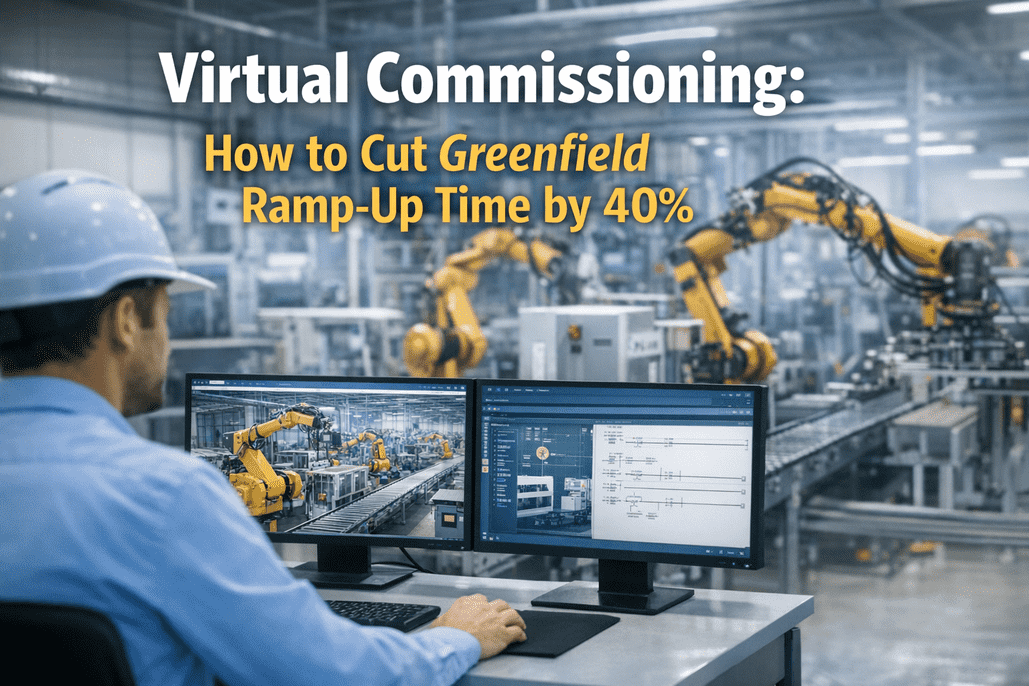
70% of commissioning delays trace to errors in control software. Traditional commissioning — debugging PLC logic, robot paths, and integration sequences on live equipment — burns through the most expensive weeks of any greenfield project: the facility is built, labor is on-site, and every day of delay costs $50K-$500K depending on scale. Virtual commissioning flips this equation. By testing the same PLC code, the same robot programs, and the same I/O signals against a functionally accurate digital twin before equipment arrives on-site, manufacturers are cutting commissioning time by 40-75%, eliminating 15-25% of on-site troubleshooting costs, and compressing the ramp-up curve by weeks. Research shows the ROI is 3:1 to 5:1 on the first project alone. This guide explains exactly how it works, what it tests, what it costs, and how to implement it in your greenfield project. Book a demo to see virtual commissioning in action.
What Virtual Commissioning Actually Is
Virtual commissioning is the process of testing and validating an automation system's control logic, robot programs, sensor responses, and integration sequences in a digital twin environment — using the same PLC code that will run on the physical controller. It is not a 3D animation. It is not a PowerPoint rendering. It is a functionally accurate, closed-loop simulation where the virtual model responds to PLC outputs and generates sensor inputs exactly as the physical system would.
Digital Twin Model
A kinematically accurate 3D replica of every machine, robot, conveyor, actuator, and sensor in the production system. Not just geometry — full mechanical constraints, motion profiles, and physics behavior are defined. Imported from CAD and enhanced with kinematic, dynamic, and logical parameters.
Controller Code (PLC / Robot Programs)
The actual PLC code — same ladder logic, structured text, or function blocks that will run on the physical controller. Executed via virtual PLC emulators (Siemens PLCSIM Advanced, Rockwell Studio 5000 Logix Emulate, Mitsubishi GX Simulator). Robot programs run in manufacturer-native simulators (FANUC Roboguide, ABB RobotStudio, KUKA.Sim).
Co-Simulation Interface
A real-time communication layer that connects the digital twin to the controller, exchanging I/O signals at PLC scan rates. The virtual model sends sensor signals to the PLC; the PLC sends actuator commands back. This closed loop is what makes virtual commissioning functionally identical to physical commissioning — every interlock, sequence, and safety check is tested against the real control logic.
The key insight: virtual commissioning doesn't test an approximation of your system. It tests your actual control code against a physics-accurate model of your actual equipment. Every bug found virtually is a bug that doesn't appear at 2 AM on the factory floor during physical commissioning.
What Virtual Commissioning Tests
| Test Domain | What's Validated | Typical Issues Caught | Cost if Caught On-Site Instead |
|---|---|---|---|
| PLC Logic Validation | Sequential logic, interlocks, state machines, error handling, HMI integration | Race conditions, deadlocks, incorrect state transitions, missing error handlers | $10K–$100K per bug (debug + downtime) |
| Robot Path Simulation | Motion paths, reach envelopes, collision avoidance, cycle times, tool changes | Fixture collisions, unreachable positions, suboptimal paths, singularities | $5K–$50K per path rework |
| Sensor & I/O Verification | Every photoelectric, proximity, encoder, and safety device mapped and tested | Wrong sensor types, incorrect mounting positions, signal polarity errors | $2K–$20K per sensor correction |
| Material Flow Simulation | Conveyor routing, buffer sizing, accumulation logic, product handoffs | Bottlenecks, starvation, accumulation overflow, incorrect routing logic | $50K–$500K per layout change |
| Safety System Validation | E-stops, light curtains, safety interlocks, zone-based safety logic | Incomplete safety zone coverage, incorrect interlock logic, bypass vulnerabilities | $20K–$200K (regulatory + rework) |
| Cycle Time Verification | Station-by-station cycle times, line balance, throughput at target speed | Bottleneck stations, takt time violations, insufficient buffer between stations | $100K–$1M+ (throughput shortfall) |
| HMI & Operator Interface | Screen layouts, alarm management, operator workflows, mode transitions | Unusable layouts (with gloves), missing alarm states, confusing mode transitions | $5K–$30K per interface redesign |
Want to see virtual commissioning applied to your automation layout? Book a 30-minute demo — we'll show PLC validation, robot path simulation, and material flow testing running against a digital twin.
The ROI: Virtual vs. Physical Commissioning
The numbers from real projects are unambiguous. Virtual commissioning adds 5-8% to the engineering budget but eliminates 15-25% of on-site troubleshooting costs. Here's a documented comparison from two similar-scope welding cells — one with full virtual commissioning, one without:
The 5-Step Virtual Commissioning Process
3D Model Import & Kinematic Setup
CAD models of all machines, robots, conveyors, fixtures, and tooling are imported into simulation software. Unnecessary geometry is removed for performance. Kinematics are assigned — joint limits, motion profiles, acceleration curves. Mechanical constraints are defined to ensure simulation consistency. This transforms static geometry into a dynamic, physics-aware model.
1–3 weeks depending on system complexitySensor & I/O Mapping
Every sensor, actuator, and I/O point in the physical system is mapped to a virtual equivalent. Photoelectric sensors trigger at the correct positions. Proximity sensors detect parts at the right distances. Encoders count at the right resolution. The I/O map matches the PLC wiring exactly — so when the virtual PLC reads an input, it reads the same signal the physical PLC would.
1–2 weeksPLC & Robot Code Integration
Actual PLC code is loaded into a virtual controller emulator. Robot programs are loaded into manufacturer-native simulators. The co-simulation interface connects both to the digital twin model, creating a closed loop: PLC sends commands, the model executes motion, sensors generate feedback, PLC processes the feedback. This loop runs at real-time or accelerated speed for testing.
2–4 weeks (includes iterative debugging)Test Execution & Debugging
Controls engineers run every operating mode: automatic, manual, maintenance, startup, shutdown. They trigger every failure mode: part jams, sensor failures, E-stops, communication losses. They test every product variant, every changeover sequence, every edge case. Bugs are found and fixed in software — not on the factory floor. The test plan mirrors the physical SAT procedure exactly.
2–6 weeks (varies with system complexity)Validation Report & Handoff to Physical SAT
A comprehensive test report documents every test case, result, and resolution. The validated PLC code and robot programs are deployed directly to physical controllers. On-site commissioning now focuses on mechanical verification and fine-tuning — not software debugging. The digital twin continues as a living operational asset for training, optimization, and future changeovers.
1 week for documentation + handoffReady to add virtual commissioning to your greenfield plan? Schedule a consultation — we'll scope the virtual commissioning effort for your automation architecture and show you the expected time and cost savings.
Cost & Timeline: What to Budget
| Project Scale | Virtual Commissioning Cost | % of Total Engineering | On-Site Time Saved | Typical ROI |
|---|---|---|---|---|
| Single Robotic Cell ($400K-$800K) | $20K–$60K | 5–8% | 7–10 days | 3:1 to 5:1 |
| Multi-Station Assembly Line ($2M-$8M) | $100K–$400K | 5–7% | 2–6 weeks | 4:1 to 6:1 |
| Full Factory Automation ($10M-$50M+) | $500K–$2M | 4–6% | 4–12 weeks | 5:1 to 8:1 |
The ROI increases with complexity. Simple systems get moderate benefit. Complex, multi-robot, multi-PLC systems with tight integration requirements get massive benefit — because those are the systems where on-site debugging is most expensive and most unpredictable.
When to Start Virtual Commissioning in the Greenfield Timeline
Begin Model Development
Start importing CAD models and defining kinematics as factory layout and equipment specifications are finalized. Don't wait for equipment to arrive — the model should be built in parallel with procurement.
Integrate PLC Code & Test
As PLC code is developed and robot programs are written, integrate them into the virtual environment. Run tests continuously. This is the phase where 80% of software bugs should be found and fixed — while the building is still being constructed.
Full Virtual Acceptance Test
Run the complete Factory Acceptance Test virtually before physical FAT at vendor facilities. All operating modes, failure scenarios, and product variants tested. Punch list items documented. Operations team participates for training purposes.
Deploy Validated Code On-Site
On-site commissioning now focuses on mechanical verification and sensor calibration — not code debugging. The digital twin runs in parallel for real-time comparison. Commissioning timeline compressed by 40-75%.
Cut Your Ramp-Up Time by 40%
iFactory's virtual commissioning service tests your PLC logic, robot paths, and production flows in a digital twin before equipment arrives on-site. Every bug found virtually saves $10K-$100K on the factory floor.
Frequently Asked Questions
Every Bug Found Virtually Is a Bug That Doesn't Cost You $100K on the Factory Floor
Virtual commissioning compresses ramp-up by 40-75%, eliminates 80%+ of software bugs before physical deployment, and delivers 3:1 to 8:1 ROI. Start the conversation today.


