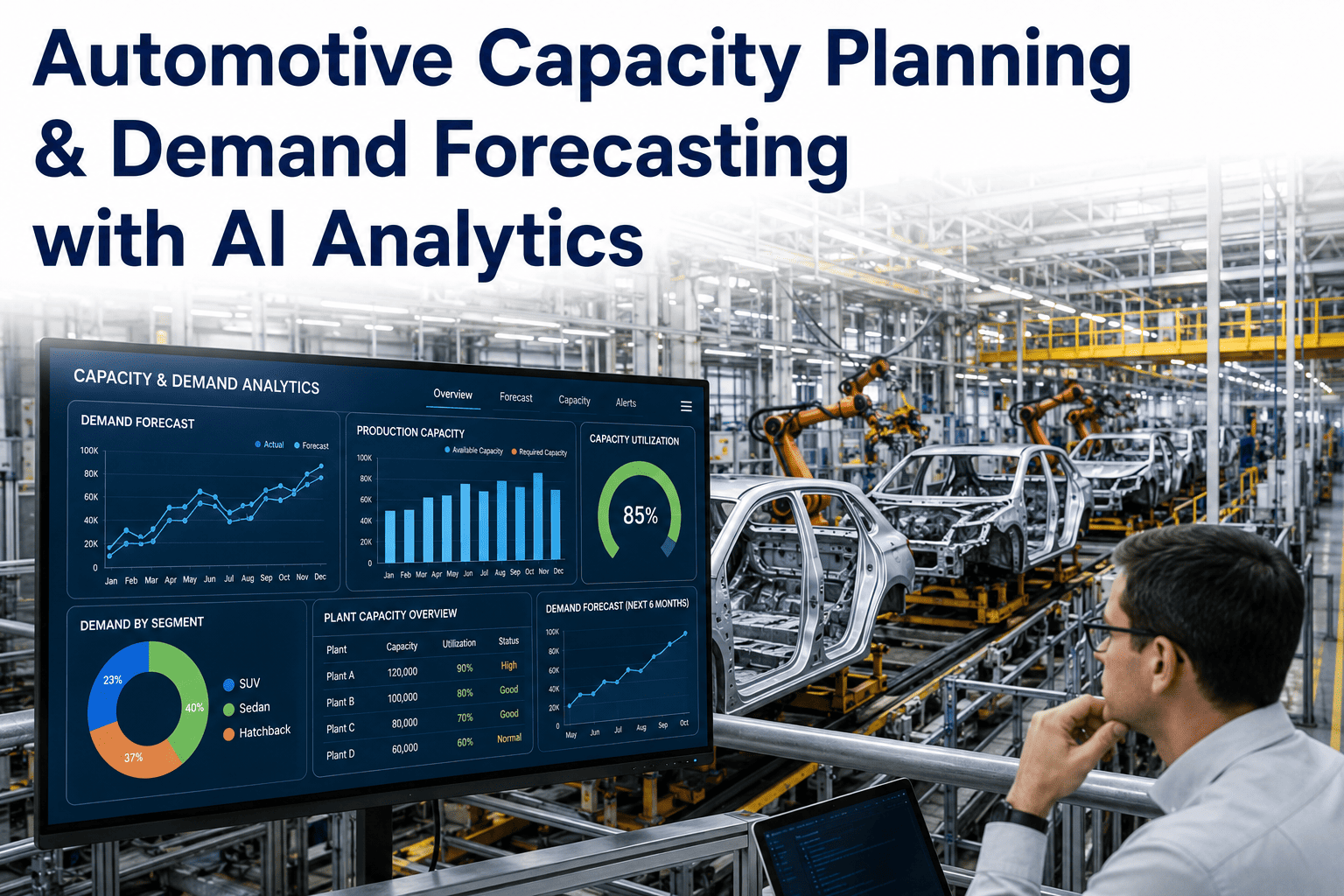
Automotive manufacturers face unprecedented demand volatility from EV adoption, supply chain disruptions, and consumer preference shifts that traditional forecasting methods cannot predict. Manual demand planning using 24-36 month historical data creates forecast errors of 15-35% that result in either excess inventory tying up $100M+ in working capital or stockouts causing production line stoppages costing $50K-$500K per hour. Tier-1 suppliers and OEMs managing 500,000+ SKUs across global plants cannot respond fast enough to demand changes using Excel-based forecasts updated monthly. AI-powered demand sensing monitors real-time sales velocity, dealer inventory, customer orders, and supply availability simultaneously — providing demand accuracy within 92-98% compared to 65-80% for traditional methods. iFactory's platform automatically generates purchase orders aligned to actual demand within 3-7 days vs 30-60 days for manual planning, prevents $12M-$80M in excess inventory accumulation annually, and optimizes production scheduling to maximize OEE while meeting customer delivery commitments. Predict Failures Before They Stop Production. Real-Time Visibility Into Every Production Line. Book a Demo to see how iFactory demand sensing transforms your inventory planning and supply chain efficiency.
Demand Planning Crisis in Automotive Manufacturing
15-35%
Forecast error with traditional methods — resulting in $12M-$80M excess inventory or production stoppages
$50K-$500K
Per-hour production line stoppage cost from stockouts — preventing delivery commitments
92-98%
Demand accuracy with AI sensing vs 65-80% for traditional forecasting methods
3-7 days
Purchase order response time with AI vs 30-60 days for manual planning cycles
Quick Answer
AI demand sensing monitors real-time sales velocity, dealer inventory, customer orders, and supply constraints simultaneously to predict demand 92-98% accurately. Traditional forecasting relies on historical data extrapolation, creating 15-35% errors that result in excess inventory or stockouts. Built for Manufacturing Plants, Not Generic CMMS. AI demand sensing generates purchase orders within 3-7 days aligned to actual demand vs 30-60 day manual cycles. One Platform for Smart Manufacturing with AI-Powered Maintenance, OEE, and Operations.
Limitations of Traditional Demand Forecasting
Traditional demand planning uses historical data extrapolation with 24-36 month lookback periods, updated monthly or quarterly, missing real-time demand signals and market shifts. Results in systematic forecast errors that compound through supply chain causing excess inventory or production stoppages.
01
Reliance on Historical Data Patterns
Traditional methods assume past demand patterns predict future demand — invalid in automotive where EV adoption, supply disruptions, and consumer preferences shift rapidly. COVID, chip shortages, and OEM model changes invalidate historical patterns instantly.
02
Slow Update Cycles & Manual Processes
Monthly or quarterly forecast cycles miss demand changes happening weekly or daily. Managers spend 20-30% of time in forecast meetings rather than responding to actual demand. Purchase orders lag 30-60 days behind actual market signal.
03
Siloed Data Sources & Disconnected Systems
Sales, logistics, supply chain, and manufacturing teams operate separate systems without real-time information sharing. Demand signal from dealer inventory or customer orders arrives weeks after data collection, too late to adjust orders.
04
Forecast Accuracy Ceiling at 65-80%
Best-in-class traditional forecasting achieves 65-80% accuracy. Remaining 20-35% error creates $12M-$80M inventory costs. Excess inventory ties up working capital; stockouts lose sales and damage OEM relationships.
05
Limited Scalability for 500K+ SKUs
Forecasting 500,000+ SKUs across multiple plants, suppliers, and variants manually is impossible. Teams focus on top 5% of SKUs; 95% are forecasted by simple rules or historical averages.
How AI Demand Sensing Works in Automotive
AI demand sensing monitors real-time demand signals from sales velocity, dealer inventory, customer orders, supply constraints, and market trends simultaneously. Machine learning models learn demand patterns continuously, identifying shifts within hours vs days or weeks. Eliminate Manual Logs with AI Digital Shift Logbooks. Connects to Your Existing SCADA/PLC Systems.
01
Real-Time Sales Velocity Monitoring
Captures actual sales transactions daily, identifies demand acceleration or deceleration patterns within 24 hours vs monthly forecast cycles. Dealer inventory levels monitored to detect channel demand shifts.
02
Customer Order & Point-of-Sale Integration
Directly integrates customer orders, build-to-order signals, and retail POS data. Eliminates 15-20 day lag between customer order and supply chain visibility in traditional systems.
03
Supply Constraint & Risk Monitoring
AI identifies supplier delays, material shortages, and logistics bottlenecks affecting demand fulfillment. Automatically adjusts purchase orders to account for supply risks and lead time variability.
04
Continuous ML Model Learning & Adaptation
Models learn from actual demand outcomes vs forecasts daily, continuously improving accuracy. Models adapt to EV adoption trends, supply disruptions, and seasonal patterns in real time.
05
Automatic Purchase Order Generation
Demand sensing triggers purchase orders automatically within 3-7 days aligned to actual demand vs 30-60 day manual cycles. Prevents both excess inventory and stockouts through dynamic quantity adjustments.
06
Demand Sensing & Production Alignment
Predicted demand feeds directly into production scheduling and build plans. Maximizes OEE by scheduling production aligned to actual demand vs forecasts. The Complete AI Platform for Manufacturing Operations.
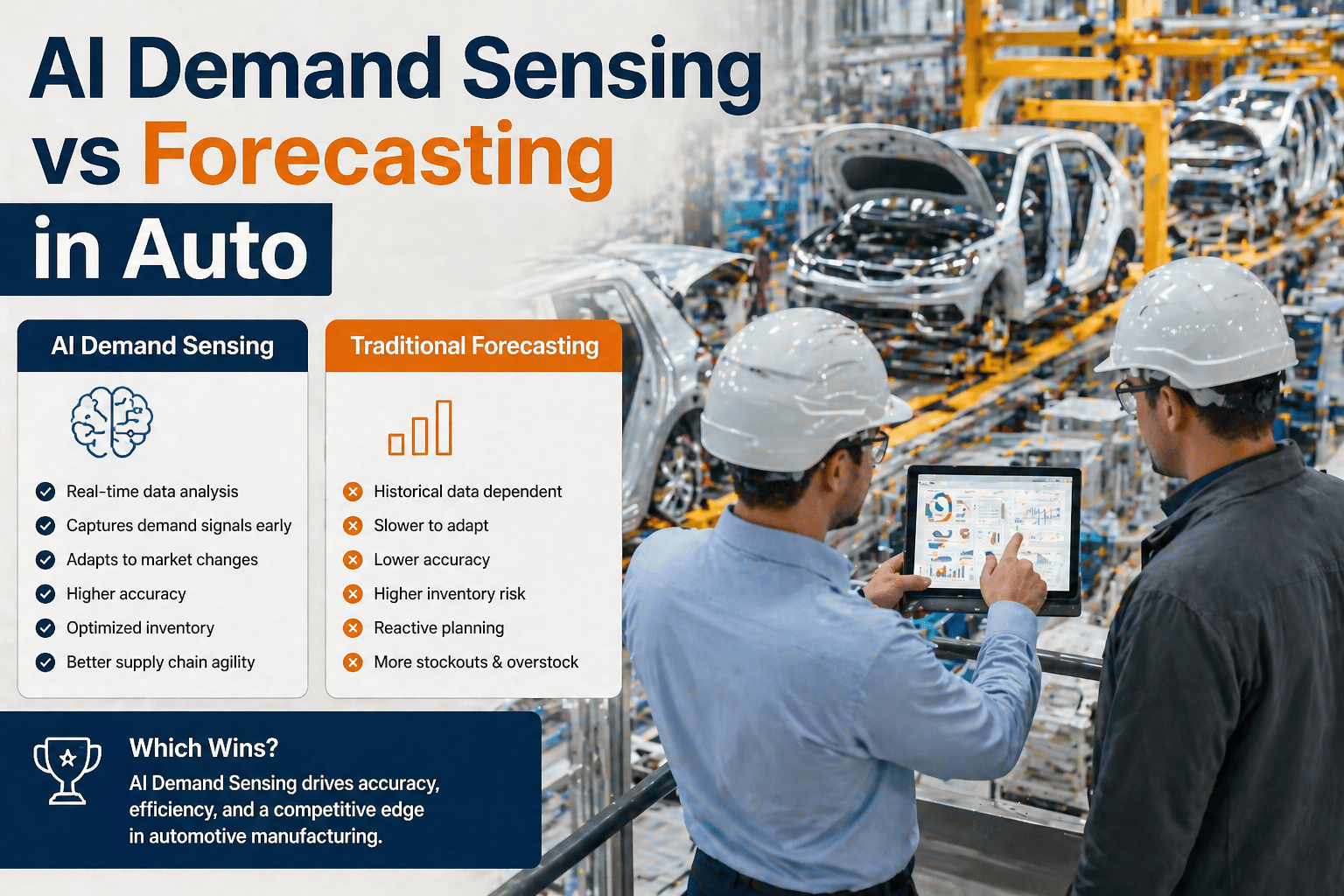
AI Sensing vs Traditional Forecasting Comparison
Direct comparison of capabilities, accuracy, speed, and business impact between AI demand sensing and traditional forecasting methods in automotive manufacturing environments.
| Capability |
Traditional Forecasting |
AI Demand Sensing |
| Demand Accuracy |
65-80% accuracy |
92-98% accuracy |
| Data Sources |
Historical data only |
Real-time sales, orders, inventory, supply |
| Update Frequency |
Monthly or quarterly |
Continuous, daily updates |
| PO Response Time |
30-60 days |
3-7 days |
| Inventory Impact |
$12M-$80M excess inventory |
$6M-$8M reduction, higher turns |
| Demand Signal Lag |
15-20 days minimum |
Same-day or next-day |
Use Cases: Demand Planning Results
Real results from automotive OEMs and tier-1 suppliers implementing AI demand sensing. Metrics reflect 6-12 month post-deployment performance.
Case 01
OEM: Demand Accuracy Improvement & Inventory Reduction
Automotive OEM with 500K+ SKUs across 12 plants forecasting monthly achieved 72% accuracy. AI demand sensing improved accuracy to 96%, reducing forecast errors 75%. Excess inventory reduced from $48M to $8M, freeing $40M working capital. Production line stoppages from stockouts eliminated. ROI achieved in 6 weeks.
Case 02
Tier-1 Supplier: Supply Chain Response & Cost Reduction
Tier-1 supplier managing 180K SKUs for 5 OEMs reduced purchase order response time from 45 days to 5 days using AI demand sensing. Demand accuracy improved from 68% to 94%. Inventory carrying costs reduced $12M annually. Emergency freight shipments eliminated (20% cost reduction). Supplier on-time delivery to OEMs improved 22%.
Case 03
EV Battery Manufacturer: New Product Demand Optimization
Battery manufacturer launching EV modules with unpredictable demand patterns. Traditional forecasting unable to predict market adoption. AI demand sensing monitored OEM model releases, consumer interest, and competitive launches. Achieved 91% demand accuracy for new products within 60 days. Prevented $18M excess battery inventory. Enabled rapid capacity scaling to 3x volume in 9 months without stockouts.
Frequently Asked Questions
QHow long does demand sensing implementation take?
8-12 weeks from data integration to live demand predictions. Weeks 1-2: connect to sales systems, ERP, POS data. Weeks 3-4: ML model training. Week 5+: live predictions and auto purchase orders.
Book Demo for your timeline.
QDoes AI sensing work for new products and EV adoption shifts?
Yes. AI continuously learns from actual demand vs forecasts, adapting to new product launches, market trends, and EV adoption patterns. Models improve accuracy 1-2% monthly as they learn from real-world outcomes.
QCan demand sensing integrate with existing ERP and MES systems?
Yes. iFactory connects to SAP, Oracle, Infor, and other ERP systems. Automatically triggers purchase orders and feeds production scheduling. No system modifications required.
Talk to Support for your integration needs.
QWhat's the ROI timeline for demand sensing?
ROI typically achieved in 6 weeks from live predictions through inventory cost reduction and improved OEE. Most implementations reach full ROI within 4 months as forecast accuracy improves and working capital is freed.
Stop Losing Money to Forecast Errors. Deploy AI Demand Sensing in 8 Weeks.
92-98% demand accuracy vs 65-80% traditional forecasting. Free $6M-$40M in excess inventory. Generate purchase orders in 3-7 days vs 30-60 days. Eliminate production stoppages from stockouts. Maximize OEE through demand-aligned production scheduling. Predict Failures Before They Stop Production.
92-98% demand accuracy
$12M-$40M inventory freed
ROI in 6 weeks