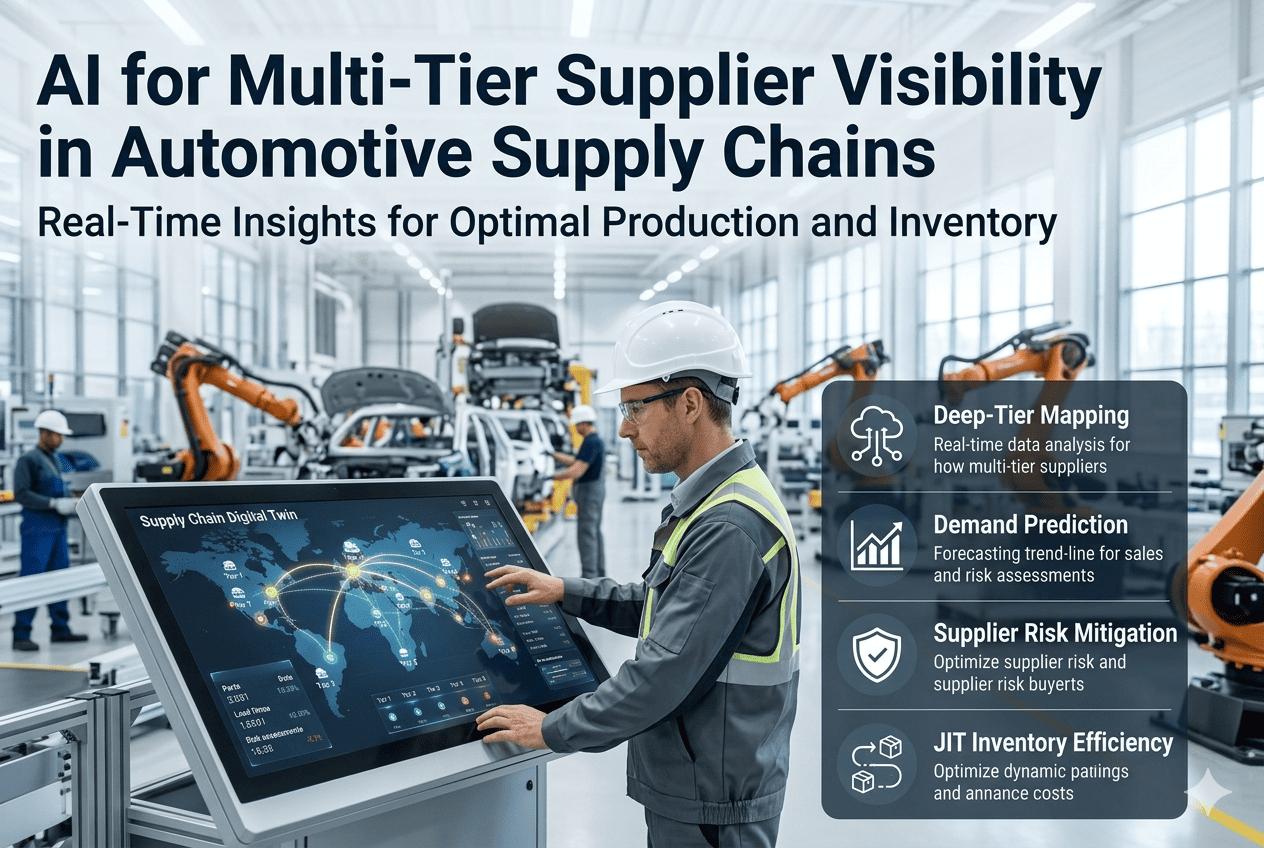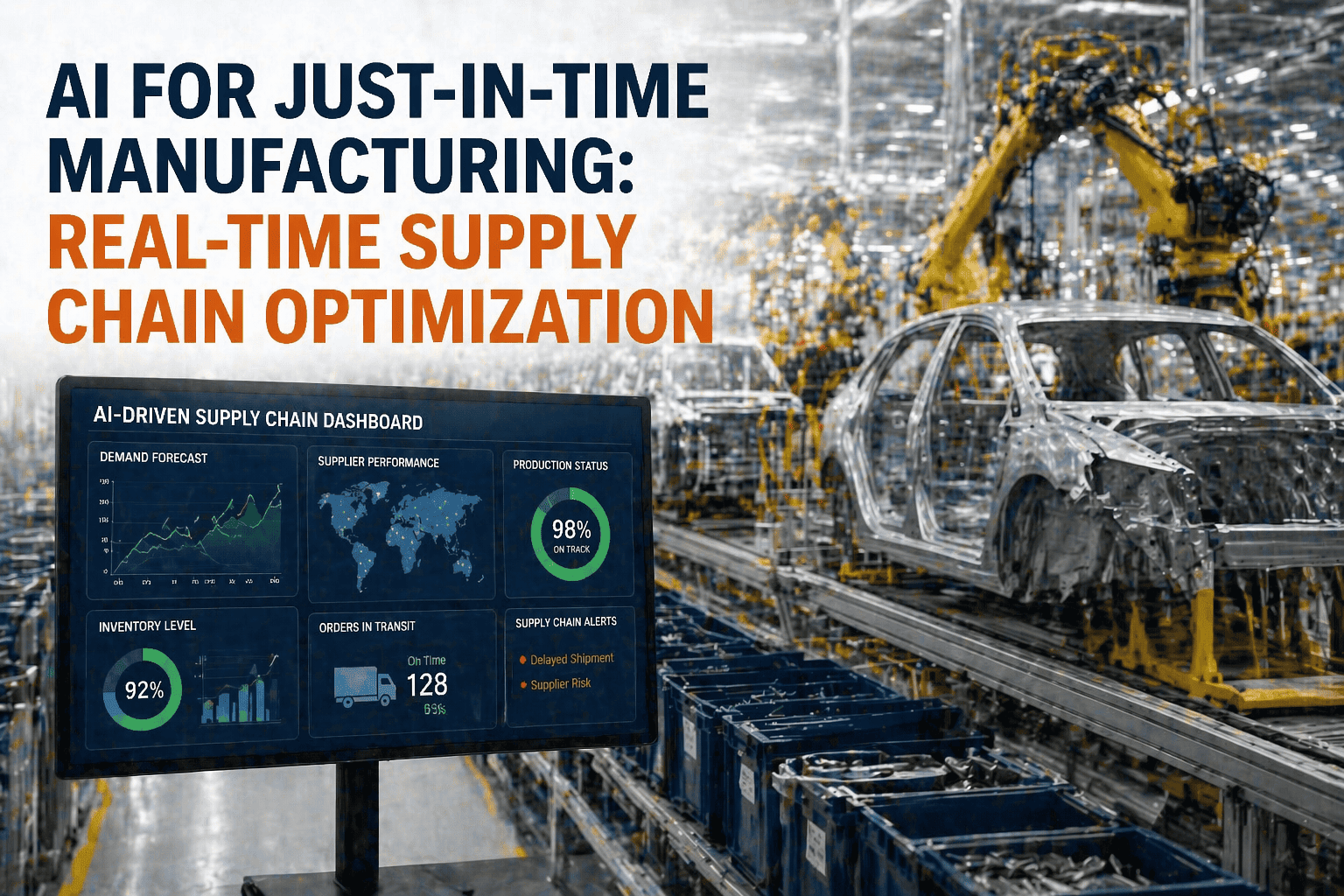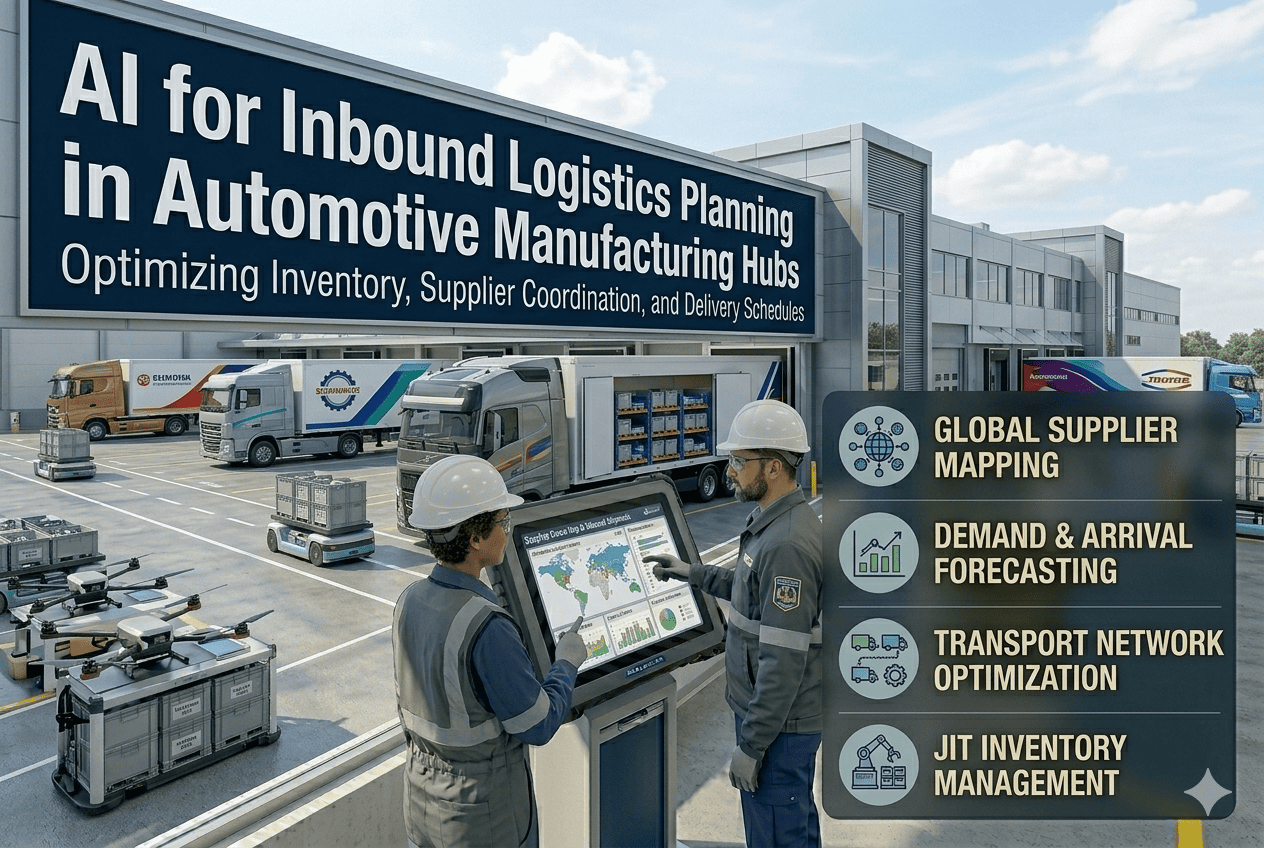
Global automotive plants lose $180-280 per minute to inbound logistics disruptions — equipment arriving 4-6 hours late triggering production line halts, supplier shortages forcing expedite procurement at 200-400% cost premiums, and warehouse inventory choking assembly scheduling because parts visibility across 3-tier supplier networks remains trapped in manual spreadsheets and email chains updated hours after reality changes. Automotive downtime costs have risen 113% since 2019 due to supply chain fragmentation: a single-shift production halt at a major OEM platform costs $840K-2.1M depending on vehicle type and line complexity, while expedited parts procurement to recover lost time adds another $180-420K per incident. Across global automotive manufacturing hubs, inbound logistics failures cause 40-60 production disruptions monthly, represent 25-35% of total downtime hours, and create cascading supplier penalties through line-stoppage SLAs that OEMs aggressively enforce. Traditional inbound planning relies on 48-72 hour supplier lead time forecasts, weekly inventory reviews, and manual truck consolidation — visibility so delayed that by the time planners detect shortage risk, mitigation options have evaporated and expedited freight becomes the only choice. iFactory's AI-powered inbound logistics platform deploys real-time visibility across multi-tier suppliers, predictive demand sensing, and autonomous logistics orchestration — predicting parts shortages 5-7 days in advance through integrated supplier inventory monitoring and demand signal correlation, automatically optimizing inbound consolidation reducing freight costs 22-28%, and coordinating just-in-time delivery schedules that align with assembly requirements enabling 15-22% inventory reduction while maintaining zero-shortage reliability. Book a Demo to see how iFactory deploys AI inbound logistics planning across your automotive hub within 8 weeks.
How iFactory AI Inbound Logistics Planning Prevents Production Disruption and Waste
Inbound disruptions originate from four root causes operating independently at most plants: supplier inventory depletion occurs 72+ hours before demand surge visibility reaches suppliers enabling proactive shipment; truck consolidation schedules remain static weekly despite 15-20% daily demand variation creating either half-empty trucks burning needless fuel or delayed shipments missing receipt windows; warehouse receiving capacity constraints go unmonitored until trucks arrive creating dock congestion and hold delays; and multi-tier supplier visibility stops at Tier 1 contract manufacturers while Tier 2-3 material availability remains unknown until shortages cascade upstream. AI inbound logistics monitoring inverts this workflow — analyzing real-time demand signals, supplier inventory levels, in-transit shipment status and warehouse capacity to predict shortage scenarios 5-7 days in advance, automatically consolidating and rerouting truck loads optimizing for both cost and delivery timing, and coordinating with suppliers and logistics providers enabling proactive mitigation before production impact occurs. See live demo of AI predicting parts shortages 5-7 days in advance with 88% accuracy enabling preventive supplier coordination.
How iFactory Is Different from Manual Logistics Planning and Legacy Supply Chain Tools
Most automotive plants manage inbound logistics through weekly supplier communication, manual spreadsheet consolidation of shipment requests, and reactive response to supplier delays discovered 24-72 hours before parts shortages impact assembly. iFactory is built differently — purpose-designed for automotive where millisecond production timing, 100+ supplier networks, and SLA penalties demand daily predictive analytics and autonomous orchestration traditional methods cannot deliver. Compare iFactory's AI inbound logistics planning against your current manual planning baseline directly.
| Capability | Manual Logistics Planning | iFactory AI Inbound Logistics |
|---|---|---|
| Shortage Prediction Timing | Detected 24-72 hours before shortage impacts assembly through supplier communication lag and delayed demand signal propagation. Post-shortage expedite procurement only option. | Predicted 5-7 days in advance through real-time supplier inventory monitoring and demand sensing. Mitigation options available: supplier acceleration, consolidation, safety stock positioning. |
| Mitigation Options | Limited to expedited freight at 200-400% premium cost once shortage detected. No proactive supplier or inventory positioning capability. | Proactive options include supplier acceleration, freight consolidation timing adjustment, safety stock positioning, or model mix sequencing changes. Prevents expedite-driven cost inflation. |
| Freight Consolidation | Static weekly consolidation schedules based on seasonal patterns. Cannot respond to daily demand variation. Typical utilization 60-70% with frequent partial trucks. | Daily AI-optimized consolidation responding to real-time demand and delivery window requirements. Maintains 85-90% truck utilization reducing freight cost 22-28%. |
| Supplier Visibility | Limited to Tier 1 contract manufacturers. Tier 2-3 material availability unknown until shortage cascades upstream creating unavoidable line-stoppage risk. | Real-time integration across Tier 1, Tier 2, and Tier 3 suppliers enabling complete supply chain visibility and risk detection before impact propagates. |
| Demand Forecast Accuracy | Manual forecast based on sales plan and seasonal trend. Typical accuracy 75-80% two weeks forward. Model mix variation and actual line throughput not incorporated. | Neural network demand sensing incorporating production schedules, actual line throughput, model mix variation and external demand signals. 94% accuracy 2-4 weeks forward enabling supplier coordination. |
| Inventory Levels | Safety stock maintained to cover forecast uncertainty and supplier variability. Typical inventory 18-25% of monthly consumption enabling shortage risk coverage. | Safety stock optimized to 8-12% of monthly consumption through improved forecast accuracy and advance shortage prediction. 15-22% working capital reduction while maintaining zero shortage. |
| Warehouse Coordination | Manual dock scheduling without visibility into receiving capacity. Frequent truck congestion and hold delays reducing dock efficiency 15-20%. | AI predicts receiving capacity constraints 12-24 hours in advance and orchestrates truck arrival timing preventing dock congestion and optimizing receiving staff productivity. |
| Deployment Timeline | Immediate with existing staff and manual procedures. No system changes or supplier integration required. | 8-week fixed deployment including supplier integration, MES/SAP connectivity, demand model training and staff training. Faster than manual system redesign and organizational change. |
iFactory AI Implementation Roadmap for Inbound Logistics Planning
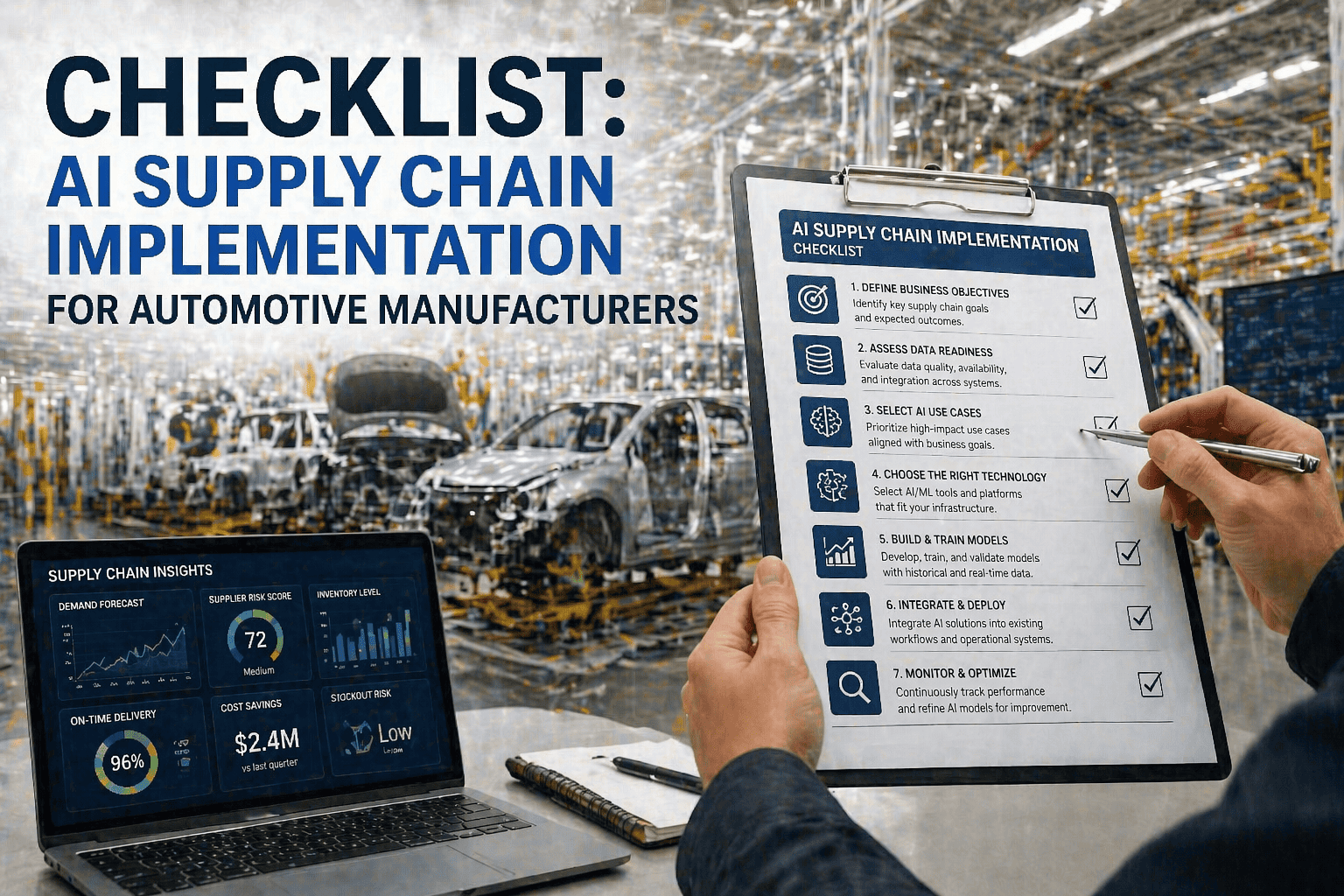
iFactory follows a fixed 6-stage deployment methodology designed specifically for automotive inbound logistics — delivering shortage predictions on critical material families in week 4 and full portfolio optimization by week 8. No production disruption required.
8-Week Deployment and ROI Timeline
Every iFactory engagement follows a structured 8-week program with defined deliverables per week — and measurable shortage prevention and cost reduction beginning from week 4 when pilot predictions demonstrate 88%+ accuracy on critical material families. Request the full 8-week deployment scope document customized to your vehicle types and supplier network.
Use Cases and ROI Results from Live Deployments
These outcomes are drawn from iFactory AI inbound logistics deployments at operating automotive assembly plants across three vehicle segment types. Each use case reflects 6-month post-deployment performance data. Request the full case study report for the vehicle type and supplier network most relevant to your operations.
What Automotive OEM Operations Say About iFactory Inbound Logistics Planning
The following testimonials are from supply chain and operations leaders at automotive OEMs currently running iFactory's AI inbound logistics platform.
Frequently Asked Questions
Region-Wise Automotive Inbound Logistics Challenges and iFactory Solutions
Automotive supply chains face different supplier concentration, regulatory frameworks and logistics infrastructure across global regions. iFactory AI inbound logistics planning adapts to regional constraints while delivering consistent shortage prediction and cost optimization.
| Region | Key Inbound Challenges | Compliance & Logistics Requirements | How iFactory Solves |
|---|---|---|---|
| United States (Michigan, Ohio, Texas) | Highest supplier concentration (40-60% sourcing within 500 mile radius) creating just-in-time dependency, volatile freight rates due to driver shortages, automotive tariff impact on Mexican supplier cost, cross-border integration with Canadian suppliers | IATF 16949 SLA enforcement, automotive safety regulations (FMVSS), quality escrow penalties, cross-border tariff classification tracking | Real-time freight rate monitoring enables consolidation timing optimization around rate spikes. Supplier diversity intelligence predicts concentration-driven shortage risk. Cross-border integration with Mexican and Canadian suppliers enables unified demand visibility optimizing tariff-exposed sourcing. |
| Europe (Germany, Poland, Spain) | Complex multi-country supplier networks requiring customs coordination, EU-UK post-Brexit trade barrier complexity, driver shortage creating rising freight costs, automotive energy transition supplier volatility (EV component availability) | IATF 16949, EU customs regulations, trade agreement compliance (USMCA equivalents), environmental goods movement tracking, electric vehicle supply chain standards | Customs documentation automation integrated into shipment planning preventing delays. Trade agreement intelligence optimizes intra-EU supplier selection minimizing tariff exposure. Energy transition supplier monitoring identifies battery and motor component availability risks before impact cascades. |
| UAE and Middle East (Abu Dhabi, Saudi Arabia) | Longer supplier lead times (30-45 days typical) reducing shortage prediction window, port congestion at major entry points (Jebel Ali, King Abdulaziz), complex sourcing blend of regional manufacturers and global imports, high logistics cost due to geography | GCC trade agreements, port authority compliance, local content regulations (UAE 50%+ local sourcing mandates), safety inspection and quarantine protocols | Extended lead time visibility (30-45 days forward) enables early mitigation through safety stock positioning and supplier acceleration. Port congestion monitoring predicts dock delays enabling dock-side consolidation coordination. Local content regulation tracking ensures sourcing mix compliance while optimizing cost. |
| Canada (Ontario, Quebec) | Smaller supplier base creates single-source dependency risk, seasonal winter logistics disruptions (roads, fuel quality variation), Mexican supplier integration creates tariff and customs complexity, USMCA compliance for regional content requirements | IATF 16949, USMCA origin rules (62.5% North American content), federal and provincial safety standards, tariff code accuracy requirements | Supplier concentration monitoring identifies single-source risks enabling proactive safety stock or dual-sourcing strategies. Seasonal demand and logistics pattern incorporation predicts winter supply constraints enabling advance inventory positioning. USMCA origin tracking ensures regional content compliance. |
| Asia (China, Japan, South Korea, Thailand) | Longest supplier lead times (45-90 days) requiring extended forecasting, political supply chain disruption risk (geopolitical tensions affecting electronics and rare materials), port congestion and customs complexity, currency volatility impacting cost predictability | Trade agreement complexity, export control compliance (sensitive materials), local content requirements (China battery production mandates), currency hedging coordination with finance | Ultra-extended demand forecasting (90-day forward visibility) enables early supplier communication and container consolidation planning. Geopolitical risk intelligence identifies at-risk suppliers enabling sourcing diversification. Currency exposure coordination with finance optimizes procurement timing around rate movements. |
iFactory vs Competitive Supply Chain and Logistics Solutions
Compare iFactory's AI inbound logistics planning against traditional approaches and competitor solutions.
| Approach | Shortage Prediction | Freight Optimization | Multi-Tier Visibility | Deployment Time | Automotive Fit |
|---|---|---|---|---|---|
| iFactory AI Inbound Logistics | 5-7 days in advance, 88% accuracy, integrated supplier inventory and demand sensing, prevents expedite-driven costs | Daily AI consolidation optimization, 22-28% cost reduction, dynamic load planning, real-time delivery timing | Real-time integration across Tier 1, Tier 2, Tier 3 suppliers via SAP/Oracle/APIs, complete supply chain visibility | 8 weeks fixed scope including supplier integration, MES connectivity and staff training | Purpose-built for automotive with IATF 16949 compliance, vehicle platform optimization, regional customization |
| Manual Logistics Planning | Detected 24-72 hours before shortage through supplier communication lag and delayed demand signal flow. Post-shortage expedite procurement only option. | Static weekly consolidation schedules, 60-70% truck utilization, frequent partial trucks, inability to respond to daily demand variation | Limited to Tier 1 direct suppliers, Tier 2-3 visibility requires manual escalation. Takes days to understand impact of sub-tier shortages. | Immediate with existing staff and procedures | Completely generic, no automotive specialization, reactive-only posture |
| Legacy ERP Supply Chain Modules (SAP, Oracle) | Forecast-based with typical 75-80% accuracy, lag between actual demand and forecast update (weekly or monthly), no real-time supplier inventory integration | Static order consolidation based on economic lot sizing, no dynamic real-time optimization, freight cost not primary optimization objective | Limited to Tier 1 data in your ERP, Tier 2-3 requires custom development or manual processes, no continuous integration | 6-12 months customization, significant IT overhead, requires internal resource commitment | Industrial generic tools applied to automotive, deep configuration required to match automotive processes |
| Logistics Consulting Firms | Periodic optimization studies (annual basis), retrospective analysis, no real-time continuous prediction capability | Recommendations for consolidation improvement, requires internal implementation, consulting ends leaving execution to you | Study-based assessment, no real-time continuous monitoring, recommendations may become outdated as supplier networks evolve | 12-18 months study and implementation cycle | General logistics consulting without automotive production timing specialization or continuous optimization |
| Third-Party Logistics (3PL) Providers | No shortage prediction capability, reactive to customer orders only | Optimize consolidation within their own network, no visibility into customer's full supplier ecosystem or demand patterns | No multi-tier supplier visibility, limited to their contracted carriers and consolidation points | Immediate engagement | Generic logistics execution, no automotive-specific optimization or OEM compliance features |