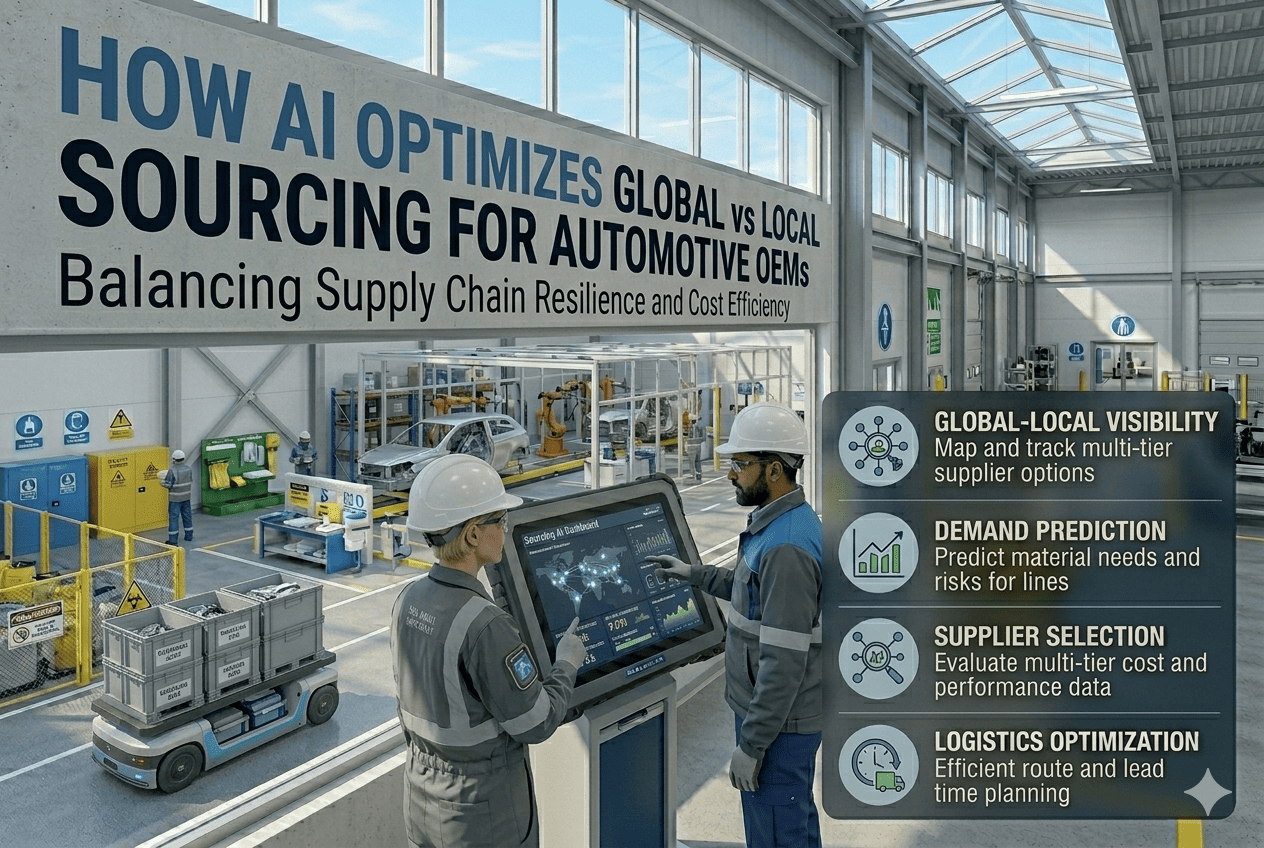
Automotive OEMs face a $2.8-7.2B annual cost penalty from suboptimal global vs local sourcing decisions — sourcing high-complexity components offshore creates 15-22 week lead times and geopolitical supply chain risk while over-reliance on local suppliers results in 18-35% cost premium with limited capacity scaling for production ramps. Sourcing decisions are made quarterly or annually using cost benchmarks and supplier rating scorecards disconnected from real-time demand forecasts, tariff changes, currency fluctuation, and port congestion data — leaving OEMs locked into sourcing strategies that no longer match operating realities. Manual sourcing analysis across 200+ suppliers across Tier 1-3 layers with conflicting cost, quality, delivery and risk variables produces analysis paralysis where strategic sourcing remains static for 18-36 months despite market shifts. iFactory's AI sourcing optimization platform continuously analyzes global vs local supplier options across cost, lead time, quality, capacity, risk and ESG criteria — recommending dynamic sourcing adjustments that improve total cost of ownership 8-16% annually while reducing supply chain disruption risk 40-55% through optimized geographic diversification and supplier mix. Book a Demo to see how iFactory deploys AI sourcing optimization across your supplier network within 8 weeks.
AI sourcing optimization for automotive OEMs is a decision support platform that continuously analyzes global vs local supplier options across cost (materials, freight, tariffs, currency), lead time, quality (defect rates, IATF 16949 compliance), capacity, delivery risk, geopolitical exposure and ESG criteria — recommending dynamic sourcing adjustments that improve total cost of ownership 8-16% annually while reducing disruption risk 40-55%. Unlike manual sourcing analysis that requires 4-8 week quarterly reviews, AI sourcing updates recommendations daily as market conditions, tariffs, freight rates and supplier performance change.
Three Global vs Local Sourcing Challenges Costing OEMs Millions
These are not procurement department decisions — they drive profitability, supply chain resilience, and strategic flexibility directly to the executive P&L. See the complete global sourcing optimization framework for automotive manufacturers.
High-complexity components (powertrains, EV batteries, semiconductors) sourced from Asia incur 15-22 week lead times and 40-60% tariff exposure. OEMs quote 18-month contracts with offshore suppliers, locking in sourcing decisions despite currency swings, geopolitical tensions, or supplier bankruptcy. Single offshore source for critical components leaves OEMs vulnerable to port strikes, pandemic disruptions, or trade escalation. Switching suppliers mid-contract triggers 6-12 month recertification delays and emergency procurement costs 200-400% above normal buys.
Localized suppliers typically command 18-35% cost premium over offshore equivalents due to smaller scale, higher labor and material costs, and limited automation. North American stamping and aluminum suppliers operate at 75-85% capacity utilization with inability to absorb 20-30% demand spikes without significant capex or months of lead time. Over-reliance on local suppliers for cost reasons creates inflexible supply chain unable to meet production ramps or variant demand volatility without premium expedites.
Sourcing decisions reviewed quarterly or annually using fixed cost benchmarks and static supplier scorecards disconnected from live tariff changes, currency fluctuation, freight cost volatility, or port congestion. By the time a sourcing review identifies an opportunity to shift components from offshore to local (or vice versa) due to tariff changes or geopolitical risk, implementation requires 4-8 weeks of supplier qualification adding 3-5% cost to the transition. Manual analysis across 200+ Tier 1-3 suppliers producing conflicting tradeoff recommendations results in analysis paralysis where sourcing remains stuck for 18-36 months.
How iFactory AI Optimizes Global vs Local Sourcing
iFactory deploys in four operational phases — from live supplier data integration through dynamic sourcing recommendations — with most automotive OEMs running continuously updated sourcing optimization within 6 weeks of deployment start.
All 200+ active suppliers registered with detailed attributes: geographic location (North America, Europe, Asia, Mexico, other), commodity classification, production capacity, lead time, quality metrics (PPM defect rates, IATF 16949 compliance), financial stability scores, tariff exposure, and ESG ratings. Current contracts imported with volume commitments, pricing, and contract expiration dates. See the supplier data requirements framework for sourcing optimization.
Real-time feeds from tariff databases (US HTS codes, EU tariff schedules, regional trade agreements), currency exchange rates, and freight cost indices (Shanghai Containerized Freight Index, spot rates) automatically update component-level landed costs daily. Tariff exposure by supplier and commodity automatically recalculated when trade policies change. Suppliers with significant tariff exposure are flagged with alternative sourcing options showing tariff-neutral equivalent costs through other geographic origins.
AI model optimizes across 12+ sourcing variables simultaneously: cost (materials, labor, overhead, freight, tariffs, currency), lead time (production + transit), quality (IATF 16949 compliance, PPM rates, test requirements), capacity (available vs committed), delivery reliability, geopolitical risk score, ESG ratings, and supply chain concentration metrics. Weighted optimization adjusts per OEM strategy (cost-focused vs risk-focused vs sustainability-driven). Identifies optimal sourcing mix that minimizes total cost of ownership while maintaining risk diversification.
AI generates daily sourcing recommendations for each commodity grouping showing optimal supplier mix, cost impact of alternative scenarios, and geopolitical risk assessment. Alerts trigger when tariff changes, currency moves, or supplier capacity constraints create sourcing switches with positive ROI after transition costs. Contract renewal opportunities identified 90-180 days in advance with analysis of alternative supplier options and potential cost savings for renegotiation leverage.
Optimize Your Global and Local Supplier Mix on One Platform
iFactory unifies supplier data, tariff tracking, currency exposure, freight costs, and quality metrics across your entire supply network — providing daily sourcing recommendations that improve total cost of ownership 8-16% while reducing disruption risk 40-55%, live in 8 weeks with zero process disruption.
How iFactory Is Different from Manual Sourcing Analysis and Legacy Tools
Most automotive OEMs make global vs local sourcing decisions through quarterly procurement reviews using cost benchmarks and supplier scorecards disconnected from real-time market data. iFactory is built differently — continuous AI analysis of 12+ sourcing variables updating daily as tariffs, currency, freight and supplier capacity change. Compare iFactory's AI sourcing optimization against your current manual sourcing process baseline.
| Capability | Manual Sourcing Reviews | iFactory AI Sourcing Optimization |
|---|---|---|
| Analysis Frequency | Quarterly or annual reviews. Sourcing decisions locked for 12-18 months. Manual re-analysis requires 4-8 weeks to implement changes. | Daily analysis with real-time recommendations. Sourcing optimization updates every 24 hours as tariffs, currency, freight and supplier capacity change. Recommendations implement within 1-2 weeks. |
| Data Integration | Static spreadsheet data from supplier master file, prior cost quotes, and historical lead times. Tariff and currency data entered manually if at all. Freight costs outdated 30+ days. | Real-time integration of tariff databases, currency feeds, freight indices, supplier capacity APIs, and quality metrics. All landed cost calculations update automatically reflecting current market conditions. |
| Optimization Scope | Typically 2-3 variables considered: cost, lead time, quality. Tradeoffs analyzed manually with high subjectivity. Risk factors (geopolitical, concentration) noted but not quantified. | 12+ variables optimized simultaneously: cost (materials, labor, freight, tariffs, currency), lead time, quality, capacity, delivery reliability, geopolitical risk, ESG, concentration. Weighted optimization per OEM strategy. |
| Geographic Diversification | Sourcing concentrated by supplier relationship and historical volume. Regional risk exposure not actively managed. No automatic alerts for geopolitical escalation or port disruptions. | Automatic calculation of supply chain concentration risk and geographic diversification metrics. AI recommends supplier mix that minimizes concentration risk while optimizing cost. Geopolitical risk alerts trigger recommended diversification switches. |
| Tariff and Trade Analysis | Tariff impact estimated using outdated rates or manual research. Tariff exposure unknown until trade changes announced. No pre-planning for tariff escalation mitigation. | Daily tariff database updates showing component-level tariff exposure by supplier and origin. Tariff escalation scenarios modeled showing cost impact of different geographic sourcing strategies. Alternative tariff-neutral suppliers identified automatically. |
| Total Cost of Ownership | Comparison typically limited to unit cost and lead time. Tariffs, freight, currency, quality costs, and transition costs estimated roughly. Total TCO unclear. | Complete TCO calculation including materials, labor, overhead, freight, tariffs, currency conversion, quality costs, and recertification transition costs. Sourcing switches recommended only if net TCO improvement exceeds transition cost. |
| Deployment Timeline | Immediate if using existing tools. Sourcing changes require 4-8 weeks of supplier qualification and contract renegotiation. | 8 weeks to live sourcing optimization with real-time recommendations. Sourcing switches can implement within 1-2 weeks using pre-qualified suppliers already in system. |
AI Sourcing Implementation Roadmap
iFactory follows a fixed 6-stage deployment methodology designed specifically for automotive OEM sourcing optimization — delivering live sourcing recommendations on critical commodity groups in week 4 and full portfolio analysis by week 8.
8-Week Deployment and ROI Timeline
Every iFactory engagement follows a structured 8-week program with defined deliverables per week — and measurable sourcing cost optimization beginning from week 4 when pilot recommendations demonstrate 8-12% TCO improvement opportunity. Request the full 8-week deployment scope document customized to your commodity mix and supplier network.
Full AI Sourcing Optimization. Live in 8 Weeks. ROI Evidence in Week 4.
iFactory's fixed-scope deployment program means no extended pilots, no consulting cycles, and no months of sourcing analysis paralysis before optimization begins improving your bottom line and reducing supply chain risk.
Use Cases and ROI Results from Live Deployments
These outcomes are drawn from iFactory AI sourcing optimization deployments at operating automotive OEMs across three platform types. Each use case reflects 6-month post-deployment performance data. Request the full case study report for the platform type and supplier network most relevant to your operations.
Results Like These Are Standard for Automotive Sourcing Optimization. Not Exceptional.
Every iFactory deployment is scoped to your specific platform mix, tariff exposure, supplier network complexity, and geographic footprint — so you get sourcing optimization and risk reduction calibrated to your operations, not generic automotive benchmarks.
What Automotive OEM Procurement Leaders Say About iFactory Sourcing Optimization
The following testimonials are from procurement and supply chain leaders at automotive OEMs currently running iFactory's AI sourcing optimization platform.
Frequently Asked Questions
Region-Wise Automotive Sourcing Challenges and iFactory Solutions
Automotive OEMs face different tariff regimes, labor costs, supplier concentration, and regulatory requirements across global regions. iFactory AI sourcing optimization adapts to regional constraints while delivering consistent cost optimization and risk reduction.
| Region | Key Sourcing Challenges | Regulatory and Trade Requirements | How iFactory Solves |
|---|---|---|---|
| North America (US, Mexico, Canada) | USMCA regional content requirements (75% North American), tariff exposure on Asian imports (15-25%), tariff volatility from trade policy changes, labor cost differences between Mexico and US/Canada, supply concentration in Mexico | USMCA 75% regional content tracking, US HTS tariff classification, tariff mitigation strategies within trade agreement, country-of-origin documentation | Tariff-neutral sourcing optimization within USMCA constraints. Regional content requirement built into optimization. Tariff escalation scenarios modeled showing cost impact of different geographic mixes. Mexico supply concentration monitored with US/Canada sourcing alternatives recommended when tariff or political risk rises. |
| Europe (EU, UK, others) | Post-Brexit UK tariffs and rules-of-origin complexity, EU tariff union enabling efficient multi-country sourcing, geopolitical risk from Russian sanctions and Eastern Europe exposure, labor cost variations across Eastern/Western Europe, supply chain concentration in Germany/Poland | EU tariff union requirements, UK origin rules post-Brexit, EU trade agreements with other regions, export control regulations on sensitive technologies | EU vs UK tariff optimization showing cost impact of post-Brexit supply chains. Eastern European supplier diversification recommended to reduce concentration risk. Trade agreement intelligence guides sourcing mix across EU 27. Geopolitical risk alerts trigger Central European supplier diversification when tensions escalate. |
| Asia (China, Japan, South Korea, Thailand) | Longest lead times (15-22 weeks) creating schedule risk, geopolitical tensions between US and China creating tariff and supply uncertainty, limited local suppliers for high-complexity components, single-country sourcing concentration from China dominance, currency volatility across Asian currencies | US-China trade tensions and tariff exposure, regional trade agreements (RCEP), export controls on advanced technologies, currency fluctuation across Asian currencies | Extended lead time visibility (16-24 weeks forward) enables safety stock optimization without excess inventory. China tariff exposure quantified with alternative sourcing in Japan/South Korea/Thailand recommended when geopolitical risk rises. Currency hedging opportunities identified. Long-term contracts modeled for tariff escalation risk with contract renewal triggers. |
| Mexico (nearshoring hub) | Increased nearshoring creating capacity constraints, labor cost escalation from increased OEM demand, USMCA compliance complexity, supplier quality consistency, tariff exposure within USMCA framework | USMCA 75% regional content requirements, Mexico-specific labor and compliance regulations, tariff treatment within trade agreement | Mexico supplier capacity monitoring identifies bottlenecks enabling US/Canada nearshoring alternatives. USMCA compliance tracking ensures regional content requirements met without forfeiting tariff benefits. Supplier quality metrics feed sourcing optimization preventing quality-driven disruptions. |
iFactory vs Competitive Sourcing and Procurement Solutions
Compare iFactory's AI sourcing optimization against traditional approaches and competitor solutions.
| Approach | Global vs Local Analysis | Cost Factor Integration | Risk Assessment | Deployment Time | Automotive Focus |
|---|---|---|---|---|---|
| iFactory AI Sourcing | Daily analysis of 12+ sourcing variables, optimal supplier mix recommendations, dynamic adjustments as market conditions change | Real-time integration of tariffs, currency, freight, materials cost, with daily landed cost updates, tariff escalation scenarios modeled | Geopolitical risk scoring, supply chain concentration metrics, supplier financial stability monitoring, diversification recommendations | 8 weeks fixed scope including data integration, AI model training and staff training | Purpose-built for automotive with IATF 16949 compliance, vehicle platform optimization, regional customization (USMCA, EU tariff, tariff codes) |
| Manual Sourcing Reviews | Quarterly or annual analysis using spreadsheets and static benchmarks, sourcing locked for 12-18 months, manual re-analysis requires 4-8 weeks | Static cost data from prior quotes, tariff entered manually if at all, freight costs outdated 30+ days, currency manually researched | Risk factors noted but not quantified, single-country exposure unknown, supplier financial stability not monitored, no diversification strategy | Immediate with existing staff | Completely generic, no automotive specialization, reactive-only posture |
| Legacy Procurement Platforms (SAP, Oracle) | Supplier management and contract tracking, no tariff or risk-based optimization, sourcing decisions remain manual based on cost benchmarks | Supplier cost history and contract data, no real-time tariff or freight integration, no currency or risk factor analysis | No geopolitical risk assessment, no supply concentration metrics, no diversification recommendations | Already deployed, no additional implementation required | Industrial generic tools applied to automotive, no supply chain optimization features |
| Procurement Consulting Firms | Periodic sourcing studies (annual basis), retrospective analysis, no real-time continuous recommendations | Study-based cost analysis, recommendations become outdated as markets change, no continuous tariff or freight tracking | Strategic risk assessment, but no real-time monitoring, recommendations may become obsolete within months | 12-18 months study and implementation cycle | General procurement consulting without automotive production timing specialization |