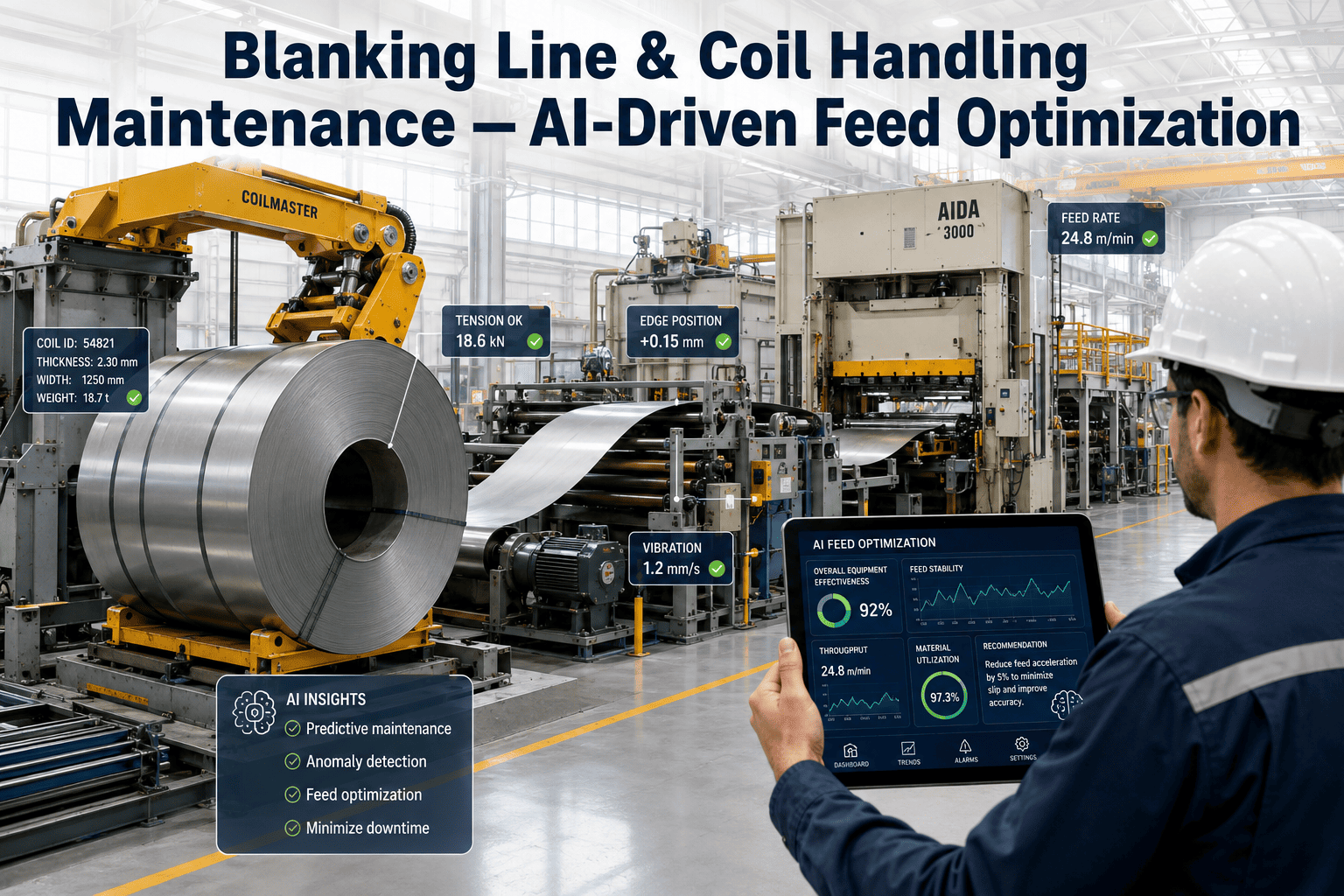
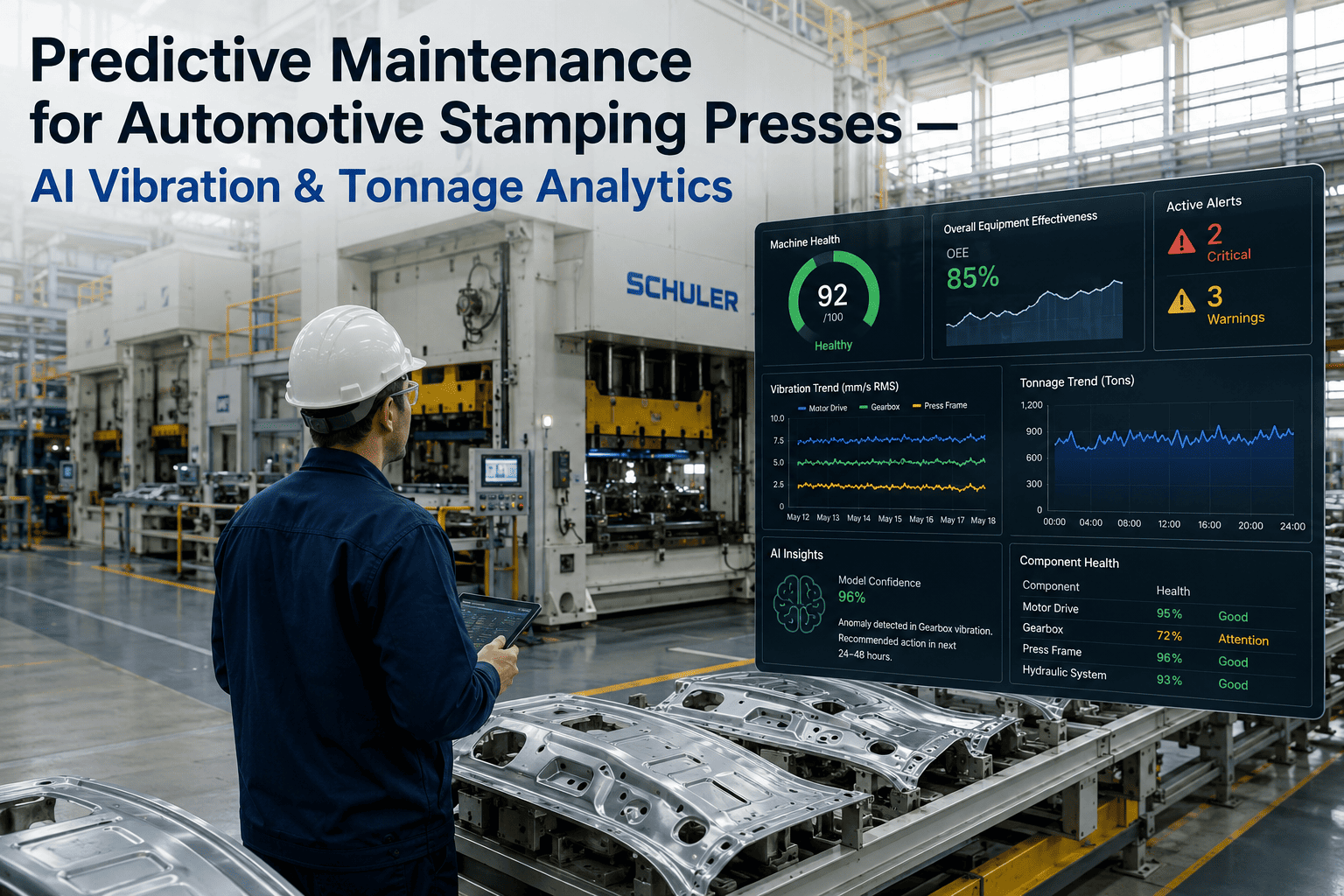
Knife clearance on a blanking line has to stay within 1 to 3 percent of material thickness, and that tolerance erodes quietly with every coil that runs through it — nobody sees it happen until a batch of blanks comes off with a burred edge that a downstream stamping press won't accept. Coil handling and blanking equipment is full of these slow, invisible failure modes: leveler rolls losing their crown, shear blades dulling stroke by stroke, coil cradles drifting out of alignment under repeated loading. Maintenance managers who wait for a scheduled inspection to catch these are, on average, finding out weeks after the wear started, which is why more plants are shifting to condition-based monitoring that watches the equipment continuously instead — book a demo to see what continuous monitoring looks like on your own line.
Stamping & Press Shop · Maintenance
Blanking Line & Coil Handling Maintenance Optimization
Predict leveler roll wear, shear blade dulling, and coil cradle failures before they interrupt material flow into your press operations.
Three Assets, Three Silent Failure Modes
Blanking and coil handling equipment doesn't usually fail all at once. It drifts — a fraction of a millimeter here, a degree of clearance there — until the drift shows up as a rejected coil or a stopped line.
Leveler Rolls
Failure mode: crown wear and surface pitting
Multi-roll levelers rely on precise crossbow correction. As roll surfaces wear unevenly, flatness quality degrades gradually, producing crossbow or edge wave that only becomes obvious once it fails downstream forming tolerance.
Shear Blades
Failure mode: edge dulling and chipping
Cutting edge condition drives burr formation directly. A blade that has quietly dulled past its wear gauge threshold produces burred blanks that stamping presses and dies were never tolerant of in the first place.
Coil Cradles & Cars
Failure mode: bearing wear and alignment drift
Cradles and coil cars carry loads up to 40 tons repeatedly. Bearing wear and structural fatigue build up under that cycling, and a misaligned cradle can mishandle a coil worth thousands in seconds.
Where Scheduled Maintenance Runs Out of Room
Weekly, monthly, and campaign-end inspection cycles are the backbone of any PM program, but they were built for a world where wear happens on a predictable calendar. Coil processing wear doesn't cooperate.
Weekly Inspection Catches
Visible blade chipping or cracking
Obvious bearing temperature anomalies
Gross hydraulic pressure deviations
Weekly Inspection Misses
Gradual knife clearance drift within tolerance until it isn't
Slow roll crown wear building across thousands of cycles
Early-stage bearing degradation before audible symptoms appear
Scheduled PM finds what's already visible. Continuous monitoring finds what's building toward visible.
What Continuous Monitoring Actually Tracks
01
Knife Clearance Trend
Tracked against the 1 to 3 percent of material thickness tolerance window, flagged the moment drift approaches the edge of spec rather than after a burr shows up.
02
Roll Crown & Flatness Output
Correlates leveler settings against actual flatness results over time, isolating which rolls are compensating more than they should be for worn neighbors.
03
Bearing Vibration & Temperature
Continuous vibration and temperature signatures on cradle, car, and roll bearings catch degradation patterns weeks ahead of a catastrophic failure.
04
Hydraulic System Health
Filter condition, cylinder seal integrity, and pressure trends across the shear and leveler hydraulics, watched as one connected system rather than isolated checklist items.
Maintenance Perspective
Roll management is the highest-frequency maintenance activity on a coil processing line, which also makes it the easiest place for small deviations to hide in plain sight. Every roll change is technically an inspection opportunity, but if that inspection only happens when a roll is already scheduled to be swapped, you're relying on the calendar to line up with the wear — and wear doesn't read calendars.
Reflects published guidance on rolling mill and coil processing PM practice for steel service centers and blanking operations.
Scheduled PM vs. Condition-Based AI Monitoring
Frequently Asked Questions
Does this replace our existing PM schedule and work order system?
No, it sits alongside it and makes it more precise. Scheduled PM work orders still happen, but condition data lets maintenance teams prioritize which shear, leveler, or cradle actually needs attention this week instead of treating every asset on the calendar identically.
Book a demo to see how it integrates with an existing CMMS.
Can it really predict a shear blade going dull before it produces bad blanks?
Yes, by trending cutting force, vibration signature, and edge condition indicators over the blade's service life rather than waiting for a manual wear gauge check at a fixed interval. The trend typically shows a clear upward slope well before the blade crosses the point where burr formation becomes visible on finished blanks.
Contact support to see sample trend data from a working blanking line.
How does this help with coil handling safety specifically?
Coil cars and cradles carry loads heavy enough that a bearing or alignment failure during a lift is both a production loss and a safety incident. Continuous vibration and load monitoring on these assets gives maintenance teams a warning window measured in weeks rather than discovering the problem during the lift itself.
Book a demo to walk through the coil handling monitoring setup.
We run multiple coil thicknesses and materials through the same line — does the system adjust?
Yes, tolerance bands for knife clearance and leveler settings are tied to the material and thickness running at the time, so the system compares actual performance against the correct spec for that specific job rather than a single fixed threshold. This avoids false alerts when the line legitimately switches from thin gauge to heavy plate.
Contact support to discuss configuration for your material mix.
What's a realistic first step if we've never done condition-based monitoring before?
Most plants start with the single asset causing the most unplanned downtime — often the shear or the primary leveler — rather than instrumenting the entire line at once. That gives a fast, visible win and a template for expanding monitoring to coil cradles and secondary equipment afterward.
Book a demo to map out a starting point for your line.
Stop Losing Coils to Wear You Couldn't See Coming
Watch knife clearance, roll condition, and bearing health continuously, not just at the next scheduled inspection.