The engineers who try to build their first plant-wide IoT rollout by streaming everything straight to the cloud almost always hit the same three walls: inference latency that makes real-time control impossible, a data egress bill that alarms the finance team, and a single network outage that takes the whole "smart" line down with it. None of that is a cloud problem exactly — it's an architecture problem, and it's one that a layered edge computing design solves by processing vibration, temperature, and process data where it's actually generated instead of shipping it across the plant network first. Getting this architecture right the first time saves months of retrofitting later, which is the whole point of walking through it before a single sensor goes on the wall — book a demo to see a reference architecture built around your plant's actual layout.
Digital Twin & Smart Factory · Process Engineering
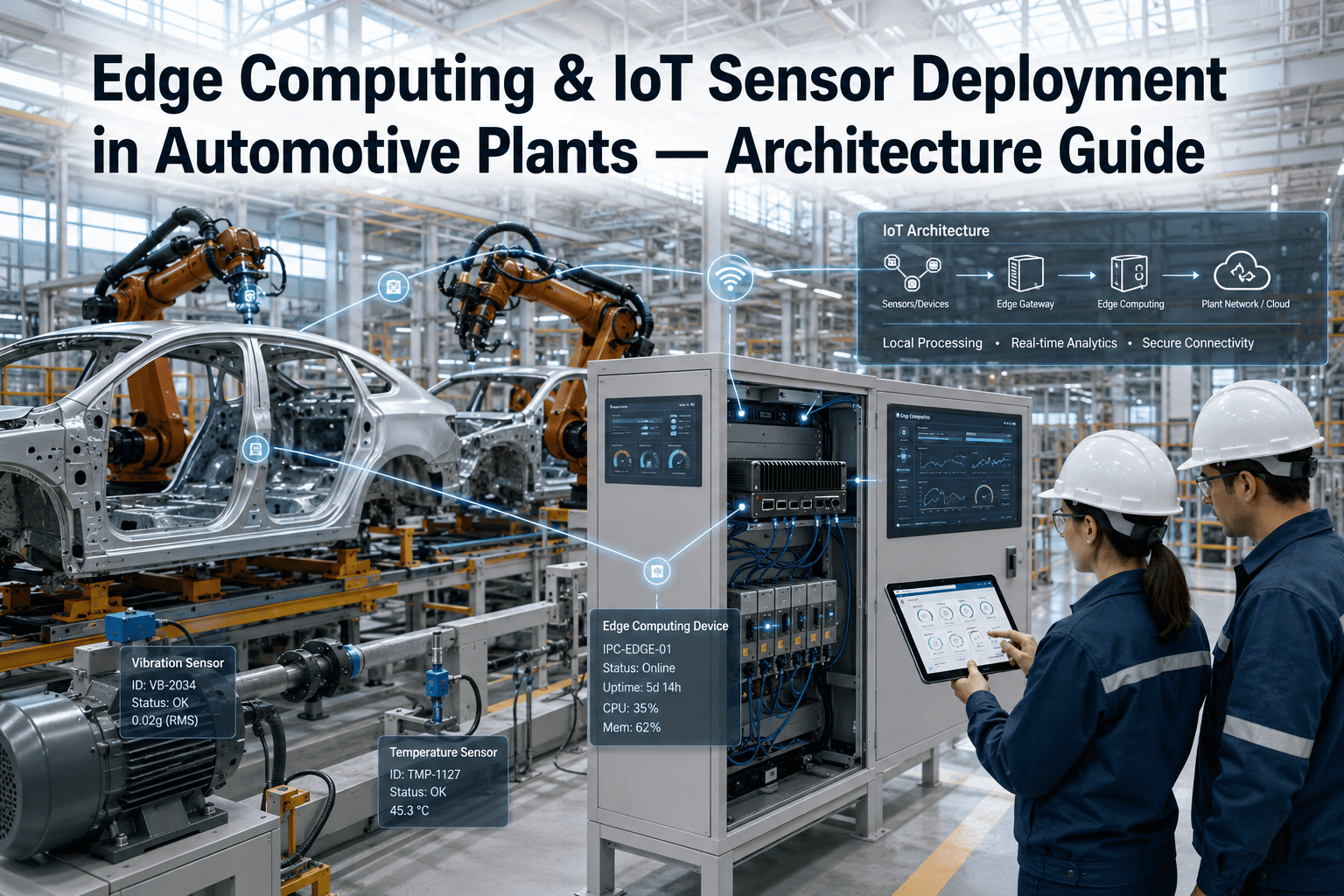
Edge Computing & IoT Sensor Deployment Architecture
Design a sensor, gateway, and edge platform architecture for vibration, temperature, and process monitoring that works across every production area, not just the pilot line.
Three Layers, Each With a Different Job
A working industrial IoT architecture isn't one system, it's three layers stacked with a clear division of responsibility. Confusing which layer should do what is where most first attempts go wrong.
Cloud Layer
Cross-site benchmarking, long-term forecasting, training AI models before deployment back to the edge.
Edge Layer
Gateways ingest, filter, and run inference on high-frequency data locally, forwarding only actionable events upstream.
Device Layer
Sensors and actuators generate raw vibration, temperature, pressure, and process signals directly on the machine.
Latency Budgets Aren't Optional, They're Physics
Different tasks on the floor genuinely need different response times, and no amount of bandwidth fixes a distance problem. A useful architecture is built around these thresholds rather than a single blanket assumption.
< 1 ms
Safety interlocks and hard stops, where the response has to be effectively instantaneous
< 100 ms
Edge-based control adjustments like closed-loop process corrections on a running line
1–2 sec
Syncing processed data to an operator dashboard where near-real-time visibility is sufficient
Get the latency budget wrong at the design stage and no amount of edge hardware fixes it later.
Four Reasons Cloud-Only Doesn't Work on the Floor
Deterministic Latency
A robotic arm or safety controller can't tolerate a round trip to a distant server measured in seconds when milliseconds are what prevent damage.
Bandwidth Cost
Streaming raw telemetry from thousands of sensors continuously over cellular or WAN links is a fiscal problem long before it's a technical one.
Connectivity Resilience
A brief internet outage shouldn't be able to halt production if control logic and inference run locally at the edge instead of depending on cloud availability.
Legacy OT Integration
Older equipment wasn't built with connectivity in mind, and an edge gateway is often the only practical way to bridge it into a modern architecture.
Architecture Perspective
The plants that get IoT deployment right treat the edge gateway as a localized brain, not just a router forwarding packets. That distinction matters because a gateway that only logs and forwards data still leaves the plant blind and idle the moment the network connection drops. A gateway running inference and control logic locally keeps operating through that outage and simply catches the cloud up once connectivity returns.
Reflects current guidance on industrial edge gateway architecture and hybrid edge-cloud deployment models.
Cloud-Only vs. Layered Edge Architecture
Frequently Asked Questions
Do we need to replace the cloud platform we already use for analytics?
No, a layered architecture is designed to work alongside existing cloud analytics rather than replace them. The cloud remains the right place for cross-site benchmarking, long-term trend analysis, and training models, while the edge layer takes over the real-time inference and control tasks the cloud was never well suited for in the first place.
Book a demo to see how edge and existing cloud systems fit together.
How do you decide which sensors need edge processing versus a simple cloud upload?
The deciding factor is usually latency tolerance and data volume rather than sensor type. High-frequency vibration or process data feeding a real-time control loop needs edge inference, while lower-frequency environmental or trend data with no immediate action tied to it can often go straight to the cloud without local processing.
Contact support to review sensor placement for your specific production areas.
What happens to production if the network connection to the cloud goes down?
In a properly layered architecture, edge nodes continue running local inference and control logic independently of cloud connectivity, buffering events and syncing them once the connection returns. This is one of the main reasons plants move away from cloud-only designs — a single WAN outage shouldn't be able to stop a physical production line.
Book a demo to see failover behavior during a simulated outage.
Can this architecture bridge older machines that were never designed to be connected?
Yes, this is one of the primary roles of an edge gateway — translating legacy fieldbus or proprietary protocols into a standardized data format without requiring the original equipment to be replaced or retrofitted with native connectivity. This is often the most practical path for plants with a mix of new and decades-old equipment on the same floor.
Contact support to discuss legacy equipment integration options.
How long does a typical edge and IoT architecture rollout take across a full plant?
Most successful rollouts start with a single line or production area to validate the sensor selection, gateway placement, and latency performance before expanding, rather than instrumenting an entire plant at once. A well-scoped pilot typically runs a matter of weeks, with full-site expansion following in phases based on what the pilot confirms works for your specific equipment mix.
Book a demo to map out a phased rollout plan for your facility.
Design the Architecture Once, Not Three Times
Get a sensor, gateway, and edge platform design built around your plant's actual latency needs, not a generic template.


.png)