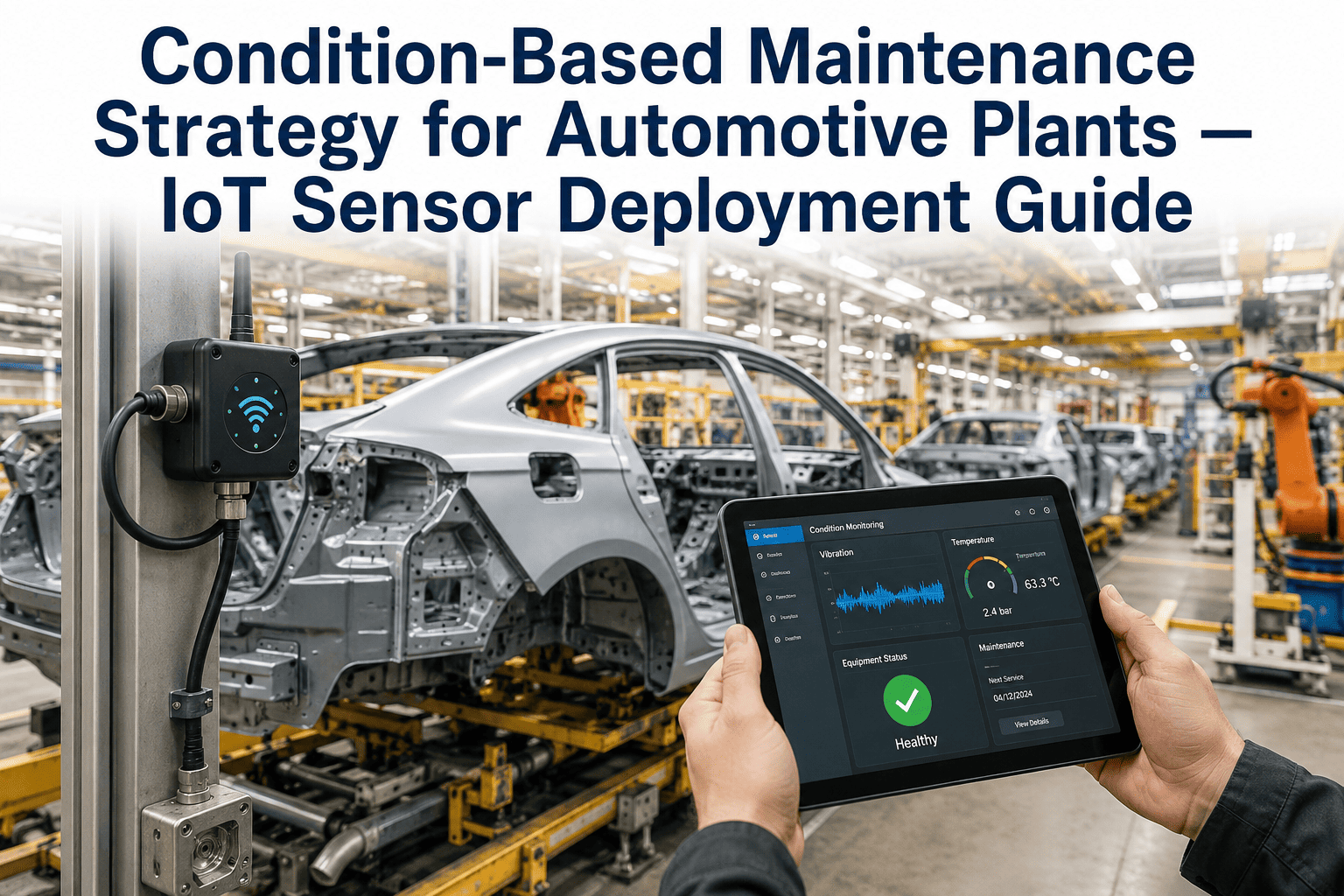
Automotive plants run hundreds of motors, bearings, gearboxes, hydraulic units, and robotic actuators around the clock. Each one is a potential unplanned stoppage waiting to happen — and most plants have no visibility into equipment condition until something breaks. iFactory AI deploys an industrial IoT sensor network across your critical assets, feeding continuous vibration, temperature, current, and pressure data into edge-native machine learning models that detect failure signatures weeks before breakdown. The result is a maintenance operation that responds to condition intelligence rather than calendar schedules or production emergencies. Book a demo to see IIoT sensor data driving live predictions on automotive equipment.
Quick Answer
iFactory AI deploys IIoT sensor networks across automotive manufacturing assets — stamping presses, robotic welding cells, conveyors, CNC machining centers, and paint shop equipment — feeding continuous condition data into edge AI models that predict failures 2 to 6 weeks in advance. Plants using iFactory IoT predictive maintenance report 40% reduction in unplanned downtime, 98% prediction accuracy at 90 days, and 3.1x ROI in year one.
Why IoT Sensors Are the Foundation of Automotive Predictive Maintenance
Traditional maintenance relies on human inspection routes, time-based schedules, and reactive response to alarms. All three approaches share the same fundamental limitation: you only know what you can see or what has already failed. IIoT sensors eliminate that limitation by creating continuous, real-time visibility into the condition of every monitored asset — feeding data to AI models that detect the subtle changes in vibration frequency, thermal signature, and electrical current that precede catastrophic failures by weeks.
Vibration Accelerometers
Triaxial MEMS accelerometers sampling at up to 25,600 Hz detect bearing defects, gear mesh anomalies, misalignment, and rotor imbalance through FFT spectrum analysis.
Robotic joints, stamping press drives, conveyor motors, CNC spindles
Thermal Sensors
Infrared and contact thermal sensors monitor motor winding temperature, bearing housing heat, gearbox oil temperature, and electrical panel thermal signatures continuously.
Drive motors, servo amplifiers, electrical cabinets, hydraulic oil circuits
Current Signature Analyzers
Non-invasive current clamps monitor motor current waveforms to detect rotor bar defects, eccentricity, load imbalance, and developing bearing faults through motor current signature analysis (MCSA).
AC drive motors, servo motors, pump motors, compressor drives
Ultrasonic Sensors
Ultrasonic emission sensors detect early-stage bearing defects, compressed air leaks, hydraulic system cavitation, and electrical discharge in high-voltage equipment before thermal changes are measurable.
Pneumatic systems, hydraulic units, high-voltage switchgear, bearing housings
Pressure Transducers
Hydraulic and pneumatic pressure sensors track system pressure trends, detect seal degradation, and identify pump cavitation or bypass valve wear in press shop and clamping systems.
Hydraulic presses, clamping units, pneumatic actuators, die cushion systems
Oil Quality Sensors
Inline oil quality sensors measure viscosity, particle count, water contamination, and dielectric constant to detect gearbox and hydraulic system degradation without manual sampling or lab turnaround.
Transfer gearboxes, final drive units, hydraulic power units, centralized lubrication
IIoT Sensor Deployment Demo
See Which Sensors Your Plant Needs and Where to Place Them
Book a 30-minute session where iFactory engineers review your equipment list and map the optimal sensor configuration for your stamping, welding, or assembly operations.
40%
Less Unplanned Downtime
From Raw Sensor Data to Maintenance Action — The iFactory AI Pipeline
Raw sensor data alone does not prevent failures. The value comes from what happens to that data — the processing, pattern recognition, and automated action chain that converts a vibration frequency spike into a scheduled bearing replacement before the line stops. iFactory AI handles the entire chain automatically. Talk to an expert about the data pipeline for your equipment types.
1
Edge Node Data Ingestion
IIoT sensors transmit to on-premises edge AI nodes via industrial protocols — OPC-UA, MQTT, Modbus, and EtherNet/IP. All data processing occurs locally. No raw sensor data is transmitted to cloud infrastructure. Edge nodes handle up to 500 sensor channels simultaneously with sub-second processing latency.
OPC-UAMQTTEtherNet/IPEdge-Native
2
Signal Processing and Feature Extraction
Edge AI performs FFT spectrum analysis on vibration data, thermal gradient calculation on temperature streams, and harmonic analysis on current waveforms. Features extracted include bearing defect frequencies, gear mesh frequencies, running speed harmonics, and statistical time-domain features — all in real time.
Robotic Welding Cell 12 — Drive End Bearing: BPFI frequency at 147 Hz elevated 4.1x baseline. Thermal: DE housing +8C above normal. Current: 3.2% harmonic distortion detected.
3
Multi-Sensor Fusion and ML Classification
Machine learning models trained on automotive equipment failure libraries fuse signals from multiple sensor types to classify the failure mode with high confidence. Multi-sensor fusion reduces false positives significantly — a vibration anomaly confirmed by correlated thermal and current changes produces a high-confidence alert rather than a nuisance notification.
Failure: Inner Race DefectConfidence: 96%Multi-Sensor Confirmed
4
RUL Calculation and Production Schedule Cross-Reference
Remaining Useful Life is calculated from the degradation trajectory and cross-referenced with your production calendar. iFactory identifies the next planned maintenance window before the predicted failure date and flags scheduling conflicts automatically — giving planners a prioritized action list, not just alerts.
RUL: 17 DaysNext Window: 12 DaysCriticality: A1
5
Automated Work Order Creation and Routing
iFactory generates a fully structured work order — asset tag, failure code, RUL window, spare parts availability check, craft assignment, and estimated labor hours — automatically. The work order is routed to the planner's queue ready for scheduling, with zero manual data entry required from any technician or engineer.
WO-44291 created. Robotic Welding Cell 12 — DE Bearing replacement. SKF 6312 confirmed in stock (2 units). Mechanical Crew A assigned. Window: Weekend shutdown in 12 days.
IoT Sensor Network Architecture for Automotive Plants
iFactory AI is built on an edge-first architecture designed specifically for the connectivity constraints, cybersecurity requirements, and data volume of automotive manufacturing environments. No production data leaves your plant perimeter.
Edge AI Processing
All FFT analysis, ML inference, and RUL calculation runs on hardened industrial edge nodes located on-premises. Zero dependency on cloud connectivity for real-time predictions. Data sovereignty preserved — no raw sensor data leaves the plant.
Cybersecurity-First Network Design
IIoT sensors connect via isolated OT network segments with air-gap options for high-security zones. Industrial firewalls, encrypted sensor communication, and role-based access control meet automotive OEM cybersecurity requirements including ISA/IEC 62443.
Wireless and Wired Sensor Options
iFactory supports industrial wireless sensors (WirelessHART, ISA100, Bluetooth LE mesh) for retrofitting existing equipment without cable runs, as well as wired configurations for high-vibration assets where wireless reliability requires hardwired backup.
iFactory AI vs. Competitor Platforms — IoT Predictive Maintenance
Most CMMS and OEE platforms offer dashboards without the sensor-to-prediction pipeline that actually prevents failures. iFactory AI delivers the complete stack from sensor network deployment through automated work order generation. Book a comparison demo.
| Capability |
iFactory AI |
QAD Redzone |
Fiix (Rockwell) |
IBM Maximo |
MaintainX |
L2L Platform |
| IIoT Sensor and Data Acquisition |
| Native IIoT sensor network deployment |
Full sensor-to-prediction stack |
OEE focus, no sensors |
Partner integration only |
APM add-on required |
CMMS only |
Production focus |
| Multi-sensor fusion (vibration + thermal + current) |
Built-in, reduces false positives |
Not available |
Single-sensor only |
Maximo APM limited |
Not available |
Not available |
| Industrial protocol support (OPC-UA, MQTT, Modbus) |
All major protocols |
Limited OPC-UA |
Rockwell ecosystem |
Broad protocol support |
Not applicable |
Basic API only |
| Predictive Intelligence |
| Edge AI processing (on-premise, no cloud needed) |
Edge-native architecture |
Cloud only |
Cloud only |
On-premise option |
Cloud only |
Cloud only |
| RUL forecast per asset and failure mode |
Automotive-trained models |
Not available |
Not available |
APM add-on only |
Not available |
Not available |
| Auto work order from sensor prediction |
Fully automated |
Manual trigger |
Alert only |
Workflow add-on |
Manual from alert |
Dispatch only |
| Security and Compliance |
| ISA/IEC 62443 cybersecurity alignment |
OT network segmentation |
Not addressed |
Rockwell guidelines |
Configurable |
Not addressed |
Not addressed |
| IATF 16949 maintenance documentation |
Automated audit records |
Partial |
Not available |
Configurable |
Not available |
Not available |
Based on publicly available product documentation as of Q1 2025. Verify current capabilities with each vendor before procurement decisions.
Regional Compliance — IoT Sensor Networks in Automotive Manufacturing
Deploying IIoT sensor networks in automotive plants involves compliance with machinery safety directives, industrial cybersecurity standards, and data protection regulations that differ by region. iFactory AI is configured to meet requirements across all major automotive manufacturing markets.
| Region |
Key Standards and Regulations |
iFactory AI Compliance Coverage |
Data and Network Security |
| United States |
OSHA 29 CFR 1910, IATF 16949, NIST Cybersecurity Framework, ISA/IEC 62443 OT security, NFPA 70E electrical safety |
OSHA-aligned maintenance records, IATF 16949 audit documentation, NIST CSF-aligned OT security architecture for sensor network deployment |
US data centers. On-premise edge processing mandatory for OT data. Encrypted sensor communication. No raw production data transmitted externally. |
| United Arab Emirates |
UAE Federal OSH Law, ADNOC HSE IIoT guidelines, UAE Cybersecurity Council regulations, MOIAT industrial equipment standards, National ICS Security Standards |
Arabic-language sensor dashboard, UAE OSH-compliant inspection integration, ADNOC-aligned condition monitoring protocols, UAE National ICS security compliance |
UAE local edge deployment. On-premise processing for all OT data. Sovereign data compliance. Air-gap options for sensitive production environments. |
| United Kingdom |
PUWER 1998, HSE IIoT guidance for industrial machinery, UK Cyber Resilience Act (upcoming), ISO 55001, UK GDPR for operational data |
PUWER inspection record automation, HSE-compliant machinery condition monitoring documentation, ISO 55001 asset lifecycle integration |
UK data centers. Post-Brexit UK GDPR compliant. Encrypted OT network. On-premise edge processing available. |
| Canada |
CSA Z432 machine safeguarding, provincial OHSA requirements, PIPEDA data protection, federal Critical Infrastructure Protection guidelines |
Bilingual EN/FR interface, province-specific safety templates, CSA-aligned sensor installation procedures, critical infrastructure security protocols |
Canadian data residency available. PIPEDA compliant. On-premise edge processing. Encrypted OT communications. |
| Europe (EU) |
EU Machinery Directive 2006/42/EC, EU Cyber Resilience Act 2024, NIS2 Directive for industrial operators, GDPR, EN 13306 maintenance standard, IATF 16949 |
CE compliance documentation, NIS2-aligned OT security measures, GDPR data processing agreements, EN 13306 work order taxonomy, multilingual: DE, FR, IT, ES, PL |
EU-only data processing. GDPR Article 46 compliant. Frankfurt and Amsterdam nodes. NIS2 Directive OT security architecture. |
Value iFactory IoT Predictive Maintenance Delivers
Deploying an IIoT sensor network is an investment. The ROI comes from multiple compounding value streams — not just avoided downtime — that accumulate from the moment your first predictions go live.
Unplanned Downtime Elimination
iFactory AI delivers 40% reduction in unplanned stoppages on monitored assets. At $50,000 per hour of automotive line downtime, preventing two unplanned stops per month typically covers the entire annual platform cost. Every prediction that converts an emergency breakdown to a planned repair generates immediate, measurable ROI.
False Positive Reduction Through Multi-Sensor Fusion
Single-sensor systems generate excessive false alarms that erode maintenance team trust and cause alert fatigue. iFactory AI multi-sensor fusion confirms anomalies across vibration, thermal, and current signals before generating an alert — reducing false positive rates to under 4% and ensuring every alert receives appropriate maintenance response.
Spare Parts Procurement Optimization
RUL forecasts 2 to 6 weeks in advance allow spare parts to be sourced through standard procurement channels rather than emergency orders with premium freight. Plants using iFactory AI report 18% reduction in total spare parts spend within 12 months — a direct consequence of eliminating emergency procurement and reducing premature preventive replacements.
Secondary Damage and Cascade Failure Prevention
A bearing that fails catastrophically damages the shaft, housing, and adjacent components — turning a $200 bearing replacement into a $15,000 repair event plus production loss. iFactory AI detects the defect weeks before catastrophic failure, when only the primary component requires replacement. Secondary damage prevention alone justifies sensor deployment on high-criticality assets.
OEE Improvement Through Continuous Asset Visibility
Real-time asset health dashboards give production managers continuous visibility into equipment condition across the entire plant floor. Availability improvements from eliminating unplanned stops directly increase OEE — plants using iFactory AI report 12 to 18 percentage point availability gains that compound across multiple production lines over time.
Scalable Fleet Intelligence Across Multiple Plants
iFactory AI aggregates anonymized failure pattern data across all deployed plants to continuously improve ML model accuracy. A failure mode detected at a facility in Michigan informs prediction models in plants in the UAE, UK, and Germany — building fleet-wide intelligence that improves detection accuracy over time across your entire manufacturing network.
Client Results — Automotive Plants Using iFactory IIoT Predictive Maintenance
40%
Reduction in Unplanned Downtime
98%
Prediction Accuracy at 90 Days
Under 4%
False Positive Alert Rate
18%
Reduction in Spare Parts Spend
3.1x
ROI Delivered in Year 1
12 wks
Average Time to First Live Predictions
"We had three different vibration monitoring systems across our plant — none of them talked to our CMMS and all of them generated constant alerts that nobody trusted. iFactory replaced all three with a unified IIoT network that feeds directly into work orders. In the first four months, the system identified seven bearing defects that our route-based inspection had missed. Two of those would have been catastrophic press failures during production."
Director of Plant Engineering
Tier 1 Stamping and Assembly Plant — Indiana, USA
IIoT Deployment Scoping
Get a Sensor Map for Your Automotive Plant in 30 Minutes
iFactory engineers will review your equipment list and layout, identify your highest-ROI monitoring candidates, and define the sensor configuration that delivers the fastest path to live predictions on your critical assets.
Frequently Asked Questions
QHow many IIoT sensors does a typical automotive plant need to start seeing predictions?
Most plants achieve strong predictive coverage on critical assets with 50 to 150 sensors in phase one — focusing on the highest-criticality stamping presses, welding robots, and conveyor drive systems where a single failure causes the most production impact. iFactory engineers define the optimal starting configuration based on your equipment list and failure history.
Book a scoping session to get a sensor count estimate for your plant.
QCan iFactory AI connect to sensors we already have installed from other vendors?
Yes — iFactory integrates with existing sensors from SKF, Emerson, Fluke, Siemens, Honeywell, and most major IIoT sensor vendors via OPC-UA, MQTT, Modbus, and REST API. Existing sensor data feeds into the iFactory AI edge processing pipeline without requiring sensor replacement.
Talk to an expert to assess compatibility with your current sensor estate.
QWhat happens to sensor data if the edge node loses connectivity to the plant network?
Edge nodes buffer sensor data locally during network interruptions and continue processing predictions independently — iFactory AI is designed for the connectivity realities of industrial plant environments. Data syncs automatically when connectivity is restored, and no prediction capability is lost during brief network outages.
Book a demo to see the edge resilience architecture in detail.
QHow does iFactory AI handle cybersecurity for OT sensor networks in automotive plants?
iFactory deploys sensor networks in isolated OT network segments with industrial firewalls, encrypted communications, and role-based access control aligned to ISA/IEC 62443. All sensor data processing occurs on-premises on the edge nodes — no raw production or condition data is transmitted to external cloud infrastructure.
Talk to an expert about the security architecture for your specific plant environment.
Continue Reading
IIoT Sensor Networks for Automotive Predictive Maintenance — From Raw Data to Prevented Failures.
iFactory AI deploys, processes, and acts on IIoT sensor data across your entire automotive plant — turning vibration spectra, thermal signatures, and current waveforms into scheduled maintenance actions that prevent the breakdowns your business cannot afford.
Multi-Sensor Fusion
Edge AI Processing
OPC-UA and MQTT
ISA/IEC 62443 Security
Auto Work Orders
IATF 16949 Compliant
US · UAE · EU · UK · Canada

.png)