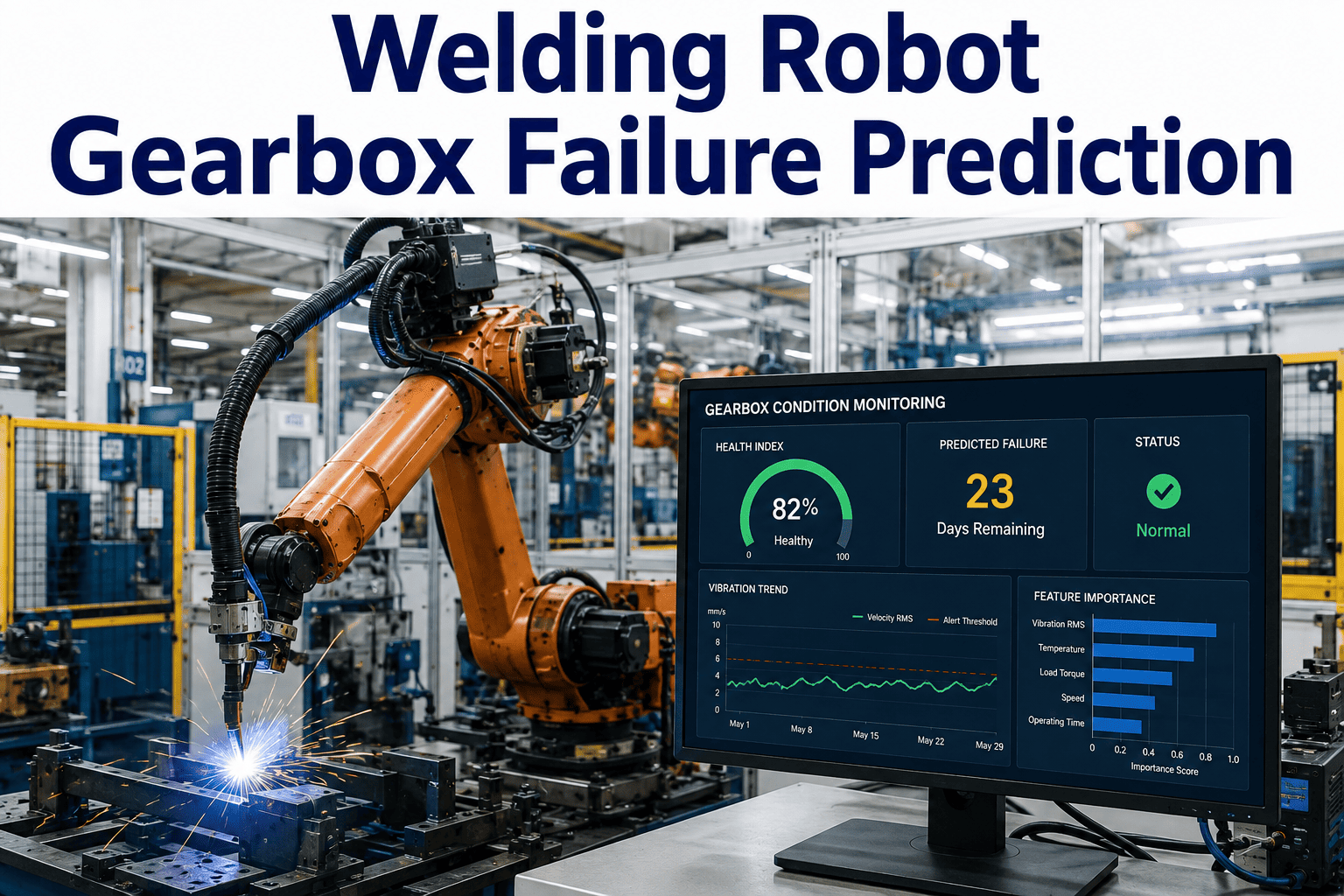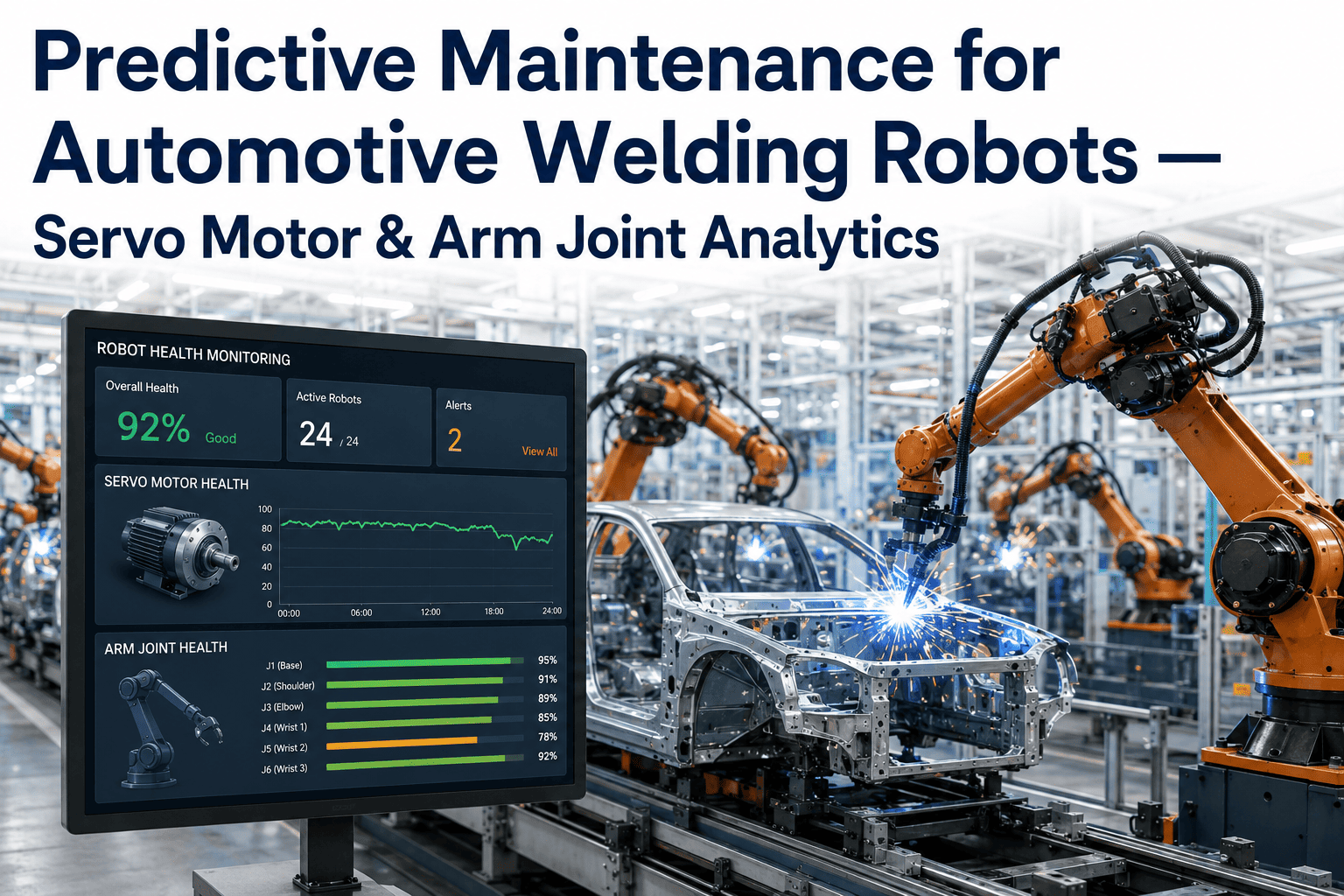
In the high-speed world of automotive manufacturing, welding robots are the backbone of production lines. These robotic arms perform thousands of precise welds per shift, but their servo motors and arm joints are under constant stress from heat, torque, and repetitive motion. Traditional maintenance schedules often lead to unexpected breakdowns, costly downtime, and compromised weld quality. The solution lies in predictive maintenance powered by AI and real-time analytics. By continuously monitoring current draw, vibration patterns, and positional accuracy, manufacturers can forecast failures before they occur, schedule repairs during planned downtime, and extend the life of critical components. This article explores how predictive analytics transforms welding robot maintenance, reduces unplanned stops, and safeguards production throughput. Discover how our platform helps reliability engineers achieve zero unplanned downtime.
Transform Your Robot Fleet Maintenance
Stop reacting to breakdowns. Our AI-driven platform predicts servo motor and joint failures with 90% accuracy, allowing you to schedule maintenance during planned downtime and keep production flowing.
Why Servo Motors Fail in Welding Robots
Servo motors in welding robots face extreme conditions: high ambient temperatures, electrical noise from welding arcs, and mechanical shock from rapid acceleration and deceleration. Over time, these stresses degrade the motor windings, bearings, and encoders. Common failure modes include insulation breakdown, bearing wear, and encoder misalignment. These issues manifest as increased current draw, abnormal vibration, and reduced positional accuracy. Without predictive monitoring, a failing servo motor can cause weld defects, scrapped parts, and expensive emergency repairs. By analyzing real-time data such as current harmonics, temperature trends, and vibration signatures, AI models can detect early signs of degradation and alert maintenance teams weeks before a failure occurs.
Arm Joint Degradation and Its Impact on Weld Quality
Arm joints, especially the wrist and elbow axes, are subjected to high cyclic loads and wear. As joints degrade, backlash increases, causing the robot to miss weld points or produce inconsistent weld beads. This leads to rework, increased scrap, and potential safety issues. Predictive maintenance for arm joints focuses on monitoring joint torque, position error, and vibration at each axis. By establishing baseline performance and tracking deviations, reliability engineers can identify which joint is degrading and plan replacement during scheduled maintenance windows. This proactive approach not only maintains weld quality but also prevents catastrophic joint failure that could damage the robot and surrounding equipment.
Current Draw Analysis
Monitor the electrical current drawn by each servo motor. An increase in current, especially at idle or during constant motion, indicates rising friction or electrical inefficiency. AI models detect subtle changes that human operators might miss.
Vibration Signature Monitoring
High-frequency vibration sensors on each joint capture unique signatures. Changes in amplitude or frequency patterns point to bearing wear, imbalance, or misalignment. Our algorithms classify vibration types to pinpoint the root cause.
Positional Accuracy Tracking
Robots report their actual position versus commanded position. Increasing error over time signals encoder drift or mechanical backlash. This data is critical for predicting weld quality issues before they become visible in the final product.
Temperature Trend Analysis
Servo motor and joint temperatures rise under load. Persistent high temperatures accelerate insulation aging and lubricant breakdown. AI models correlate temperature with duty cycle to forecast remaining useful life.
Your 4-Step Predictive Maintenance Workflow
Data Collection
Install sensors on existing welding robots or integrate with the robot controller's built-in data streams. Collect current, vibration, temperature, and position data at 1-second intervals.
Baseline Establishment
Our AI analyzes the first two weeks of data to create a performance baseline for each robot and joint. This baseline accounts for normal variations due to weld cycle, payload, and ambient conditions.
Anomaly Detection
Machine learning models continuously compare live data against the baseline. When a parameter deviates beyond a threshold, the system generates an alert with a severity score and predicted time to failure.
Actionable Recommendations
Receive detailed reports that specify which servo motor or joint is degrading, the likely root cause, and recommended maintenance actions. Schedule repairs during planned downtime to avoid production loss.
Frequently Asked Questions
How does predictive maintenance improve weld quality?
Predictive maintenance directly impacts weld quality by detecting issues like servo motor current spikes or arm joint backlash before they cause weld defects. For example, a failing servo motor may produce inconsistent wire feed speed, leading to poor fusion. By alerting the maintenance team early, the motor can be replaced during a scheduled break, preventing hundreds of defective welds. Our platform analyzes positional accuracy trends to ensure the robot consistently hits the target weld point. This proactive approach reduces rework, scrap, and the need for costly post-weld inspections. Learn more about our weld quality analytics.
What data is needed to start predictive maintenance on welding robots?
To begin, you need access to the robot controller's data output, typically via Modbus TCP, OPC UA, or the robot manufacturer's proprietary API. Essential data points include motor current for each axis, joint position feedback, vibration data (if sensors are installed), and temperature readings from built-in thermistors. Many modern robots from FANUC, KUKA, ABB, and Yaskawa already output this data. If not, retrofitting vibration and temperature sensors is straightforward. Our platform supports standard industrial protocols and can integrate with your existing SCADA or MES system. Book a demo to see how we connect to your robots.
Can predictive maintenance work with older robots that lack sensors?
Yes, absolutely. For older robots without built-in sensors, we recommend retrofitting with wireless vibration and temperature sensors that attach magnetically to the motor housing or joint casting. These sensors are cost-effective and easy to install during a routine maintenance window. Additionally, many older robot controllers still output motor current and position data via analog or digital signals. Our edge gateway can capture these signals and convert them to digital data for analysis. This approach allows you to extend the life of legacy robots while still benefiting from predictive analytics. Contact our team for a retrofit consultation.
How accurate are the failure predictions?
Our AI models achieve over 90% accuracy in predicting servo motor and joint failures when trained on at least one month of operational data. Accuracy improves over time as the model learns the specific behavior of each robot and its operating environment. We use ensemble methods combining gradient boosting, LSTM neural networks, and anomaly detection algorithms to minimize false positives. In field deployments, our system has correctly predicted failures up to three weeks in advance, giving maintenance teams ample time to plan. False alarm rates are typically below 5%. Book a demo to see accuracy metrics from real deployments.
What is the ROI of implementing predictive maintenance for welding robots?
Typical ROI includes a 45% reduction in unplanned downtime, 30% longer servo motor lifespan, and 20% reduction in maintenance costs. For a facility with 50 welding robots, this translates to annual savings of over $500,000 when factoring in avoided production losses, reduced spare parts inventory, and lower overtime labor. Additionally, improved weld quality reduces scrap and rework costs by up to 15%. Most clients see a full return on investment within 6 to 12 months. Request a custom ROI calculator for your facility.
Ready to Eliminate Unplanned Downtime?
Join leading automotive manufacturers who use our AI platform to predict servo motor and joint failures. Get a personalized demo and see how we can protect your production line.