In the high-stakes environment of an automotive paint shop, even minor deviations in temperature, humidity, or air pressure can cascade into costly paint defects like orange peel, solvent pop, or dirt in paint. Traditional reactive maintenance approaches—waiting for a filter to clog or an HVAC unit to fail—leave quality and throughput vulnerable. Predictive maintenance, powered by AI and IoT sensors, transforms this dynamic by continuously monitoring critical parameters across paint booth HVAC systems, air handling units (AHUs), and filtration banks. This article explores how automotive maintenance managers can leverage real-time data on airflow degradation, humidity drift, filter loading, and temperature fluctuations to prevent defects before they occur. By shifting from a fix-when-broken to a predict-and-prevent strategy, paint shops can reduce rework costs, improve first-pass yield, and extend equipment life. Discover actionable insights and a step-by-step framework to implement predictive maintenance in your paint booth environment, supported by case studies and expert recommendations. Explore iFactory's support resources to start your predictive journey.
Why Predictive Maintenance for Paint Booth HVAC is Non-Negotiable
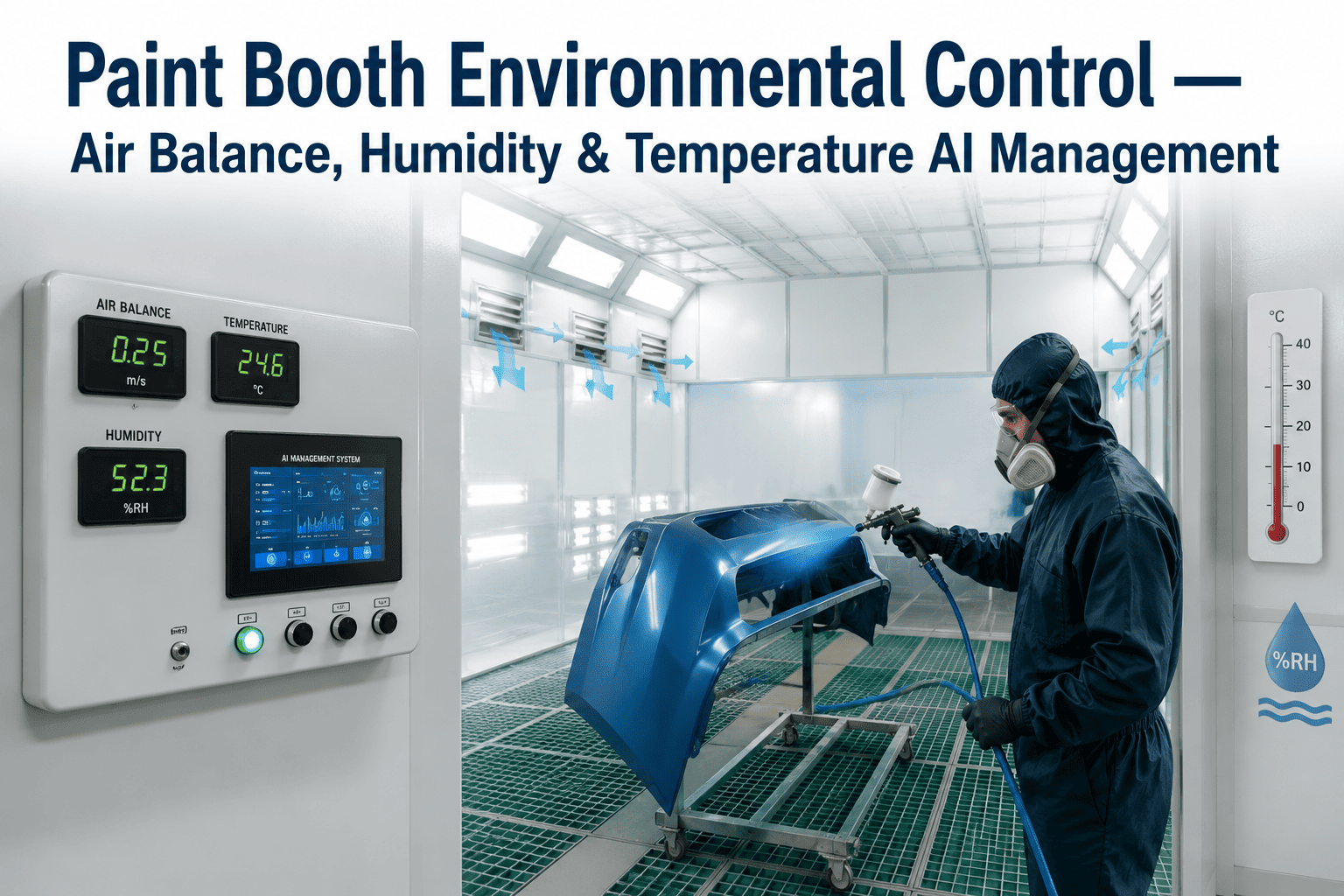
Automotive paint booths operate within tight environmental envelopes: temperature must stay within 70-80°F, relative humidity between 50-70%, and air pressure differentials precisely balanced. Any drift—a 2°F rise, a 5% humidity drop, or a partially loaded filter—can instantly degrade paint finish quality. Traditional preventive maintenance schedules, based on fixed intervals, often miss these subtle shifts. Predictive maintenance uses AI models trained on historical sensor data to forecast when a filter will reach 80% loading, when an AHU bearing will overheat, or when humidity will drift outside spec. This allows maintenance teams to intervene during planned downtime, not during production. The result? A 30-50% reduction in unplanned downtime, up to 25% improvement in first-pass yield, and significant savings in compressed air and energy costs. For maintenance managers, this means fewer fire drills and more strategic resource allocation.
Ready to Transform Your Paint Booth Maintenance?
Book a demo with iFactory to see how AI-driven monitoring can protect your paint quality and reduce costs. Our experts will tailor a solution for your facility.
How AI Monitors Paint Booth HVAC and Air Handling Units
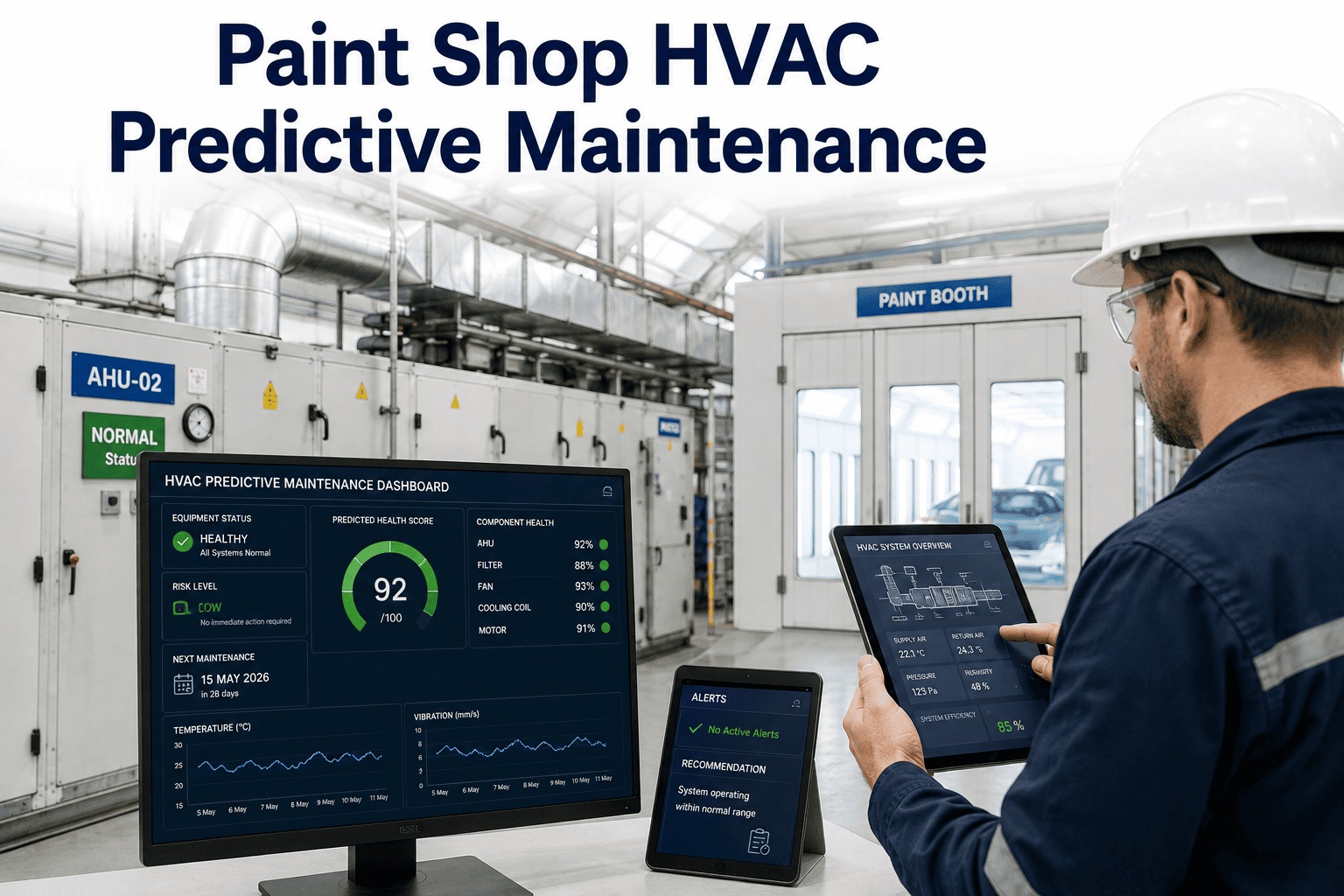
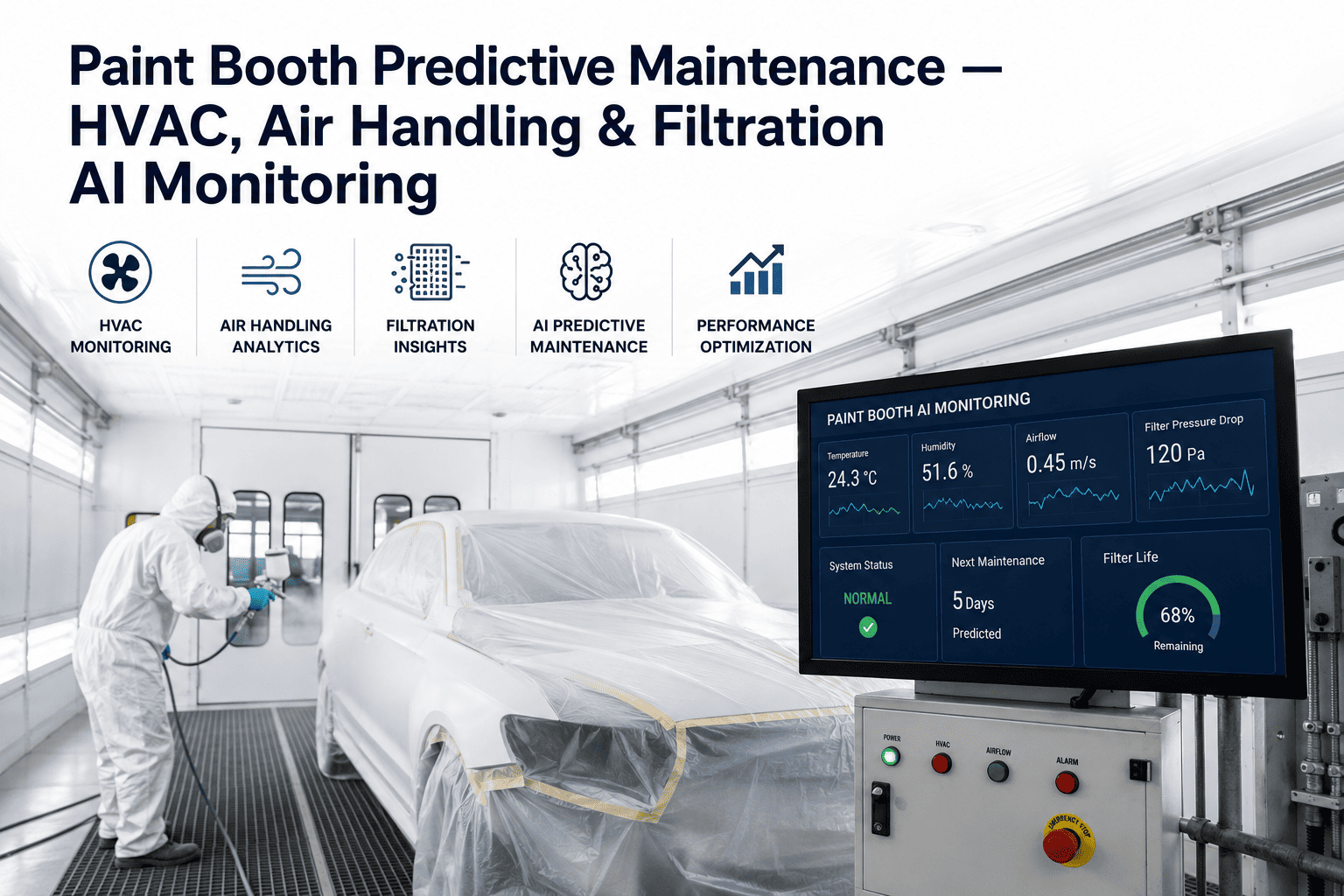
AI-powered predictive maintenance begins with sensor deployment across critical points: inside the paint booth, on AHU supply and return ducts, at filter banks, and on compressor lines. Sensors measure temperature, humidity, air velocity, pressure differential, vibration, and energy consumption. Data streams to a cloud-based AI platform that learns normal operating patterns. For example, the system detects a gradual increase in pressure drop across a supply filter—indicating loading—and predicts when it will reach the threshold that triggers airflow reduction. Similarly, it monitors AHU motor vibration to forecast bearing wear. The AI model considers external factors like outdoor temperature and production schedule to refine predictions. Maintenance managers receive alerts on a dashboard with recommended actions and lead time. This proactive approach replaces calendar-based filter changes with condition-based replacements, saving labor and materials. It also prevents the quality defects that occur when filters are changed too late—or too early.
Real-Time Detection of Airflow Degradation and Humidity Drift
Airflow degradation in a paint booth can stem from clogged filters, damper misalignment, or fan belt slippage. AI models track airflow velocity at multiple points and compare against baseline. A 10% drop in airflow velocity triggers a yellow alert; 20% triggers red. Humidity drift is equally critical: low humidity causes solvent to evaporate too quickly, leading to orange peel; high humidity causes blushing or solvent pop. Sensors measure relative humidity every 30 seconds. The AI model identifies trends—like a slow upward drift due to a failing dehumidifier valve—and alerts maintenance before the drift crosses the quality threshold. In one case study, a Tier-1 automotive supplier used iFactory's platform to detect a 3% humidity drift over 48 hours, allowing them to recalibrate the dehumidifier during a shift change, avoiding 12 hours of potential rework. This level of granularity is impossible with manual checks or time-based schedules.
Key Parameters for Paint Booth Predictive Maintenance
Temperature Control
Maintain 70-80°F with AI monitoring of heater output, damper position, and zone differentials. Predict thermostat calibration drift before it affects paint viscosity.
Humidity Management
Keep RH between 50-70%. AI detects dehumidifier performance degradation and valve sticking, preventing solvent evaporation issues and blushing.
Air Pressure Differential
Positive pressure in booth prevents contamination. AI tracks pressure drop across filters and supply fans, signaling when to clean or replace.
Filter Loading
Monitor pressure rise across intake, supply, and exhaust filters. AI predicts remaining useful life, optimizing change intervals and reducing waste.
AHU Vibration
Accelerometers on fan and motor bearings detect imbalance or wear. AI forecasts failure 2-4 weeks in advance, allowing planned replacement.
Compressed Air Quality
Monitor dew point and particulate levels. AI alerts when dryer performance drops, preventing moisture in paint lines.
Step-by-Step Implementation of Predictive Maintenance in Paint Booth
Sensor Installation and Baseline Collection
Deploy IoT sensors for temperature, humidity, pressure, vibration, and airflow at key points in the paint booth, AHU, and filter banks. Collect data for 2-4 weeks to establish normal operating baselines. This phase is critical for training AI models to recognize deviations.
AI Model Training and Threshold Setting
Use historical data and expert knowledge to train AI models that predict filter loading, humidity drift, and component wear. Set alert thresholds for yellow (caution) and red (critical) levels, with lead times of 24-72 hours for corrective action.
Dashboard Integration and Workflow Automation
Integrate AI insights into a central dashboard visible to maintenance and production teams. Automate work order generation when alerts trigger, including recommended parts and procedures. Connect to CMMS for seamless execution.
Continuous Learning and Optimization
AI models continuously learn from new data, improving prediction accuracy over time. Review alert effectiveness monthly and adjust thresholds based on actual failure patterns. Expand sensor coverage to additional zones or equipment as ROI is demonstrated.
Take Control of Your Paint Booth Quality
Don't let hidden HVAC and filtration issues compromise your paint finish. iFactory's predictive maintenance platform gives you real-time visibility and actionable alerts. Schedule a demo today to see how we can help you reduce defects and downtime.
Frequently Asked Questions
How does predictive maintenance differ from preventive maintenance for paint booths?
Preventive maintenance relies on fixed schedules—for example, changing filters every 30 days or calibrating sensors quarterly. This approach can lead to either under-maintenance (if failures occur between intervals) or over-maintenance (if components are replaced prematurely). Predictive maintenance uses real-time sensor data and AI algorithms to forecast exactly when a component will need attention. For paint booths, this means filter changes are triggered by actual pressure drop readings, not calendar dates. Similarly, humidity drift is detected as a trend, not after it has already caused defects. The result is optimized labor, reduced spare parts consumption, and most importantly, consistent paint quality. Learn more about iFactory's predictive approach and how it compares to traditional methods.
What sensors are needed to monitor paint booth HVAC and filtration?
A comprehensive paint booth monitoring system typically includes temperature and humidity sensors inside the booth and on AHU supply ducts, differential pressure transmitters across filter banks, airflow velocity sensors at supply and exhaust points, vibration sensors on AHU fan and motor bearings, and energy meters on compressors and heaters. For compressed air quality, dew point and particulate sensors are recommended. All sensors should be industrial-grade with IP65 or higher rating to withstand paint booth conditions. Data is collected via wireless IoT gateways and transmitted to the cloud for AI analysis. The specific sensor count and placement depend on booth size, number of zones, and criticality of the process. Contact iFactory support for a sensor deployment consultation tailored to your facility.
Can predictive maintenance integrate with existing CMMS or ERP systems?
Yes, modern predictive maintenance platforms like iFactory are designed to integrate with popular CMMS (Computerized Maintenance Management Systems) such as SAP PM, Maximo, and Fiix, as well as ERP systems. Integration typically uses REST APIs or OPC-UA protocols. When an AI model predicts a filter change is needed in 48 hours, the platform can automatically create a work order in the CMMS, assign it to the appropriate technician, and list required parts from inventory. This eliminates manual data entry and ensures maintenance actions are executed on time. For best results, choose a platform that supports bidirectional data flow—so that work order completion data can feed back into the AI model to improve future predictions. See iFactory's integration capabilities and how they streamline your workflow.
What is the typical ROI for implementing predictive maintenance in a paint booth?
ROI varies by facility size and current maintenance maturity, but typical savings come from three areas: reduced rework and scrap due to fewer paint defects (saving 5-15% of material costs), reduced unplanned downtime (saving 30-50% of lost production time), and optimized spare parts and labor (saving 10-20% on maintenance spend). For a mid-sized automotive paint shop with 10 booths, annual savings often exceed $200,000. Payback period is typically 6-12 months. Additionally, extended equipment life and improved energy efficiency (15-20% reduction in HVAC energy) contribute to long-term value. Book a demo with iFactory to receive a personalized ROI estimate based on your current operations.
How does AI handle false alarms and sensor noise in a paint booth environment?
AI models are trained on historical data that includes normal variations due to production cycles, ambient weather, and sensor noise. Advanced models use techniques like anomaly detection with adaptive thresholds that adjust based on context—for example, allowing wider humidity tolerance during summer months. They also employ temporal smoothing to filter out transient spikes. When a potential alarm is detected, the system cross-references multiple sensors to confirm the trend. For instance, a humidity drift alert is only triggered if both the booth humidity sensor and the AHU return air sensor show a consistent trend over 30 minutes. False alarms are logged and used to retrain the model, continuously improving accuracy. iFactory's support team provides ongoing model tuning to minimize false positives in your specific environment.
Protect Your Paint Quality with AI-Driven Predictions
Stop reacting to defects and start preventing them. iFactory's predictive maintenance platform gives you the visibility and control to maintain optimal paint booth conditions. Our team is ready to help you implement a solution that fits your budget and goals.