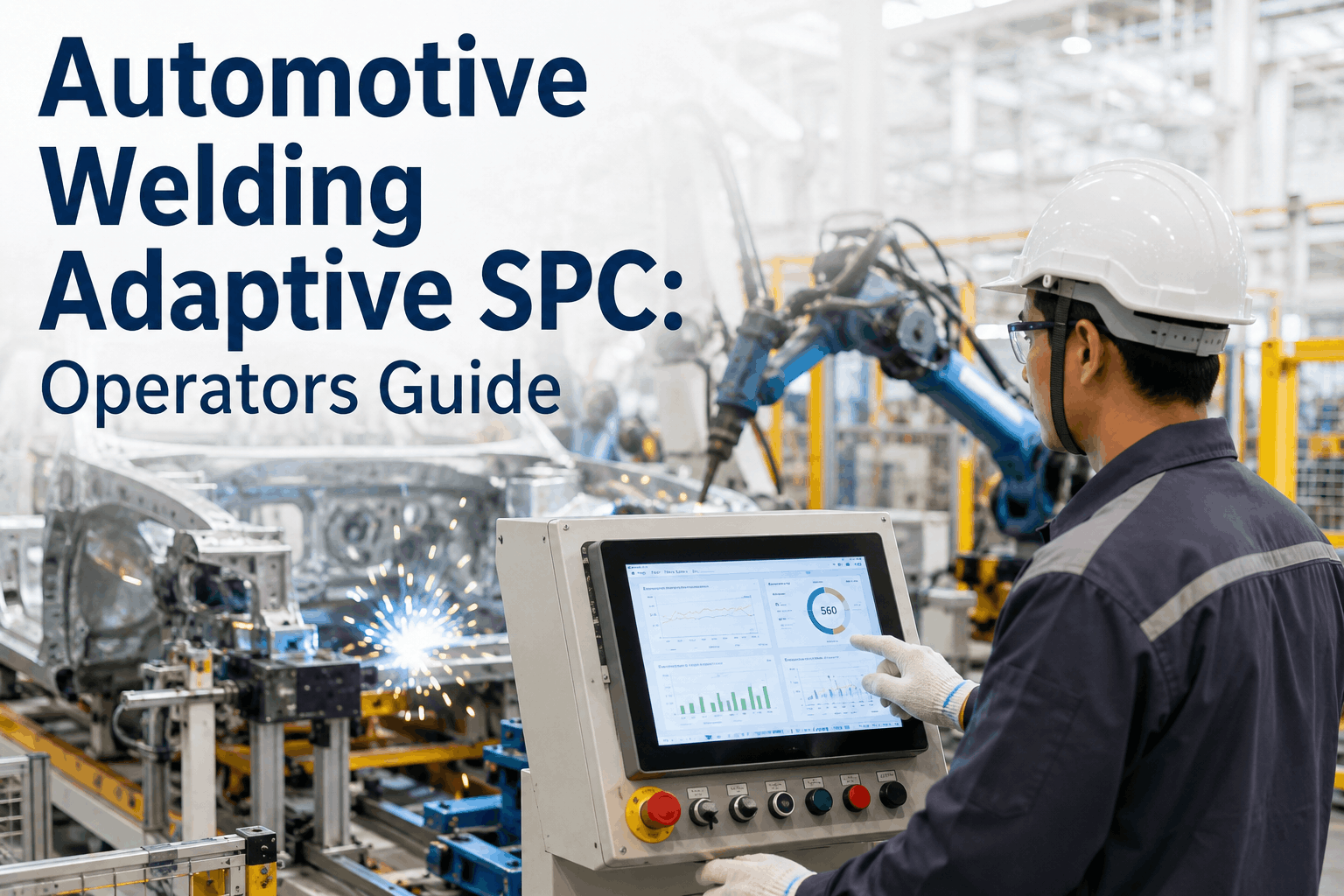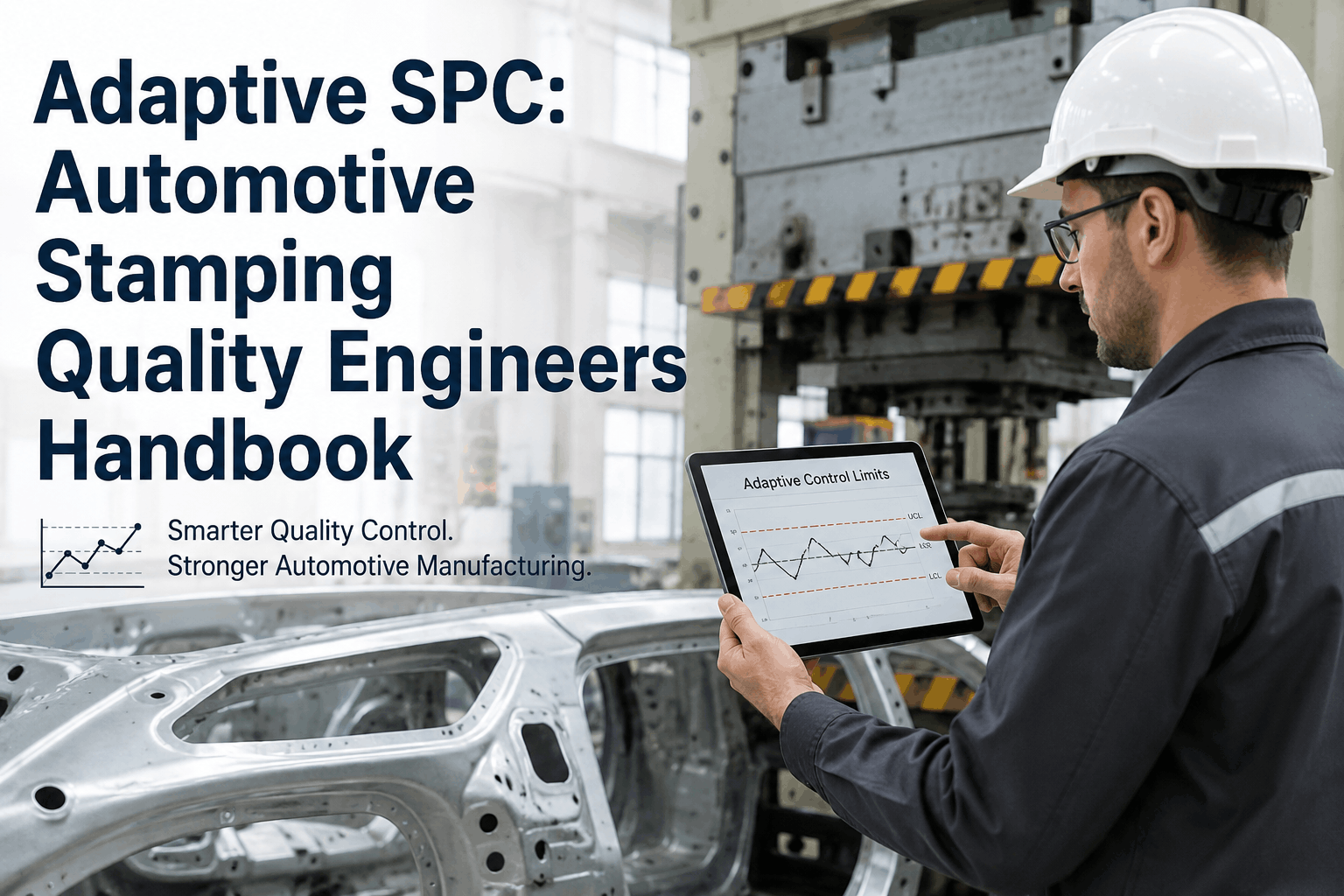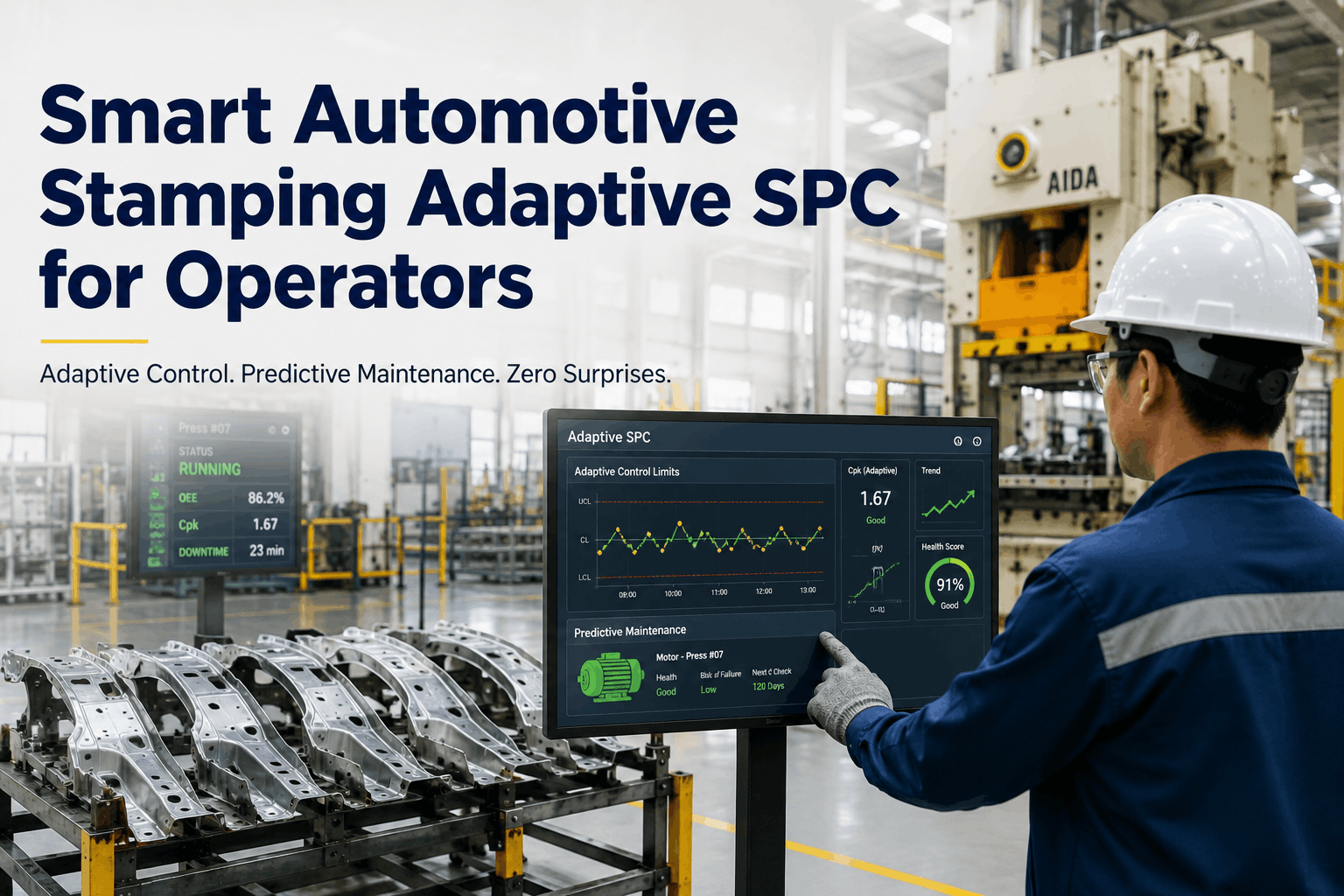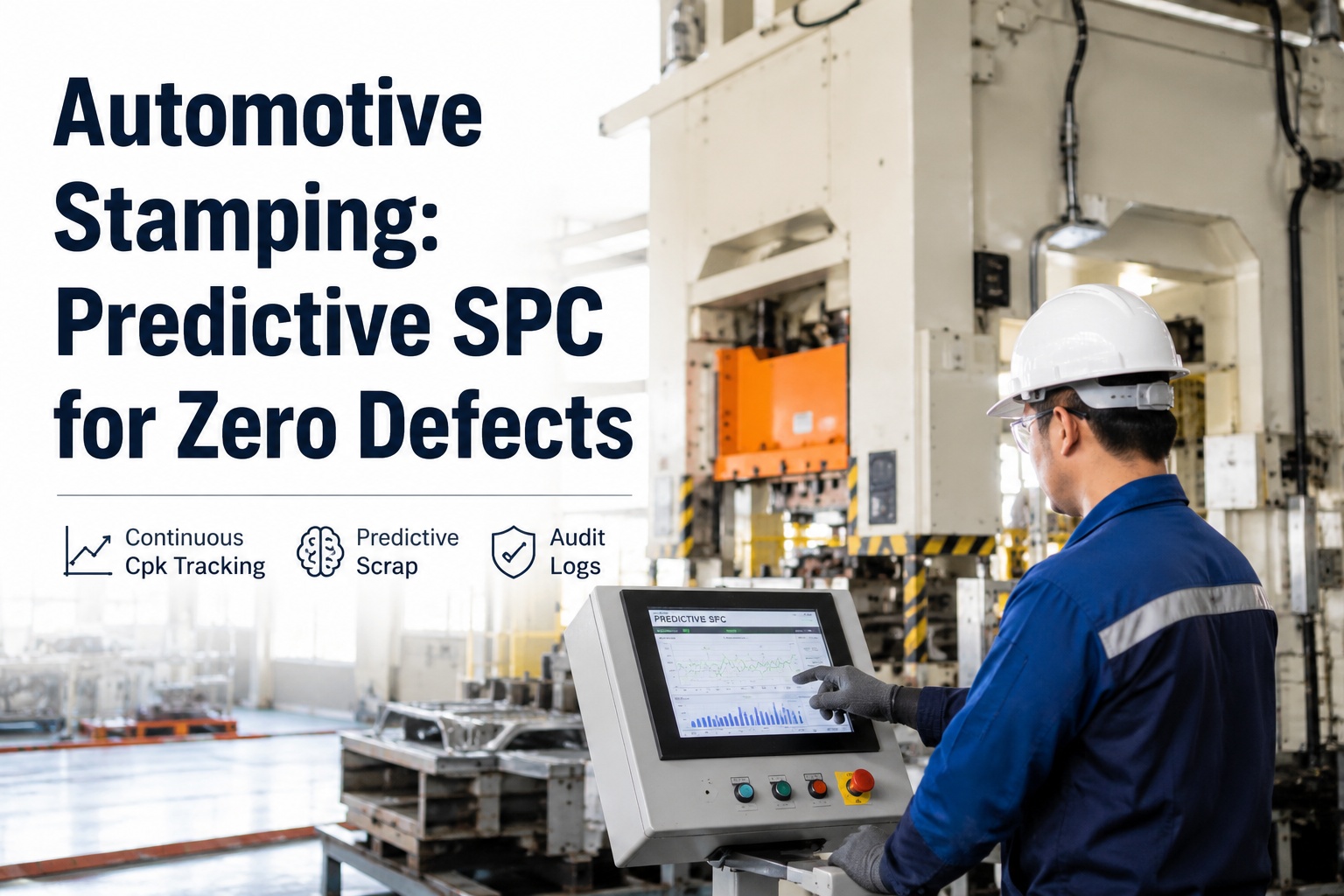
If you run a stamping press — tandem, transfer, or progressive — you already know the rhythm. The line runs, parts come off, you check the first piece and the every-Nth piece against the control plan, you read the tonnage signature, you watch for splits, wrinkles, burrs, and dimensional drift. The traditional SPC chart shows you a problem only after a part has gone out of spec. The first you hear about a draw mark trending toward a customer reject is usually when your supervisor flags it from yesterday's scrap log. Predictive SPC changes that. By analyzing the same tonnage curve, die temperature, lubrication pressure, blank position, and historian data you already produce — but running LSTM and autoencoder models against it in real time — predictive SPC catches the drift hours before the next bad part hits the conveyor. This is the operator's playbook for using predictive SPC on the stamping line — what it does, what defects it catches, what your shift looks like with it running, and how it preserves your IATF 16949 audit position while cutting defect rates 30 to 70%. iFactory delivers this on a turnkey on-premise NVIDIA appliance or fully managed cloud — same predictive AI, your deployment choice.
Automotive Stamping: Predictive SPC for Zero Defects
A practical operator guide to predictive SPC in the press shop — six common stamping defects it catches before parts hit the conveyor, the shift-by-shift workflow, and the IATF 16949 audit trail it builds automatically. For shop-floor operators and line technicians.
What Predictive SPC Actually Does on Your Line
Traditional SPC tells you when a part has already gone out of spec. Predictive SPC tells you when a part is about to go out of spec — and gives you time to do something about it. It's the same control chart you already know, plus three AI models running underneath that watch every signal coming off your press and learn what "normal" looks like for your dies, your material lots, your shift patterns. When something starts drifting away from normal, the system tells you before the trend reaches the control limit. You adjust. The line keeps running. The scrap doesn't happen.
The three models — LSTM for time-series forecasting, autoencoder for unusual-pattern detection, and SPC fusion for combining them with the conventional Western Electric Rules — run continuously on the historian data, PLC signals, tonnage monitor outputs, and die-temperature sensors your press is already producing. No new instrumentation. No different operator screens. Just earlier warning, with the recommended action and confidence score attached.
Want to see what predictive SPC actually looks like running against a real stamping line? Book a Live SPC Walkthrough — iFactory's automotive team will demo the operator screen with live tonnage data from a representative press, showing predictive alerts firing in real time. Sessions available this week.
The Tonnage Signature — Where AI Catches Drift First
Every operator who runs a press knows the tonnage signature — the force-displacement curve you see for each stroke. A good signature is repeatable cycle to cycle. A bad signature shows you something is wrong with the die, the material, the lubrication, or the blank position. Traditional tonnage monitoring sets envelope limits on the curve and alerts when the signature breaks the envelope. Predictive AI doesn't wait that long. It compares the current signature against the LSTM-learned signature of recent good cycles, catching subtle drift that's nowhere near the envelope limit but trending in a way that will breach it within hours.
Six Stamping Defects Predictive SPC Catches Before They Happen
Predictive SPC isn't theoretical — it maps to specific stamping defect modes operators see on the floor every day. Here are the six highest-impact defects and the predictive signals that catch them early.
Splits & Cracks
AI watches blank holder force, tonnage peak position, and material gauge correlation to predict thinning before it tears.
Wrinkles
Multivariate model correlates BHF, draw bead pressure, and lubrication temperature to predict wrinkle onset.
Springback Drift
AI tracks tonnage signature shape changes that precede dimensional drift, flagging coil-to-coil variation.
Burr Generation
Autoencoder catches unusual tonnage signature changes that indicate punch dulling before burrs appear.
Oil Canning
AI correlates material thickness data with forming sequence parameters to predict panel snap-through risk.
Surface & Draw Marks
Models track lubricant flow, temperature, and forming pressure to predict surface defect risk.
Want to see which of these six defects matter most for your specific stamping line? Request a stamping defect-pattern audit from iFactory support — we'll analyze 30 days of your tonnage and scrap data and rank the predictive coverage opportunities by annual scrap value, returned within 5 business days.
The Operator's Daily Playbook with Predictive SPC
What does predictive SPC actually change about your shift? Not as much as you might think. The control plan stays the same. The first-piece check stays the same. The every-Nth-piece verification stays the same. What changes is that your operator screen now shows predictive alerts alongside the conventional charts — telling you what to watch for, where, and when.
System status check
Operator dashboard shows AI-flagged trends from previous shift. Anything trending toward a limit gets highlighted with recommended action.
Predictive alerts (if any)
If drift is detected, operator gets a clear alert — "BHF drift detected, wrinkle risk in 2 hours, suggest adjusting to 12.8 bar" — with confidence score.
Recommended interventions
AI pre-prioritizes any die maintenance items based on predicted wear patterns — operator sees the list in order of risk impact.
Auto-generated handover
Cpk trend, defect prevention log, AI prediction outcomes, and notes for next operator — all generated automatically with full audit trail.
Human-Eye SPC vs AI-Eye SPC — What the AI Sees That You Can't
Operator experience is irreplaceable — you read a tonnage signature, a part-coming-off-line, a die-half-in-the-press in ways no AI model can. But there are patterns the human eye genuinely can't catch in real time. Multivariate correlations across 30+ signals. Subtle drift that doesn't show up cycle to cycle but is obvious across thousands of cycles. Statistical patterns that require continuous mathematical processing. Predictive SPC handles those — it doesn't replace operator judgment, it adds a second set of eyes on the patterns humans can't process in real time.
What you do better than any AI
- Recognize sound and vibration changes from the press
- Spot visual defects on parts coming off the line
- Read die wear at die changes and tryout
- Judge material lot quality at coil load
- Apply intuition from years of running this specific press
- Make production calls based on order priorities and customer urgency
What AI catches that humans can't in real time
- Subtle tonnage signature drift across thousands of cycles
- Multivariate correlations among 30+ signals continuously
- Statistical patterns invisible cycle-to-cycle but obvious across hours
- Predictive forecasts of Cpk drift over the next 60–360 minutes
- Anomaly patterns matched against historical defect events
- Continuous monitoring during routine cycles when human attention drops
Curious how AI predictive SPC interacts with operator judgment on your specific press? Book a Live SPC Walkthrough — bring an experienced operator and we'll run the system on a representative line, showing exactly where AI complements operator decisions and where it stays out of the way. Sessions available this week.
IATF 16949 & PPAP — Audit Trail Built Automatically
Every predictive SPC event feeds your audit-ready record
- Cpk / Ppk trend per critical characteristic, automatically updated
- Process capability evidence for PPAP submission packages
- Control plan adherence evidence, real-time
- Reaction plan execution evidence with operator sign-off
- Customer-Specific Requirement (CSR) reporting — Q1, BIQS, PIST, SQA
- Layered Process Audit (LPA) data feeds
- Tamper-evident electronic records (21 CFR 11 aligned)
- Predictive intervention log — what was caught, what was prevented
For the operator, that means the part of the job that's normally manual data entry — recording reaction plan execution, signing off on Cpk drift response, documenting customer-specific reporting — happens automatically. You verify, the system captures. PPAP submission packages assemble themselves from the same data feeds.
Two Real Stamping Plant Outcomes
14 progressive die lines, multi-OEM, persistent split / wrinkle scrap
A Tier 1 stamping supplier with 14 progressive die lines producing structural body components. Annual scrap dominated by splits, wrinkles, and dimensional springback. Operators chased after-the-fact defects with reactive interventions. Q1 and BIQS scorecards under continuous pressure.
Class-A surface panels, oil canning and surface defects driving rework
An OEM press shop producing class-A exterior panels (door outers, hoods, fenders). Oil canning and surface draw mark defects driving rework rate. Material lot variation a known root cause but hard to isolate in real time. Customer complaints elevated for panel cosmetic quality.
Neither scenario matches your stamping operation exactly? Send your top stamping defect categories and process tag list to iFactory support and the automotive team will return a customised predictive coverage assessment — defect-by-defect AI capability map and projected savings range — typically within 3 business days, no obligation.
iFactory's Stamping Deployment — On-Premise or Cloud
The deployment choice depends on your plant. Both options run the same predictive SPC stack — same LSTM models, same multivariate analysis, same operator AI assistant, same IATF 16949 audit trail. Same Cpk dashboards. The decision is data residency, IT capacity, and budget posture.
iFactory On-Premise Appliance Default for press shops with CSR data-residency rules
- Pre-configured NVIDIA AI server — racked, software-loaded, ready to plug in.
- Sub-50ms inference at the press — fits cycle times on high-speed transfer presses.
- All production data stays inside the plant — CSR-compliant by design.
- Works during WAN outages — line operations continue uninterrupted.
iFactory Cloud For multi-plant fleet benchmarking and cloud-first IT
- Fully managed — no rack, no facility requirements.
- Same predictive SPC stack — LSTM, autoencoder, operator AI assistant.
- Fleet-wide stamping benchmarking across all press shops in one tenant.
- Fastest deployment — first plant live in 2–4 weeks.
See predictive SPC on a stamping line — this week.
The iFactory live SPC walkthrough is a 30-minute session showing the operator screen running on a representative press line, with predictive alerts firing on real tonnage and scrap data. Bring an operator if you can — the feedback we get from people who actually run presses is what makes the demo most useful for your team. On-premise appliance or fully managed cloud, your call on deployment.
Frequently Asked Questions
Will predictive SPC replace operator judgment on the press?
No — it complements it. Predictive SPC catches statistical patterns that humans can't process in real time across 30+ continuous signals. Operators still make the production decisions, the die-change calls, the lot-acceptance judgments. The AI is a second set of eyes on patterns you wouldn't otherwise see; the operator stays in control of what to do about it.
Do I need new sensors or instrumentation on the press?
No, in most cases. Predictive SPC runs on the data your press is already producing — tonnage monitor outputs, PLC tags, historian feeds, die temperature sensors. If specific defect categories need additional instrumentation (e.g., for advanced surface defect detection), iFactory's team scopes it during the readiness assessment, but the default setup uses existing signals.
How does the operator screen actually look?
Designed to feel familiar to anyone who has used a conventional SPC display — the same control charts, same Cpk/Ppk indicators, same Western Electric and Nelson Rule call-outs. The new elements are predictive alerts that appear alongside the conventional chart, showing "drift predicted in X hours; recommended action Y." Live walkthroughs are the best way to see it; we run them weekly.
Do I have to buy NVIDIA servers separately?
No. iFactory's on-premise appliance ships fully loaded — pre-configured NVIDIA AI server, software pre-installed, network gear, cabling, edge devices for line-side inference. You provide rack space, line power, and Ethernet. For cloud deployment, there's no hardware investment at all.
How accurate are the predictive alerts?
For mature deployments running on 6+ months of training data, predictive alerts typically show 85–92% true-positive rate. False-positive rate matters more for operator trust — typically below 8% with confidence-fusion suppression of low-confidence predictions. The system continuously learns from operator feedback, so accuracy improves over time as you flag false alarms and confirmed catches.
How long until we see results on the defect rate?
For the top defect categories — splits, wrinkles, tonnage-related issues — defect reduction is typically visible within 4–8 weeks of go-live. Full portfolio reduction across all six stamping defect categories typically lands in 3–6 months. Most stamping plants see 30–50% reduction on covered defect categories within 6 months, with the upper end (50–70%) seen in plants with strong operator engagement and clean baseline data.
Does this work for tandem presses, transfer presses, and progressive dies?
Yes — all three. Each press type has slightly different tonnage signature characteristics, and iFactory's models train on your specific press signatures. Progressive die operations particularly benefit because the multi-station nature means more signals to monitor and more opportunities for predictive intervention. Transfer presses and tandem lines deploy the same way; the AI adapts to the cycle structure.
Predictive SPC is the upgrade your operators have been waiting for.
Less reactive scrap-chasing. More predictive intervention. Same control plan, same first-piece check, same operator experience — with AI providing earlier warning and the audit trail building itself. iFactory's live SPC walkthrough is the fastest way to see what this looks like on a real press line — sessions available this week, on-premise appliance or fully managed cloud.
.png)