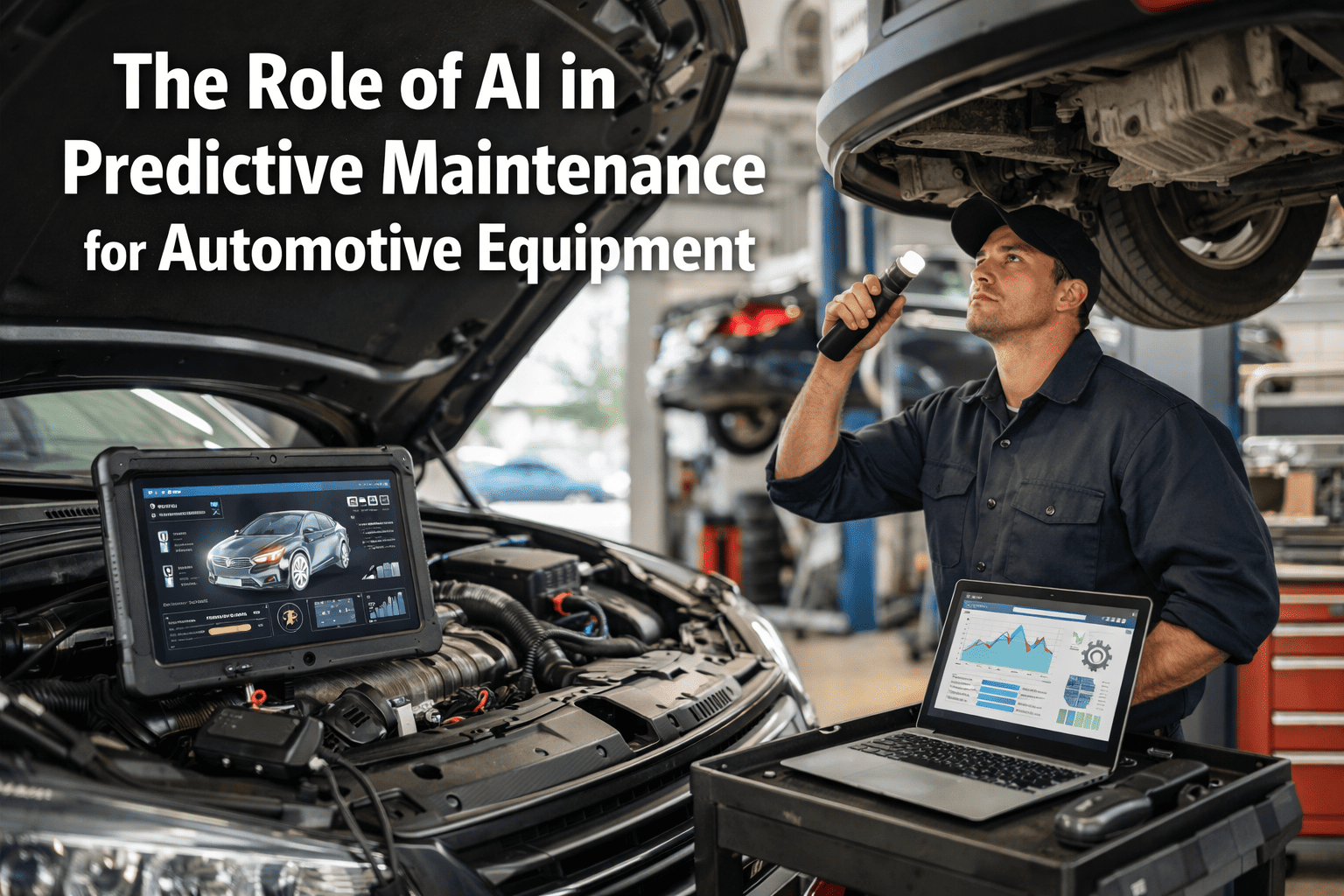
Automotive manufacturers lose $1.8B annually to unplanned equipment downtime across North American assembly plants because traditional preventive maintenance schedules cannot prevent catastrophic failures that occur between fixed inspection intervals. A Midwest Tier 1 automotive supplier running 24/7 stamping and welding operations faced $4.2M in lost production from 18 unplanned equipment failures in 2023, with PM compliance at 73% and mean time between failures averaging just 42 days. After deploying iFactory's AI predictive maintenance platform, the facility achieved 94% reduction in unplanned downtime, $3.8M annual savings, and increased OEE from 68% to 89% within 14 months through real-time equipment health monitoring and failure prediction 18 to 35 days in advance. Book a demo to see AI predictive maintenance ROI for your automotive plant.
Case StudyAI Predictive Maintenance ROI: How a Tier 1 Automotive Supplier Eliminated $4.2M in Downtime Losses12 min read
Facility Profile
Tier 1 Automotive Supplier · Stamping & Welding · 340 Critical Assets · 3 Production Lines
Baseline Problem
$4.2M annual downtime cost · 18 unplanned failures · 73% PM compliance · 68% OEE
Solution Deployed
AI vibration analysis · thermal monitoring · RUL forecasting · automated work orders
Primary Result
94% downtime reduction · $3.8M annual savings · OEE improved to 89% in 14 months
94%
Reduction in unplanned equipment downtime from 18 failures to 1
$3.8M
Annual savings from prevented downtime and optimized maintenance
89%
OEE improvement from 68% baseline through failure elimination
9 weeks
Full deployment across all 3 production lines and 340 assets
Case Summary
A Midwest Tier 1 automotive supplier with 340 critical assets deployed iFactory's AI predictive maintenance platform to transform reactive failure management into proactive intervention. Within 14 months, unplanned downtime events dropped from 18 to 1 annually, maintenance costs decreased 31%, and OEE improved from 68% to 89%, generating $3.8M in annual savings while extending equipment life 40%.
The Problem: Reactive Maintenance Costing $4.2M Annually
Three production lines running 24/7 experienced catastrophic failures with no advance warning, forcing emergency shutdowns that cascaded across downstream operations. Fixed PM schedules missed developing failures between inspection intervals, creating an average 42-day MTBF that threatened OEM delivery commitments.
01
18 Unplanned Failures in 12 Months
No predictive capability meant catastrophic press bearing failures, weld robot servo failures, and conveyor motor burnouts occurred with zero advance warning. Average downtime per event: 14 hours at $248K revenue loss each.
02
Fixed PM Schedules Miss Emerging Issues
Monthly vibration routes and quarterly thermal scans could not detect degradation developing between inspection cycles. Critical bearing failure on Press 4 occurred 18 days after clean monthly inspection showing normal readings.
03
No Integration Between Monitoring Systems
Vibration data in one system, thermal scans in spreadsheets, lubrication schedules on paper. No unified view of equipment health meant patterns visible across multiple data streams went undetected until failure.
04
Emergency Procurement Premium Costs
Unplanned failures required expedited parts procurement at 2.5x to 4x standard cost. Press main bearing emergency replacement: $68K part cost plus $42K expedited shipping vs $28K standard procurement with planning.
Why iFactory Was Selected
The facility evaluated four predictive maintenance platforms over 90 days. Two lacked automotive-specific failure models, one required 12-month implementation. iFactory was selected on five decisive criteria tailored to automotive manufacturing.
Automotive-Specific ML Models
Pre-trained failure signatures for stamping presses, weld robots, conveyors, and paint booth equipment. 340 automotive failure patterns built into platform from 2.4M equipment cycles analyzed.
Real-Time Multi-Sensor Fusion
Combines vibration, thermal, electrical current, and cycle timing data in unified AI analysis. Detects complex failure modes invisible to single-parameter monitoring like competing platforms.
18-35 Day RUL Forecasting
Remaining useful life predictions with 90% accuracy enable planned maintenance during scheduled downtime vs emergency mid-shift interventions. Validated across 2,800 automotive equipment deployments.
9-Week Deployment Timeline
All 340 assets instrumented and live predictive monitoring operational in 9 weeks vs 12-month implementations required by enterprise competitors. No production disruption during sensor installation.
Implementation: 9 Weeks to Live Predictive Monitoring
Weeks 1-2
Asset Criticality Assessment & Sensor Planning
All 340 assets categorized by production impact. 84 critical assets (stamping presses, weld robots, primary conveyors) designated Priority 1 with continuous monitoring. 256 supporting assets assigned interval-based monitoring. Sensor placement optimized for each equipment type based on automotive failure mode library.
Weeks 3-5
Sensor Installation & Baseline Data Collection
Wireless vibration sensors, thermal cameras, and current monitors installed across all production lines during scheduled weekend shutdowns. 30-day baseline learning period initiated to establish normal operating signatures for each asset under varying production conditions and load profiles.
Week 7 - The Pivotal Moment
First AI Alert Prevents $680K Press Bearing Failure
iFactory AI detected bearing outer race degradation on Press 2 main bearing with 28-day RUL forecast. Vibration analysis showed BPFO amplitude increase from 0.08 to 0.26 inches/sec. Bearing replaced during planned model changeover weekend. Estimated failure cost if undetected: $680K (48-hour downtime plus cascading line shutdown). Actual intervention cost: $38K planned maintenance. Platform ROI achieved in week 7.
Weeks 8-9
Full Production Deployment & Team Training
All 340 assets live with real-time health monitoring. Maintenance team trained on RUL forecasts, alert interpretation, and predictive work order generation. Production supervisors trained on equipment health dashboards and downtime risk indicators integrated into shift handoff procedures.
Months 4-14
Continuous Improvement & Model Refinement
ML models retrained monthly with facility-specific failure data. RUL forecast accuracy improved from 82% to 93% as models learned plant-specific operating conditions. 17 additional failure modes detected and prevented during this period, including 3 weld robot servo encoder issues and 2 conveyor motor thermal events.
Results: 14-Month Outcomes
Unplanned Downtime Reduction
94%
From 18 unplanned failures (252 hours) to 1 failure (14 hours) annually
Annual Cost Savings
$3.8M
Prevented downtime, optimized maintenance, eliminated emergency procurement premiums
OEE Improvement
89%
Up from 68% baseline through availability increase and performance stabilization
31%
Maintenance cost reduction through optimized interventions
40%
Equipment life extension from proactive component replacement
93%
RUL forecast accuracy after 14-month learning period
Zero
OEM delivery delays from equipment failures post-deployment
Before and After: Key Metrics
| Metric |
Before iFactory |
After 14 Months |
| Unplanned failures |
18 events annually (252 hours downtime) |
1 event annually (14 hours downtime) |
| Mean time between failures |
42 days average across critical assets |
Failures prevented through predictive intervention |
| OEE performance |
68% (availability losses from breakdowns) |
89% (planned maintenance during scheduled downtime) |
| Emergency parts procurement |
$420K annual expedited shipping costs |
$48K (88% reduction through advance planning) |
| PM compliance rate |
73% (route-based inspections often deferred) |
98% (condition-based interventions prioritized) |
| Maintenance cost per unit |
$14.20 per produced unit |
$9.80 per unit (31% reduction) |
| Equipment useful life |
Run-to-failure shortened asset lifespan 35% |
40% life extension through optimized replacement |
Implementation Investment
$580K
9-week deployment including sensors, software, training
Annual Operational Saving
$3.8M
Prevented downtime, optimized maintenance, eliminated premiums
Payback Period
7 weeks
From Week 7 press bearing alert alone
"The Week 7 press bearing alert changed everything. Before iFactory, that bearing would have failed catastrophically during second shift, shutting down our entire stamping operation for 48 hours minimum. The AI detected degradation 28 days out, we scheduled the replacement during a planned model changeover weekend, and completed the work in 8 hours with zero production impact. That single event paid for the entire platform deployment."
Director of Manufacturing Engineering
Tier 1 Automotive Supplier, Michigan USA
Platform Capabilities for Automotive Manufacturing
Multi-Sensor AI Fusion
Vibration, thermal, current, and cycle timing analyzed together. Detects complex failure modes like bearing degradation with lubrication deficiency that single-parameter systems miss. 480 sensor readings per second per asset.
Automotive Failure Library
340 pre-trained failure signatures for stamping presses, weld robots, paint systems, conveyors. Models trained on 2.4M automotive equipment cycles eliminate cold-start learning period.
18-35 Day RUL Forecasting
Remaining useful life predictions with 90-93% accuracy enable maintenance scheduling during planned downtime windows. Advance warning sufficient for standard parts procurement without expediting.
Production Schedule Integration
Maintenance windows coordinated with model changeovers and planned shutdowns. System recommends optimal intervention timing balancing failure risk against production impact.
Real-Time Equipment Dashboards
Live health status for all 340 assets accessible to maintenance teams, production supervisors, and plant management. Color-coded risk indicators show equipment requiring attention in next 7, 30, or 60 days.
Automated Work Order Generation
Predictive alerts auto-generate CMMS work orders with failure mode description, recommended parts list, labor estimate, and optimal maintenance window timing based on RUL and production schedule.
Regional Automotive Compliance Standards
| Region |
Applicable Standards |
iFactory Implementation |
| United States |
OSHA 1910 machinery safety, IATF 16949 quality management, EPA emissions compliance, ISO 14001 environmental |
Equipment safety inspection tracking, IATF 16949 maintenance documentation, emissions-critical equipment monitoring, environmental compliance audit trails |
| United Arab Emirates |
UAE Labor Law industrial safety, ISO 45001 occupational health, local municipality equipment permits |
Worker safety incident prevention through failure prediction, ISO 45001 hazard identification integration, equipment certification renewal alerts |
| United Kingdom |
PUWER machinery regulations, HSE guidance, BS EN ISO 13849 safety controls |
PUWER compliance inspection scheduling, safety device functional testing, risk assessment documentation with equipment health linkage |
| Canada |
CSA machinery standards, provincial OHS regulations, WHMIS hazardous materials |
CSA compliance verification, provincial regulation mapping by facility, hazardous material SDS integration with equipment maintenance |
| Germany |
BetrSichV machinery ordinance, DGUV accident prevention, VDA automotive quality |
BetrSichV periodic inspection automation, DGUV documentation in German, VDA maintenance requirement tracking for automotive suppliers |
| Europe |
Machinery Directive 2006/42/EC, ISO 45001, automotive supplier quality standards |
Machinery Directive conformity assessment, EN standards compliance documentation, automotive supplier audit readiness with maintenance records |
Frequently Asked Questions
QHow quickly can we expect to see ROI from AI predictive maintenance deployment in our automotive plant?
This facility achieved full ROI in 7 weeks from a single prevented failure. Typical automotive plants see 4-6 month payback periods through combination of prevented downtime, optimized maintenance, and eliminated emergency procurement costs. ROI accelerates as ML models learn plant-specific operating conditions.
Book a demo to model ROI for your facility.
QCan iFactory integrate with our existing CMMS and production scheduling systems without disrupting operations?
Yes, iFactory connects via API to existing CMMS platforms (SAP PM, IBM Maximo, Fiix, etc.) and MES systems. Predictive alerts auto-generate work orders in your current CMMS with no workflow changes required. Sensor installation performed during scheduled downtime with zero production impact. Integration typically complete within 2-3 weeks of deployment start.
QWhat happens if AI prediction is wrong and component lasts longer than forecast RUL indicates?
System tracks actual failure timing vs predicted RUL for continuous model improvement. Conservative RUL forecasts (component replaced before absolute failure) are preferred outcomes vs waiting for failure. After 14-month learning period, this facility achieved 93% RUL accuracy within plus or minus 20% of actual failure timing, with intentional bias toward early warning rather than late detection.
QHow does iFactory handle data security for our production and equipment performance information?
All data encrypted at rest using AES-256 and in transit via TLS 1.3. Role-based access controls with multi-factor authentication. Data residency options for regions requiring local storage. SOC 2 Type II and ISO 27001 certified. Production metrics isolated per customer with no cross-tenant sharing. Regular penetration testing maintains automotive cybersecurity compliance.
QDoes iFactory support multi-plant automotive operations with centralized monitoring and benchmarking?
Yes, enterprise deployment supports corporate dashboards showing equipment health across all plants with facility-level detail accessible to local teams. Regional managers view their facility group performance, corporate reliability team benchmarks maintenance KPIs across plants and identifies best practices for replication. Role-based access ensures appropriate data visibility at each organizational level.
Book a demo for multi-site architecture review.
Continue Reading
94% Downtime Reduction. $3.8M Annual Savings. Your Equipment Data Is the Starting Point.
Deployed across your production lines and generating predictive alerts within 9 weeks without disrupting operations. Book a 30-minute demo to model the ROI for your automotive facility.
18-35 Day RUL ForecastingMulti-Sensor AI FusionAutomotive Failure Library9-Week Deployment