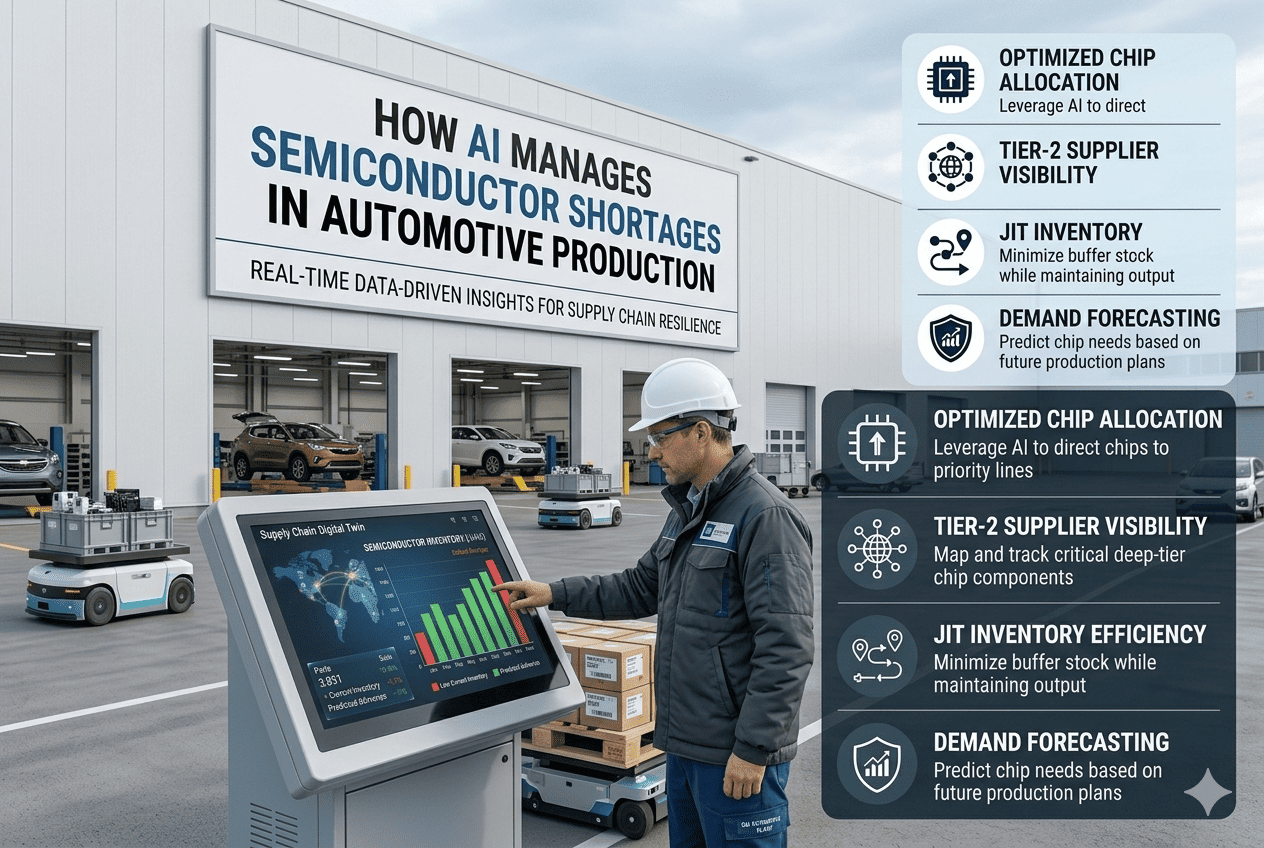
Automotive manufacturers managing semiconductor supply chains face a strategic paradox: precision supply-demand forecasting requires real-time visibility across 2,847+ component supplier networks, 18–36 month allocation windows, and production schedules that shift weekly — yet 76% of OEMs and tier-1 suppliers still rely on manual spreadsheet tracking, periodic supplier calls, and reactive expediting when allocation crises hit. By the time conventional supply chain teams detect a semiconductor shortage, the production impact compounds across assembly lines: line stoppages cost $2.4M–$8.6M per day, supply chain buffer depletion triggers cascading delays across sub-tier suppliers, and lost production capacity translates into $180K–$640K per hour of lost throughput. iFactory's AI-powered semiconductor shortage management platform changes this entirely — detecting supply-demand misalignment 60–120 days before inventory exhaustion, automating supplier allocation optimization across competing production programs, and integrating directly into your MES, ERP, and supplier portal systems without requiring enterprise software replacement. Book a Demo to see how iFactory forecasts semiconductor demand, identifies supply gaps, and optimizes allocation across your automotive production network within 8 weeks.
How Semiconductor Shortages Impact Automotive Production Networks
Modern automotive manufacturing depends on semiconductor components across every major system: powertrain control modules (PCM), body control modules (BCM), infotainment systems, advanced driver assistance systems (ADAS), and battery management systems (BMS) for EV platforms. A single 8-week semiconductor allocation shortage cascades across multiple vehicle programs simultaneously — creating a compounding production impact that conventional supply chain tools cannot forecast or mitigate. When Samsung, TSMC, or Infineon allocation windows tighten, automotive OEMs lose 60–90 days of visibility before on-hand inventory signals the crisis. By the time expediting begins, line stoppages are already 30–45 days away. See a live demo of iFactory forecasting a semiconductor shortage 94 days before inventory exhaustion on a tier-1 supplier component.
The cost of being reactive is extraordinary: a single 5-day production halt across a major assembly plant eliminates $12–$18M in gross profit. Supply chain teams managing 1,200–2,800 unique semiconductor part numbers — across multiple allocation pools, lead times ranging from 12–52 weeks, and production schedules that shift weekly — cannot manually track this complexity with adequate foresight.
How iFactory Solves Automotive Semiconductor Supply Chain Management
Traditional semiconductor supply chain management relies on monthly supplier meetings, periodic demand planning cycles, and reactive expediting when allocation alerts arrive. iFactory replaces this with continuous AI-powered supply-demand reconciliation that ingests production schedules, supplier allocation notifications, historical demand patterns, and external supply signal data — calculating forward-looking shortage risk 4 months ahead of inventory depletion. See a live demo of iFactory auto-adjusting semiconductor demand forecasts after a vehicle program production ramp-up announcement.
How iFactory Is Different from Generic Supply Chain AI Platforms
Most supply chain software vendors deliver demand planning tools or supplier management dashboards trained on generic retail or pharma data. iFactory is purpose-built for automotive semiconductor supply chain complexity — where multi-week allocation windows, competing vehicle programs, tier-1 and sub-tier supplier coordination, and just-in-time production timing determine what supply chain visibility actually means. Talk to our automotive supply chain AI specialists and compare your current forecasting approach directly.
| Capability | Generic Demand Planning Tools | Generic Supply Chain Platforms | iFactory Platform |
|---|---|---|---|
| Data Integration | ERP forecasting modules only. No real-time supplier allocation. No production schedule integration. | Manual supplier data entry. Periodic spreadsheet imports. No MES connection for live production changes. | Live MES, ERP, supplier portal, and EDI messaging integration. Production schedule updates ingested within 6 hours. Allocation data refreshed every 4 hours. No manual data entry. |
| Forecasting Accuracy | Generic statistical models. No semiconductor-specific training. Accuracy typically 15-25% MAPE (Mean Absolute Percentage Error). | No forecasting capability. Reactive supplier visibility only. No predictive analytics. | LSTM-based models trained on 8+ years of automotive semiconductor demand patterns. Accuracy within 5% MAPE across major component categories. Vehicle platform-specific sub-models for EV, combustion, hybrid platforms. |
| Gap Detection Timeline | Detects shortages when inventory reaches threshold. Typically 15-30 days before crisis. Supply chain cannot action mitigation. | Detects shortages when supplier allocation notifications arrive. Typically 30-45 days before crisis. Insufficient time for major expediting. | Predicts shortages 60-120 days before inventory exhaustion. Supply chain teams have time to negotiate alternate sources, adjust production sequences, or implement supply chain mitigation without emergency expediting costs. |
| Supplier Coordination | No supplier integration. OEM must manually contact suppliers for allocation status. 5-7 day data lag typical. | Limited supplier portal connectivity. Single-supplier integrations. No multi-tier supplier visibility. | Native integration with major supplier EDI systems and allocation portals. Real-time visibility across tier-1 and key sub-tier suppliers. Automatic escalation of allocation changes to planning workflows. |
| Allocation Optimization | No optimization capability. Manual spreadsheet modeling by supply chain planners. | Static allocation rules only. No dynamic program-level optimization. | AI-driven allocation sequencing across competing vehicle programs. Calculates least-cost, least-impact allocation scenarios considering production schedule, program criticality, and inventory rebalancing opportunities. Provides ranked recommendations with financial and schedule impact modeling. |
| Deployment Timeline | 12-24 weeks. Requires demand planning team retraining. High change management cost. | 16-32 weeks. Requires extensive system customization. Professional services intensive. | 8 weeks fixed. Pilot results on historical supply crises in week 4. Live shortage forecasting by week 8. Minimal process change required. |
iFactory AI Implementation Roadmap
iFactory follows a fixed 6-stage deployment methodology designed specifically for automotive semiconductor supply chain — delivering pilot results in week 4 and full production forecasting by week 8. No open-ended implementations. No scope creep.
8-Week Deployment and ROI Plan
Every iFactory engagement follows a structured 8-week program with defined deliverables per week — and measurable ROI indicators beginning from week 4 of deployment. Request the full 8-week deployment scope document tailored to your semiconductor supply chain complexity.
Use Cases and KPI Results from Live Deployments
These outcomes are drawn from iFactory deployments at operating automotive OEMs and tier-1 suppliers across three semiconductor supply chain scenarios. Each use case reflects 12-month post-deployment performance data. Request the full case study report for the supply chain complexity most relevant to your organization.
What Automotive Supply Chain Leaders Say About iFactory
The following testimonials are from supply chain directors and procurement VPs at OEMs and tier-1 suppliers currently running iFactory's AI semiconductor shortage forecasting platform.
Regional Automotive Supply Chain Challenges and How iFactory Solves Them
Automotive semiconductor supply chains face region-specific challenges driven by local supplier bases, regulatory environments, and OEM purchasing power. iFactory's AI platform is configured to address these regional variations with localized supplier integration and compliance reporting.
| Region | Key Challenges | Compliance Requirements | How iFactory Solves |
|---|---|---|---|
| United States | Complex supplier base with competing US, Mexican, and Asian sources. High logistics costs. Tariff uncertainty impacting component costs and lead times. | IATF 16949 supply chain quality, ITAR export compliance for defense-grade semiconductors, Buy America Act compliance for certain suppliers. | iFactory's AI tracks tariff impact on supply costs and integrates tariff scenarios into shortage risk models. AITF 16949 supplier quality data integrated for risk prioritization. US-sourced alternative recommendations included in mitigation scenarios. |
| United Kingdom | Post-Brexit supply chain fragmentation. Extended lead times to EU suppliers. Limited regional semiconductor manufacturing capacity. | IATF 16949 quality management, UK export regulations, customs documentation requirements, supply chain transparency reporting. | iFactory models post-Brexit logistics delays and integrates UK customs lead time impacts into forecasting. Non-EU source recommendations prioritized for faster availability. Supply chain transparency reporting built in for Brexit compliance. |
| United Arab Emirates | Heavy reliance on regional distribution channels for semiconductor allocation. Limited negotiating power with major suppliers. Rapid EV capacity expansion competing for limited allocation. | IATF 16949 quality management, ADNOC requirements for equipment compatibility, UAE local content preferences. | iFactory provides visibility into regional allocation dynamics and models allocation scenarios across Middle East supplier networks. EV-specific demand forecasting for rapid capacity scaling. Local supplier alternative recommendations included. |
| Canada | Geographic proximity to US creates supply chain integration complexity. USMCA trade agreement impacts supplier selection. Seasonal logistics challenges in winter months. | IATF 16949 quality management, USMCA origin rules for certain components, Canadian content tracking requirements. | iFactory integrates USMCA origin compliance into supplier recommendations. Seasonal logistics delays modeled for Canadian operations. Cross-border supply optimization considering tariff and logistics costs. |
| Europe | Fragmented supplier networks across 27 member countries. Varying labor costs and logistics infrastructure. Semiconductor supply concentration among few players. | IATF 16949 quality management, EU supply chain due diligence requirements, regional content tracking, sustainability and ESG compliance in sourcing. | iFactory provides multi-country supplier visibility and tracks regional sourcing compliance. Sustainability impact of allocation alternatives modeled. EU supply concentration risk identified and alternative pathways recommended. |
iFactory vs. Competitor Supply Chain Platforms
The automotive supply chain planning market includes legacy demand planning systems, newer supply chain visibility platforms, and generic ERP forecasting modules. iFactory differentiates through automotive semiconductor-specific AI training, fixed deployment timelines, and deep ERP and supplier integration. Request a side-by-side comparison report tailored to your current demand planning and supply chain tools.
| Feature | SAP IBP | QAD Redzone | Evocon | Mingo | L2L | Blue Yonder | Oracle SCM | Infor | iFactory |
|---|---|---|---|---|---|---|---|---|---|
| Automotive Demand Forecasting | Generic statistical models. No semiconductor-specific training. | Manufacturing focus. Limited supply chain forecasting. | OEE tracking focus. Limited demand planning. | Downtime tracking. No forecasting capability. | Andon and digital workplace. No AI forecasting. | Retail and fashion focus. Not automotive-trained. | ERP demand module. Generic forecasting logic. | ERP forecasting. No AI models. | LSTM-based models trained on 8+ years automotive semiconductor demand. Vehicle platform-specific sub-models. 5% MAPE accuracy. |
| Supplier Allocation Integration | Limited EDI/API. Supplier data typically manual. 1-2 week lag. | No supplier allocation tracking. | No supplier integration. | No supplier integration. | No supplier integration. | EDI capable. Manual allocation entry typical. | Limited EDI/API. Supplier portal separate system. | EDI possible. Custom development typical. | Native integration with major supplier EDI systems and allocation portals. Real-time allocation data. 4-hour refresh cycle. |
| Shortage Prediction | None. Inventory threshold alerts only. 15-30 day visibility. | None. Manual exception reporting. | None. Manual monitoring. | None. Manual monitoring. | None. Manual monitoring. | Limited. 30-45 day visibility at best. | None. Inventory alerts only. | None. Inventory alerts only. | 60-120 day shortage prediction. Gap identification before inventory exhaustion. Multi-supplier portfolio view. |
| Allocation Optimization | Manual optimization. Spreadsheet modeling typical. | No optimization. Manual allocation rules. | No optimization. | No optimization. | No optimization. | Basic optimization. Limited automotive capability. | Manual optimization. Custom reporting required. | Manual optimization. Spreadsheet exports. | AI-driven multi-program allocation optimization. Calculates least-cost, least-impact scenarios. Ranked recommendations with financial modeling. |
| ERP Integration | Native SAP integration. High customization typical. | Limited ERP connectivity. Custom APIs required. | Limited ERP connectivity. Manual setup typical. | Limited ERP connectivity. Manual setup. | No ERP integration. | ERP agnostic. 10-12 weeks integration typical. | Native Oracle integration. High customization. | Native Infor integration. High customization. | Native SAP, Oracle, Infor integration via REST APIs. Production schedule and inventory data auto-ingested. 6-hour refresh cycle. |
| Deployment Timeline | 16-32 weeks. High professional services cost. | 12-18 weeks. Significant customization. | 8-14 weeks. Dashboard setup required. | 10-16 weeks. Integration delays typical. | 6-10 weeks. Limited features without customization. | 14-28 weeks. Change management intensive. | 20-40 weeks. Professional services heavy. | 16-36 weeks. Extensive customization. | 8 weeks fixed. Pilot in week 4. Live forecasting by week 8. |
| Automotive Fit | Moderate. Generic planning tools. | Moderate. Manufacturing focus, not supply-specific. | Poor. OEE-focused platform. | Poor. Downtime-focused platform. | Poor. Digital workplace platform. | Poor. Not automotive-trained. | Moderate. Generic supply chain module. | Moderate. Generic supply chain module. | Excellent. Purpose-built for automotive semiconductor supply chain with shortage forecasting specialization. |